
Turning Knowledge into Products

Can You Raise Your App Subscription Price in 2026? 3 Rails, 2 Consent Rules, and a 50% Line

September 12, 2026
Share
Can You Raise Your App Subscription Price in 2026? 3 Rails, 2 Consent Rules, and a 50% Line

Get Creator Revenue Insights

How creators are turning audiences into subscription businesses
Share
Key Takeaways:
  • Apple lets you raise the price on people already subscribed without asking them, as long as the increase is not more than 50% of the current price and the difference does not exceed about $5 per period, or $50 per year on an annual plan
  • Apple also requires consent if "the subscriber experienced a price increase for that subscription within the past 12 months," so the frequency limit is one increase per subscriber per year, not one per quarter
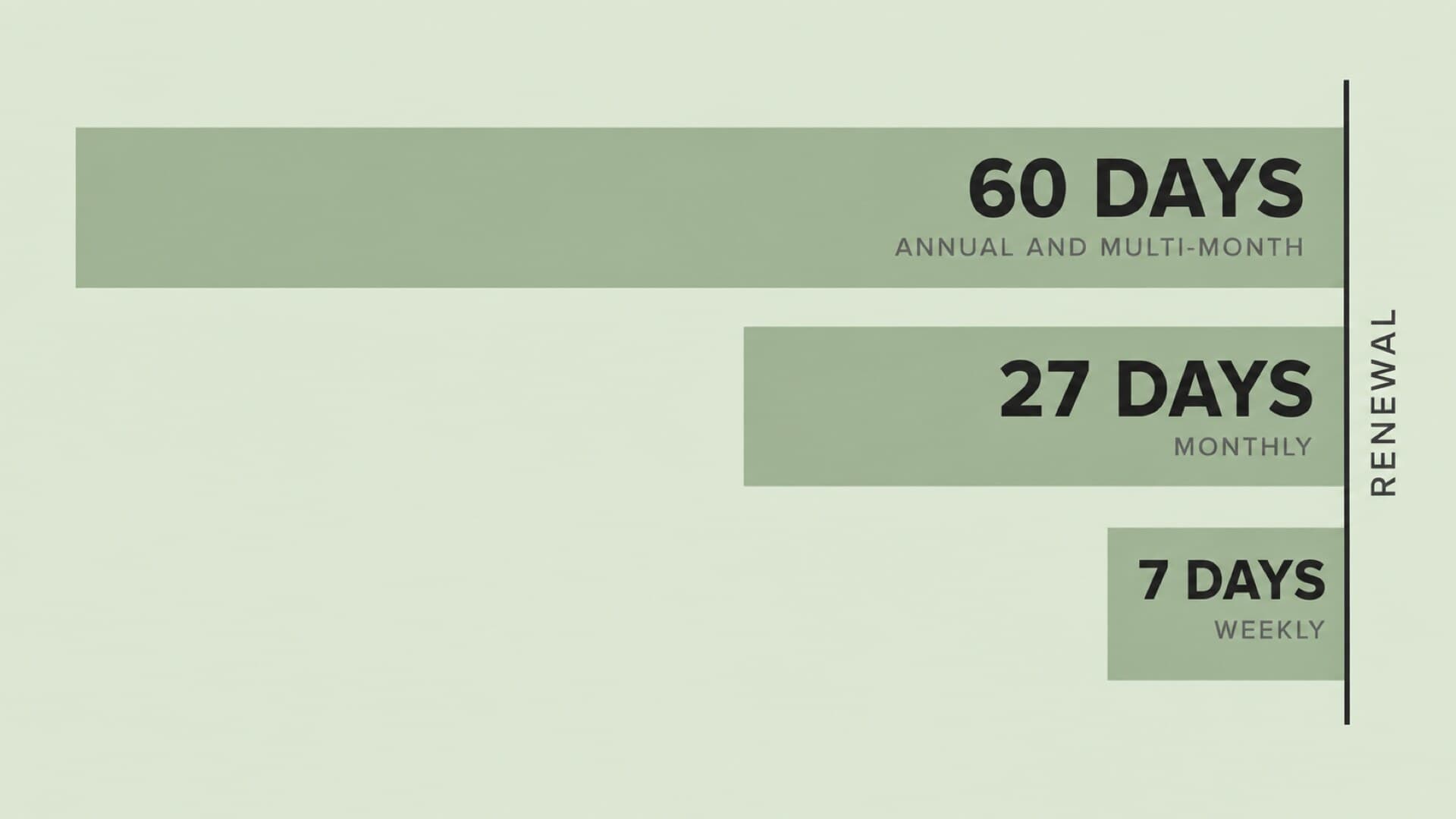
  • Apple sends the notices for you: 60 days for annual and multi-month plans, 27 days plus a 7 day push for monthly, 7 days for weekly
  • Google Play allows "a single opt-out price increase per country/region in the last 365 days," capped at the greater of 50% of the current price or 17 USD cents per day, which is $5.10 across a 30 day month
  • One checkbox decides everything. App Store Connect offers to "keep the current price for existing subscribers," and checking it means your increase reaches new buyers only
  • Price cuts are not symmetrical. Apple states that existing subscriptions "will automatically renew at the lower price" and that "you don't have the option to preserve the higher price"
  • On your own Stripe checkout there is no cap and no notice requirement, and also no automation: existing subscriptions keep their original price until you update every subscription item yourself
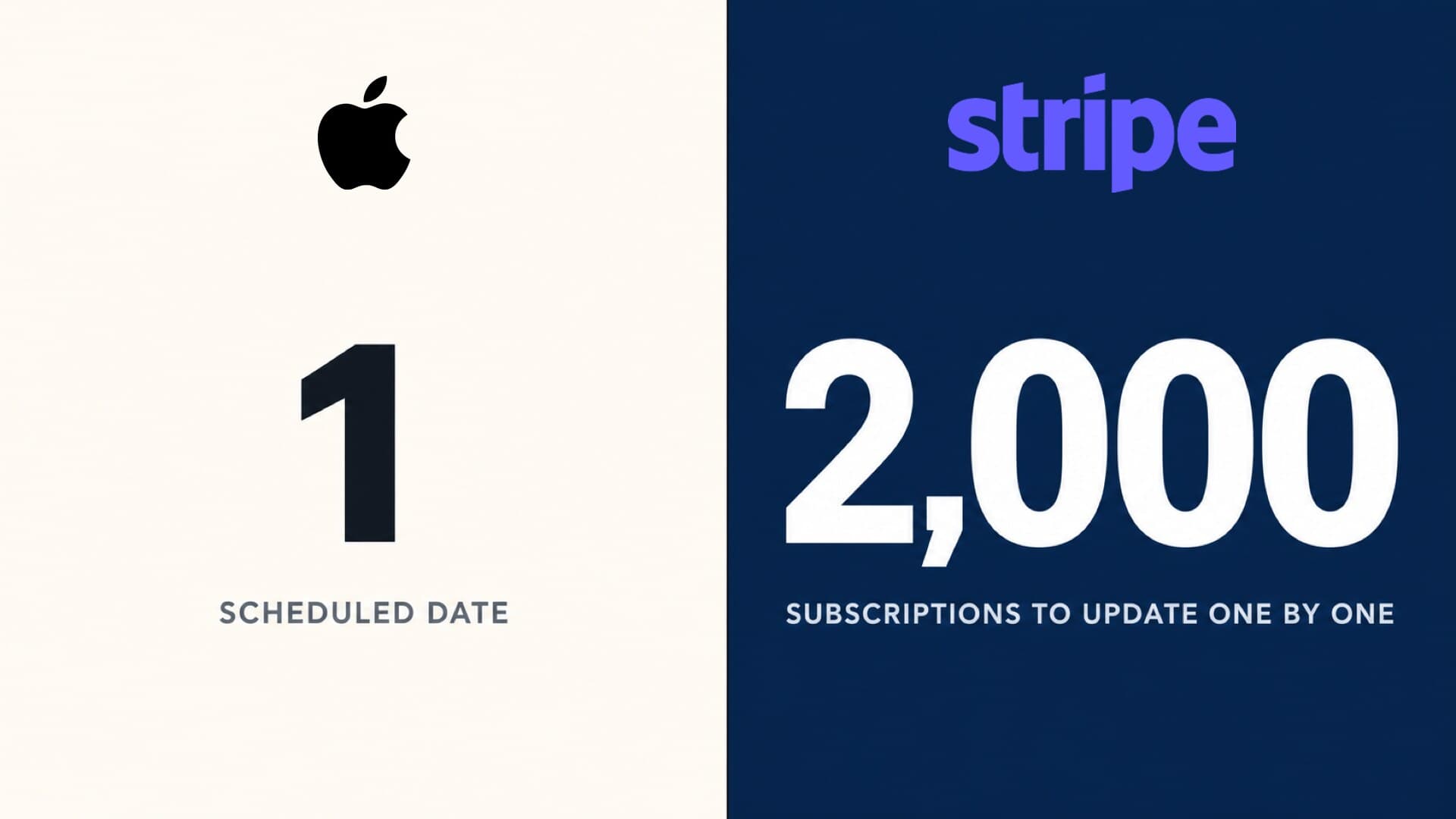
  • On 2,000 subscribers, moving $4.99 to $6.99 is $48,000 a year gross. The same change applied to new buyers only is worth roughly nothing in month one
You picked $4.99 eighteen months ago because it felt safe. You have shipped four features since. Your costs went up, your churn went down, and you have known for a year that the number is wrong. So you open the dashboard and you hesitate, because nobody has told you what actually happens when you move it. Do the people already paying you get moved too? Do they have to agree? Do they get an email you did not write? Can you do it twice? Every one of those answers is published. They are just published in three different places, by three companies, with three different ideas about who is in charge. Here they are. You do, on all three rails, but only one of them will carry out the decision for you. Apple and Google will move your existing subscribers to the new price and send the legally required notices on your behalf, within published caps. Stripe will do neither, at any price, ever, because on your own checkout an existing subscription keeps its original price until you write the code that changes it. That is the sentence the rest of this article expands, and it inverts the usual argument about fees. The standard case against the App Store is the commission. The case nobody makes for it is that the store operates the single hardest piece of subscription business machinery on your behalf: moving the back book. Your back book is everyone who subscribed before today. On a mature subscription product it is almost all of the revenue. A price increase that only touches new buyers is not a price increase; it is a new price list, and it takes as long to matter as your entire customer base takes to turn over.
RailCan you move existing subscribers?Published cap without consentWho sends the noticeFrequency limit
App StoreYes, by defaultNot more than 50% and not more than about $5 per period, or $50 per yearApple, by email, push and in-app messageOne increase per subscriber per 12 months
Google PlayYes, where eligibleThe greater of 50% of the current price or 17 USD cents per dayGoogle, 30 to 60 days ahead by regionOne opt-out increase per base plan per country per 365 days
Your own Stripe checkoutOnly by updating each subscription yourselfNo cap published by StripeYou do, or nobody doesNone published by Stripe
Two of those rows describe a machine. One describes a to-do list. Apple requires the subscriber to tap through a consent prompt only if one of three things is true: they are in a region that requires consent for any price change, the increase is more than 50% of the current price and the difference exceeds roughly $5 per period for non-annual plans or $50 per year for annual plans, or that subscriber already had a price increase on that subscription in the past 12 months. If none of those apply, Apple's help states it "will automatically notify subscribers of the price increase with no additional request for consent." Read the second condition carefully, because the word joining the two halves is "and." App Store Connect Help states that consent is needed when "the price increase is more than 50% of the current price and the difference in price exceeds approximately US$5 per period for non-annual subscriptions, or US$50 per year for annual subscriptions." Both halves have to trip. A dollar increase on a $1.99 weekly plan is more than 50% but nowhere near $5, so it goes through silently. A $4 increase on a $19.99 monthly plan is $4 and well under half, so it goes through silently too. Where it stops being silent is the ambitious jump. Take a $9.99 monthly product to $19.99 and you have tripped both halves: 100% and $10.00. Every existing subscriber now sees a prompt, and anyone who does not tap it stops being a subscriber. That is not a price increase with some churn attached. That is a mandatory re-opt-in on your entire back book, run on Apple's schedule, and it is why the same revenue is usually safer collected as two moves eleven months apart than as one. The third condition is the one that quietly sets your cadence. Because consent is required if "the subscriber experienced a price increase for that subscription within the past 12 months," the practical rule is one free increase per subscriber per year. Apple adds a separate constraint on your side of the desk: "You can schedule one future price change at a time, per country or region, per billing plan type," and scheduling a second overwrites the first. Between 7 and 60 days, depending on the billing period, and Apple sends it rather than you.
Subscription durationNotice Apple sendsExtra push notification
Annual, 6 month, 3 month, 2 month60 days before renewalNot listed
Monthly27 days before renewal7 days before renewal
Weekly7 days before renewalNot listed
There is a trapdoor underneath that table and it is worth knowing before you schedule anything. Apple states that if a price increase lands inside the minimum notice window, "subscribers will renew at their existing price for one more billing period and will receive price consent requests from Apple before the end of their next billing period." Schedule carelessly and you have not raised the price; you have deferred it a full cycle and converted a silent change into a consent prompt. The scheduling itself is fast. Apple says App Store Connect determines the soonest available date for you, "generally 1 to 2 days in advance," and prices are set per storefront across "all 175 App Store countries and regions," from a list of 800 price points per currency.
Three bars ending at a renewal line: 60 days for annual and multi-month plans, 27 days for monthly, 7 days for weekly
One opt-out increase per base plan, per country, per 365 days, capped at the greater of 50% of what the user currently pays or 17 USD cents per day. Anything above that becomes an opt-in increase, and Google cancels the subscription of anyone who declines before the first charge at the higher price. Google's help center writes the cap as "50% of the price the user is currently paying; or 17 USD cents per day," whichever is greater. The per-day framing is unusual and it is worth converting once, because it is not the same shape as Apple's ceiling:
Billing periodGoogle's 17 cents per day headroomApple's approximate ceiling
Weekly$1.19About $5 per period
Monthly, 30 days$5.10About $5 per period
Annual, 365 days$62.05About $50 per year
On a monthly plan the two stores land in almost the same place. On an annual plan Google is meaningfully more permissive, and on a weekly plan it is far more restrictive. If you sell the same product on both stores at the same price, the binding constraint is whichever store is tighter for that billing period, because you are not going to run two different prices for the same thing. Two conditions attach to the opt-out route that do not attach on Apple's side. Google states it is "only available in certain countries/regions, and only to developers in good standing," with certification requirements about your terms of service and consumer notices. And the notice window is 30 to 60 days depending on region, during which "subscribers may experience additional renewals at the current price." Budget for the lag. Google's default when you do nothing is a legacy price cohort: existing subscribers stay on what they were paying until they change plans or you end the cohort. That is the same behavior as Apple's preserve checkbox, arrived at from the opposite direction, and it produces the same outcome for a creator who never revisits it, which is a back book frozen at a number you chose when you had a tenth of the product. When you schedule an increase in App Store Connect, Apple offers you an option, and its exact wording is this: "Keep the current price for existing subscribers. Anyone who subscribed before the start date of this price change won't be affected. Subscribers whose subscription expires can resubscribe at the preserved price within 60 days of expiration." It sounds like the kind thing to do. It is also, in most cases, the difference between a price increase and a press release to nobody. Here is the arithmetic on a real shape: 2,000 active monthly subscribers at $4.99, moving to $6.99. That is a 40.1% increase and a difference of $2.00, so it trips neither half of Apple's consent test and it sits inside Google's $5.10 monthly headroom. No prompt, no re-opt-in, no cancellation screen.
ChoiceSubscribers affected in month oneMonthly gross changeAnnual gross changeAnnual after Apple's 15% Small Business rate
Apply to existing subscribers2,000+$4,000+$48,000+$40,800
Keep the current price for existing subscribers0+$0Depends entirely on turnoverDepends entirely on turnover
$48,000 a year is the entire value of the decision, and it is decided by a checkbox most creators tick because it feels polite. The second row is not zero forever. It is zero until your existing base churns out and is replaced, which on a healthy product is the slowest process in your business, and on an unhealthy one is a different article about why app subscribers cancel. There is a version of the checkbox that is correct, and it is narrow: you are moving the price a long way, you know the increase trips the consent test, and you would rather protect a loyal cohort than run a re-opt-in on people who have paid you for three years. That is a real decision. Ticking it out of nervousness on a $2.00 move is not. Two details in Apple's wording repay attention. The preserved price survives a lapse for 60 days, so a subscriber who cancels and comes back inside two months returns to the old number rather than the new one. And Apple's non-preserving option applies the change to "existing subscribers who are paying the price of your subscription currently displayed on the App Store," which means subscribers already sitting on an older preserved price from a previous increase are not swept along. Run enough increases with the checkbox on and you are not operating one price. You are operating a museum. This is the asymmetry nobody expects, and it is stated flatly in Apple's documentation: "If you decrease the price of your auto-renewable subscription, existing subscriptions will automatically renew at the lower price. You don't have the option to preserve the higher price for existing subscribers." So a cut is instant, universal and irreversible in one direction, while an increase is capped, notice-bound, once a year and optional. The stores are not neutral machinery. They are built with a thumb on the scale toward the subscriber, and any pricing experiment you run has to survive that asymmetry. The practical consequence: a temporary promotional price is not something you do by editing the price. Editing the price down moves everyone, including the 2,000 people who were happily paying full freight, and putting it back up starts the 12 month consent clock for every one of them. Promotional pricing belongs in introductory offers and promotional offers, which are a separate mechanism, and the annual versus monthly decision usually gives you more room than a discount does anyway. Because nothing happens automatically. Stripe publishes no cap and no notice requirement, which reads like freedom, and then existing subscriptions keep billing at their original price indefinitely because a Stripe subscription points at a specific Price object and editing your pricing page does not touch it. To actually move someone you update the subscription item and swap the price identifier, one subscription at a time. Stripe's documentation is explicit about the trap: "You must specify the subscription item to replace the current price with the new price. Failing to do so results in adding the new price so both prices are active for the subscription." Get that wrong at scale and you have not raised a price, you have double-billed your best customers. Three more things are waiting behind it. Changing a price "often results in a proration to apply the new price to the remaining days in the billing period," so everyone gets a partial charge on a day they were not expecting one. Updating a price "automatically reverts the quantity to the default value of 1," so any subscription with a quantity above one silently collapses unless you pass it again. And if the new price has a different billing interval, "the new price is billed at the new interval, starting on the day of the change," which resets billing dates across your base. None of that is Stripe being difficult. It is what running your own billing means, and it is a line item people forget when they compare what it costs to run a subscription app against a commission. The commission buys the migration, the notices, the consent flow, the 175 storefronts and the localized price points. The 2.9% buys a payment.
The same increase on two rails: one scheduled date under the Apple mark, 2,000 subscriptions to update one by one under the Stripe mark
You already have the product and the audience. This is a 30 minute exercise with a five figure answer.
  • Write down the date you last changed the price. If it is more than 12 months ago, Apple's consent clock on every existing subscriber is clear and you have a free move available today.
  • Compute your silent ceiling. Take 50% of your current price and compare it to $5 per period. The smaller number is your headroom on the App Store without a consent prompt, and if you are also on Google Play, check it against 17 cents per day for your billing period.
  • Decide the checkbox before you open the dashboard. Multiply your active subscriber count by the increase. That number is what the checkbox costs you if you tick it, and you should know it before the UI asks.
  • Schedule outside the notice window. Give yourself more than 60 days on an annual plan and more than 27 on a monthly one, or the change slips a cycle and turns into a consent prompt.
  • Count how many people are on preserved prices already. If you cannot answer, that is the finding. Old prices do not expire on their own, and churn math looks very different when part of the base is paying a number you retired.
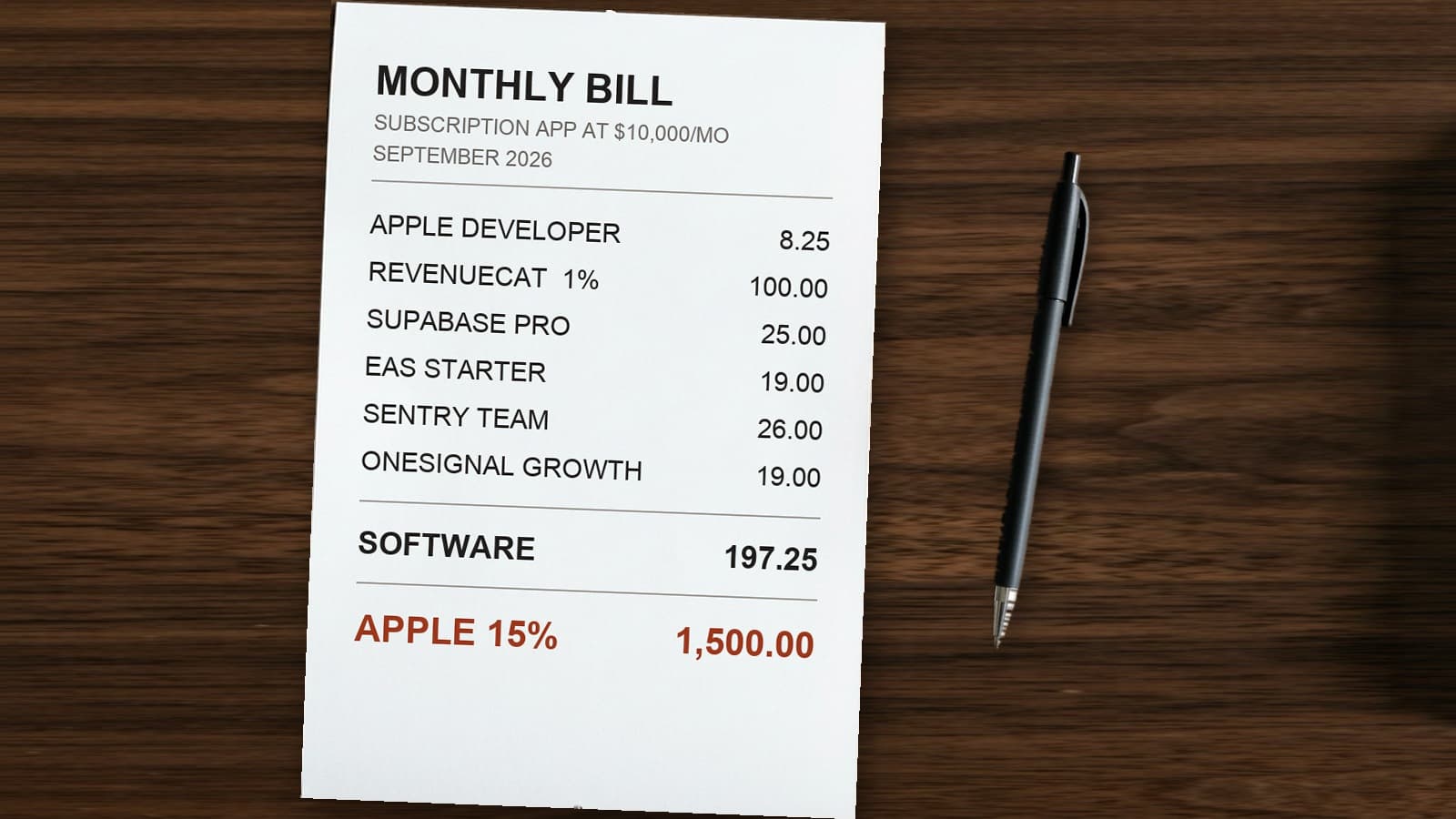
If step two produced a headroom of $2.00 and you have 2,000 subscribers, you are looking at $48,000 a year that has been sitting behind a checkbox. That is more than most brand deal calendars, it recurs, and it required no content. The fee argument gets all the attention, and we have written the fee argument ourselves, including why the 15% Small Business rate exists and who it actually covers. But pricing power is a different axis, and on that axis the stores are not the tax. They are the infrastructure. A creator selling through their own checkout has total theoretical freedom over price and almost no practical ability to exercise it, because exercising it is an engineering project with a double-billing failure mode. A creator with an app has a capped, annual, notice-bound ability to move the whole base with a scheduled date and a checkbox, and the platform does the hard part. If you are still choosing a launch number, start here and then come back to this page in a year, because you will need it. BUILT BY FOUNDRY builds the product your audience is already asking you for in about three weeks, at $0 upfront, on a revenue share. You own the business and you own the revenue. We keep running it after launch, which includes the pricing surface, the scheduled increases, the storefront price points and the notice windows, so the decision above is a conversation rather than a project. The creators who never raise a price are not being generous. They are running a business whose revenue per customer has been falling in real terms every month since launch, and calling it loyalty. Usually yes. App Store Connect Help states that Apple will "automatically notify subscribers of the price increase with no additional request for consent" unless the subscriber is in a region that requires consent for any change, unless "the price increase is more than 50% of the current price and the difference in price exceeds approximately US$5 per period for non-annual subscriptions, or US$50 per year for annual subscriptions," or unless "the subscriber experienced a price increase for that subscription within the past 12 months." Once per subscriber per 12 months if you want it to stay consent-free on the App Store, because a second increase inside a year trips Apple's third condition. On Google Play the equivalent limit is stated at the plan level: "each subscription base plan can only have a single opt-out price increase per country/region in the last 365 days." Apple separately allows only one scheduled future price change at a time per country and billing plan type, and scheduling another overwrites the first. The greater of "50% of the price the user is currently paying" or "17 USD cents per day," for an opt-out increase. Across a 30 day month that second figure is $5.10, and across a 365 day year it is $62.05. Larger increases must be opt-in, where the user approves the change or the subscription "is automatically canceled before the first charge at the higher price." Opt-out increases are limited to certain countries and to developers Google describes as in good standing. Yes, and you do not send it. Apple notifies subscribers 60 days before renewal for annual, 6 month, 3 month and 2 month subscriptions, 27 days before renewal for monthly plans with an additional push notification at 7 days, and 7 days before renewal for weekly plans. Google Play's minimum notification window is 30 to 60 days depending on country or region. Only deliberately. Apple's option reads "Keep the current price for existing subscribers. Anyone who subscribed before the start date of this price change won't be affected," which means the increase reaches new buyers only. On 2,000 subscribers moving from $4.99 to $6.99, that checkbox is the difference between $48,000 a year in additional gross revenue and roughly nothing in month one. Preserve prices when the increase is large enough to trip consent and you want to protect a long-tenured cohort, not as a default. Yes, automatically, and you cannot opt out. Apple states that "if you decrease the price of your auto-renewable subscription, existing subscriptions will automatically renew at the lower price" and that "you don't have the option to preserve the higher price for existing subscribers." That asymmetry is why a temporary discount should be run as an introductory or promotional offer rather than as an edit to the subscription price. Because a Stripe subscription item references a specific Price object, so creating a new price on your pricing page leaves every existing subscription pointed at the old one. Moving a customer requires updating the subscription item with the replacement price identifier, and Stripe warns that "failing to do so results in adding the new price so both prices are active for the subscription." Expect prorations on the remaining days of the period, a quantity that reverts to 1 unless you pass it again, and reset billing dates if the new price uses a different interval. Every figure above is a live published page and can change without notice. Apple's own ceilings are written as approximate dollar amounts and vary by storefront and currency. Verify against the source before you schedule anything.
Our work

Creators who already did this

These are apps we designed, built, shipped, and still run today, with the creator keeping the code and the audience.

Ellie Fausett

Ellie Fausett

Founder & CEO of Vector Guard

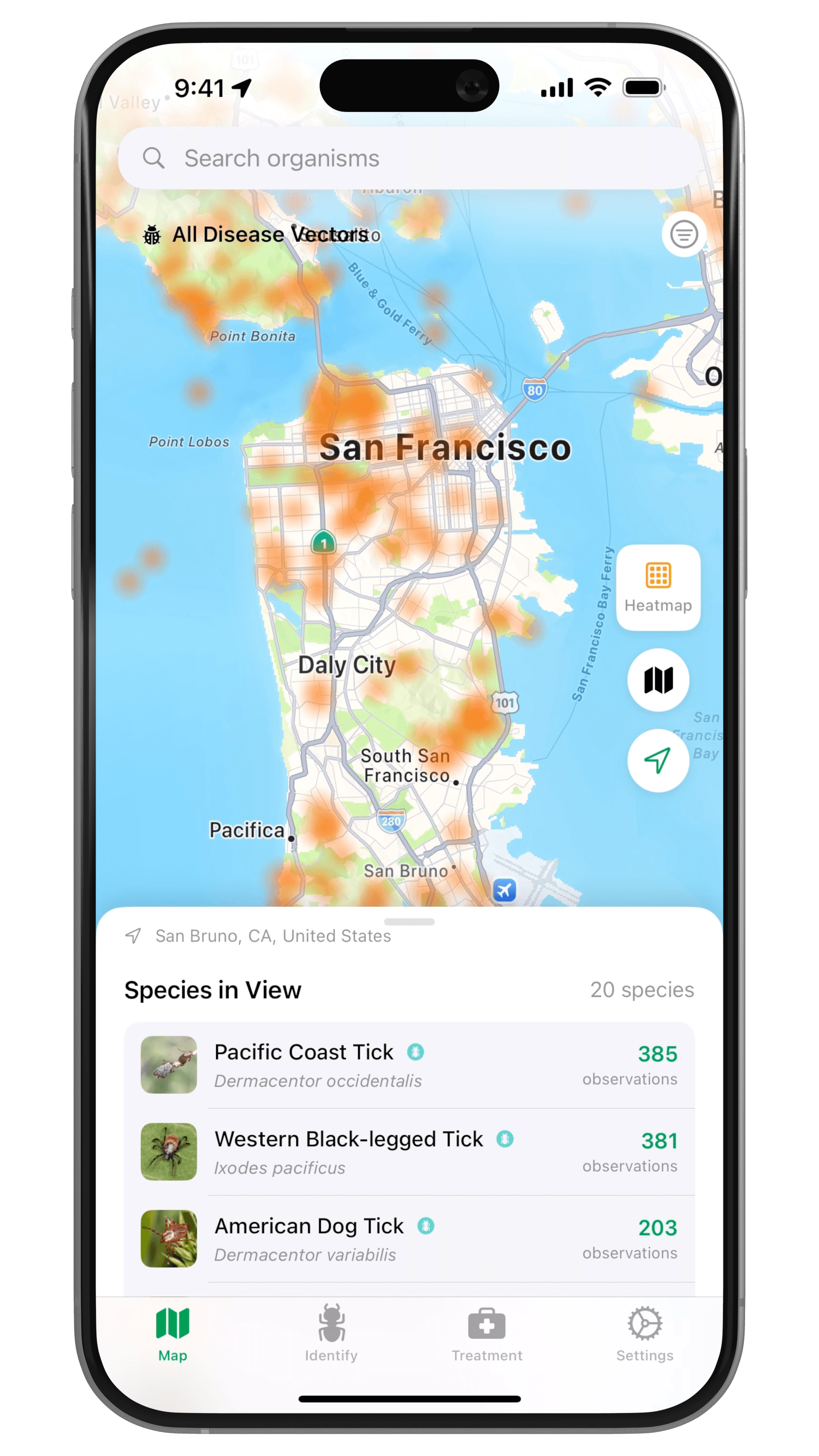
Spot disease-carrying pests before they reach your family.

Top Health App
Read the case study
Vector Guard screenshots
Samantha Mae

Samantha Mae

Founder & CEO of NineLives

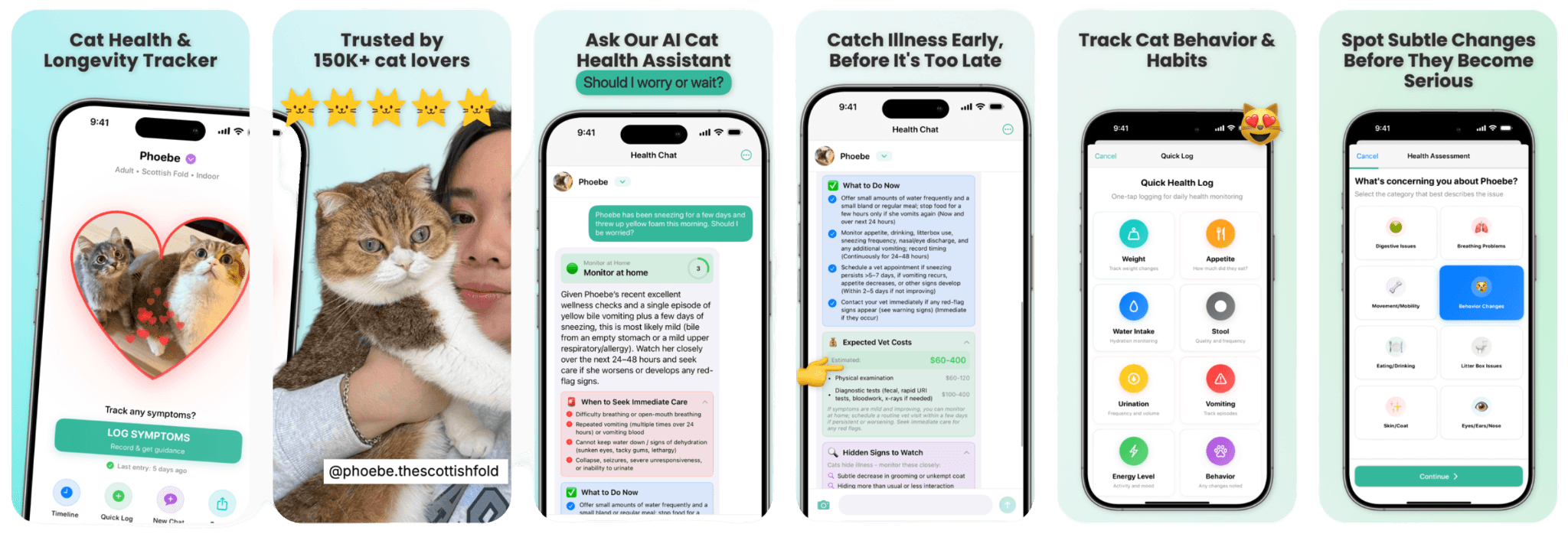
Cat health tracking from the world's most beloved Scottish Fold.

Top Health App150K+ followers
Read the case study
NineLives screenshots
Liv Merima

Liv Merima

Founder & CEO of Claim It

Custom affirmations that help millions choose themselves.

Top Lifestyle App150K+ followers
Read the case study
Claim It screenshots

Creator app strategy

Curious what your app could be?

Enter your handle and BUILT BY FOUNDRY will research your audience and present custom app concepts. Free.

Can You Raise Your App Subscription Price in 2026? 3 Rails, 2 Consent Rules, and a 50% Line