
Turning Knowledge into Products

Annual vs Monthly App Subs: Which Earns Creators More?

Foundry
May 22, 2026
Share
Annual vs Monthly App Subs: Which Earns Creators More?

Get Creator Revenue Insights

How creators are turning audiences into subscription businesses
Share
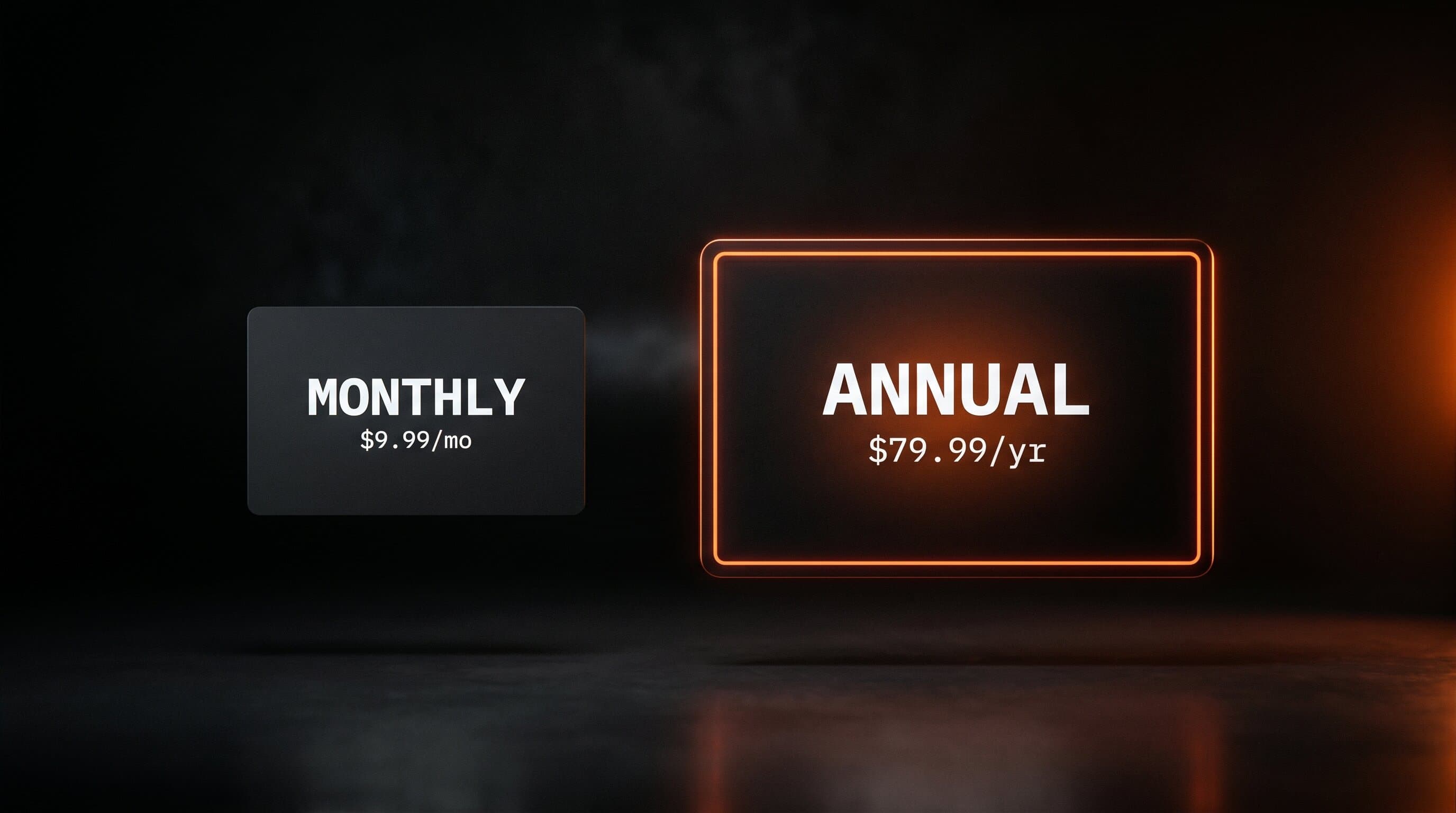
A creator opens RevenueCat for the first time after launching an app. Two numbers sit on the dashboard. Monthly subscribers: 412. Annual subscribers: 188. The monthly price is $9.99. The annual price is $79.99. The creator stares at the screen, does some quick mental math, and gets it backwards. Almost every creator gets it backwards. The annual subscribers are the business. The monthly subscribers are the marketing budget. This guide breaks down the real economics of annual versus monthly app subscriptions for creators, with current public benchmarks, and shows you how to price both plans so the first dollar lands on day one instead of month thirteen. Key Takeaways:
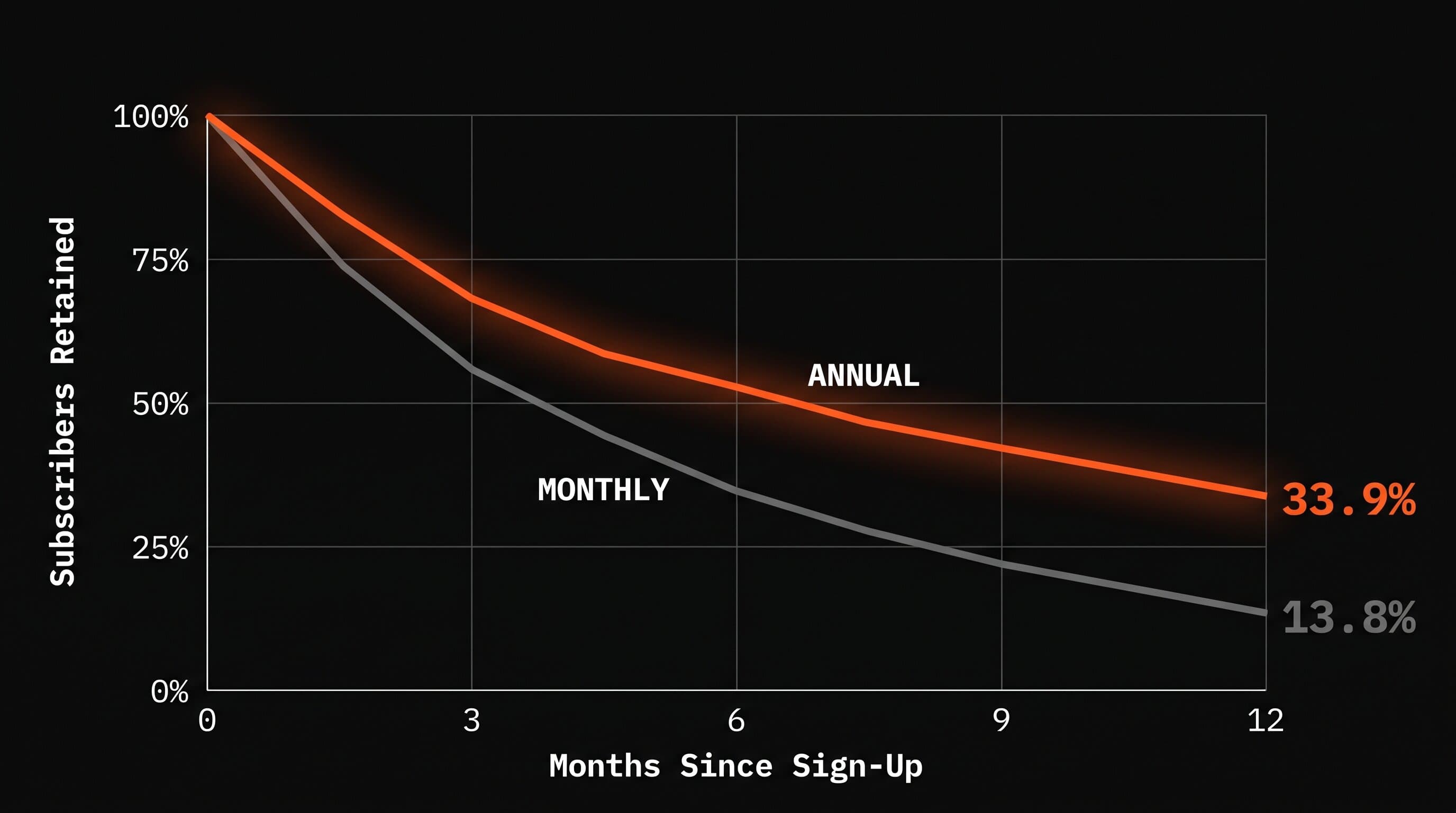
  • Annual subscribers retain at 33.9% after 12 months. Monthly subscribers retain at 13.8%. Annual plans reduce churn by roughly 51% (RevenueCat, 2024).
  • Annual subscribers are about 2.4x more profitable per user than monthly subscribers across the median consumer app (RevenueCat, 2024).
  • Monthly plans went from 21.1% of subscription revenue in 2023 to 11.7% in 2025. The market is moving toward annual at speed (Adapty, 2025).
  • The default price ratio that converts best for creators: annual priced at 5x to 7x the monthly rate, displayed with the monthly equivalent next to it.
  • Monthly is not dead. It is your trial-after-the-trial, your low-friction onboarding lane, and your repricing experiment ground. You need both. You need one to win.
A monthly subscription is a customer renting access one month at a time. An annual subscription is a customer paying you twelve months up front for the same access at a discount. The cash flow, the churn profile, and the customer's psychology are completely different products that happen to share an icon in the App Store. Annual vs Monthly: the one-paragraph definition. Annual app subscriptions bill the customer 12 months of access in a single upfront charge. Monthly app subscriptions bill 1 month at a time, recurring on the same date. Annual plans typically offer a discount (often 30 to 50% off the monthly rate) in exchange for the longer commitment. Monthly plans are easier to start and easier to cancel, which is why they convert higher at the paywall and churn faster after the first 90 days. If you only remember one number from this guide, remember this: annual subscribers stay roughly 2.4x longer than monthly subscribers on the median creator app. Length of stay is the entire game. Annual subscribers retain better because they have already paid. Cancellation in month four costs them nothing in saved cash, so they don't cancel. They just stop opening the app and let the auto-renew handle the decision at month twelve. RevenueCat's 2024 report puts the 12-month retention for annual at 33.9% versus 13.8% for monthly. That is not a small gap. That is two completely different businesses sharing a tag in the App Store. There's a second effect that creators underestimate. Annual buyers are self-selecting. The person who chooses the annual plan at checkout is signaling that they expect to use the app for the long haul. The person who chooses monthly is signaling that they want to keep their options open. You are not converting the same person into two different plans. You are sorting two different people into the plan that matches their intent. This is why pricing strategy is a sorting problem, not a margin problem. We covered the fundamentals of how creators set prices in 5 pricing strategies for creator subscription apps. The plan structure on top of those prices is what decides who walks through which door. Here is a cohort of 1,000 paid subscribers at the median retention curve. Half take monthly at $9.99. Half take annual at $79.99 (which prices out to $6.67 per month). Run the cohort for 24 months and look at total revenue per user.
PlanSticker PriceMonthly Equivalent12-mo RetentionAvg Months ActiveLTV (24 mo)
Monthly$9.99/mo$9.9913.8%6.2$61.94
Annual$79.99/yr$6.6733.9%16.4$109.31
The annual subscriber pays less per month and still produces 77% more lifetime revenue. The "discount" is not a discount. It is a bribe to make a 12-month commitment, and the commitment is what makes the unit economics work. There is one more line in the spreadsheet that nobody talks about. Annual revenue lands in your account on day one. Monthly revenue dribbles in over two years and assumes nothing breaks. If the App Store changes its rules, if Apple pulls your app, if you fumble an update, the monthly book of business evaporates. The annual book of business already cleared. That cash is sitting in your MRR run rate the moment the customer hits subscribe.
Cohort retention chart showing annual subscribers retaining at 33.9% and monthly at 13.8% after 12 months
The default ratio that works for most creator apps is annual at 5x to 7x the monthly price. So $9.99 monthly becomes $59.99 to $69.99 annual. Anything cheaper than 5x and you're leaving money on the table. Anything more than 7x and the discount is too thin to move the customer. Three rules for setting the prices side by side:
  • Anchor on monthly, discount the annual. Show the monthly price first, then show annual with "billed yearly, save 38%" underneath. The brain does the math you want it to do.
  • Display the monthly equivalent on the annual plan. "$79.99/yr ($6.67/mo)" converts better than "$79.99/yr" alone. The customer is comparing the monthly equivalents, not the totals.
  • Default the toggle to annual. If your paywall has a toggle, set it to annual by default. The default carries 60 to 70% of selections in most paywall tests.
This is where the free trial versus paywall decision gets interesting. A free trial on the annual plan converts the lowest at the trial-end moment, but the people who do convert stay the longest. A free trial on the monthly plan converts higher but produces a churn cliff at month three. Most creator apps end up running a free trial on the annual plan with a "switch to monthly" option after trial, which sounds like a hack and is actually the optimal default. No, but it is losing share fast. Adapty's 2025 in-app subscription report shows monthly plans dropped from 21.1% of subscription revenue in 2023 to 11.7% in 2025. Annual dropped from 29.2% to 22.5%. Weekly plans picked up most of the difference, which is its own conversation, but the trend inside the long-form plans is clear: customers and operators are voting with their dollars for annual. Monthly still earns its place on the paywall for three reasons:
  • It captures the maybe-buyers. People who would never click an $80 button will click a $10 button. Some of them upgrade to annual six weeks later when the app proves itself.
  • It funds your experiment surface. Monthly subscribers are easier to A/B test pricing against because the renewal happens 12 times a year, not once.
  • It is the fall-back from a failed annual trial. When a customer cancels at the end of a 7-day annual trial, the salvage offer is "go monthly for $9.99." That salvage closes maybe 15% of canceling trialists. Free money.
Run both. Push annual. Let monthly catch what annual misses. Weekly is the loud cousin of monthly. It converts hardest at the paywall because the sticker price is the smallest, and it churns hardest because the customer revisits the cancel button four times more often. Weekly plans with a free trial produce the highest 12-month LTV in some categories ($49.27 in Adapty's 2025 data), but only because the trial converts so well. The post-trial behavior is brutal. For most creator apps, weekly is a B-tier choice. Use it if you are in a categorically high-impulse niche (entertainment, dating, gaming) and skip it if you are in a deliberate-purchase niche (fitness, productivity, education). Creators in the deliberate-purchase niche have an audience that already invested attention. The right ask is annual, not weekly. The pattern across the apps we study at Foundry is remarkably consistent. Most of the seven and eight-figure creator apps run three plans: annual primary, monthly secondary, lifetime as a wildcard. The annual plan is the default. The monthly plan is the safety net. The lifetime plan (when it exists) is a one-time grenade for whales, priced at 3 to 5x the annual rate. Look at the public structure of Sami Clarke's FORM app, which has reportedly cleared $42M in lifetime revenue. The paywall pushes annual front and center, with the monthly equivalent shown right next to it, and the monthly plan tucked underneath as the "I'm not sure yet" option. That is the playbook. The variation between apps is in the trial mechanics, not the plan structure. Same playbook for Adriene Mishler's Find What Feels Good and the Sweat app Kayla Itsines built before her $400M exit. Annual is the headline. Monthly is the buffer. Everything is priced so the math works for the customer who actually uses the app. The ranges below are pulled from publicly listed App Store prices and product pages for top-grossing creator apps as of May 2026. They are not universal. They are the gravity well most creator categories settle into.
CategoryMonthlyAnnualAnnual Monthly-Equivalent
Fitness / Wellness$9.99 to $19.99$69.99 to $129.99$5.83 to $10.83
Mindset / Coaching$9.99 to $14.99$59.99 to $99.99$5.00 to $8.33
Education / Skill$7.99 to $14.99$49.99 to $99.99$4.17 to $8.33
Community / Creator$4.99 to $9.99$39.99 to $79.99$3.33 to $6.67
Faith / Devotional$4.99 to $9.99$39.99 to $59.99$3.33 to $5.00
Three signals to watch when you pick your number:
  • Is the monthly price tolerable as a one-time impulse? If yes, you can afford to anchor higher on annual.
  • What is the comparable cost in your customer's life? A fitness app priced like a gym is fine. A fitness app priced like a personal trainer is not.
  • Are competitors clustered tightly or spread wide? Clustered means there's a market consensus and you should pick a price near the median. Spread wide means there's no consensus and you have permission to test.
The right answer almost always lives inside a band you can find on the App Store in 20 minutes. We're not inventing categories. We're picking where to sit inside one. A lifetime plan is the third lever and the trickiest. Price it at 3x to 5x the annual rate ($249 to $499 for a $79 annual app). It will convert at 1 to 3% of total paywall views, and those customers are gold: zero churn, zero renewal fail, full payment up front. The downside is you cap the LTV on someone who would have stayed seven years on annual. Use lifetime as a launch-week incentive, an anniversary special, or a top-of-funnel promotion. Don't make it permanent on the paywall. Permanent lifetime erodes annual conversions because it gives the customer a "why not just pay once" out. For long-form context on why subscription always beats one-time products at scale, see our piece on why your best brand deal is worse than your worst month of MRR and the breakdown of recurring revenue economics. The TL;DR: a $100 one-time sale prints once. A $9.99 monthly sale prints for 6.2 average months. A $79.99 annual sale prints for 16.4 average months. The math is not close. This is the highest-ROI optimization most creator apps never run. You already have a paying customer. They've already cleared the trust barrier. The job is to upgrade them to a plan that pays you longer. Three tactics that work:
  • The "save 40%" in-app offer at month four. Show subscribers who've renewed monthly three times an in-app offer to switch to annual at a discount. Conversion rates in the 8 to 14% range across the apps we operate.
  • The renewal email. Send a "you've been with us 90 days, here's an annual offer" email when a subscriber hits day 90. Email open rates among paying users are high. Conversion is in the 4 to 8% range.
  • The annual-only feature. Gate one premium feature (offline downloads, advanced analytics, an exclusive community channel) behind the annual plan. This shifts new paywall conversions toward annual and gives existing monthlies a reason to upgrade.
Every monthly subscriber you move to annual is worth roughly 2.4 monthly subscribers in expected lifetime revenue. Run the optimizer. After running paywall tests across dozens of creator apps, the same five mistakes repeat:
  • Annual priced too close to monthly. A $9.99 monthly and a $99.99 annual is a 17% discount. Customers don't notice. Move it to $69.99 to $79.99 and the conversion shifts.
  • No monthly equivalent shown next to annual. Customers compare the small number, not the big number. Show the small number.
  • Default toggle set to monthly. The default carries the vote. Set it to annual.
  • No salvage offer when annual cancels. A canceling annual trial deserves a "stay monthly" offer at the cancellation screen. This is a 10 to 20% catch rate.
  • Free trial on the wrong plan. Free trial on monthly trains the customer to think monthly. Free trial on annual sorts the customer toward annual. Default to free trial on annual.
The good news: these are all paywall fixes, not product fixes. They cost a day of engineering and pay back forever. If you're running a creator app and you haven't run these tests, the lowest-effort, highest-yield work is sitting on your dashboard right now. We handle this work for the creators we partner with as part of App Care. The renewal flow, the salvage offer, the annual upgrade prompts. The product never stops being optimized. For the business, yes, with one caveat: annual produces more lifetime revenue per customer because the customer stays roughly 2.4x longer. The caveat is that annual converts lower at the paywall, so you need monthly as a fall-back to capture customers who won't commit. Run both. Push annual. The conversion sweet spot is a 30 to 45% effective discount versus the monthly price. Less than 30% and customers don't notice. More than 45% and you cannibalize your monthly revenue without enough lift in annual sign-ups to compensate. Use lifetime as a launch-week incentive, an anniversary promotion, or a top-of-funnel boost. Price it at 3x to 5x the annual rate. Don't keep it on the paywall permanently, because it erodes annual conversion. Default to annual. The trial-to-paid conversion rate is lower on annual, but the customers who do convert stay roughly 2.4x longer. The math is on the annual side once you account for retention. Most agencies take 6 to 12 months. Built by Foundry ships in three weeks, with the paywall, both plans, and the renewal optimization wired in from day one. See our model on the about page. Zero upfront cost, revenue share, we handle the App Store, payments, push notifications, and ongoing optimization forever. Most creators look at their dashboard and feel proud of the bigger monthly number. The bigger monthly number is the warm leads list. The smaller annual number is the actual business. Until your annual plan is producing the majority of your subscription revenue, your unit economics are working against you. If you have an audience and no app, you are leaving the most durable revenue model in the consumer subscription economy on the table. We build creator apps in three weeks, $0 upfront, and tune the paywall forever. The math only works if it's running.
Let's Build →
Annual vs Monthly App Subs: Which Earns Creators More?