

What Is Churn? The Metric Killing Creator Apps

What Is Churn? The Metric Killing Creator Apps

Foundry
April 17, 2026
Churn rate is the percentage of paying subscribers who cancel their subscription in a given time period. If you have 1,000 subscribers and 80 cancel this month, your monthly churn rate is 8%. It's the number that determines whether your creator app compounds into a real business or bleeds out slowly. Key Takeaways:
  • Churn rate = subscribers who cancel / total subscribers at start of period
  • The average mobile subscription app loses 9% of subscribers per month (RevenueCat, 2025)
  • At 10% monthly churn, you replace your entire subscriber base every 10 months just to stay flat
  • Health and fitness apps retain just 27.2% of users after 30 days (Business of Apps, 2026)
  • Top creator apps keep monthly churn below 5% by pairing sticky features with creator involvement
Churn rate measures how fast you lose paying customers. The formula:
Monthly Churn Rate = (Subscribers Lost This Month / Total Subscribers at Start of Month) x 100
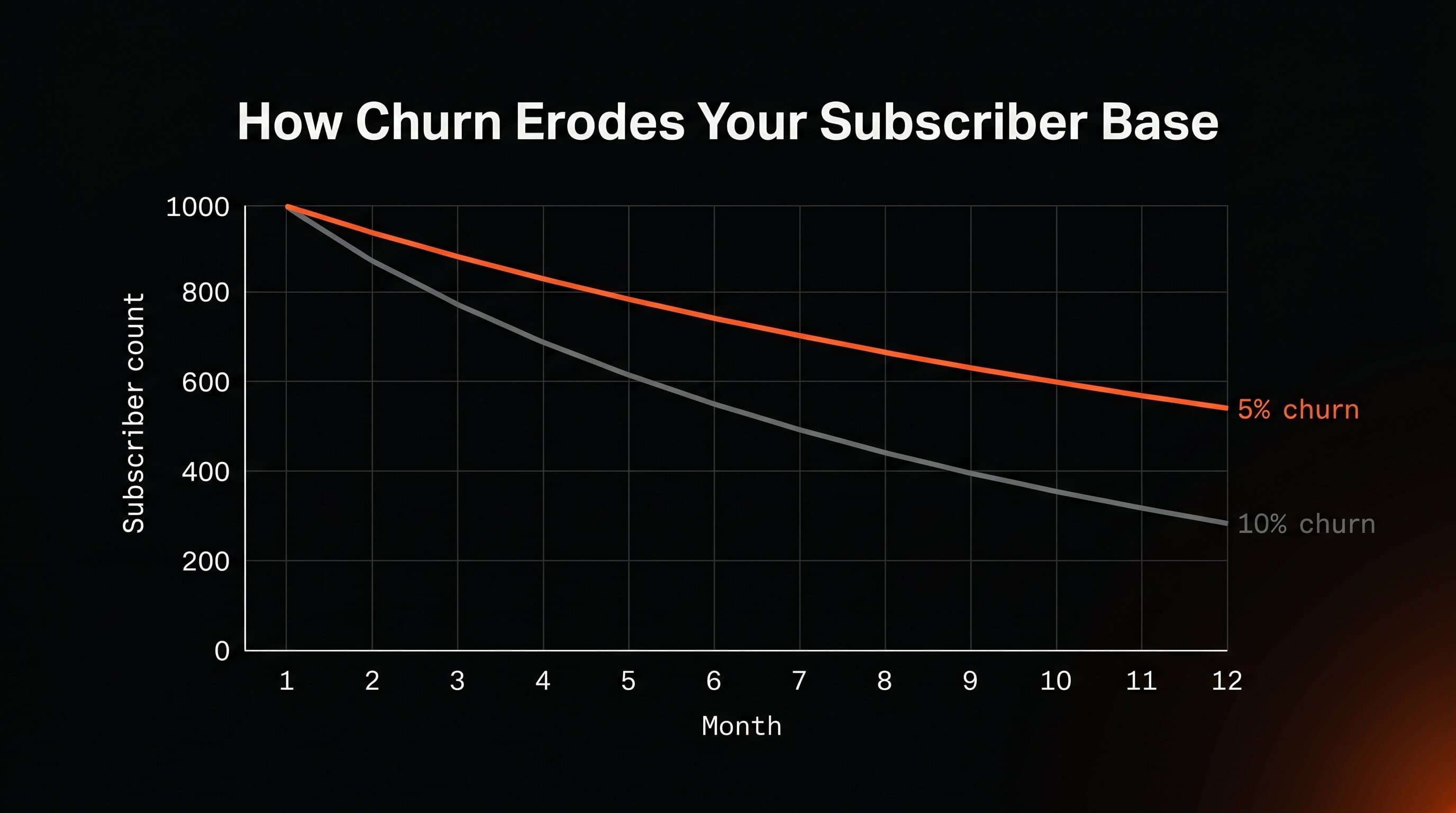
A 5% monthly churn rate means 5 out of every 100 subscribers cancel each month. That sounds manageable until you run the math forward. At 5% monthly churn, you lose roughly 46% of your subscribers in a year. At 10%, you lose 72%. If you already track MRR (Monthly Recurring Revenue), churn is MRR's shadow. MRR tells you what's coming in. Churn tells you what's leaking out. Ignore it, and your revenue hits a ceiling no amount of marketing can break through. Most creators obsess over downloads and new subscribers. That's the wrong focus once your app is live. Say you're adding 200 new subscribers per month at $15/month. Feels great. But if your churn rate is 12%, and you have 1,000 existing subscribers, you're losing 120 per month. Net gain: 80. And as your subscriber base grows, churn eats more in absolute numbers. At 2,000 subscribers, that 12% churn means 240 losses per month. Now those 200 new signups don't even cover the hole. The relationship between churn and LTV (Lifetime Value) is direct. At 5% monthly churn, average subscriber lifespan is 20 months. At 10%, it drops to 10 months. A subscriber paying $15/month is worth $300 at 5% churn and $150 at 10% churn. Cutting churn in half doubles the value of every subscriber you already have.
How churn erodes your subscriber base over 12 months at 5% vs 10% monthly churn
Churn rates vary by industry, billing cycle, and product type. Here's where creator apps sit relative to other subscription businesses:
CategoryAvg Monthly ChurnAnnual Equivalent
B2B SaaS3.5%35%
Digital media and entertainment6.5%55%
Mobile subscription apps (all)9%72%
Health and fitness apps8-12%63-77%
Top creator apps3-5%31-46%
Sources: Recurly Churn Benchmarks, RevenueCat 2025, Business of Apps 2026. Billing cycle matters too. Weekly subscriptions lose 65% of users within 30 days. Monthly plans retain 43% at 90 days. Annual plans keep nearly everyone for 12 months, but churn spikes at renewal. According to RevenueCat, 30% of annual subscriptions get canceled in the first month alone. The reasons subscribers cancel fall into a few predictable buckets:
  • Low usage. 40% of cancellations come from subscribers who simply stopped opening the app. No usage, no value, no reason to keep paying.
  • Weak first week. 77% of daily active users stop using an app within 3 days of installing it (Business of Apps, 2026). If your onboarding doesn't hook them immediately, they're gone.
  • No fresh content. A static app is a dead app. Subscribers expect new workouts, challenges, lessons, or features. The moment it feels "done," they cancel.
  • Price mismatch. Not that it's too expensive. The perceived value doesn't match what they're paying. A $20/month app needs to deliver $20/month of value every single month.
  • Involuntary churn. Expired credit cards, failed payments, billing errors. This accounts for 20-30% of all churn and is completely fixable with retry logic and payment recovery tools.
The basic formula works for most creators:
Monthly Churn = (Subscribers at Start of Month - Subscribers at End of Month) / Subscribers at Start of Month x 100
Track it monthly. Graph it. If it's trending up, something broke. If it's stable or declining, your product is working. Two related metrics worth tracking alongside churn:
  • Net Revenue Retention (NRR): Revenue from existing customers after upgrades, downgrades, and cancellations. Over 100% means existing customers spend more over time, even after churn.
  • Cohort retention: Track each month's signups as a group. Do January subscribers behave differently than March subscribers? Cohort analysis reveals whether product improvements actually move the needle.
The best creator apps share a pattern: they make the app feel alive. Creator involvement. New challenges, live sessions, personal touches from the creator. Kayla Itsines' Sweat app maintained over 1 million monthly active users by constantly rotating workout programs and making Kayla visible inside the product (Harvard Digital Innovation). Smart notifications. Not spam. Targeted messages based on behavior. "You haven't worked out in 3 days" beats "Check out our new feature!" every time. Annual plans. Annual subscribers retain at 44% after 12 months vs. 17% for monthly plans (RevenueCat, 2026). Offering a discounted annual option isn't just a revenue play. It's a retention strategy. Pause instead of cancel. A "pause subscription" option recovers 30-40% of users who would otherwise cancel. They're not unhappy with the product. They're just busy. Community features. Adding social elements improves retention by 30% in fitness apps. When subscribers know other people in the app, leaving feels like leaving a group, not canceling a payment. "Low churn means my app is good." Not necessarily. If you only acquire one type of user and they all stay, your total addressable market might be tiny. Growth and retention both matter. "I can outrun churn with marketing." You can't. At 15% monthly churn on a 1,200 person base, you need 180 new subscribers per month just to stay flat. That marketing gets expensive fast. "Annual plans eliminate churn." They delay it. 30% of annual subscribers cancel in the first month. And the renewal cliff at month 12 hits hard if the app hasn't delivered continuous value. "Churn is just about the product." Involuntary churn from failed payments and expired cards accounts for 20-30% of all churn (Recurly, 2026). A smart payment recovery system recaptures most of it without the subscriber even noticing. Your app is either compounding or eroding. Churn determines which. The creators who build real subscription businesses track churn weekly, fix the causes, and build products people can't imagine canceling.
Let's Build →
The average mobile subscription app has 9% monthly churn. Top creator apps achieve 3-5% monthly churn. Below 5% is the target for any subscription app aiming for compounding growth. They're inverses. If your monthly churn rate is 8%, your monthly retention rate is 92%. Both measure the same thing from opposite angles. Most subscription businesses track churn because it's the number you're trying to shrink. Partially. Fixing involuntary churn through payment retry logic and dunning emails can recover 20-30% of lost subscribers. But long-term churn reduction requires a product people actively use and value every month. Monthly at minimum. Weekly if you have a large subscriber base. Track it as a cohort metric so you can see whether product changes are actually working, not just whether the aggregate number moved.

Get Creator Revenue Insights

How creators are turning audiences into subscription businesses

You might also enjoy...

What Is Churn? The Metric Killing Creator Apps