
Turning Knowledge into Products

How to Price a Creator Subscription App in 2026

Foundry
June 21, 2026
Share
How to Price a Creator Subscription App in 2026

Get Creator Revenue Insights

How creators are turning audiences into subscription businesses
Share
Most creators price their app by guessing. They pick $4.99 because it feels safe, watch a few people subscribe, and never touch the number again. That guess is quietly costing them thousands of dollars a month. Pricing a creator subscription app in 2026 is not a vibe. It's a decision backed by data from over 115,000 apps, and the gap between a good price and a lazy one is the difference between a side project and a real business. This guide walks through the exact numbers: what to charge monthly, what to charge annually, whether to run a free trial, and how many subscribers you actually need to clear $10K a month. Key Takeaways:
  • The median subscription app charges $6.68/month, but $9.99/month is the most common price and sits in the top quartile of earners (RevenueCat, 2026).
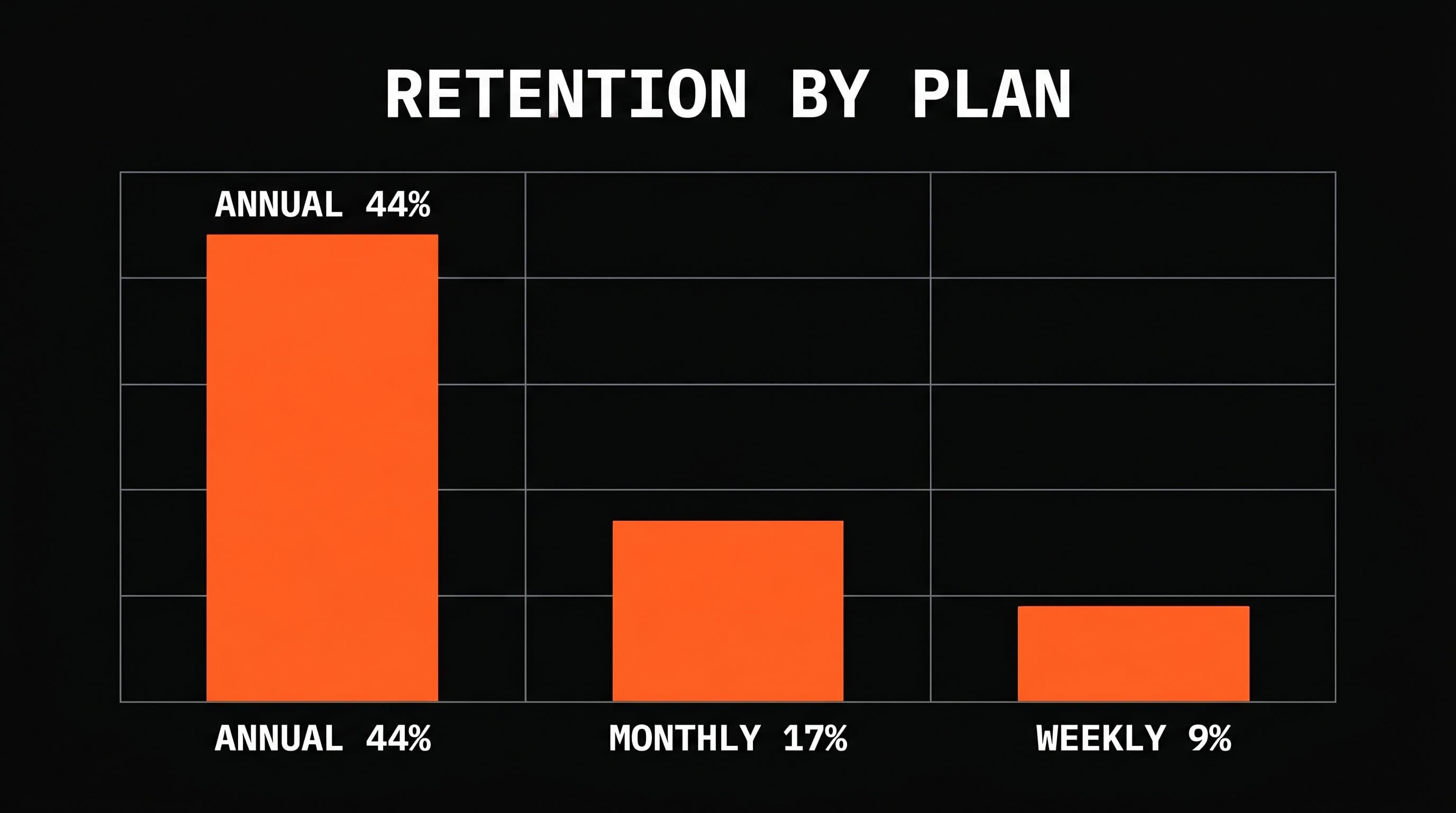
  • Annual plans retain at 44% over 12 months versus 17% for monthly, so pricing should push subscribers toward the yearly option.
  • Apps with a hard paywall and a free trial convert at a 10.7% Day-35 median, roughly 5x better than freemium apps at 2.1%.
  • At $9.99/month after Apple's cut, you need about 1,180 paying subscribers to hit $10K MRR.
  • Education and finance apps command the highest prices: a $44.99 annual median, more than double gaming.
The market has settled on a clear pricing architecture, and you should start inside it, not invent your own. The median monthly price across subscription apps is $6.68, while the most common single price point is $9.99/month. The annual median rose to $34.80 (RevenueCat State of Subscription Apps, 2026). What is a creator subscription app? It's a standalone mobile app that charges your audience a recurring monthly or yearly fee for access to your content, tools, or community. Unlike a course or a PDF, it earns every month whether you post or not. Here's the pricing grid the market has converged on:
PlanCommon Price RangeMedian
Weekly$4.99 to $6.99$5.99
Monthly$7.99 to $9.99$6.68
Annual (upfront)$29.99 to $39.99$34.80
Price by category, not by gut. Education apps lead with a $44.99 annual median, more than double gaming's $20.55. If your app teaches a skill (fitness, finance, music, language), you have room to charge near the top of the range. People pay more to get better at something than to be entertained. If you want to see where these numbers come from and how they map to revenue, the full creator app benchmarks for 2026 break down conversion, pricing, and retention side by side. Annual plans are the single biggest lever on your revenue, and most creators ignore them. The reason is retention. Yearly plans hold 44.1% of subscribers over 12 months. Monthly plans hold 17.0%. Weekly plans hold under 10% (RevenueCat, 2026). When a subscriber commits to a year upfront, you collect 12 months of revenue on day one and you stop fighting churn every 30 days. The math is brutal in your favor: a monthly subscriber who quits after four months gives you $40. An annual subscriber at $69.99 gives you $69.99 and a 44% chance of renewing.
Bar chart showing 12-month subscriber retention by plan: annual 44%, monthly 17%, weekly 9%
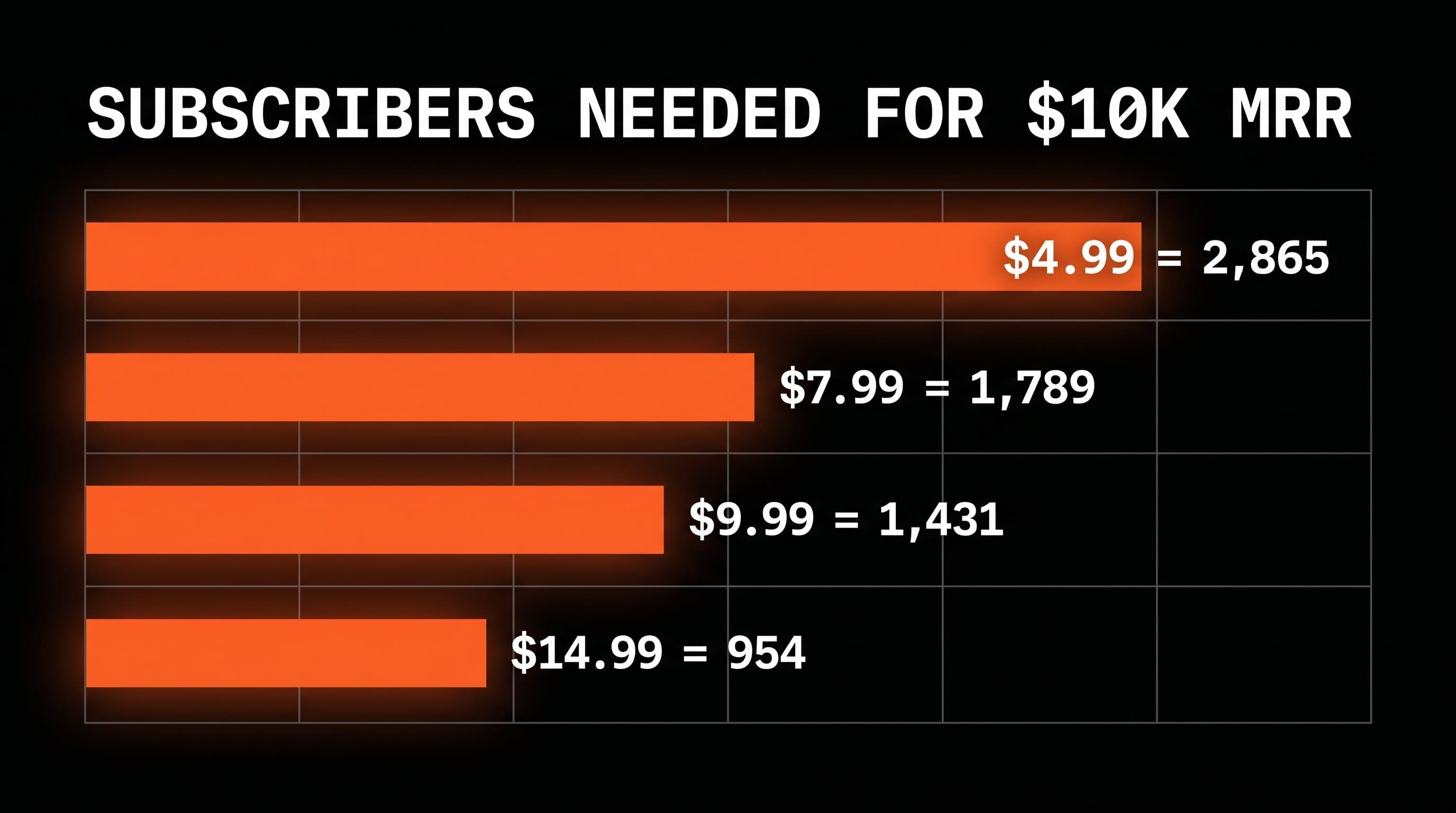
The play is to offer both, but pre-select annual on your paywall. Apps that do this see 60 to 70% of subscribers pick the yearly plan. Frame it as savings: "$9.99/month or $69.99/year (save 42%)." The discount feels generous to the buyer and locks in revenue for you. $10K MRR is the number that turns a creator into a founder with a real income. Here's exactly how many subscribers it takes at each price point, after Apple takes its cut. Assume Apple's standard 30% commission (we'll cover the 15% rate below). Your take-home on a $9.99 sale is about $6.99. To clear $10,000 in monthly revenue:
Monthly PriceYour Take-HomeSubscribers for $10K MRR
$4.99$3.49~2,865
$7.99$5.59~1,789
$9.99$6.99~1,431
$14.99$10.49~954
Horizontal bar chart of subscribers needed for $10K MRR by monthly price: $4.99 needs 2,865, $7.99 needs 1,789, $9.99 needs 1,431, $14.99 needs 954
Look at the spread. Charging $9.99 instead of $4.99 cuts the subscribers you need in half. You are not working twice as hard for the same money. You are charging a fair price for something people value. Now run it against your audience. A creator with 100,000 engaged followers converting just 1.5% to a paid app lands 1,500 subscribers. At $9.99/month, that's over $10K MRR from an audience most creators would call small. This is the entire thesis behind why 50,000 engaged followers beat millions of passive ones: Emily Skye built a $36M fitness app on exactly this kind of math. Yes, but pair it with a hard paywall, not a freemium model. This is the most misunderstood pricing decision creators make. The data is not subtle: apps with a hard paywall plus a free trial hit a 10.7% median Day-35 trial-to-paid conversion. Freemium apps that let users in for free forever convert at 2.1% (RevenueCat, 2026). A hard paywall means the user hits the subscription screen before they get the value. A free trial then lets them experience the full app for a set window before the first charge. They get to feel the product, but they never get a permanent free version that removes any reason to pay. Trial length depends on your category:
  • 3-day trials convert 10 to 15% higher for utility and quick-win apps, where value is obvious fast.
  • 7 to 14-day trials work better for fitness, finance, and education, where the user needs several sessions to feel the payoff.
If your app teaches a habit, give people enough time to build it. A 7-day fitness trial that spans two workouts converts worse than a 14-day trial that spans six. Apple and Google take a slice of every subscription, and you have to price with that in mind. The standard commission is 30%. But if you earn under $1M a year through the App Store, you qualify for the App Store Small Business Program, which drops the rate to 15%. After year one of a subscription, Apple's cut also falls to 15% on that subscriber. Here's what that means in practice for a $9.99/month plan:
Commission RateApple TakesYou Keep
30% (standard)$3.00$6.99
15% (Small Business / Year 2+)$1.50$8.49
This platform tax is exactly why owning your own app beats renting a creator platform. When Apple's 30% Patreon tax hits, creators on those platforms pay the fee with no control over their pricing or their customer data. With your own app, you set the price, you own the subscriber list, and you qualify for the 15% rate. The platform fee is a cost, not a cage. Pricing too low to be "accessible." $2.99 does not feel generous to your audience. It signals the app is not worth much. You need 3x the subscribers to make the same money, and cheap subscribers churn just as fast as fair-priced ones. Confidence in your price is confidence in your product. Offering only a monthly plan. No annual option means you leave the highest-retention, highest-LTV revenue on the table. You are choosing 17% retention over 44% retention for no reason. Setting it once and forgetting it. Pricing is a living number. The apps that win test price points, trial lengths, and paywall placement constantly. A 10% lift in conversion from a paywall tweak compounds every single month. Ongoing optimization is the whole job, which is why our app care model treats pricing as something you tune forever, not set once.
  • Anchor to your category. Fitness, finance, and education apps charge $9.99 to $14.99/month. Entertainment and utility sit lower. Start where your category sits, not where it feels comfortable.
  • Default to $9.99/month. It's the most common price for a reason. Unless you have a specific reason to go lower, this is your starting line.
  • Add an annual plan and pre-select it. Price it at a 40 to 50% discount versus monthly. This is where your real revenue lives.
  • Run a hard paywall with a free trial. Match the trial length to your category: 3 days for quick wins, 7 to 14 for habit-building apps.
  • Test and adjust quarterly. Move the price, watch conversion and retention, keep what works. Pricing is the highest-impact number you own.
Most creators never get past step one because they're trying to build the app themselves with a vibe-coding tool, or duct-taping a link-in-bio platform together. Pricing strategy means nothing if you can't ship a real product with working subscriptions, trials, and App Store billing. That's the part that actually separates a demo from a business, and it's the part we handle end to end. You can read more about how our model works and why we take revenue share instead of charging you upfront. Want to turn your expertise into an app with pricing that actually makes money? We build custom apps for creators: $0 upfront, 3-week delivery, and we tune your pricing with real subscriber data forever.
Let's Build →
Start at $9.99/month, the most common price point across subscription apps. Adjust by category: education, fitness, and finance apps charge $9.99 to $14.99/month, while entertainment and utility apps sit at $4.99 to $7.99. Always pair the monthly plan with a discounted annual option. Annual is far better for your revenue. Yearly plans retain 44% of subscribers over 12 months versus 17% for monthly. Offer both, but pre-select the annual plan on your paywall and frame it as a 40 to 50% saving versus paying monthly. Yes, paired with a hard paywall. Apps with a hard paywall and free trial convert at a 10.7% median, roughly 5x better than freemium apps at 2.1%. Use a 3-day trial for quick-win apps and 7 to 14 days for fitness, finance, or education apps. At $9.99/month after Apple's 30% cut, you keep about $6.99 per subscriber, so you need roughly 1,431 paying subscribers for $10K MRR. At $14.99/month, that drops to about 954 subscribers. Apple takes 30% by default, but drops to 15% if you earn under $1M a year through the App Store Small Business Program, and to 15% on any subscriber after their first year. Price with the 30% rate to be safe, then keep more as you grow.

Creator app strategy

Want us to review your creator business?

Apply for a Foundry Creator App Review. We'll tell you whether there is a real app opportunity hiding in your audience.

How to Price a Creator Subscription App in 2026