
Turning Knowledge into Products

Can Your App Link Out to Your Own Checkout? 6 Rates for 2026
September 3, 2026
Share
Can Your App Link Out to Your Own Checkout? 6 Rates for 2026

Get Creator Revenue Insights

How creators are turning audiences into subscription businesses
Share
Key Takeaways:
  • Apple's App Review Guidelines state in 3.1.1(a) that entitlements "are not required for developers to include buttons, external links, or other calls to action in their United States storefront apps." No application, no approval queue
  • Apple currently collects no commission on those purchases. On August 13, 2026 it asked the US District Court for the Northern District of California to approve 15% for standard apps, 10% for partner-program apps and subscription renewals, and 5% for Small Business Program apps
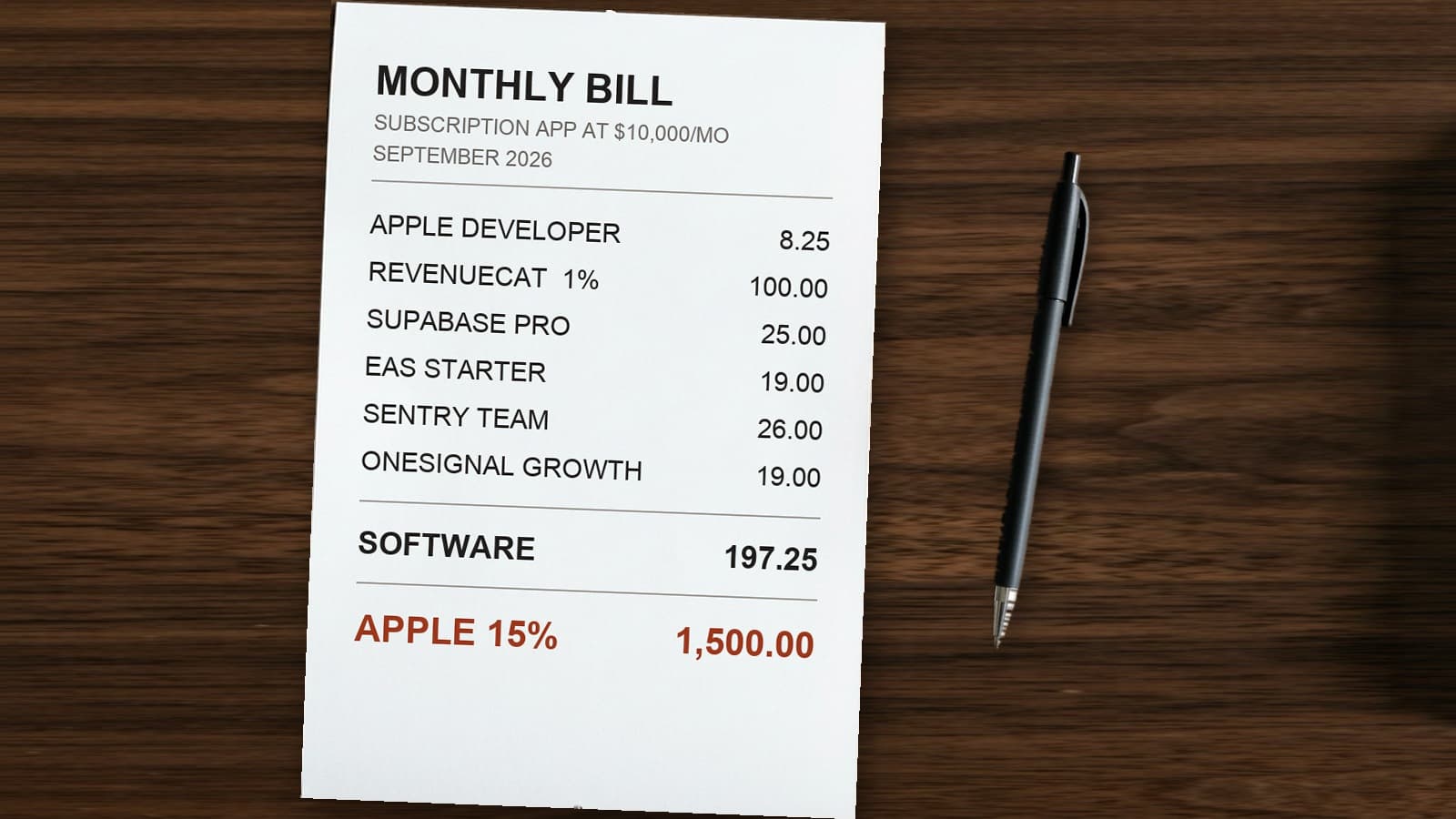
  • On $10,000 a month at $10 a subscriber, linking out nets $9,410 today against $8,500 for the same revenue billed in-app under the Small Business Program. The gap is $910 a month
  • Stripe's published rate is 2.9% plus 30 cents per transaction, and the 30 cents is the part nobody prices. It is 6.0% of a $4.99 charge and 0.3% of a $99.99 charge, so the link-out route rewards annual billing and punishes cheap monthly
  • The break-even is 90.3%. If your web checkout converts worse than nine tenths as well as Apple's in-app sheet, the $910 is already gone, and it goes to zero entirely if the court grants Apple's 15%
For four years the loudest objection to a creator building software has been one number. Apple takes 30%. It gets repeated in every comment section by people who have never opened App Store Connect, and it has talked more creators out of owning a product than any other single sentence. That number is now negotiable in a way it has never been, and almost nobody selling to creators has noticed. As of 2026, an app on the United States storefront can put a plain link to your own website inside itself, send the customer to your own checkout, and pay Apple nothing on the purchase. Apple wrote the permission into its own guidelines. This is a guide to what that actually buys you. Every rate below comes from a published page or a filed court document, checked on September 3, 2026. The arithmetic at the end is the part that matters, because the free route is only free until you price the two things it costs you. On the United States storefront, yes, with no entitlement and no application. Apple's App Review Guidelines 3.1.1(a) state that entitlements "are not required for developers to include buttons, external links, or other calls to action in their United States storefront apps." Apple presently collects no commission on the resulting purchase. Everywhere else, the same guideline still prohibits it unless you hold an entitlement. Read that twice, because the shape of it is unusual. This is not a program you enroll in, a partner tier you qualify for, or a percentage you negotiate. It is a prohibition that stopped existing in one storefront, and the storefront in question is the one where most creator audiences live.
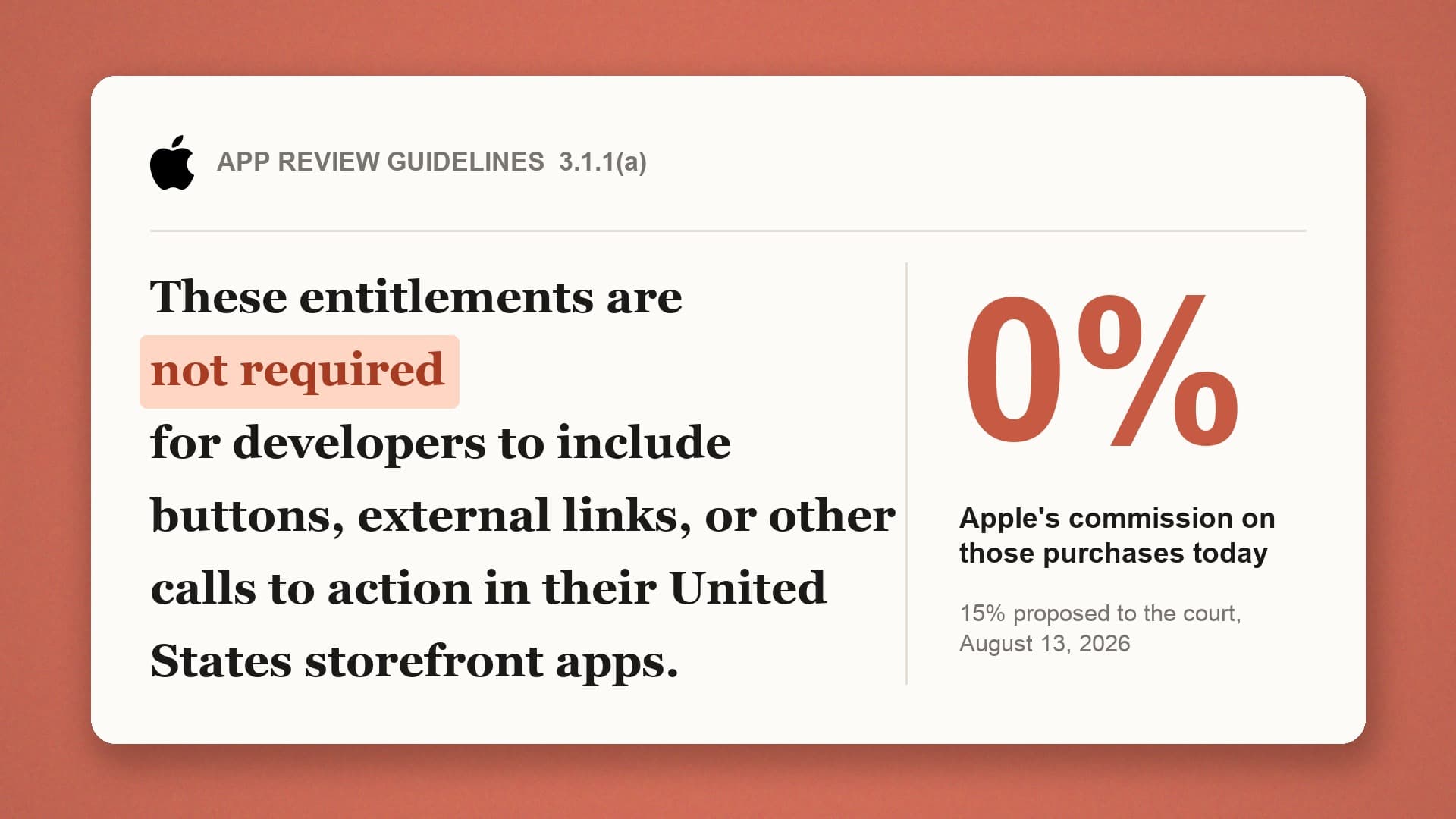
Apple's App Review Guidelines 3.1.1(a) quoted on a printed card, stating that entitlements are not required for buttons and external links in United States storefront apps
The reason it exists is litigation rather than generosity. A US District Court injunction in the Epic Games case forced the change, Apple updated its guidelines in May 2025 to comply, the Ninth Circuit later upheld the finding that Apple had violated the injunction while reversing the outright ban on any commission, and the question of what Apple may charge went back to Judge Yvonne Gonzalez Rogers. On August 13, 2026 Apple filed its answer to that question: 15% for standard apps, 10% for apps in its Video, News, and Mini Apps Partner Programs and for subscription renewals, and 5% for Small Business Program members. The court has not ruled. So the honest framing of this whole topic is that you are looking at a live rate, not a permanent one. Build on it accordingly. Six ways the same $10 subscription can be charged in 2026, with what Apple takes in each.
RouteStorefrontEntitlementApple's cutYour processing cost
In-app purchase, standard rateAllNot applicable30%None
In-app purchase, Small Business ProgramAllNot applicable15%None
In-app subscription after one paid yearAllNot applicable15%None
Link to your own checkout, US storefront, todayUnited StatesNone required0%2.9% + $0.30
Apple's proposed link-out rate, standardUnited StatesPending court approval15% proposed2.9% + $0.30
Apple's proposed link-out rate, Small Business ProgramUnited StatesPending court approval5% proposed2.9% + $0.30
The first three rows are Apple's ordinary published terms. The Small Business Program sets 15% for any developer with up to $1 million in proceeds in the prior calendar year, which is every creator reading this and most of the ones who are not. Apple's subscription terms separately drop a standard developer to 15% once a subscriber has paid for a year, and Small Business Program members are at 15% from the first billing cycle regardless. The last three rows are the new thing. Note what column four does across them: 0%, then 15%, then 5%, all describing the same button in the same app depending on how a judge rules. That is the risk you are underwriting if you build your business on the link.
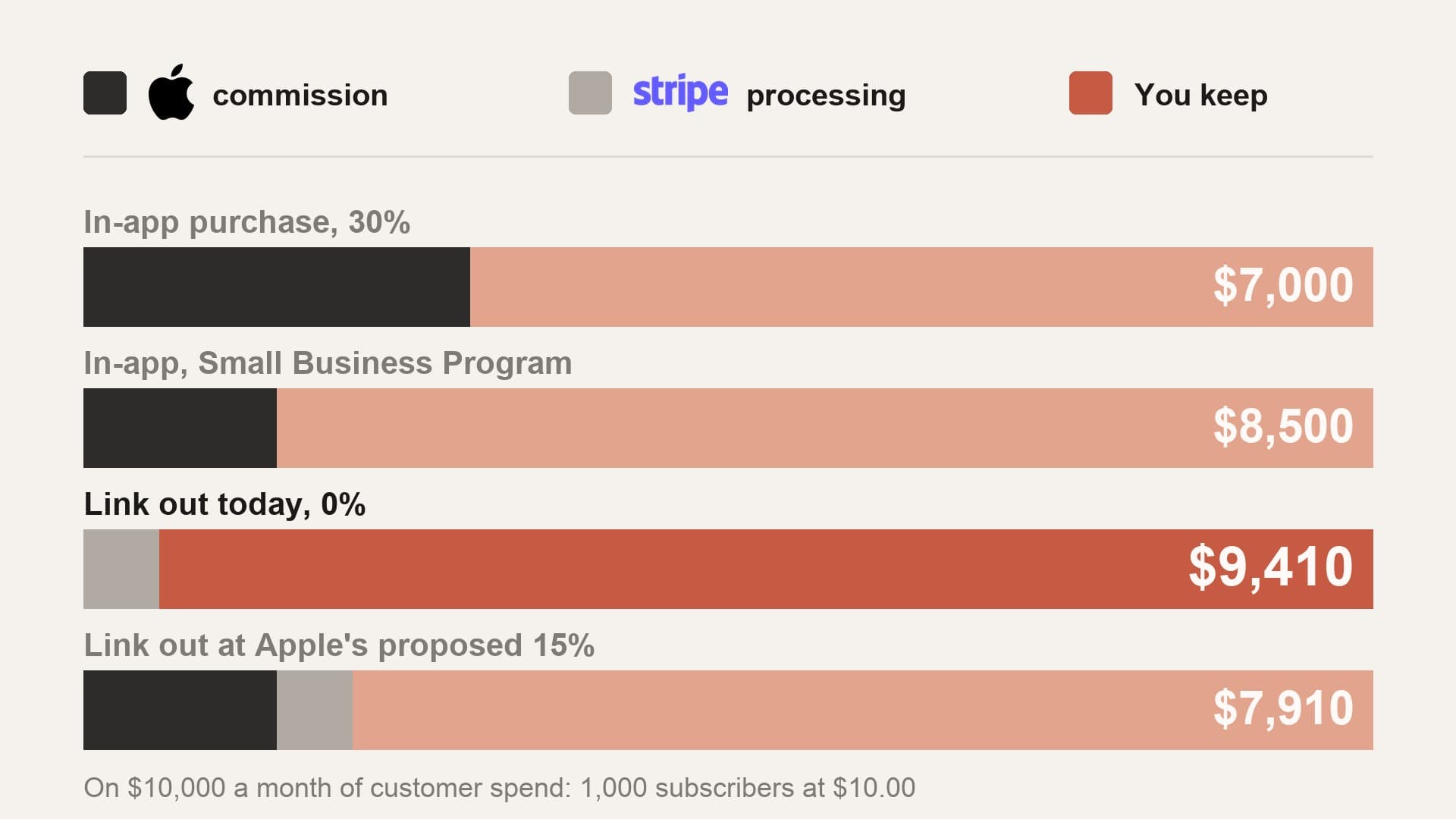
The real Apple and Stripe marks with what each of four billing routes nets a creator on $10,000 a month of customer spend
On 1,000 subscribers at $10, linking out today nets $9,410 after payment processing, against $8,500 billed in-app under the Small Business Program and $7,000 at Apple's standard 30%. If the court grants Apple's proposed 15% link-out rate, the same link nets $7,910, which is worse than doing nothing and staying in-app. Here is the arithmetic in full, priced from published rates on September 3, 2026.
RouteApple takesProcessing takesCreator keeps
In-app, standard 30%$3,000$0$7,000
In-app, Small Business Program 15%$1,500$0$8,500
Link-out today, 0%$0$590$9,410
Link-out at proposed 5%$500$590$8,910
Link-out at proposed 15%$1,500$590$7,910
Three readings, and the third is the one worth arguing about. The first is that the win is real but small. $910 a month on $10,000 is 9.1 points of margin, which is a good year's worth of pricing work handed to you by a court order. Take it seriously. The second is that the win is fragile by design. At the 15% Apple has asked for, the link-out route is $590 worse than the in-app route it replaced, because you now pay Apple the same percentage and a payment processor on top. A creator who spent six months rebuilding their billing around a web checkout would end that period with a worse business than the one they started with, through no decision of their own. The third is the interesting one. Look at the $590. It is not a rounding error, and most of it is not a percentage. Because it is charged per transaction rather than per dollar. Stripe's published US rate is 2.9% plus 30 cents, and those 30 cents are 6.0% of a $4.99 charge, 3.0% of a $9.99 charge, and 0.3% of a $99.99 charge. A cheap monthly subscription billed through your own checkout loses more to a flat fee than to the percentage everyone quotes. Apple does not charge a flat fee at all. Its cut is purely proportional, which means the in-app route is priced identically whether you sell a $2.99 tier or a $299 one. The moment you move billing to your own site, the price point starts deciding your effective rate.
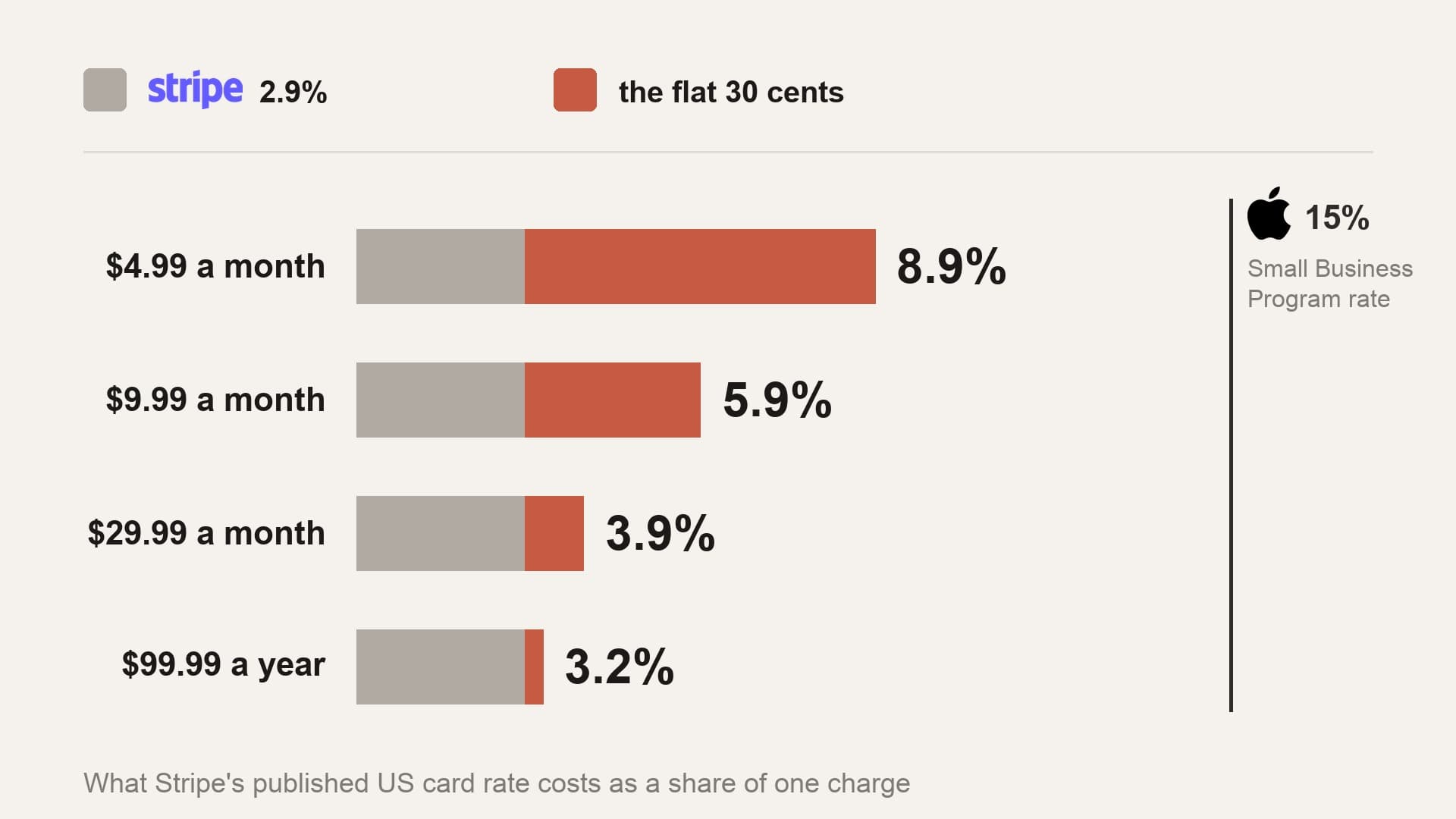
Your pricePercentage feeFlat 30 centsTotal effective rate
$4.99 a month2.9%6.0%8.9%
$9.99 a month2.9%3.0%5.9%
$29.99 a month2.9%1.0%3.9%
$99.99 a year2.9%0.3%3.2%
Run the last row against the second. Twelve monthly charges at $9.99 come to $119.88 and lose $7.07 to processing. One annual charge at $99.99 loses $3.20. The annual plan collects 83% of the revenue and pays 45% of the fee. That is a genuinely useful piece of arithmetic and it has nothing to do with Apple. If you are ever going to bill on your own rails, the first thing to fix is not the processor, it is the billing period. We have written before about why annual plans change the shape of a creator subscription business, and the link-out route makes that argument roughly twice as expensive to ignore.
What the flat 30-cent processing fee costs as a percentage at four different subscription price points, from $4.99 monthly to $99.99 annual
90.3%. Linking out nets $9,410 where in-app nets $8,500, so the web checkout can convert at 90.3% of the in-app rate before the entire advantage disappears. Below that, the free route costs you money. This is the number the fee comparisons never publish, and it is the only one that decides anything. Nobody buys a subscription because the seller has a good margin on it. They buy it because the purchase took one thumb press. Consider what you are actually asking a customer to do at that link. Leave your app. Land in Safari. Read a page they have never seen, from a brand their bank has never seen, and type a card number on a phone. Apple's in-app sheet is a double-click on a device that already has the card, the address, and the customer's trust. The two experiences are not close, and the gap between them is worth more than nine points to almost every product. You do not have to guess at your own number. Ship both, and put the link where it costs you nothing to test: not in the paywall, but in account settings, in the renewal email, on the page a subscriber lands on when they cancel. The purchase that happens on your own site is worth 9.1 points more, and the purchase that does not happen is worth nothing, so route the impulse buys through Apple and the deliberate ones through your checkout. That is the same logic behind where a paywall belongs inside a creator app, applied one layer further down. The link-out conversation gets framed as though 15% were a tax on nothing. It is worth listing what stops happening the moment the money stops going through Apple, because these are real costs that simply move onto your desk. Tax. Apple acts as merchant of record across the regions it sells in, which means it calculates, collects, and remits sales tax and VAT for you. On your own Stripe checkout you are the merchant of record, and every US state with an economic nexus rule and every EU country with a VAT threshold becomes your filing problem. Renewals. An in-app subscription renews inside a system that already holds the card, retries a failed charge, and handles the plan change. A web subscription renews only as well as you built it. Involuntary churn from expired cards is the quiet killer of small subscription businesses, and it is a solved problem on one side of this line and an engineering project on the other. Refunds, family sharing, and the rest. Apple absorbs refund handling, currency, regional pricing, and the customer service that comes with all three. None of that makes 15% a bargain. It makes 15% a price for a service, which is a different argument from the one usually being had. We priced six podcast paywalls against an identical $10,000 month and found five of the six landed between 12.5% and 17.9% effective. Membership platforms sit in the same band. The store is not the expensive option, and the reason creators keep moving off the 30% Patreon path onto their own app was never really about the percentage. Run this on your own numbers rather than on the example, because the answer changes completely with your price point. Take what you charge, or what you would charge. If it is under $10 a month, the flat 30-cent fee eats a third of the advantage before you have written a line of code, and the honest recommendation is to bill in-app, enroll in the Small Business Program, and stop thinking about this. If you sell at $30 a month or bill annually, the arithmetic tilts and a link in your account settings is worth building. Then set the whole question against its actual size. The full software bill for running a live subscription app is under $200 a month at $10,000 in revenue, the Small Business Program halves Apple's cut with one enrollment form, and this entire article is about the last nine points of a margin you do not currently have, on a product you have not built, for an audience that is already asking you for it. That is the thing to notice. The 30% was never what stopped you. It was a reason that sounded like arithmetic. BUILT BY FOUNDRY builds and runs the business, not the app alone. Three weeks, $0 upfront, revenue share. The creator owns the business and owns the revenue, and we keep operating the product after launch, which includes making exactly these calls as the rates move, because they will move again. Apple just handed every US developer nine points of margin and a court date. Neither of those is worth anything to a creator who does not own a product. Not at present. Following a US District Court injunction in the Epic Games case, Apple stopped collecting commission on purchases made through external links in United States storefront apps. On August 13, 2026 Apple filed a proposal with the Northern District of California asking to charge 15% for standard apps, 10% for partner-program apps and subscription renewals, and 5% for Small Business Program members. Judge Yvonne Gonzalez Rogers has not ruled on it. Not on the United States storefront. Apple's App Review Guidelines state in 3.1.1(a) that entitlements "are not required for developers to include buttons, external links, or other calls to action in their United States storefront apps." On every other storefront the guideline still prohibits buttons, external links, and other calls to action that direct customers to purchasing mechanisms other than in-app purchase, unless the developer holds an applicable entitlement. Slightly, and only today. At $10 a month, 1,000 subscribers billed through a web checkout net $9,410 after Stripe's published 2.9% plus 30 cents, against $8,500 billed in-app under Apple's Small Business Program. That $910 advantage disappears if the web checkout converts below 90.3% of the in-app rate, and it inverts to a $590 loss if the court approves Apple's proposed 15% link-out commission. $0.59, made up of 2.9% of the charge plus a flat 30 cents, per Stripe's published US online card pricing. The flat portion is 3.0% of a $9.99 charge and 6.0% of a $4.99 charge, which is why the same processor is meaningfully more expensive on a cheap monthly plan than on an annual one. Both, in different places. In-app purchase belongs on the paywall, where the double-click checkout converts and where Apple's 15% Small Business Program rate buys tax handling, renewal retries, and refunds. An external link belongs where the customer is already deliberate, such as account settings, a renewal email, or a cancellation page, and it is worth most on annual plans and price points above $30 a month.
Our work

Creators who already did this

These are apps we designed, built, shipped, and still run today, with the creator keeping the code and the audience.

Creator app strategy

Curious what your app could be?

Enter your handle and BUILT BY FOUNDRY will research your audience and present custom app concepts. Free.

Can Your App Link Out to Your Own Checkout? 6 Rates for 2026