

Creator Economy Trends

Apple's 30% Patreon Tax: Why Creators Build Apps

Foundry
June 16, 2026
Share
Apple's 30% Patreon Tax: Why Creators Build Apps

Get Creator Revenue Insights

How creators are turning audiences into subscription businesses
Share
On January 28, 2026, Apple gave Patreon a deadline: move every creator onto Apple's in-app purchase system by November 1, 2026, or get pulled from the App Store. For creators, that deadline has a price tag. Apple takes 30% of every subscription dollar in the first year, then 15% after. Stack that on Patreon's own cut and the math stops working. This is the moment the smartest creators stop renting and start owning. Key Takeaways:
  • Apple set a November 1, 2026 deadline for Patreon to move all creators to in-app purchases (TechCrunch).
  • Apple's commission is 30% in year one, 15% after, on top of Patreon's 8-12% platform fee plus processing.
  • A creator on Patreon's iOS app can lose 35-45% of every dollar to combined platform and store fees.
  • Subscription apps that creators own keep the relationship, the data, and a far bigger share of revenue.
  • The fix is not a better link-in-bio. It is your own app, where you set the terms.
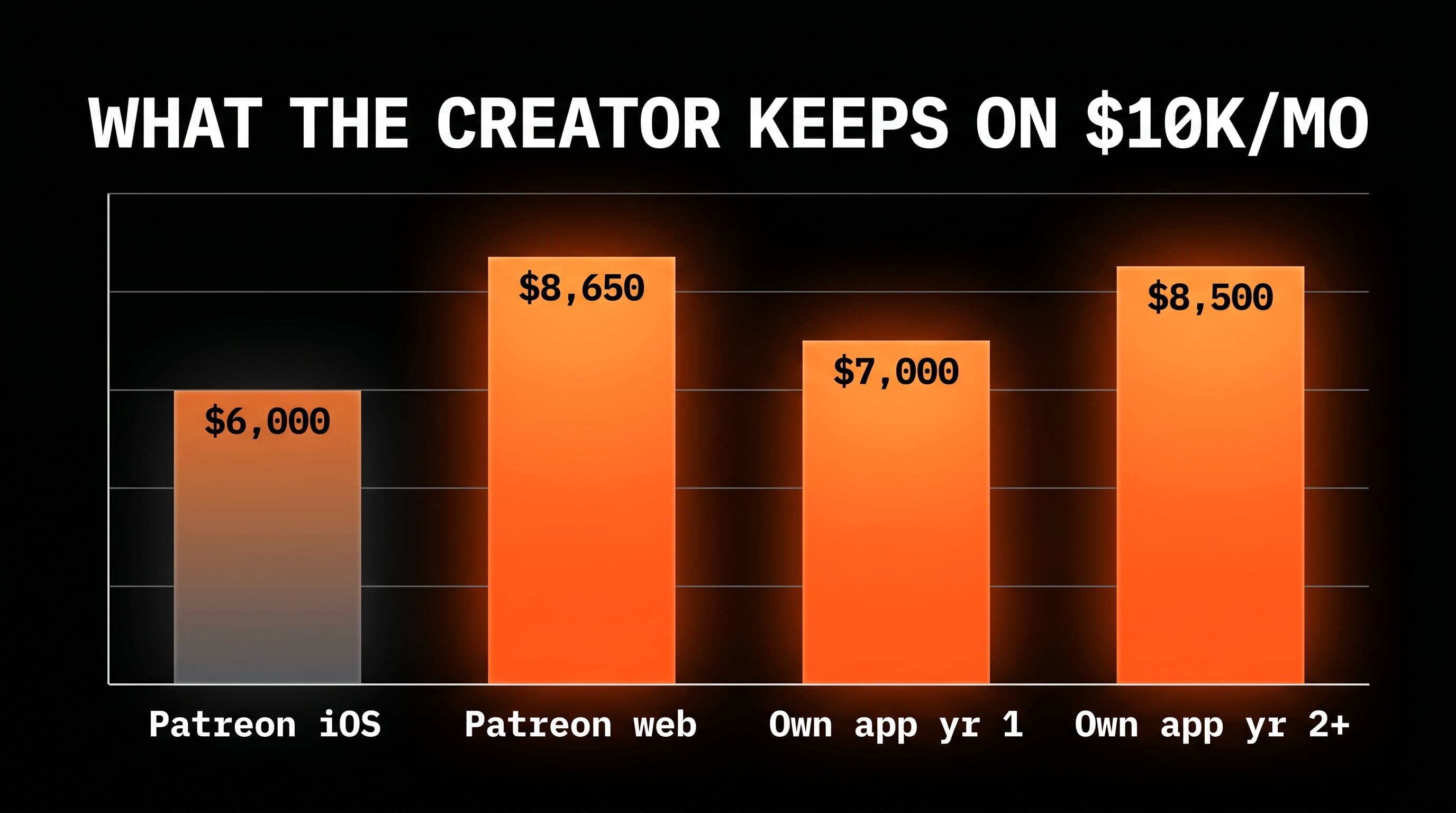
Apple ordered Patreon to migrate all creators still on legacy billing to Apple's in-app purchase system by November 1, 2026. Creators who do not comply risk Patreon being removed from the App Store entirely. Patreon called it "the third such change from Apple in the past 18 months" and warned that creators "need consistency and clarity in order to build healthy, long-term businesses." The change affects the 4% of creators still using older billing methods, but the direction is clear. When your business lives inside someone else's app, the landlord sets the rent. And the landlord just raised it. The platform tax is the combined cut that app stores and middleman platforms take from every dollar a creator earns through them. On iOS, Apple takes 30% of subscription revenue in the first year and 15% after that. Patreon layers its own fee on top: creators who joined after August 4, 2025 pay a 10% platform fee, while older accounts pay 8-12%, all before payment processing of 2.9% plus 30 cents per transaction (Patreon Help Center). Add it up and a creator collecting subscriptions through Patreon's iOS app can hand over 35-45% of gross revenue before a single dollar reaches them. Run the numbers on a creator pulling $10,000 a month in subscriptions. The platform stack quietly removes a third or more of it every single month, forever.
ChannelStore + platform cutCreator keeps on $10K/mo
Patreon on iOS (year 1)35-45%$5,500-$6,500
Patreon on web12-15%$8,500-$8,800
Your own app (Apple year 1)30% store only$7,000
Your own app (after year 1)15% store only$8,500
The difference between renting and owning is not just a percentage. On your own app there is no platform skimming a second layer, no policy that changes three times in 18 months, and no risk of being removed because a third party broke a rule you never agreed to. That gap compounds. We broke down the full picture of where creator money flows in The Creator Economy Hits $480B by 2027. Who Wins?, and the answer is rarely the creator. This is not a Patreon problem. It is the structural reality of building your business on rented land. Substack takes 10%. Kajabi locks you into monthly fees. Linktree owns the front door to your audience. Every one of these tools sells convenience today and charges you for it forever. The pattern repeats because the incentives never change. A platform's job is to keep your audience inside its walls, where it can monetize them. Your job is to own that relationship outright. Those two goals are not compatible, and the creator always loses the standoff. Creators who saw this early built apps instead. Joe Wicks turned park workouts into a £24M business through the Body Coach app, where he owns the subscriber list and the revenue. We covered the full story in Joe Wicks: The £24M Body Coach App Empire.
Bar chart comparing how much a creator keeps on $10K monthly across Patreon iOS, Patreon web, and an owned app, on a dark background with orange bars
When you own the app, you own the economics. There is no middleman between you and your subscriber, only the store fee that every app pays. You set the price, the tiers, the trial length, and the content. You keep the email list and the usage data, which means you can win a churning subscriber back instead of watching a platform email them about other creators. Owning the app also turns your product into a content engine. Every leaderboard, every streak, every user result is something to post about. Instead of staring at a blank screen wondering what to make today, the app generates the material for you. That is the difference between a creator who chases content and a founder whose product feeds the feed. And the app keeps earning while you sleep. A brand deal pays once. A subscription compounds month over month, and the App Store keeps sending new users who never saw your videos. To learn how that pivot actually works, read Turn Your YouTube Channel Into a Subscription App. The money is moving toward apps, and the data is blunt about it. RevenueCat's State of Subscription Apps 2026 analyzed more than 115,000 apps and over $16 billion in revenue. Apps that ask for payment upfront convert about 5x better than freemium, 10.7% versus 2.1%. Free trials lasting 17 to 32 days convert at a 42.5% median, well above shorter trials (RevenueCat). The same report shows top-decile apps grew revenue 306% or more year over year, while the median app grew 5.3%. Owning the product, the paywall, and the data is what separates the top from the middle. The creators winning right now are not the ones with the most followers. They are the ones who own the checkout. For the exact conversion, pricing, and retention targets to aim for, see Creator App Benchmarks: The Numbers to Hit in 2026. A creator collects subscribers inside a platform and prays the rules do not change. A founder owns the app, the list, and the revenue, and the rules are theirs to set. One gets a notification that the rent went up. The other sets the rent. The creator economy is on track to clear $250 billion in 2026, and the fastest-growing slice of it is subscriptions. The creators who capture that growth will be the ones who stopped treating their audience like a following and started treating it like a customer base. That shift does not require more followers. It requires owning the product they pay for. Apple requires that digital subscriptions sold inside an iOS app use its in-app purchase system, which carries a 30% commission in year one. Patreon had been billing some creators through its own system, which Apple treated as skirting that commission. The November 1, 2026 deadline closes that gap. Apple takes 30% of subscription revenue during a subscriber's first year, then drops to 15% for subscriptions that continue past one year. On your own app, that store fee is the only platform cut, with no second layer from a middleman platform. For creators earning meaningful subscription revenue, yes. Your own app pays only the store fee instead of stacking a platform fee on top of it. Built by Foundry builds your app for $0 upfront and takes a revenue share, so there is no large bill before you earn. Most agencies take six to twelve months. Built by Foundry ships in about three weeks, handles App Store submission, and runs every update after launch so you never touch code. Stop paying rent on your own audience. We build custom apps for creators: $0 upfront, three-week delivery, and we run the tech forever.
Let's Build →

Creator app strategy

Want us to review your creator business?

Apply for a Foundry Creator App Review. We'll tell you whether there is a real app opportunity hiding in your audience.

Apple's 30% Patreon Tax: Why Creators Build Apps