
Platform Reviews

Podcast Paywalls in 2026: 6 Fees Compared on $10,000 a Month

August 31, 2026
Share
Podcast Paywalls in 2026: 6 Fees Compared on $10,000 a Month

Get Creator Revenue Insights

How creators are turning audiences into subscription businesses
Share
Key Takeaways:
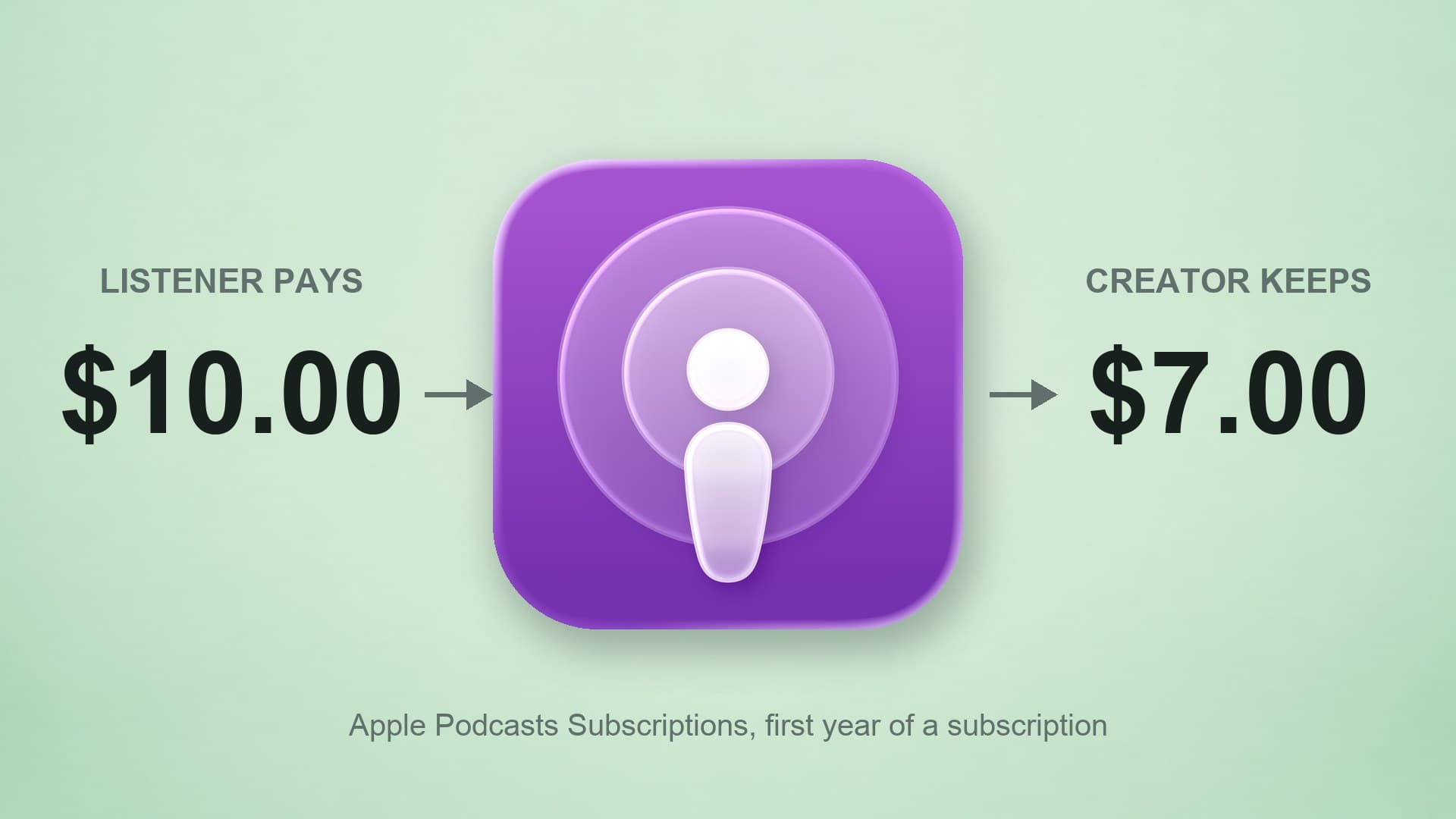
  • Apple pays creators 70% of a podcast subscription in year one and 85% after a subscriber accumulates one year of paid service, per Apple's own announcement, plus $19.99 a year for the Apple Podcasters Program
  • Buzzsprout Subscriptions takes a flat 15%. Captivate takes 12% plus Stripe. Patreon takes 10% plus processing. Supercast charges $0.59 per subscriber per month plus Stripe
  • On 1,000 subscribers at $10 a month, the cheapest option costs $1,250 a month and the most expensive costs $3,000. That spread is $21,000 a year
  • Five of the six land between 12% and 18% effective. The fee is not the decision, because the difference between the best and worst realistic choice is roughly 5% of revenue
  • The App Store's Small Business Program rate is 15%, all in, with no processor on top. Apple charges half as much for an app with your name on it as it does for a premium feed inside its own player
Every podcast paywall sells the same promise: your listeners pay you monthly, the platform handles the plumbing, and you keep most of it. What "most" means varies by a factor of two and a half, and the published numbers are scattered across six help centers that use six different words for the same cut. So we priced all of them against one identical scenario: 1,000 subscribers paying $10 a month, which is $10,000 a month in gross subscription revenue. Every figure below comes from the company's own published page, checked on August 31, 2026. The answer is not the one a fee comparison is supposed to produce. There is one clear outlier, and after you remove it the remaining five cluster so tightly that choosing between them is worth less than a decent brand deal.
PlatformPublished cutCost on $10,000 a monthWho holds the payment relationship
Apple Podcasts Subscriptions30% year one, 15% after a year of paid service, plus $19.99 a year$3,000Apple
Captivate Memberships12% plus Stripe 2.9% + $0.30$1,790Your Stripe account
Patreon10% plus payment processingAbout $1,590Patreon
Buzzsprout Subscriptions15% flat$1,500Buzzsprout Wallet
Your own subscription app15% App Store Small Business Program, all in$1,500Apple, as merchant of record
Supercast$0.59 per subscriber per month, plus Stripe 2.9% + $0.30 and 0.7% billing$1,250Your own Stripe account
Transistor is the honest omission. Its pricing starts at $19 a month for 20,000 downloads and 50 private podcast subscribers, and its private podcast pages describe distribution rather than billing. Transistor sells you the feed; the money is somebody else's job. Apple takes 30% of a podcast subscription in the first year and 15% after a subscriber reaches one year of paid service, plus a $19.99 annual program fee. Buzzsprout takes a flat 15%. Captivate takes 12% plus Stripe fees. Patreon takes 10% plus processing. Supercast charges $0.59 per subscriber per month plus Stripe fees rather than a percentage. Apple states its split plainly: 70% of the subscription price goes to the creator, rising to 85% once a subscriber has accumulated one year of paid service, and 100% of other podcast revenue including ads stays with the creator. The Apple Podcasters Program costs $19.99 a year to join. That is the highest headline rate in the category and the only one with a membership fee attached. Buzzsprout's subscriptions page calls its rate "a low, transparent 15% flat fee," with payments landing in a Buzzsprout Wallet that you can either spend on hosting or cash out through PayPal. Hosting is a separate bill: the free tier allows two hours of uploads a month and keeps episodes for 90 days, and paid plans on the pricing page start at $15 a month billed annually for 72 upload hours a year. Captivate splits its fee in two. Its help documentation states 12% on memberships and 5% on tips, with Stripe's 2.9% plus $0.30 charged on top of both. Hosting starts at $17 a month billed annually for 30,000 downloads on the pricing page. Patreon's pricing page lists a single rate of 10% of income earned on Patreon, plus payment processing, currency conversion, and payout fees. The 10% is the number everyone quotes; the rest of that sentence is where the other five points live. Supercast is the only one that refuses the percentage model entirely. Its pricing is $0.59 per subscriber per month plus Stripe's transaction fee and a 0.7% recurring billing fee, and the billing runs through your own Stripe account, which means the customer records stay yours if you leave. Supercast, at about $1,250 a month on 1,000 subscribers paying $10, because its $0.59 flat fee stops scaling once the subscription price rises. Apple Podcasts Subscriptions is the most expensive at $3,000 a month in year one. The spread between them is $1,750 a month, or $21,000 a year. Converted to a single effective rate on a $10 subscription, the field looks like this.
OptionEffective take on a $10 subscriptionMonthly cost on 1,000 subscribersAnnual cost
Apple Podcasts Subscriptions, year one30.0%$3,000$36,000
Captivate Memberships17.9%$1,790$21,480
Patreon15.9%$1,590$19,080
Buzzsprout Subscriptions15.0%$1,500$18,000
Your own app, Small Business Program15.0%$1,500$18,000
Supercast12.5%$1,250$15,000
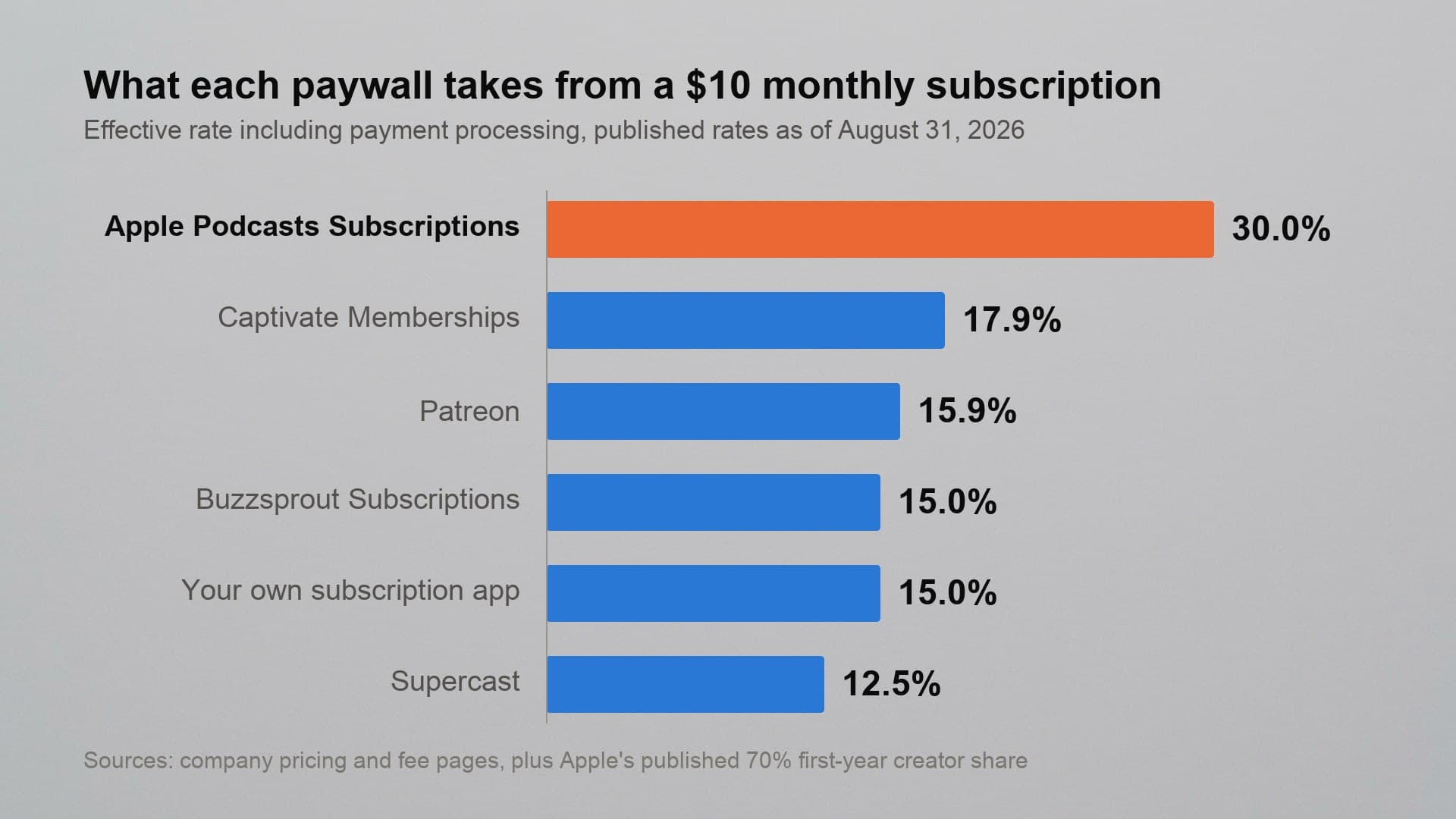
A horizontal bar chart of six podcast paywall take rates on a ten dollar subscription, with Apple Podcasts at thirty percent running far past a tight cluster between twelve and eighteen percent
Look at what happens once Apple leaves the chart. The remaining five options sit inside a 5.4 point band. On $10,000 a month, moving from the worst of them to the best saves $540 a month before you count the hosting bill, the migration, the re-onboarding email, and the subscribers who never re-enter their card details. Supercast's advantage is also conditional in a way a percentage is not. Its flat $0.59 is 21% of a $5 subscription and 6.6% of a $30 one, so the cheapest platform in this category depends entirely on what you charge. Price low and the flat fee is the worst deal on the page. Because Apple is charging for distribution rather than for billing. A premium feed sits inside Apple Podcasts, an app carrying 2,073,637 ratings on the US App Store, and Apple prices that placement at 30% for the first year of every subscriber. That is a defensible price when you have no audience. Discovery you cannot buy anywhere else is worth 30% of nothing, and 30% of a listener you would never have reached is a bargain. It is an indefensible price when you brought the audience with you. If 1,000 of your existing listeners follow a link from your own show notes into a premium feed, Apple did not find a single one of them, and it charges the same 30% as if it had. That is the distribution tax we described in Apple's 30% Patreon tax, arriving through a different door. Here is the detail that should stop anyone comparing these pages. The same company, in the same year, charges 15% under its App Store Small Business Program to any developer with under $1 million in prior-year proceeds. Half the rate, all in, with no Stripe fee stacked on top. The difference between the two products is not the payment rail. It is whether the thing your subscriber opens has your name on the icon or Apple's. Two products in this category are built on the belief that a paywall is plumbing, not a partner, and both are worth understanding even if you choose neither. Supercast charges per subscriber, which means its bill stops growing when your price goes up. A creator moving from $5 to $15 a month triples revenue and pays Supercast the same $0.59. Every percentage platform on this page triples its own income for doing nothing different. Transistor sells the feed and stays out of the money. Its Starter plan at $19 a month includes 50 private podcast subscribers, Professional at $49 includes 500, and Business at $99 includes 3,000. Those are distribution allowances rather than a monetization product, which is why serious private-feed operators pair Transistor with something else that bills. Both approaches point at the same conclusion from opposite directions: the billing is a commodity. Stripe does the hard part for 2.9% and everyone else is marking up a checkout form. What you are actually choosing when you pick a podcast paywall is who owns the surface your subscriber opens. No. Every option on this page delivers your paid content inside an app that carries somebody else's name, ranks in somebody else's search, and collects the reviews that somebody else's listing accumulates. The subscriber is yours; the surface is not. Search the App Store for "podcast subscription" and count the creators in the results. There are none. The top four are general-purpose players belonging to companies your listeners could not name.
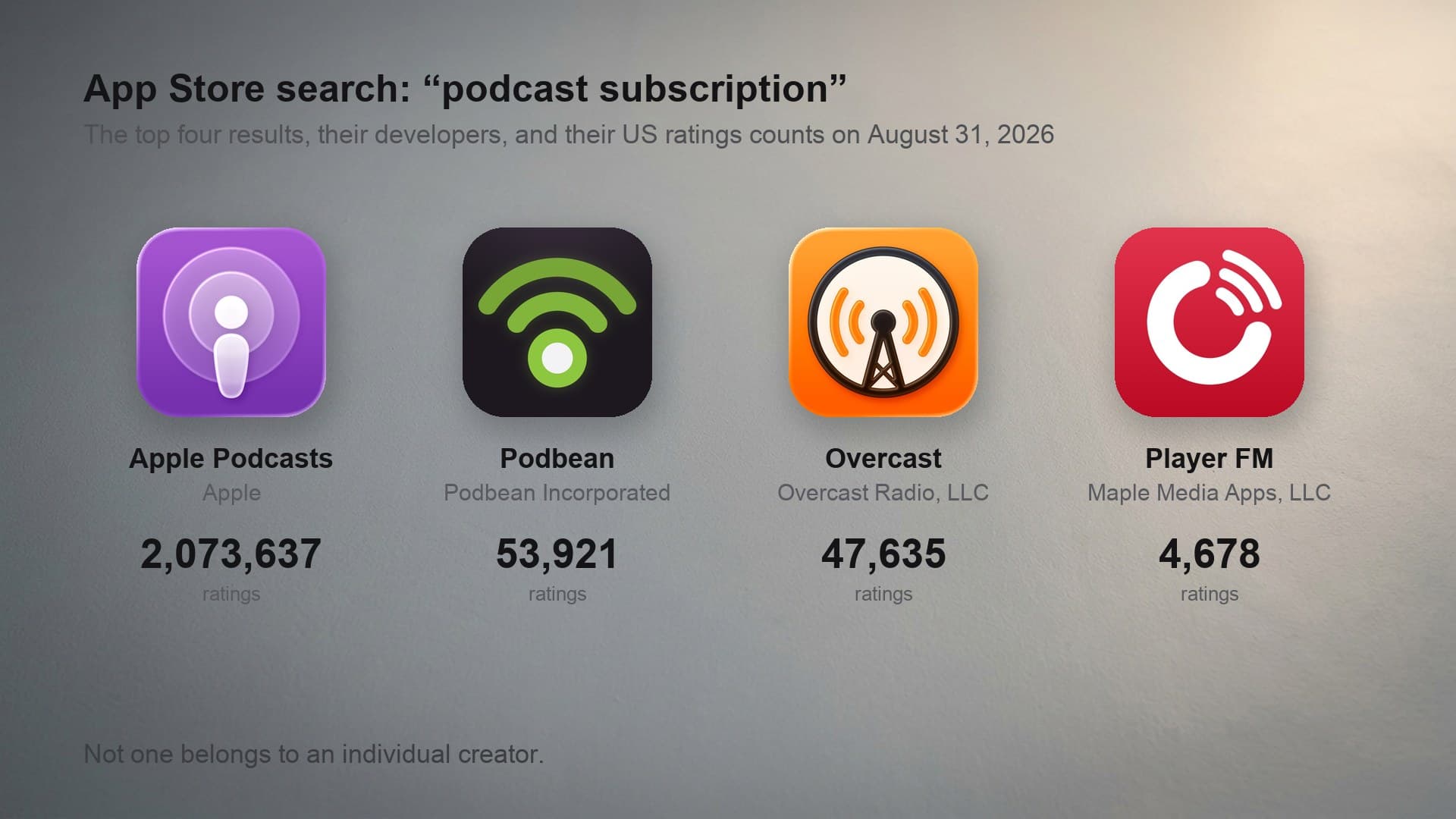
The top four App Store results for podcast subscription shown as real app icons with their developers and ratings counts, none belonging to an individual creator
Apple Podcasts holds 2,073,637 ratings. Podbean holds 53,921, Overcast holds 47,635, and Player FM holds 4,678. Those are the storefronts your premium feed lives inside, and every one of them was built by a company that is not you. An owned app inverts all three parts of that. Your listing ranks in App Store search, which means strangers find the product before they find your show, and new subscribers arrive in weeks when you did not publish. Daily use inside the app generates the material for next week's episode, which is the quiet reason podcasters who build products stop running out of things to say. And the subscription renews on the first whether or not you recorded anything, which is the whole difference between an income and a business. If you are a podcaster with 50,000 engaged listeners who already sell something, this is the specific trap you are in. Your show is already a habit on a schedule. Your listeners already pay. The only thing missing is a product they open on the days you do not publish, and no paywall on this page is capable of being that, because none of these companies is building it. We walked through what the migration actually looks like in how to turn your podcast into a subscription app. If you have no audience and need discovery more than margin, use Apple Podcasts Subscriptions and pay the 30%. The rate drops to 15% on any subscriber who stays a year, and by then it has paid for itself in people you would never have met. If you already run a paid community and the podcast is one more benefit inside it, use Patreon and stop optimizing. Its 10% plus processing is mid-pack, and the tiers, messaging, and existing billing relationships are worth more than the 3% you would save moving. We went through its full fee stack in our Patreon review and compared it head to head with the newsletter route in Substack vs Patreon. If your host is already Buzzsprout or Captivate, use the paywall that is already switched on. A 15% flat fee with no processor on top is a genuinely good deal, and the integration you do not have to build is worth more than the two points. If you charge $15 a month or more and want the customer records in your own Stripe account, Supercast is the correct choice and it is not close. Flat per-subscriber pricing plus subscriber ownership is the strongest combination in the category for a show with a high price and a real list. And if the honest answer to "what does a subscriber do with this on a Tuesday, on a week you did not publish?" is nothing, then none of these is your destination. Run one test on any paywall decision. If this company doubled its fee tomorrow, what would you still have? On five of these six you would have a CSV of email addresses and a Stripe account, and in Apple's case not even that. The listing, the ranking, the reviews, the push notifications, the retention mechanics, and the reason anyone opens the app on a Wednesday all stay with the company you were paying. That cost never appears in a fee schedule and it is larger than every percentage on this page combined. BUILT BY FOUNDRY builds the other version. We build a creator's subscription software business in about three weeks, $0 upfront, on a revenue share. The creator owns the business and the revenue. We ship it, then we keep improving it after launch, because our side only works if the product keeps earning. The paywall companies are all good at collecting money for audio you already recorded. The better question is what your listeners would pay for on the days you did not. Apple pays creators 70% of the subscription price in the first year and 85% after a subscriber has accumulated one year of paid service, which is a 30% and then 15% commission. Joining the Apple Podcasters Program costs $19.99 a year. Apple states that 100% of other podcast revenue, including advertising, goes to the creator. On a $10 monthly subscription, Supercast is cheapest at about 12.5% effective, because it charges $0.59 per subscriber per month rather than a percentage, plus Stripe fees. That advantage reverses at low prices: on a $5 subscription the same flat fee works out to roughly 21%. Slightly. Buzzsprout states a flat 15% on subscriber payments, while Patreon takes 10% plus payment processing, which on a $10 subscription lands near 15.9% effective. The larger difference is where the money sits: Buzzsprout pays into a Buzzsprout Wallet, and Patreon holds the billing relationship. Transistor's plans include private podcast subscriber allowances, 50 on Starter, 500 on Professional, and 3,000 on Business, but its private podcast pages describe distribution rather than listener billing. Hosts typically pair it with a separate membership or payment platform. If the audience already pays and would use something on the days you do not publish, yes. Apple's Small Business Program rate is 15% all in for developers under $1 million in prior-year proceeds, which is half what a premium Apple Podcasts feed costs in year one, and an owned listing earns App Store search traffic that no private feed can.

Creator app strategy

Curious what your app could be?

Enter your handle and BUILT BY FOUNDRY will research your audience and present custom app concepts. Free.

Podcast Paywalls in 2026: 6 Fees Compared on $10,000 a Month