
Turning Knowledge into Products

Whop vs Skool 2026: 7 Costs Compared

August 12, 2026
Share
Whop vs Skool 2026: 7 Costs Compared

Get Creator Revenue Insights

How creators are turning audiences into subscription businesses
Share
Key Takeaways:
  • Skool now sells two plans: Hobby at $9 a month with a 10% transaction fee, and Pro at $99 a month with a 2.9% fee
  • The Hobby plan stops being the cheap option at roughly $1,268 in monthly member revenue, where Pro takes over
  • Whop's published pricing page lists no monthly cost and prices everything per transaction, starting at 2.7% plus $0.30 on domestic cards
  • At $10,000 a month in member payments, Skool Pro costs about $449 and Whop costs about $340 before optional add-ons
  • Both are storefronts around your expertise. Neither one ships the product your audience actually uses every day
If you are comparing Whop and Skool, you are choosing between two very different bets. Skool sells you a community with a course library attached. Whop sells you a checkout with a marketplace attached. The pricing pages make them look like variations on the same product. They are not. Skool also changed its pricing since most comparisons on the internet were written. The old story was one flat $99 plan with no cut of member revenue. That story is out of date, and if you plan around it you will price your community wrong. We reviewed each platform on its own terms in our Whop review and our Skool review. This piece puts the current numbers side by side and then asks the question neither pricing page will ask you.
CategoryWhopSkool
Monthly cost$0 published$9 Hobby, $99 Pro
Cut of member payments2.7% + $0.30 domestic cards10% Hobby, 2.9% Pro
Core productCheckout, access gating, marketplace listingCommunity feed, courses, events, gamification
Native discoveryMarketplace listing on whop.comNone
Best forGated Discord and Telegram access, digital productsPaid communities built around a course
Branded App Store appNoNo
The shapes are opposite. Whop charges nothing to exist and takes a slice of every transaction. Skool charges you to exist and, on Pro, takes a much smaller slice. Which is cheaper depends entirely on how much money is moving. Skool charges $9 a month with a 10% transaction fee on its Hobby plan, or $99 a month with a 2.9% fee on Pro. Whop publishes no monthly cost and charges 2.7% plus $0.30 per successful domestic card transaction, with additional per-transaction fees for international cards, payouts, and optional features. Those figures come from the live Skool pricing page and the live Whop pricing page, checked on 12 August 2026. Skool's own payments documentation adds the detail its pricing page leaves out: the transaction fee carries a fixed $0.30 per charge, and payments above $900 move to a higher 3.9% rate. Both plans include unlimited members, unlimited courses, video, events, and a custom URL. The plans differ on price and fee, not on features. Whop's pricing page is a payments price list rather than a plan menu. It states "no setup fees, no monthly costs" and then prices each capability separately: 2.7% plus $0.30 on domestic cards, an extra 1.5% on international cards, an extra 1% for currency conversion, and 1.5% capped at $5 on ACH debits. Whop's fee documentation matches. Read your own dashboard terms before you model this, because Whop prices several things as optional add-ons that other platforms bundle. Sticker price is one line. These are the seven that decide what lands in your bank account.
  • Monthly software. Skool: $9 or $99, charged whether you have two members or two thousand. Whop: nothing published.
  • The cut of member payments. Skool: 10% on Hobby, 2.9% on Pro, 3.9% above $900 per charge, plus $0.30 each. Whop: 2.7% plus $0.30 on domestic cards.
  • International and currency costs. Whop charges an extra 1.5% on international cards and 1% for currency conversion. If a third of your members pay from outside the United States, that is a real line, not a footnote.
  • Payout costs. Whop prices getting your own money out: $2.50 for next-day ACH, 4% plus $1 for an instant bank deposit, 5% plus $1 for crypto or Venmo, $23 for a wire. Weekly instant payouts on $10,000 a month cost roughly $404 a year more than weekly ACH.
  • Risk and dispute handling. Whop lists $15 per dispute, $29 per early dispute alert, $0.07 for machine-learning fraud detection, and $0.03 for 3DS authentication. High-ticket and high-refund niches feel this.
  • Optional per-transaction add-ons. Whop prices payment orchestration at 0.8%, billing automation at 0.5%, and tax collection and remittance at 2% when tax is collected. Stack all three and the headline 2.7% is closer to 6%.
  • Switching. Member records export. Course progress, post history, streaks, and the habit of opening a particular app do not. Migration is a business event with a revenue dip attached.
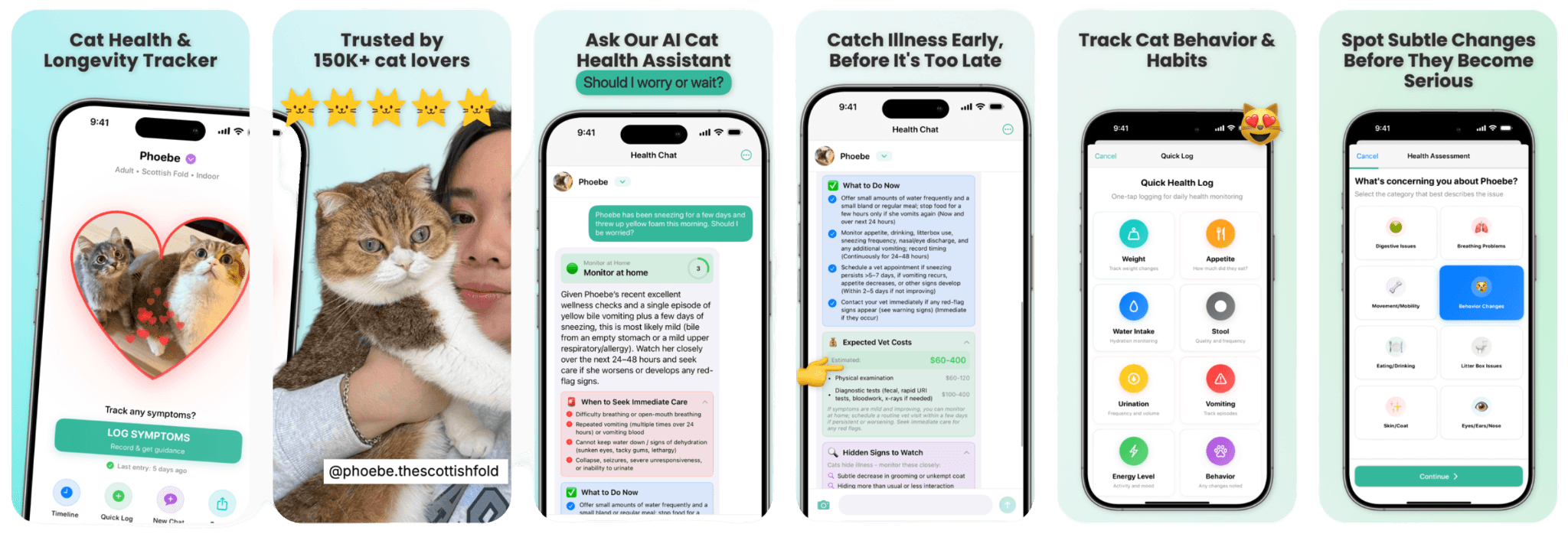
Skool's list is short because Skool does less. Whop's list is long because Whop is a payments company that grew a marketplace. Neither is a trick. They are different businesses. NineLives by Samantha Mae
Our work

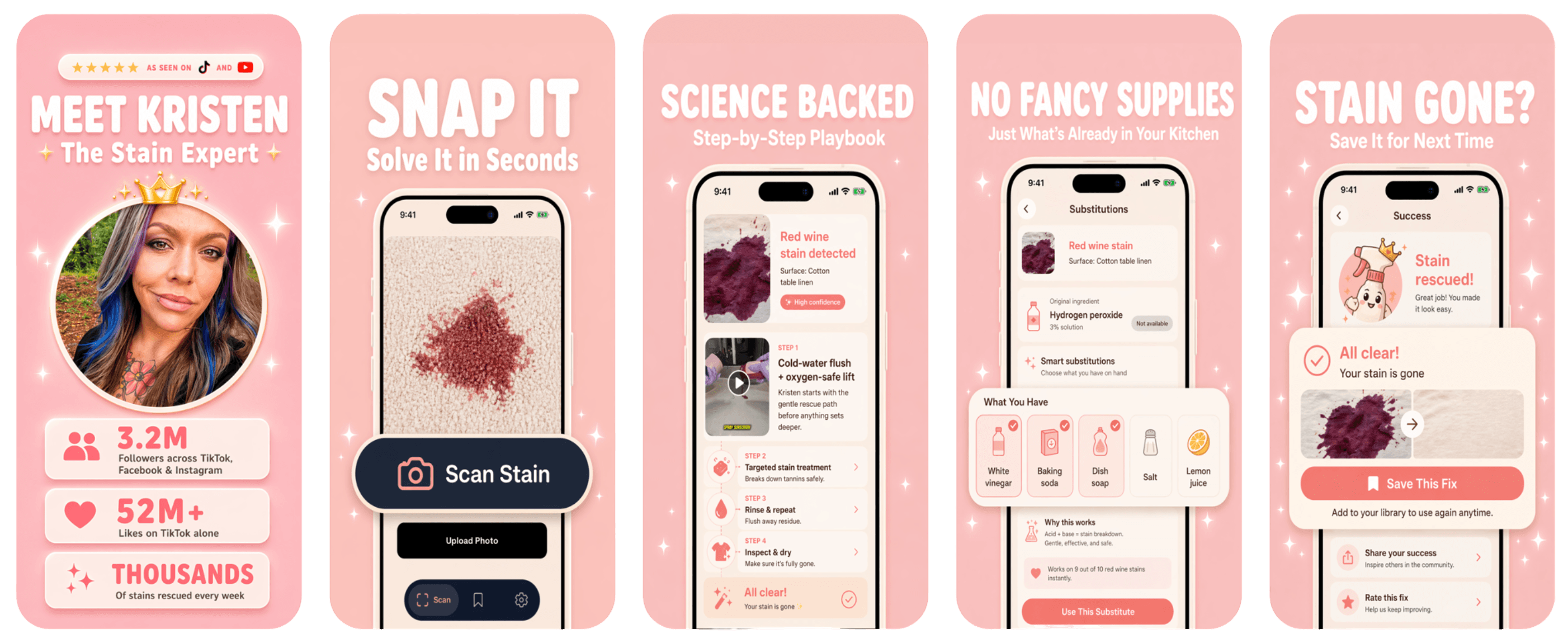
How Samantha Mae Turned a Cat Community Into the NineLives Health App

Samantha Mae's community shared cat-care questions that vanished into comment threads. We built NineLives with her — an iOS app that keeps every cat's health history in one place.

Read the case study → (opens in a new tab)
Two scenarios, both with members paying $50 a month, both using domestic cards and next-day ACH payouts.
ScenarioSkool HobbySkool ProWhop
20 members, $1,000/month$115$134$43
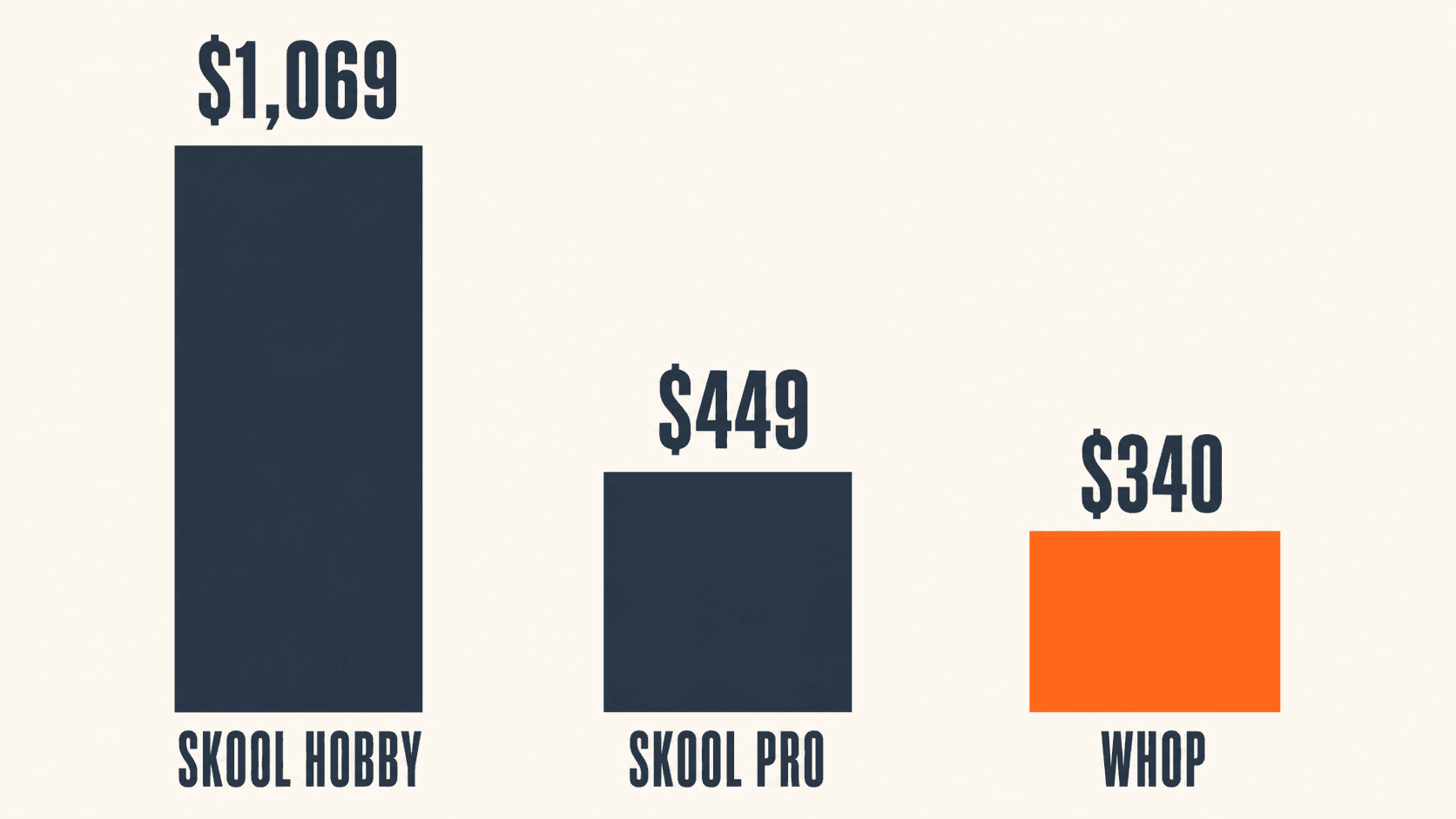
200 members, $10,000/month$1,069$449$340
Effective rate at $10,00010.7%4.5%3.4%
Bar chart of monthly platform cost at $10,000 in member payments: Skool Hobby $1,069, Skool Pro $449, Whop $340
Three things fall out of that math. The Skool Hobby plan is a trap dressed as a discount. Set $9 against $99 and the choice looks obvious. Set 10% against 2.9% and it inverts the moment you have real revenue. The two plans cost the same at about $1,268 a month in member payments, which is 26 members at $50. Above that line, every month you stay on Hobby to save $90 costs you more than $90. Whop is cheaper than Skool at both scales, and that is the honest read of the numbers. It is also comparing a checkout to a community platform. The $99 you pay Skool buys the courses, the feed, the events, and the gamification. On Whop you supply the community yourself, usually in Discord, which is a separate product with separate moderation work. And the add-on stack is where Whop's advantage narrows. Turn on tax remittance, billing automation, and instant payouts, and a 3.4% effective rate becomes something in the 6% range. Model your own configuration rather than the headline. Skool is better when the paid experience is people learning together in one place. Whop is better when you sell access to something that already lives somewhere else, most often a Discord server, a Telegram channel, or a downloadable tool. Skool's product is a single feed with courses, a calendar, and a leaderboard bolted to it. That narrowness is the point. Members do not get lost, and the platform has one opinion about what a community should feel like. If your offer is a cohort, a mastermind, or a course with accountability around it, Skool's opinion is probably right. We put it against the closest alternative in Skool vs Circle, and against the wider field in five Skool alternatives. Whop's product is the transaction and the gate. It sells sports picks, trading rooms, bot access, templates, and software licenses as comfortably as it sells communities, and it has a marketplace where buyers browse. That marketplace is genuine distribution, which Skool does not offer at all. It is also somebody else's storefront with your product on the shelf. If you are a business or finance creator with 50,000 engaged followers selling Discord access, Whop is the faster path to money this month, and you should probably take it. Just be clear about what you are building: a listing, not a brand people search for by name. No. Neither Whop nor Skool publishes a branded app under your name on the App Store. Members reach your community through Whop's app, Skool's app, or a browser, and the listing, the reviews, and the search ranking belong to the platform. This is the line both pricing pages are quiet about. You can build a $30,000 a month business on either platform and still have no App Store presence, no icon on anyone's home screen, and no asset that survives the platform changing its fee schedule. Skool changed its fee schedule this year. That is not a hypothetical. An owned app inverts each of those. Your listing ranks in App Store search, which means new customers can find the product before they find you. Daily usage inside the app produces the raw material for your next post, which quietly solves the hardest recurring problem in a creator's week. And the subscription revenue arrives whether or not you shipped content that month. If you are weighing that against selling a course, the revenue math of an app versus a course is the place to start.
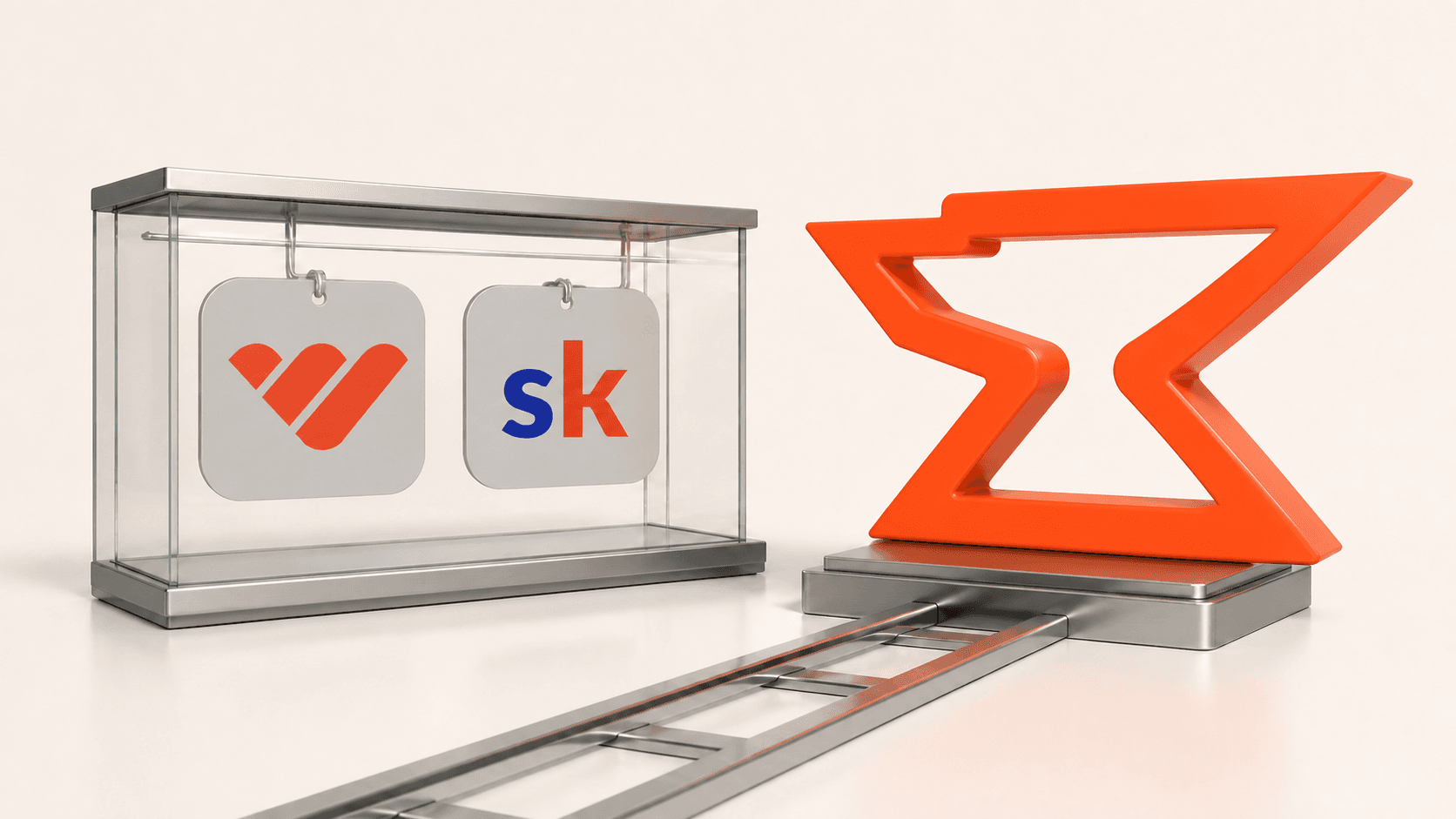
Whop and Skool shown as removable tags in a rented cabinet beside the BUILT BY FOUNDRY mark on its own foundation
Live every Thursday

Watch us tear down a creator business, live

Every Thursday at 11 AM PT we take a real creator business and show the app hiding inside it: the wedge, the paid loop, the pricing, and what would sink it. Free, and the replay goes to everyone who registers.

Save your seat → (opens in a new tab)
Choose Whop to sell gated access to something that already exists, especially in Discord or Telegram. Choose Skool Pro when the community itself is the product and you clear about $1,268 a month. Choose neither as your endgame if your audience is paying for a result that software could deliver better than a feed can. Choose Whop if you sell picks, signals, templates, tools, or Discord access, if you want marketplace traffic, and if you can live with a per-transaction cost model that grows more complicated as you turn features on. Choose Skool if your members learn from each other, if a course sits at the center of the offer, and if you want one predictable bill. Start on Hobby only while you are under 26 paying members at $50. Move to Pro the month you cross it. Choose neither as the final destination if the honest answer to "what does a member do on Tuesday morning?" is a task rather than a conversation. Tracking, planning, generating, scoring, logging, adapting: those are software behaviors, and no community platform will ever be good at them, because that is not what either company is building. Run one test on any platform decision. If this company doubled its fee tomorrow, what would you still have? On Whop you would have a customer list and a Discord server. On Skool you would have a member export and some course files. In both cases the product, the discovery, the reviews, and the retention mechanics stay with the company you were paying. That is the actual cost, and it does not show up on either pricing page. BUILT BY FOUNDRY builds the other version: a subscription software business in about three weeks, $0 upfront, on a revenue share. The creator owns the business and the revenue. We ship it, then we keep improving it after launch, because our side only works if the product keeps earning. Whop and Skool are good at collecting money for something you already made. The better question is what you would make if the product itself were yours. On published rates, yes. At $10,000 a month in member payments with domestic cards and next-day ACH payouts, Whop costs roughly $340 against $449 for Skool Pro. The comparison is not like for like, because Skool's fee includes a community and course platform while Whop's fee covers checkout and access gating. Skool costs $9 a month on the Hobby plan with a 10% transaction fee, or $99 a month on the Pro plan with a 2.9% fee. Skool's payments documentation adds $0.30 per charge and a 3.9% rate on payments above $900. Yearly billing is advertised as two months free. At about $1,268 in monthly member payments, which is roughly 26 members at $50 a month. Below that, the 10% fee costs less than the extra $90 in subscription. Above it, Pro is cheaper every single month. Whop's pricing page states no setup fees and no monthly costs, and prices each capability per transaction instead. The trade is that features other platforms bundle appear as separate line items, including 0.8% for orchestration, 0.5% for billing automation, 2% when tax is collected, and payout fees ranging from $2.50 to 5% plus $1. No. Neither platform publishes a branded app under your own name on the App Store. Members use the Whop app, the Skool app, or a web browser. A branded App Store listing requires building your own product.
Our work

Creators who already did this

These are apps we designed, built, shipped, and still run today, with the creator keeping the code and the audience.

Creator app strategy

Curious what your app could be?

Enter your handle and BUILT BY FOUNDRY will research your audience and present custom app concepts. Free.

Whop vs Skool 2026: 7 Costs Compared