

Whop Review 2026: Is It Worth It for Creators?

Whop Review 2026: Is It Worth It for Creators?

Foundry
May 4, 2026
Key Takeaways:
  • Whop is a creator commerce platform that pays out roughly $3B a year across digital products, paid Discord and Telegram communities, courses, and software
  • Headline pricing is 3% of sales plus card processing, no monthly fee, but real take-home depends on payout method, BNPL, and chargebacks
  • In February 2026, Tether led a $200M Series C at a $1.6B valuation to push Whop deeper into stablecoin payments
  • Earnings are heavily concentrated. Roughly 1% of products earn over half of platform revenue, and only about 2% of products clear $1,000 a month
  • Rating: 3.5 out of 5. A real revenue engine for the right product. A weak place to build a long-term subscription brand.
Verdict: Whop is the strongest commerce platform on the market for creators selling Discord and Telegram-gated communities, sports picks, trading rooms, and digital tools. It is not the strongest place to build a subscription app brand that compounds over five years. The fees are reasonable, the distribution is real, and the marketplace is doing what it says on the tin. The catch is that you are renting Whop's brand, Whop's payouts, and Whop's moderation rules. Whop is a creator commerce platform and marketplace where creators sell digital products, paid communities, courses, and software, with built-in gating for Discord and Telegram. It was founded in 2021 by Steven Schwartz and Cameron Zoub, who met as teenagers in a Facebook group for sneaker bots (CNBC). The company started by helping sneaker-bot communities collect monthly access fees, then expanded to every kind of paid digital product a creator might sell. Today Whop powers paid Discord servers for trading and sports picks, online courses, downloadable templates, software-as-a-service products, content-rewards programs, and a public marketplace that drives discovery to all of it. Members can buy and consume on the web or inside the Whop iOS and Android apps. The company has compounded fast. In June 2024, Bain Capital Ventures led a $50M Series B at an $800M valuation (Fortune). In February 2026, Tether announced a $200M Series C investment at a $1.6B valuation, with the goal of integrating USDT stablecoin payments and expanding into Latin America, Europe, and Asia (CoinDesk). That valuation is built on real volume. Whop now processes around $3B in annualized creator payouts across 144 countries, with ARR reported at roughly $142M as of late 2025, up about 255% year over year (Sacra). Here is where most reviews skip the fine print. The headline number is clean. The total cost is not.
Cost ItemRateNotes
Platform fee3%Charged on creator-driven sales
Card processing (US)2.7% + $0.30Standard Stripe-style pricing
International card+1.5%Stacked on US rate
FX conversion+1%Non-USD card transactions
Buy Now Pay Later15%Klarna and Afterpay sales
Standard ACH payout$2.50Next business day
Instant RTP payout4% + $1Same-day funds
Crypto or Venmo payout5% + $1Per payout
Wire payout$23Per wire
Chargeback$15Per dispute
Source: docs.whop.com/fees. For a US creator selling a $50 monthly community to US members and taking weekly ACH payouts, the all-in take rate lands around 94%. For a creator selling the same thing internationally on a buy-now-pay-later plan with instant payouts, the take rate can drop into the low 80s. That is still competitive with Stan Store, Skool, and Patreon for most use cases. It is much better than Patreon's flat 10% on new accounts. It is worse than Kajabi if you do enough volume to justify Kajabi's fixed monthly fee. What you do not pay is a monthly subscription. That is the real wedge against Skool, Kajabi, and Circle. Whop is broader than most creators realize. The platform handles:
  • Paid Discord and Telegram access. A bot auto-grants and revokes roles based on subscription status. This is the original Whop use case and still the most polished.
  • Communities and chat native to Whop, with channels, livestreams, and calls
  • Courses with video hosting, drip scheduling, and progress tracking
  • Digital downloads like templates, prompts, ebooks, and trading models
  • Software access through API keys and license-key delivery
  • Membership bundles that combine multiple products
  • Content-rewards programs where members get paid for clipping creator content
  • Affiliate programs with two-sided tracking
In April 2025, Whop launched an internal App Store that lets creators add third-party plug-ins like prediction games, paper trading, leaderboards, and quizzes inside their hub (Whop blog). It is the closest any creator platform has come to acting like a real operating system for paid communities. For trading, sports picks, sneaker bot, and prompt-library businesses, this stack is unmatched. For coaches, fitness creators, and lifestyle brands building a five-year subscription business, it is overpowered in some places and underpowered in others. This is the part most reviews avoid. The earnings on Whop are heavily concentrated. Independent analysis of public Whop data found that the top 1% of products, roughly 215 sellers, account for over half of total platform revenue, and only about 2% of products earn more than $1,000 per month (Whop Trends). The headline "$3B in payouts" is real, but most of it flows to a small number of very successful trading and sports-picks operators. This is not unique to Whop. Every creator marketplace looks like a power law. But it matters when you are deciding where to build, because the marketing on creator platforms is selling you the median outcome of the top decile, not the median outcome of all listings. The creators who win on Whop tend to share three traits. They sell a product where information goes stale fast, like sports picks or trading signals, so members renew constantly. They have an active Discord or Telegram presence that creates real perceived value beyond the content. And they cross-promote relentlessly on TikTok, X, and YouTube to drive traffic, because Whop's marketplace surface alone is not enough. If your business is a fitness coaching app, a meditation app, or a daily-habit subscription product, that pattern does not match yours. You want App Store distribution, push notifications, and a brand that lives outside of someone else's marketplace. That is a different game, and it is the game we cover in our guide to what a creator app actually is.
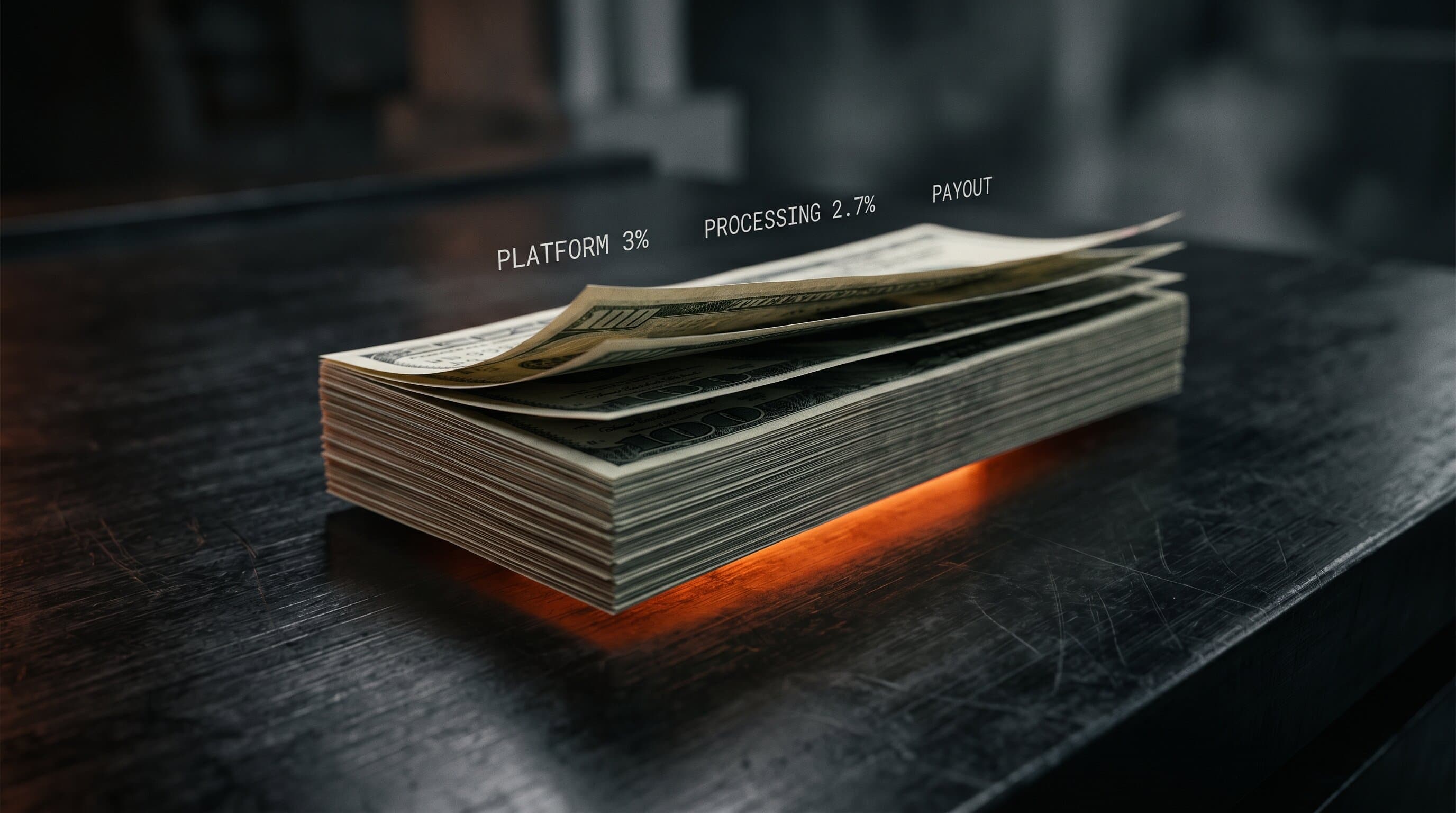
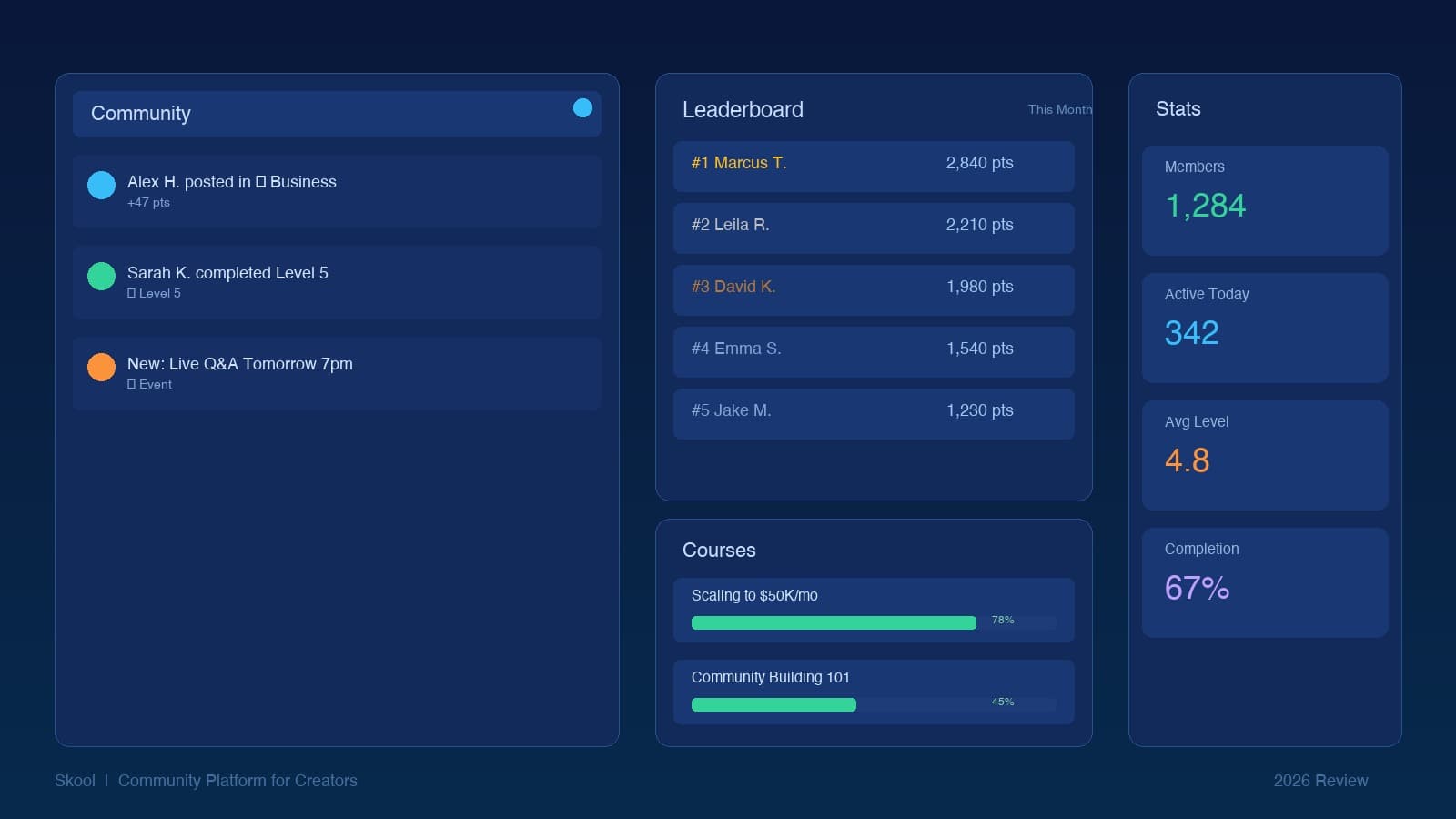
A breakdown of where Whop creator revenue actually goes, with the platform fee, processing, and payout costs visualized on a dark canvas with warm orange accents
PlatformTake RateBest ForMonthly Fee
Whop3% + processingDiscord and Telegram-gated products, marketplace discovery$0
Stan Store6% + processingLink-in-bio storefronts$29 to $99
Skool2.9% + processingCommunity plus course bundles$99
Patreon10% flatTiered fan memberships$0
Kajabi0% transactionHigh-volume course businesses$69 to $399
Your own app15% to 30% (App Store)Subscription brand you own$0 to $99 dev account
If you want a fast head-to-head, see our Skool review, Patreon review, and Stan Store review. The short version is that Whop has the lowest stated fee of the marketplace platforms and the strongest Discord integration, while paying a real cost in brand ownership. Here is the honest part. 1. Account bans near payout thresholds are a real complaint. Search Whop's BBB profile or Trustpilot page and you will find a recurring pattern of accounts getting flagged or held right before a creator hits a payout milestone, especially in the Whop Clips content-rewards program (Trustpilot, BBB). The pattern looks like aggressive fraud-protection automation that produces false positives. Whop's stated policy is a 90-day rolling reserve on funds, which is standard for high-risk merchant categories but feels harsh when you are the merchant. 2. Support is mostly automated. When something goes wrong, you are talking to a help-center article and a chatbot first. For trading and sneaker bot operators who churn through high transaction volume, this is a known cost of doing business. For a creator who has never run a payments business before, it is a shock. 3. The marketplace is dominated by a specific aesthetic. Browse whop.com/discover and the surface is heavy on trading, sports betting, sneaker bots, AI prompt packs, and side-hustle content. If your brand sits in wellness, education, or family-friendly content, the neighborhood effect cuts both ways. You get distribution, but you also get associated. 4. You are renting brand equity. Every sale you make on Whop builds Whop's domain authority, Whop's customer list, and Whop's marketplace flywheel. Your name appears in your customers' inboxes attached to a Whop receipt. This is the same trade-off we cover in our Whop alternative analysis, and it gets more expensive over time as your brand should be the asset, not the listing. 5. App Store distribution is not yours. Whop has its own iOS and Android apps that members install, but the App Store listing belongs to Whop. You do not get the "search for [your name]" surface, the App Store editorial features, or the standalone push-notification channel that comes with owning your own app. App Store search is increasingly the primary discovery channel for creator subscription products, and Whop members never reach your name in it. Whop is genuinely the right answer for some creators. The 3.5 out of 5 rating reflects that.
  • Trading, sports picks, and signals operators with active Discord or Telegram communities. Whop's gating bot is the best in market.
  • Sneaker bot, prompt library, and AI tool sellers where customers expect a marketplace surface and instant access.
  • Creators testing a paid community for the first time who do not want to commit to a monthly platform fee
  • Creators with high-velocity, low-priced digital products where 3% beats every alternative
If that is you, set up your Whop store, optimize your funnel, drive traffic, and run the play. The platform is well-built and the volume is real. You have outgrown Whop when:
  • You want App Store and Google Play distribution that lists your brand, not Whop's
  • Your subscribers are paying for an experience, not a Discord role
  • You need push notifications that hit a phone with your icon on it, not Whop's
  • You want to build a real subscription business with MRR that compounds and a customer relationship you own
  • You are running a coaching, fitness, wellness, or education business where the brand is the product
  • You want to be in control if a marketplace decides to change its rules, fees, or moderation policy
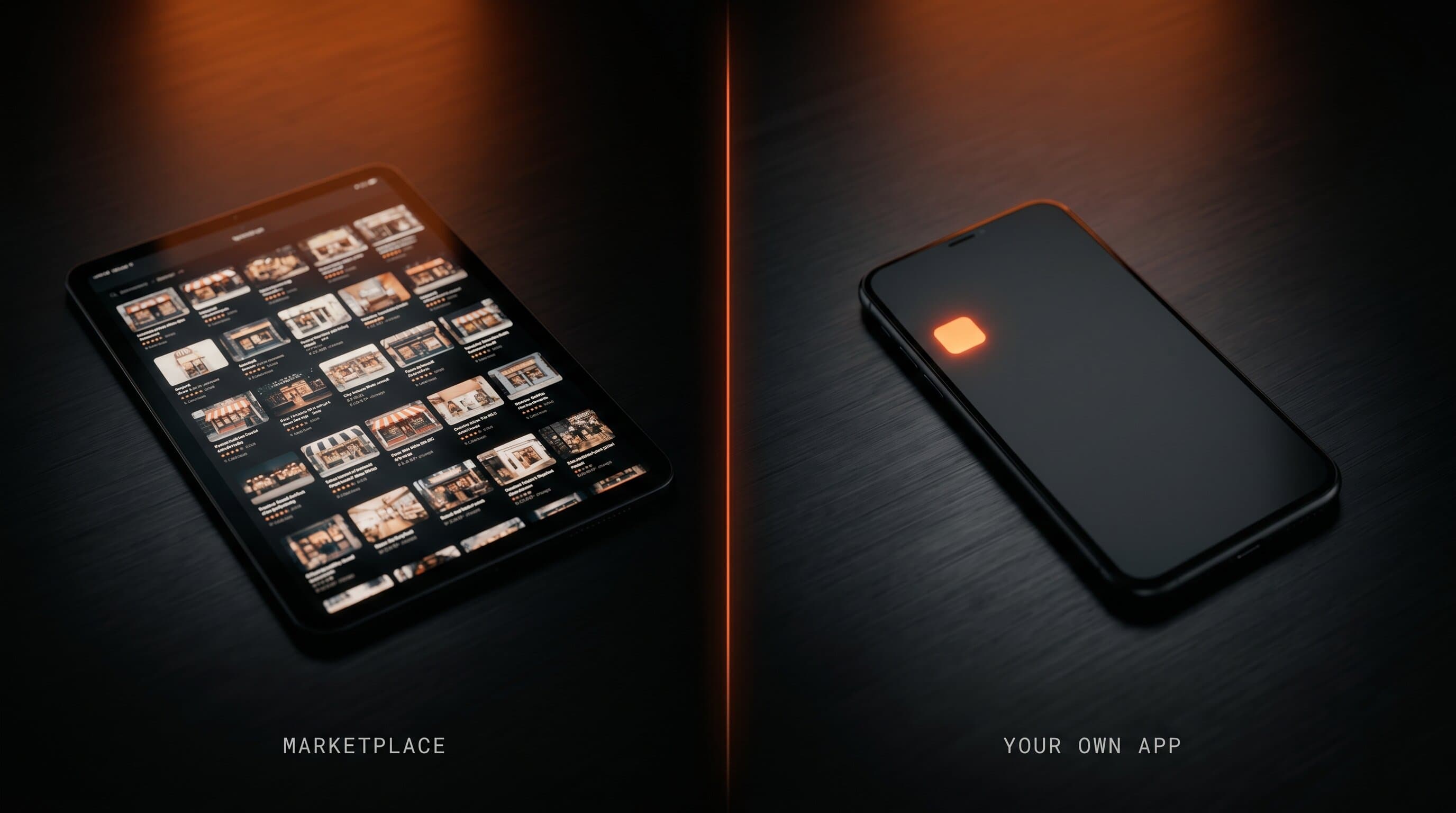
The marketplace model is great when you are starting and dangerous when you scale. The first $50K is faster on Whop. The next $5M is faster on your own app, because every renewal compounds your brand instead of someone else's.
A side-by-side comparison of a Whop marketplace listing on the left versus a creator-owned App Store listing on the right, on a dark canvas with warm orange accent lighting
The math gets interesting at scale. A creator generating $50K a month on Whop is paying roughly $1,500 a month in platform fees plus another $1,500 to $2,000 in card processing. That is fine. The hidden cost is that none of that revenue is building an asset you own. A creator generating $50K a month through their own subscription app is paying Apple or Google 15% to 30% on the first year, dropping to 15% in year two for retained subscribers, plus the cost of building and running the app. That is more money to the platform in the short term and less in the long term, with one critical difference: the brand, the customer list, the App Store listing, the push notifications, and the option to switch payment processors all belong to the creator. We break down the true cost of building a creator app honestly here. The summary is that the right answer depends on what kind of business you want to be running in five years, not which platform has the lowest fee this month. Whop is a real business doing real volume for real creators. It earns its 3.5 out of 5. The fees are reasonable, the Discord and Telegram integration is best in class, the marketplace is growing, and the team has shipped fast. For the right product, it is the most efficient way to monetize a paid community in 2026. It is also a marketplace, and marketplaces are a strategy, not a destination. The creators who use Whop best treat it as one channel inside a larger business they own. The creators who use it worst treat it as the business itself and wake up one morning to find that their listing has been suspended, their payouts are on hold, and their customer list lives on whop.com instead of on a server they control. If you are building a paid Discord, sell on Whop. If you are building a brand, build your own app. Ready to turn your audience into an app you actually own? Built by Foundry builds, launches, and runs subscription apps for creators. $0 upfront, three-week delivery, we handle all the tech forever.
Let's Build Your App
Yes. Whop is a venture-backed company with $250M+ in total funding from Bain Capital Ventures, Insight Partners, Tether, and others, processing around $3B in annualized creator payouts across 144 countries. Individual complaints about account bans and held funds are real, but the platform itself is legitimate and operating at scale. Whop charges 3% of sales as a platform fee with no monthly subscription. On top of that, you pay standard card processing of 2.7% plus $0.30 in the US, with extra fees for international cards, buy-now-pay-later, instant payouts, and chargebacks. All-in take rates typically land between 91% and 94% for US creators. Paid Discord and Telegram access, courses, communities, digital downloads, software access, membership bundles, content-rewards programs, and affiliate programs. Whop is strongest for products where members renew often, like trading signals, sports picks, sneaker bot access, AI prompt libraries, and active community memberships. Whop has lower fees than both for most use cases and beats Skool on Discord integration and Patreon on flexibility. Skool wins on simplicity for community plus course bundles. Patreon wins on tiered fan memberships and brand recognition. The right pick depends on what you are selling and who your audience is. You own your customer email list and can export it. You do not own the recurring billing relationship through Stripe directly, the App Store distribution, or the customer experience layer. Migrating an active subscriber base off any marketplace platform is a real project, not a one-click export, which is a major reason creators eventually build their own app.

Get Creator Revenue Insights

How creators are turning audiences into subscription businesses

You might also enjoy...

Whop Review 2026: Is It Worth It for Creators?