

5 Skool Alternatives for Creators Who Want Their Own App

5 Skool Alternatives for Creators Who Want Their Own App

Foundry
April 18, 2026
Key Takeaways:
  • Skool is excellent for community engagement and simple courses, but it caps your business at $99/month in platform fees with no App Store presence and zero organic discovery
  • Circle ($89-199/mo) adds branded apps and better course tools but still ties your revenue to someone else's infrastructure
  • Mighty Networks ($49-219/mo) is the only community platform with a native mobile app option, but custom-branded apps require enterprise pricing
  • Kajabi ($143-499/mo) does everything but costs the most and recently slashed contact limits by 75% on the Basic plan
  • The real alternative to Skool isn't another platform. It's a subscription app you own, listed in the App Store, acquiring customers who've never seen your content
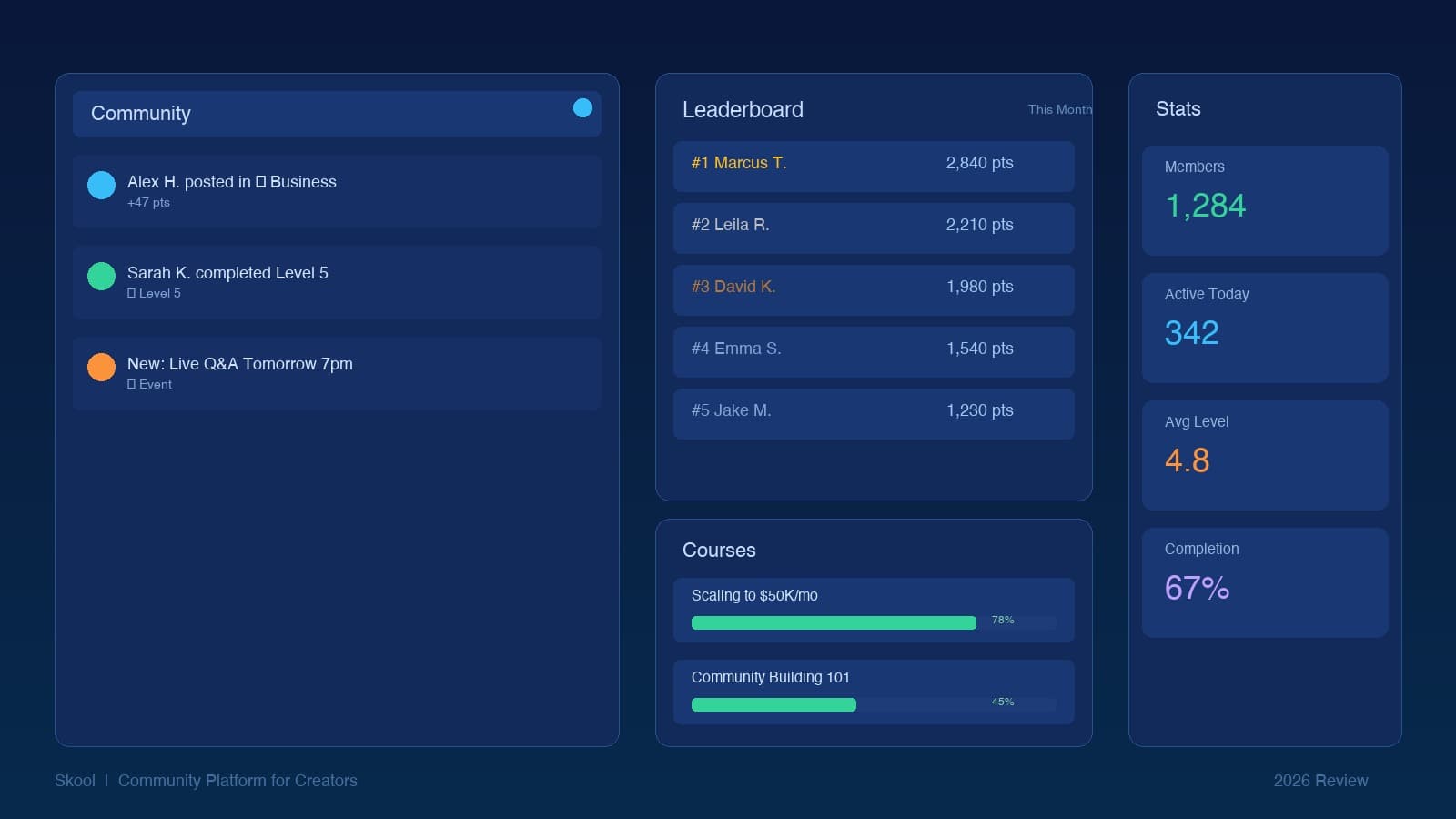
Looking for Skool alternatives? You're not alone. Skool has over 15 million users. Alex Hormozi turned it into the default community platform for creators and coaches. It deserves that position. The $99/month flat fee, zero transaction fees on paid communities, gamified engagement, and dead-simple setup make it the fastest path from "I want a community" to "I have one." But the fastest path and the right path aren't always the same. If you're searching for alternatives, you've probably hit one of Skool's walls: no App Store presence, no native mobile app, basic course tools, limited analytics, and the uncomfortable reality that your community lives on someone else's domain. (Read our full Skool review here.) Here are five alternatives worth evaluating, depending on where you want to take your business.
FeatureSkool ($99/mo)Circle ($89-199/mo)Mighty Networks ($49-219/mo)Kajabi ($143-499/mo)Discord + Patreon (Free + 5-12%)Your Own App ($0 upfront)
Community forumsYesYesYesYesYesYes
Online coursesBasicAdvancedAdvancedAdvancedNoCustom
Native mobile appNoAdd-onPro plan onlyNoYes (Discord)Yes, fully branded
App Store listingNoNoPro plan onlyNoNoYes
Email marketingNoNoNoBuilt-inNoOwned list
Custom brandingLimitedStrongStrongFullLimited100% yours
Transaction fees0%1-2%2-3%0-5%5-12% (Patreon)App Store 15-30%
Organic discoveryNoneNoneApple/Google (Pro)NoneNoneApp Store SEO
The table tells one story: all five community platforms keep your business inside their walls. Only one option puts you in the App Store, where over 650 million people browse weekly without ever needing to find your Instagram first. Best for: Creators who want branded community spaces with courses, events, and live rooms under one roof. Price: Professional ($89/mo), Business ($199/mo), Enterprise (custom). Plus 1-2% transaction fees on member payments. Circle was built by Sid Yadav, formerly VP of Product at Teachable. He saw the problem firsthand: creators who sold courses had no way to keep students engaged after the content ended. Circle fixes that with discussions, events, live rooms, and course hosting in one place. Circle does community better than Skool in several ways. The course builder is more flexible. Events and live rooms are native. Custom branding goes deeper. And the white-label mobile app on higher plans gives your community a native feel on phones. But "native feel" and "native app" aren't the same. Circle's mobile experience runs inside their infrastructure. Your community still lives at a Circle URL or inside Circle's app container. You can't list it in the App Store as a standalone product. You can't acquire customers through App Store search. (Read our full Circle review.) Who should switch from Skool to Circle: Creators with existing course libraries who need polished branding and can justify $89-199/month. Who shouldn't: Creators who want App Store distribution, organic customer acquisition, or a product that works independently from their content. Best for: Creators who want community with a mobile app, without building from scratch. Price: Community ($49/mo), Courses ($99/mo), Business ($179/mo), Mighty Pro (custom enterprise pricing). Mighty Networks is the only major community platform that offers a native mobile app option. The catch: it requires the Mighty Pro plan, which means enterprise pricing and Mighty's infrastructure baked into the experience. On the standard plans ($49-179/mo), Mighty Networks offers community spaces, course hosting, event management, and member subscriptions. The interface handles larger communities better than Skool. Members access everything through the Mighty Networks app on iOS and Android. The limitation is ownership. Members download the Mighty Networks app, not your app. Your brand is a tenant, not a landlord. And the 2-3% transaction fee on paid memberships adds up once you're doing $5,000+ monthly in community revenue. Who should switch from Skool to Mighty Networks: Creators who prioritize mobile engagement and want courses plus community in one place, starting at $49/month. Who shouldn't: Creators who want a standalone app with their own branding in the App Store. Mighty Pro gets closer but at enterprise pricing most creators can't justify. Best for: Creators who want courses, email marketing, funnels, and community in a single subscription. Price: Kickstarter ($69/mo), Basic ($143/mo), Growth ($199/mo), Pro ($399/mo). Kajabi is the Swiss Army knife. Courses, community, email marketing, sales funnels, coaching, podcast hosting, checkout. Everything under one login. Over 75,000 creators use it. They've collectively processed more than $8 billion in transactions. For course-heavy businesses, Kajabi works. The email marketing alone replaces Mailchimp or ConvertKit. But Kajabi has gotten more expensive and less generous. In January 2026, the Basic plan slashed contact limits by 75%, from 10,000 to 2,500, while prices went up. The Growth plan now charges a 0.5% transaction surcharge. And community features still feel tacked on compared to Skool's gamified engagement. (Full Kajabi review here.) There's also no App Store presence. No native mobile app. No organic discovery. Your entire business lives at a Kajabi URL that only people you personally send there will ever find. Who should switch from Skool to Kajabi: Creators running course businesses who need email marketing and sales funnels built in, and who can afford $143+/month. Who shouldn't: Creators focused on community engagement (Skool is better at that) or anyone who wants App Store distribution. Best for: Gaming, tech, and crypto creators who already have active Discord servers. Price: Free (Discord) plus 5-12% revenue share (Patreon for gated access). Discord plus a paywall tool like Patreon is the scrappy option. Discord handles real-time chat and voice. Patreon gates access. Bots automate role assignments. Total platform cost: nothing upfront. Patreon takes 5-12% of revenue depending on your plan. This stack works for creators in gaming, tech, Web3, and music where the audience already lives on Discord. Some creators run communities with 10,000+ paying members through Patreon integration. The problems are real though. There's no course hosting. The mobile experience is a chat app, not a product. Moderation at scale becomes a full-time job. And the member experience feels like joining someone's group chat, not using someone's product. For creators under $2,000/month in community revenue who already have Discord audiences, it works. For anyone trying to build a subscription business, it's a ceiling, not a floor. Who should switch from Skool to Discord: Creators in gaming, tech, or crypto with existing active Discord servers and audiences under 5,000 members. Who shouldn't: Anyone selling courses, running a coaching business, or wanting a professional product experience.
Comparison of community platforms vs. owned apps for creator businesses
Best for: Creators ready to own their business, not rent a platform. Price: $0 upfront with a revenue-share model. (Learn how Built by Foundry works.) Here's what none of the four alternatives above can do: put your business in the App Store. That matters more than most creators realize. The App Store gets over 650 million weekly visits (Apple). Those visitors search for solutions, not creators. They type "workout plans" or "meal prep" or "guitar lessons" and find apps. Your app. Without ever seeing your Instagram, your TikTok, or your YouTube. Every platform in this list requires you to drive all your own traffic. Your content brings every single customer. When you stop posting, growth stops. That's the structural problem with community platforms. A subscription app changes that equation. It generates monthly recurring revenue that compounds. It acquires customers organically through App Store search. And it becomes a content engine: every user interaction, every leaderboard ranking, every before-and-after result gives you something to post about without brainstorming from scratch. The trade-off: the App Store takes 15-30% of subscription revenue. But that commission buys you distribution to hundreds of millions of potential customers you could never reach through social media alone.
What you getCommunity platformYour own app
Revenue modelMonthly platform fee + member paymentsDirect subscription revenue
Customer acquisitionOnly from your audienceApp Store search + your audience
Push notificationsNo (or limited)Yes
Offline accessNoYes
Brand identityplatform.com/youYour name in the App Store
Content engineLimitedEvery user action = content idea
Business valuationTied to the platformIndependent, sellable asset
Skool is the right choice in specific situations. If you're building a free community to warm up leads for coaching or consulting, Skool's gamification and simplicity are hard to beat. If you're running a low-ticket community ($29-99/month) and your primary growth channel is organic social content, Skool's zero transaction fee model keeps more money in your pocket than Circle or Mighty Networks. The inflection point comes when you ask: "Is my community the product, or is it a feature of a bigger business?" If the answer is the latter, you've outgrown community platforms. You need a product. Discord is the best free alternative for real-time community. Pair it with a free Patreon plan (8% fee) or Ko-fi to gate premium access. The trade-off is no courses, no gamification, and a chat-app experience instead of a structured community. For creators with fewer than 100 community members and under $1,000/month in revenue, Skool's $99/month fee is steep. Consider Mighty Networks Community ($49/month) or Discord as a free starting point. Skool's value kicks in when community revenue justifies the fixed cost. Partially. You can export member emails and basic data, but you'll lose all engagement history, gamification points, course progress, and discussion threads. This lock-in is one reason to evaluate alternatives before your community gets too large to migrate. A community platform hosts your members on their infrastructure. You pay monthly fees, follow their rules, and your business exists at their URL. A custom app puts your brand in the App Store as a standalone product. You own the code, the data, and the customer relationship. And the App Store brings new customers who find your app through search, not through your social media. Most agencies charge $50K-$200K upfront. Built by Foundry charges $0 upfront and takes a revenue share, so we only earn when you earn. The app is designed, built, and shipped to the App Store in about 3 weeks.
Your community is a business. The question is who owns it. If the answer is "a platform," you're renting. If the answer is "me," you're building.
Let's Build →

Get Creator Revenue Insights

How creators are turning audiences into subscription businesses

You might also enjoy...

5 Skool Alternatives for Creators Who Want Their Own App