
How creators are turning audiences into subscription businesses
Share
Key Takeaways:
Skool charges $9/month with a 10% transaction fee (Hobby) or $99/month with a 2.9% fee (Pro); Circle charges $89 to $199/month plus a 1-2% fee stacked on top of Stripe processing
At $10,000 a month in member revenue, Skool Pro is the cheapest option at about $4,700 a year; Skool's $9 Hobby plan is the most expensive at about $12,100
Skool wins on simplicity, gamification, and its discovery page; Circle wins on branding, structure, and format flexibility
Circle only offers a branded mobile app as an add-on to its custom-priced Plus tier; Skool doesn't offer one at all
Skool never gives you your own App Store listing; Circle sells branded iOS and Android listings only through a custom-priced Plus add-on
Searching "Skool vs Circle"? You're choosing between the two loudest names in paid communities, and the pricing pages make it genuinely confusing. One platform costs $9 a month. The other starts at $89. And the $9 option can end up costing you more than both.We reviewed each platform on its own in our Skool review (3.8/5) and our Circle review (3.5/5). This is the head-to-head: fees, features, mobile, and the revenue math at 500 paying members.
Skool vs Circle at a Glance
Skool
Circle
Entry price
$9/mo (Hobby)
$89/mo (Professional)
Higher tiers
$99/mo (Pro)
$199/mo (Business), custom (Plus)
Transaction fee
10% (Hobby), 2.9% (Pro)
2% (Professional), 1% (Business), 0.5% (Plus)
Payment processing
Included in the quoted fee
Stripe's ~2.9% + $0.30 on top
Custom branding
Minimal, every community looks like Skool
Deep: colors, domain, layout, spaces
Gamification
Points, levels, leaderboards built in
Basic
Discovery
Public community discovery page
None, you bring the audience
Branded mobile app
Not offered
Add-on on custom-priced Plus tier only
Your own App Store listing
No
Only via Plus add-on, pricing not public
That transaction fee row decides more than any feature list. Let's run the numbers.
What Is the Real Difference Between Skool and Circle?
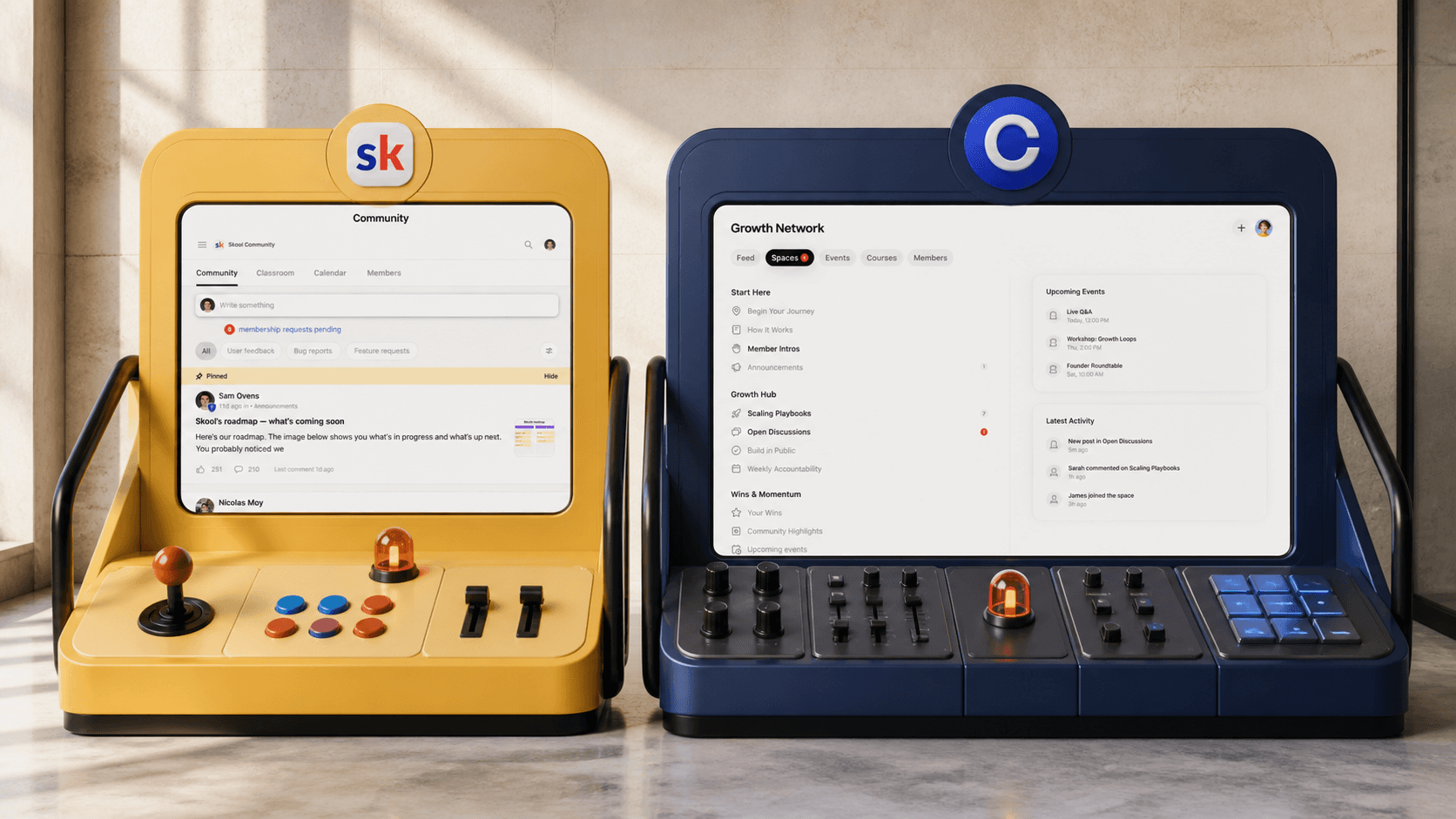
Skool is an opinionated, one-layout community platform that trades customization for simplicity and engagement mechanics. Circle is a white-label community suite that trades simplicity for control over branding, structure, and formats. Skool feels like a product you join; Circle feels like a platform you configure.The origin stories explain it. Sam Ovens built Skool in 2019 as an internal tool for his own students and kept it deliberately minimal: one feed, one classroom, one calendar, one leaderboard. Alex Hormozi became its lead investor in 2023 and turned it into the default answer for coaches and course sellers. Circle was started by Teachable alumni, led by CEO Sid Yadav, to keep course students engaged after the content ended, and it raised a $24.7 million round led by Tiger Global at a $200 million valuation in 2021.So Skool optimizes for member behavior: streaks, points, leaderboards, one place to look. Circle optimizes for operator control: spaces, courses, events, live rooms, automation, your logo on everything.
How Much Do Skool and Circle Actually Cost?
Skool costs $9/month with a 10% transaction fee on the Hobby plan, or $99/month with a 2.9% fee on Pro, and the quoted fee is the whole fee. Circle costs $89/month (Professional) or $199/month (Business) plus a 2% or 1% transaction fee charged on top of Stripe's roughly 2.9% + $0.30 processing. At $10,000 a month in member revenue, Skool Pro keeps the most money in your pocket.Those numbers come straight from the live Skool pricing page and Circle pricing page, and Circle's own help center confirms its fee stacks on top of Stripe processing.Here's the math for a community of 500 members paying $20/month, $10,000 in monthly gross:
Line item
Skool Hobby
Skool Pro
Circle Professional
Subscription
$9/mo
$99/mo
$89/mo
Platform transaction fee
$1,000 (10%)
$290 (2.9%)
$200 (2%)
Stripe processing
Included
Included
~$440 (2.9% + $0.30)
You keep
~$8,991/mo
~$9,611/mo
~$9,271/mo
Annual platform cost
~$12,100/yr
~$4,700/yr
~$8,700/yr
Read that table twice. The $9 plan is the most expensive plan on either platform once you have real revenue. Skool's Hobby tier is priced for communities that don't charge; the moment yours does, the 10% fee eats you. The crossover point is about $1,270 a month in gross revenue. Above that, the $99 plan is cheaper than the $9 one.And all three columns share the same property: the fee line scales with your success forever, while the thing you're paying for stays a page inside someone else's product.
Community Features: Simplicity vs Control
Skool's feature set fits in one sentence: feed, classroom, calendar, leaderboard, DMs, done. That constraint is the product. Members always know where to go, gamification keeps daily activity high, and setup takes an afternoon. The cost is that every Skool community looks identical, course tools are basic, and analytics are thin. There's also a public discovery page, the only organic growth mechanism on either platform.Circle gives you the toolbox Skool refuses to build: unlimited membership tiers, separate spaces for topics and cohorts, native courses with progress tracking, events, live streams and live rooms, workflow automation, and branding deep enough that members see your name, your colors, and your domain. The cost is the inverse of Skool's: more surface area to configure, more places for members to get lost, and plan limits that matter (Professional caps you at 3 admins and 20 spaces).The honest summary: Skool is better at making members show up daily. Circle is better at making your business look and feel like your business.
Can Your Members Find You in the App Store?
Not on either standard plan. Skool members use the Skool app under Skool's name and icon. Circle members use the Circle app unless you buy its branded-app add-on through custom-priced Circle Plus. That add-on can put your brand on its own iOS and Android App Store listings; Skool offers no equivalent.This is the row of the comparison table that compounds. Your community members open their phone and see Skool's logo, not yours. New people browsing the App Store find Skool and Circle, not you. Every habit your community builds is a habit attached to someone else's brand.Circle deserves credit for at least selling a path to a branded app. But it's gated behind Plus, the tier with no public price, and the app is still Circle underneath: their infrastructure, their release cycle, their rules. Skool doesn't pretend to offer one.Why does this matter more than fees? Because the App Store is a discovery engine with more than 813 million average weekly visitors worldwide, according to Apple's 2024 App Store Transparency Report. A listing of your own can help strangers discover the product before they ever see your content. We broke down that growth math in why your next 10K fans won't come from social media.
Where Skool Wins
Price at scale. $99 plus 2.9% all-in is the cheapest way to run a paid community at real revenue.
Engagement mechanics. Points, levels, and leaderboards produce daily activity that forums can't match.
Simplicity. One layout, zero configuration paralysis, members never get lost.
Discovery page. A real, if modest, source of new members you didn't recruit yourself.
Where Circle Wins
Branding. Your domain, your colors, your structure. Skool communities all look like Skool.
Formats. Courses, events, live streams, live rooms, and tiered memberships under one roof.
Automation. Workflows for onboarding, tagging, and lifecycle messages that Skool simply doesn't have.
A branded app exists at all. Even gated behind custom Plus pricing, it's an option Skool never offers.
Which Platform Should You Choose?
Choose Skool if you're a coach or course seller who wants maximum member engagement with minimum setup, and take the Pro plan the moment you charge more than about $1,270 a month. Choose Circle if your brand matters to the sale and you need tiers, events, and structure. If you have 50K+ engaged followers, neither ceiling is high enough.If you're a business coach running one flagship program, Skool's leaderboard culture will outperform anything you can configure in Circle.If you're a creator whose product spans a community, courses, and events, and whose audience expects a polished branded experience, Circle Professional earns its $8,700 a year by replacing four other tools.But if you're a fitness creator, a language teacher, a chess YouTuber, or anyone whose fans want to train, practice, and track rather than post in a feed, notice what you're actually shopping for. You don't want a forum. You want your programs and tools in your fans' pockets. A community platform is a place to talk about the work. An app is the work, a distinction we ran the numbers on in the app vs course revenue math.
Both pricing pages sell you a room inside their building. Skool takes up to 10% of your revenue for it. Circle takes $89 to $199 a month plus fees for it. Skool never puts your name in the App Store; Circle will do so only through a custom-priced Plus add-on. Either way, the product still runs on the platform's infrastructure.
A subscription app of your own inverts every line of the comparison. The App Store finds you new subscribers who have never seen your content. Push notifications land with 100% of your members under your icon. Usage inside the app generates material for your next post instead of demanding it. And the asset appreciates: you can sell an app business; you cannot sell a Skool community that lives on Skool's servers under Skool's terms.That's the product Built by Foundry builds: your own subscription app, live in the App Store in about 3 weeks, $0 upfront, on a revenue share. We design it, build it, ship it, and run and optimize it forever while you keep ownership. Skool and Circle charge you rent to borrow their software. We build software that belongs to you and only earn when it earns.Creators comparing community platforms are asking "which landlord is better?" The creators pulling ahead in 2026 stopped renting. If that's the version of this decision you actually want to make, we lined up the ownership options in 5 Skool alternatives for creators who want their own app.
Above roughly $1,270 a month in member revenue, Skool Pro at $99/month with a 2.9% all-in transaction fee is the cheapest option. Below that, Skool's $9 Hobby plan wins on cash cost despite its 10% fee. Circle Professional at $89/month plus 2% plus Stripe processing sits in the middle at most revenue levels.
Does Skool or Circle offer a branded mobile app?
Skool does not offer branded apps; all communities live inside the Skool app. Circle offers a white-label branded app only as an add-on to its custom-priced Circle Plus tier. On standard plans, members of both platforms use an app carrying the platform's name and icon.
Can I move my community from Skool to Circle or vice versa?
You can export member emails from either platform and invite people to the new one, but posts, courses, gamification history, and payment relationships don't transfer cleanly. Expect to rebuild content and re-collect payment details, and expect some members not to make the jump.
What's the alternative to renting a community platform?
Owning the product: a subscription app with your name on the App Store listing. Built by Foundry builds creator apps in about 3 weeks at $0 upfront on a revenue share, handles submission and updates permanently, and the creator keeps ownership of the business and its revenue.
Our work
Creators who already did this
These are apps we designed, built, shipped, and still run today, with the creator keeping the code and the audience.