
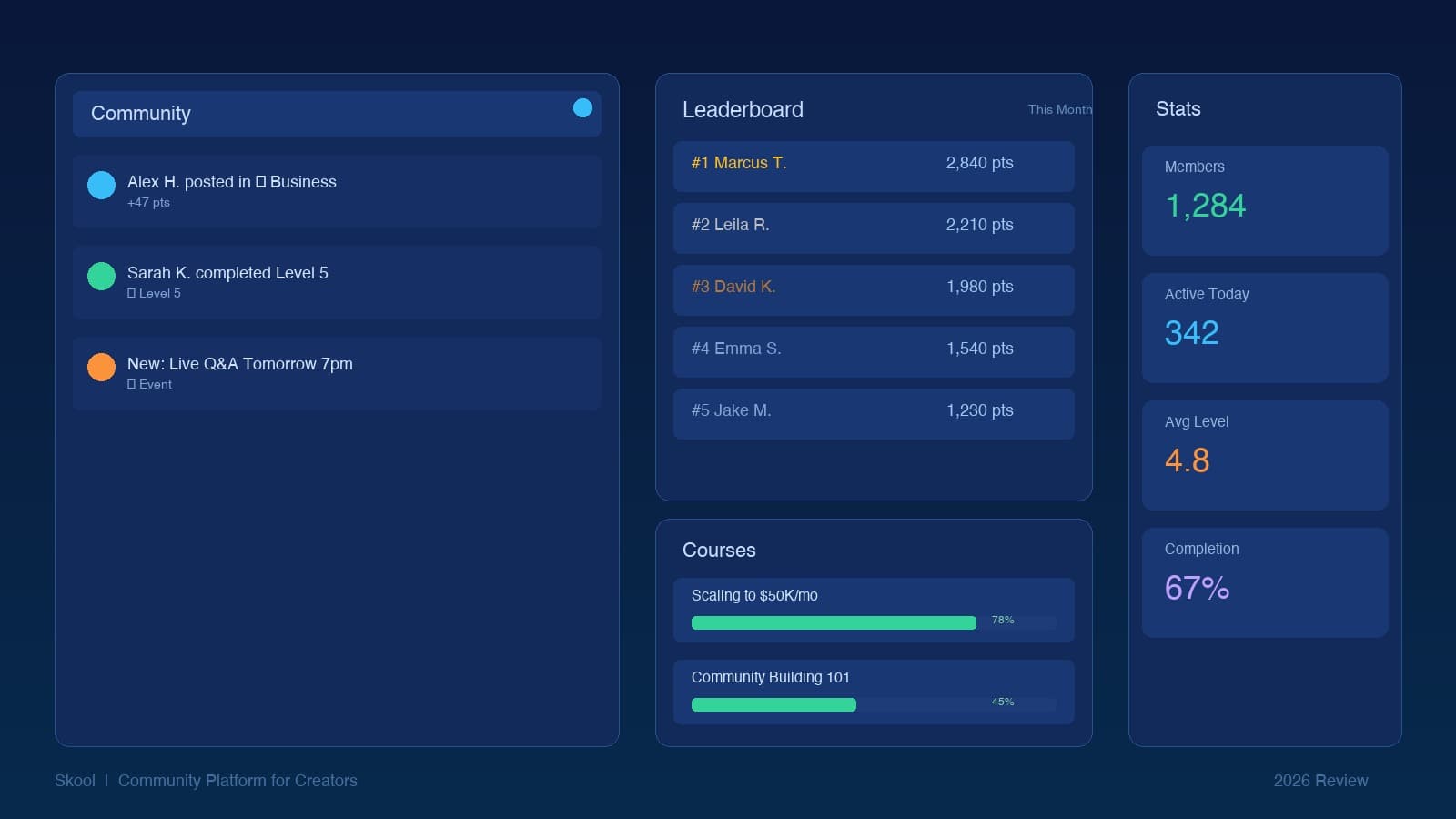
Our verdict: Skool is the best community platform for creators who want simple setup and engaged members — but it's a platform you rent, not a business you own. Rating: 3.8/5.
If you've been anywhere near the creator economy in the last two years, you've heard about Skool. Alex Hormozi put it on his back and made it the default answer to "Where should I run my community?" The platform is genuinely good. But "good" and "right for you" are different questions — and the distinction matters a lot depending on where you want to take your business.
This is an honest review. We'll cover what Skool does well, where it struggles, who should use it, and when creators should consider something else entirely.
The Verdict: Skool Rated 3.8/5
| Category | Score |
|---|
| Ease of setup | 5/5 |
| Community features | 4.5/5 |
| Course tools | 3/5 |
| Pricing transparency | 4.5/5 |
| Analytics & reporting | 2/5 |
| Ownership & portability | 2/5 |
| Mobile experience | 2.5/5 |
| Overall | 3.8/5 |
Skool earns its score through excellent community UX and the simplest onboarding of any creator platform. It loses points on analytics, mobile experience, and the fundamental ceiling every platform-as-a-service hits: you're building your business inside someone else's house.
Skool is a community and course platform that combines a discussion forum, course library, and events calendar under one $99/month subscription — with no transaction fees on member revenue.
Sam Ovens built Skool in 2019 as an internal tool for his own students. It solved a real problem: online courses had abysmal completion rates because learners had no community around the content. Skool bundled community and courses together, added gamification to drive engagement, and opened to the public in 2021.
The premise is simple:
- Creators run a community (free or paid)
- Members post, comment, and complete courses
- Gamification (points, levels, leaderboards) keeps them active
- A public discovery page helps new members find communities
That's it. Skool intentionally doesn't do much more than that.
How Did Skool Become the Hottest Creator Platform?
Two words: Alex Hormozi.
In 2023, Alex Hormozi — the $100M+ entrepreneur and content creator behind Acquisition.com — became Skool's lead investor and its most vocal advocate. He moved his own community to Skool, started making content about it, and effectively became the platform's most powerful distribution channel.
Hormozi's thesis aligned with Skool's product: simpler is better. Facebook Groups are free but algorithmic and distracting. Kajabi is powerful but complex. Discord works for gaming communities but feels chaotic for business courses. Skool offered a cleaner middle ground.
The result: a wave of online educators, coaches, and creators migrated from Facebook Groups and Kajabi to Skool. The platform grew rapidly in 2023–2024, primarily through the personal brands of creators already using it.
That's notable because it means Skool's growth story is itself a content creator play — Hormozi turned a community platform into a viral creator product through his own audience. The meta-lesson isn't lost on us.
Want to build something people talk about?
We help creators build apps their audience promotes — not platforms they just manage. $0 upfront.Book a free strategy call →
What Do You Actually Get Inside Skool?
Skool has three core modules — Community, Classroom, and Calendar — plus a gamification layer that ties them together.
Community
The community feed is the heart of Skool. It looks like a clean social media feed: posts, comments, reactions, media embeds. You can create multiple topic channels. Members can @ mention each other. Posts can be pinned or featured.
The quality bar here is genuinely high. The feed feels faster and less cluttered than Facebook Groups, and more structured than Discord. For discussion-heavy communities, this is where Skool earns its reputation.
Classroom
The course builder is functional but basic. You can create modules with video lessons, PDFs, and text content. Members unlock content as they complete previous lessons.
What's missing: no quizzes, no certificates, no advanced drip scheduling, no affiliate tracking for course sales. If you're selling a serious curriculum-based course, you'll hit walls quickly. This is where Kajabi, Teachable, or Thinkific pull ahead.
Calendar
The events calendar lets you schedule live sessions, calls, or workshops — with reminders and RSVPs. Zoom integration is available. This is a straightforward feature that works well for community events and regular live Q&As.
Gamification
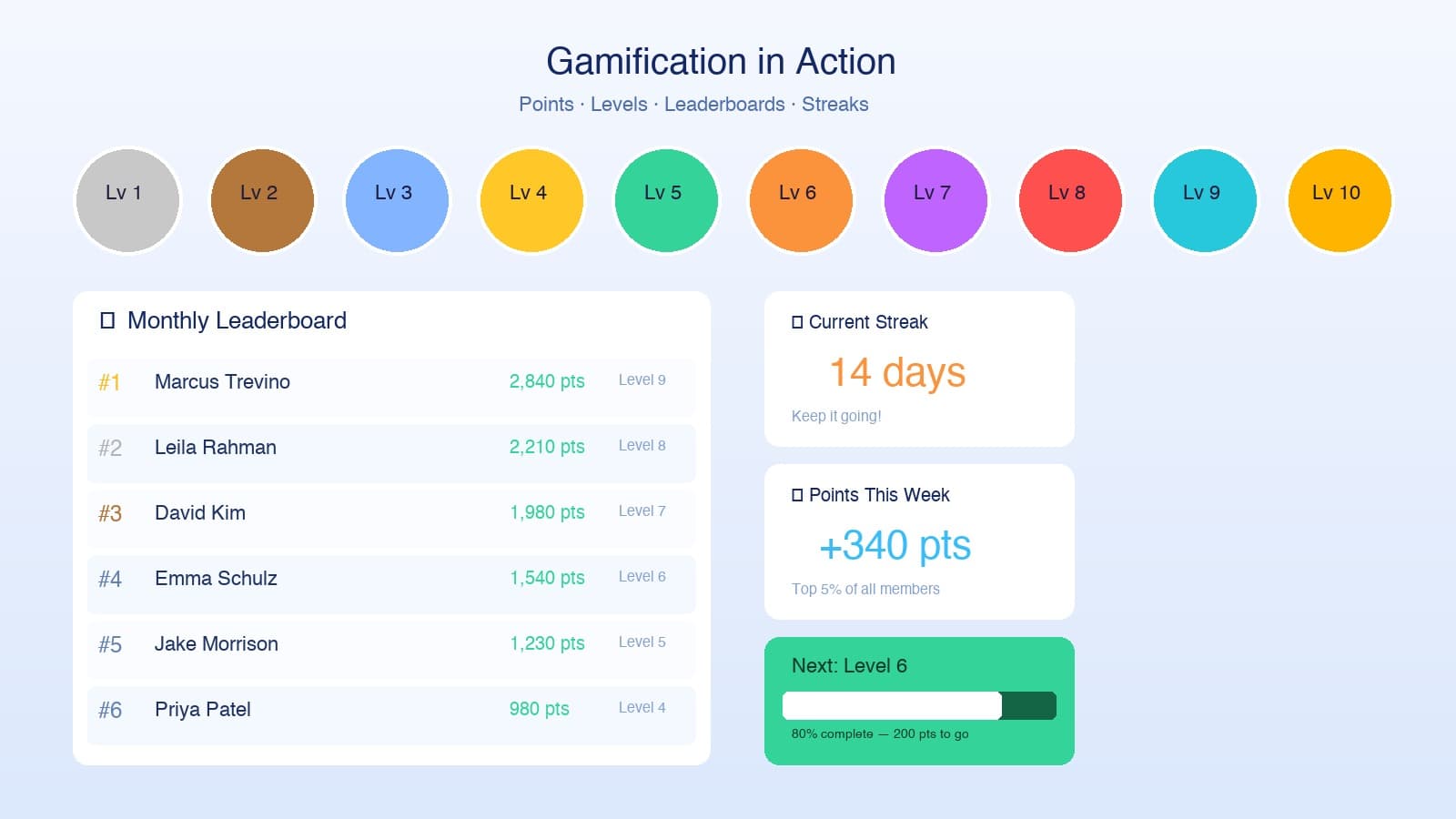
This is Skool's signature move. Members earn points by posting, commenting, completing lessons, and attending events. Points accumulate into levels, and levels are displayed publicly on a leaderboard.
The gamification works. Communities with active leaderboards tend to retain members better because the points system creates daily engagement loops. It's not revolutionary — Reddit has karma, LinkedIn has profile completion — but Skool packages it well for creator communities.
What Does Skool Actually Cost?
Skool charges a flat $99/month to run a community. That's it for the platform fee.
There are no transaction fees on member revenue. If you charge $50/month for access to your community and you have 100 members, you keep the full $5,000 — minus standard payment processing fees (Stripe charges approximately 2.9% + $0.30 per transaction).
| Plan | Monthly Cost | Member Limit | Transaction Fee |
|---|
| Skool (paid community) | $99/month | Unlimited | 0% (Stripe processing applies) |
| Skool (free community) | $99/month | Unlimited | N/A |
The flat fee model is Skool's strongest value proposition against competitors. Kajabi's Growth plan at $199/month adds up faster and still charges a percentage on some tiers. MightyNetworks charges transaction fees. Circle.so charges percentage fees on its lower tiers.
For a creator with 50+ paying members, Skool's economics make sense. The platform cost becomes a rounding error relative to membership revenue.
The honest caveat: Skool is $99/month even if you have zero members. Early-stage creators absorbing that cost while building an audience should factor that in.
Skool makes the most sense for a specific type of creator:
You're a good fit for Skool if:
- Your primary product is ongoing community access (not a one-time course)
- You run regular live events, Q&As, or coaching calls
- Your audience skews toward business, entrepreneurship, fitness coaching, or online education niches (where Skool has the most discovery traffic)
- You want to migrate from Facebook Groups to something cleaner without rebuilding everything
- You prefer paying a flat fee over revenue share models
You're probably not a good fit if:
- You need a fully featured course platform with quizzes, certificates, and affiliate tracking
- You rely on email marketing built into your platform
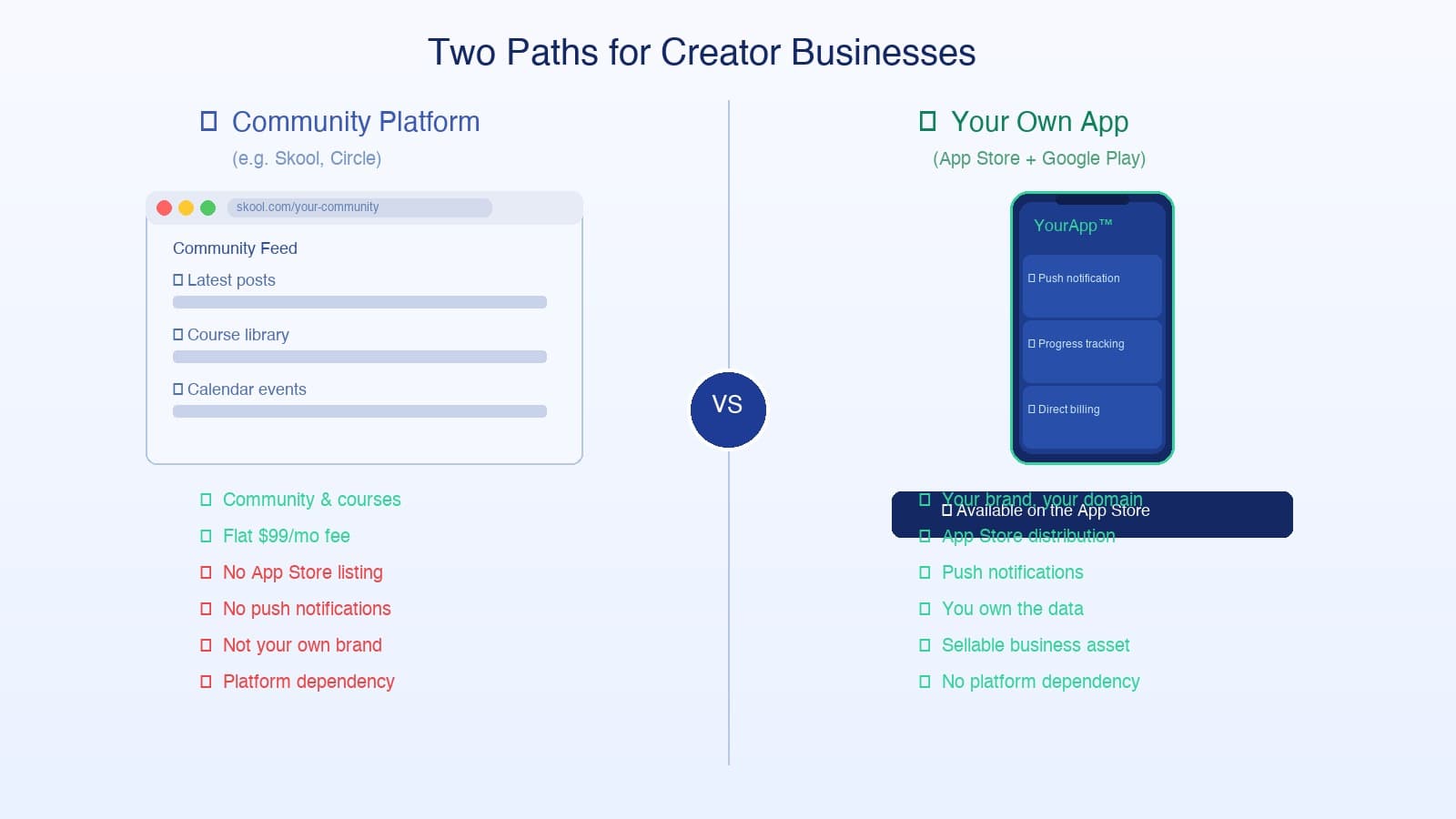
- You want a custom branded experience on your own domain
- You need deep analytics to optimize your funnel
- Your goal is to eventually build something you could sell as a standalone business
That last point matters more than most creators realize. The platforms that generate real acquisition value — the ones that get bought for 8 or 9 figures — are usually standalone apps with their own users, data, and brand identity. A Skool community is an asset you've built on someone else's land.
Skool's simplicity is a feature. It's also the primary limitation. Here's what you won't get:
No email marketing. Skool doesn't send email campaigns to your members. You'll need a separate tool (Mailchimp, ConvertKit, etc.) and manage list sync yourself. This creates fragmentation — your community data lives in Skool, your email list lives elsewhere.
No website or sales page builder. Skool doesn't replace your website. Your community lives at skool.com/your-community-name. You can't point a custom domain at it. When someone Googles your brand, they find your Skool page — not your own site.
No native mobile app. Skool has a progressive web app experience, but members don't download a branded app from the App Store with your name and logo. Push notifications are limited. The mobile experience is functional but not comparable to native iOS or Android apps.
Weak analytics. You can see member counts, posts per day, and basic engagement metrics. What you can't see: conversion funnel data, member lifetime value, cohort retention curves, or A/B test results. If you're serious about optimizing revenue, you'll be flying partially blind.
No digital downloads or product store. Skool isn't a storefront. You can't sell PDFs, presets, templates, or one-time digital products natively. You'd need a separate tool like Gumroad for that.
Is Skool Enough to Build a Real Business?
This is the question worth sitting with.
Skool can absolutely generate real revenue. Creators with highly engaged communities and strong content pipelines are earning $10K–$100K+ monthly through Skool memberships. The platform works.
The more nuanced question: what kind of asset are you building?
A Skool community is a recurring revenue stream that depends on:
- Skool continuing to operate
- Skool not raising prices significantly
- Skool not changing their terms, discovery algorithm, or platform features in ways that hurt you
- Your ability to export and migrate your member data if anything changes
This is the platform dependency problem. It's the same reason creators who build their businesses on brand deals run into ceilings — when the platform (or brand partner) changes the deal, you're exposed.
Creators who've built the most durable businesses have typically done one of two things:
- Used platforms like Skool as a stage in their journey — building community and revenue while simultaneously developing owned infrastructure (their own app, email list, website)
- Built native apps from the start, so their product lives in the App Store with their own brand, their own user data, and their own direct billing relationship
The path from content to product isn't always about skipping tools like Skool. Sometimes Skool is the right first step. But it's rarely the final destination for creators who want to build something worth real money.
Ready to go beyond a community platform?
We build subscription apps for creators — $0 upfront, on the App Store in 3 weeks, we handle everything forever.Talk to our team →
Frequently Asked Questions
Is Skool worth $99/month?
For creators with an existing audience and a clear community use case, yes. If you have 20+ paying members at $30–$50/month, the platform fee is covered and the economics work. For creators still building their first audience, $99/month is a real cost to absorb before seeing returns.
How does Skool make money if there are no transaction fees?
Skool charges all creators a flat $99/month subscription fee regardless of how many members they have or how much revenue they generate. The business model is software subscriptions to creators, not commissions on creator revenue. This aligns Skool's incentives with helping creators grow.
Can I export my Skool community and move to another platform?
Skool allows you to export basic member data including email addresses and names. However, you cannot export posts, community history, gamification points, or course completion data in formats that transfer cleanly to other platforms. Migration is possible but messy — factor that in when you're building a community inside someone else's platform.
What's the difference between Skool and Kajabi?
Kajabi is a full creator business platform: courses, email marketing, website builder, memberships, sales pages, and pipelines. It's significantly more powerful — and significantly more complex to operate. Skool is focused: community, basic courses, and calendar. Creators who are overwhelmed by Kajabi often prefer Skool. Creators who need email automation and sales funnels often outgrow Skool. If you're evaluating both, read our full breakdown of why creators leave Kajabi and what they build instead.
Does Skool work for fitness creators?
Yes — fitness and wellness is one of Skool's strongest niches. Many fitness coaches have migrated their online programs to Skool communities, particularly for group coaching programs and accountability-focused memberships. The gamification features work especially well for habit-based fitness programs. The limitation: Skool can't replace a native fitness app with workout tracking, progress photos, or Apple Health integration.
What's better than Skool for creators who want to own their business?
The answer depends on what you mean by "own." If you want more platform features, Kajabi or Circle.so add functionality. If you want to actually own your infrastructure — your own app in the App Store, your own user data, your own push notifications, your own brand — that means building a custom app. We do exactly that for creators at Software People Love: no upfront cost, 3-week delivery, we handle everything so you can focus on content.
Want to move beyond renting space on someone else's platform? We build subscription apps for creators — fully branded, fully owned, on the App Store in 3 weeks.
Book Your Free Strategy Call →