
Platform Reviews

Whatnot Review 2026: 7 Commission Tiers, a 28-Day Reset, and the $15,000 Line

October 12, 2026
Share
Whatnot Review 2026: 7 Commission Tiers, a 28-Day Reset, and the $15,000 Line

Get Creator Revenue Insights

How creators are turning audiences into subscription businesses
Share
Verdict: Whatnot earns 4 out of 5 for creators who already have physical inventory and the energy to sell it live. It has the buyers, a seller fee that now falls as volume rises, and payouts that arrive within hours of delivery in the US. It loses a point because the lower rate has to be earned again every 28 days, payment processing is charged on the full order including shipping and tax, and each sale is a one-time transaction with a customer who found you on Whatnot's marketplace. This review is built from Whatnot's public seller fees article, its payout timeline, its Tips terms and its App Store listing, all read on October 12, 2026. We have not run a seller account or a live show. Everything below is what Whatnot publishes about itself, and the rating reflects those documented terms. Key Takeaways:
  • Since September 21, 2026, Whatnot's commission depends on your total sales in a four-week period. The US card has seven tiers, from Standard ($0 to $14,999) to Tier 6 ($500,000 and up)
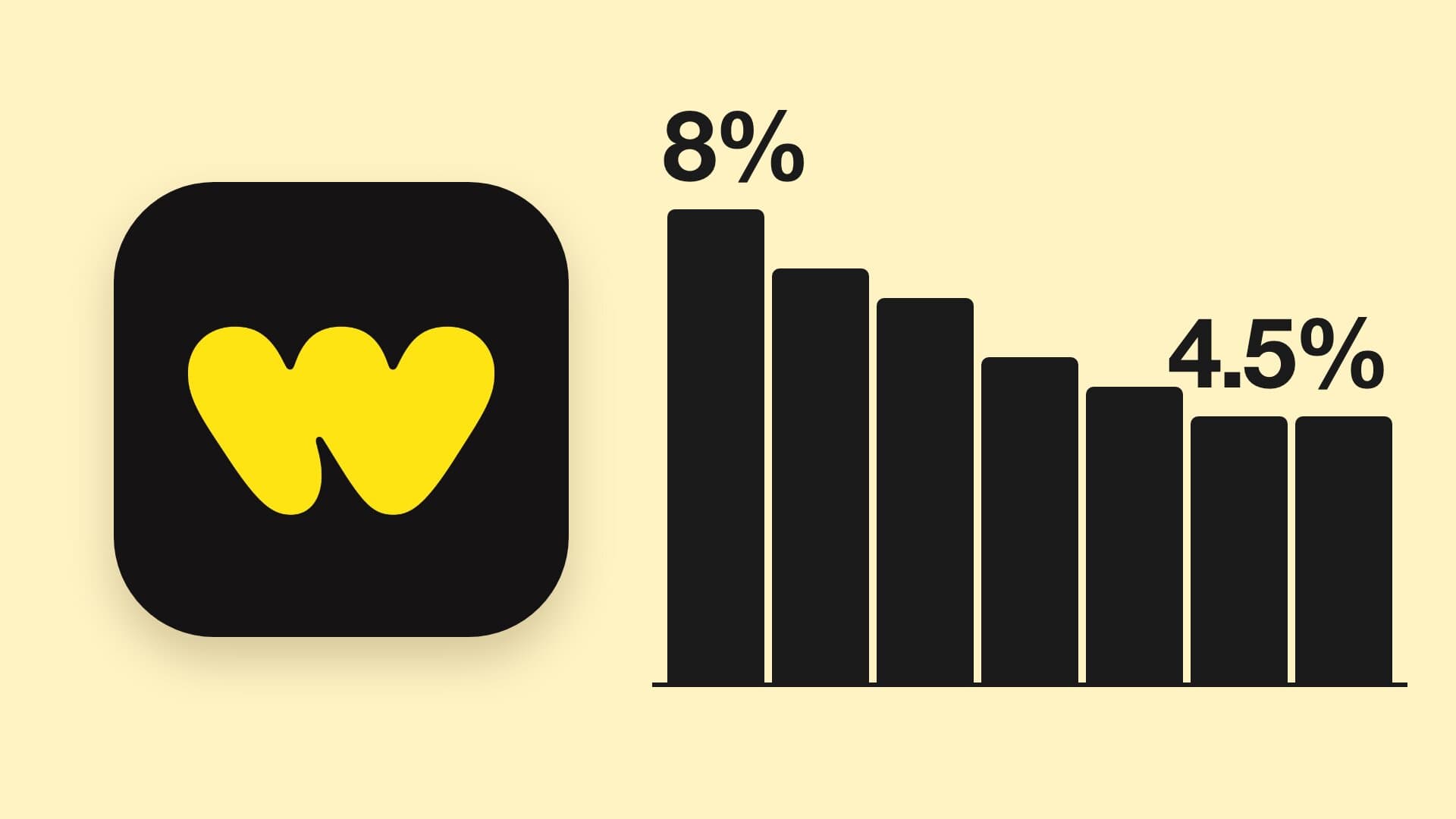
  • US commission starts at 8% in most categories (4% in Coins) and falls to 6.5% in Sports and Trading Card Games, 5% in Other Collectibles, 4.5% in Fashion and 4% in Other. The "as low as 3%" headline is a custom rate for the largest sellers
  • Commission is charged on the item price only. Payment processing of 2.9% plus $0.30 in the US is charged on the item, buyer-paid shipping and tax together, and it never falls with your tier
  • Every period starts from zero. Crossing a threshold lowers your rate next period, not today
  • The Premier Shop 10% commission discount ends November 1. Tips carry no commission, and US earnings become available up to 4 hours after confirmed delivery
Whatnot is a live shopping marketplace. Sellers run livestreamed shows with auctions, flash sales and giveaways, and also list items in a non-live marketplace. Buyers pay through Whatnot, the seller ships, and Whatnot keeps a commission plus a payment processing fee. The company was founded in 2019 by Grant LaFontaine and Logan Head. Its free iPhone app showed 1,054,808 ratings averaging 4.7 on October 12, and its listing says that "last year, small businesses generated more than $8 billion in sales on Whatnot." In August 2026 the company closed a $545 million Series G at a $20 billion valuation, which it said would fund buyer marketing, trust and safety, new categories and markets, and seller tools. The entry bar is low. According to the application guide, you need to live in a supported country and be at least 13 (with a guardian's permission under 18), and "many sellers unlock seller access within minutes." A few categories, such as Luxury Bags & Accessories and Wholesale, need extra approval. The interesting part of Whatnot in 2026 is not getting in. It is the rate card that took effect three weeks ago. In the United States, Whatnot charges a commission of 8% of the item price for most categories at the Standard tier, falling to as little as 4% to 6.5% depending on category once a seller's four-week sales pass set thresholds. Payment processing of 2.9% plus $0.30 per transaction is charged separately on the full order. Here is the full US card from Whatnot's fees article, read October 12, 2026. The sales column is your total across every category in one four-week period.
US tierFour-week salesSports and TCGFashionOther CollectiblesCoinsOther
Standard$0 to $14,9998.00%8.00%8.00%4.00%8.00%
Tier 1$15,000 to $34,9997.75%7.00%7.25%3.90%7.00%
Tier 2$35,000 to $49,9997.50%6.50%6.50%3.80%6.50%
Tier 3$50,000 to $99,9997.25%5.50%6.00%3.70%5.50%
Tier 4$100,000 to $249,9997.00%5.00%5.00%3.60%4.00%
Tier 5$250,000 to $499,9996.75%4.50%5.00%3.55%4.00%
Tier 6$500,000+6.50%4.50%5.00%3.50%4.00%
Three rules sit under the table. Your total sales pick the tier, but each sale is charged at its own category's rate: the category of the show for live sales, and the category of the product for marketplace sales. Whatnot says listing in the wrong category to get a lower rate "is considered fee avoidance" and may lead to enforcement. And the 3% you may have seen in coverage is not on the public card. Whatnot calls it a custom rate for "our highest-volume sellers who work directly with a dedicated account manager."
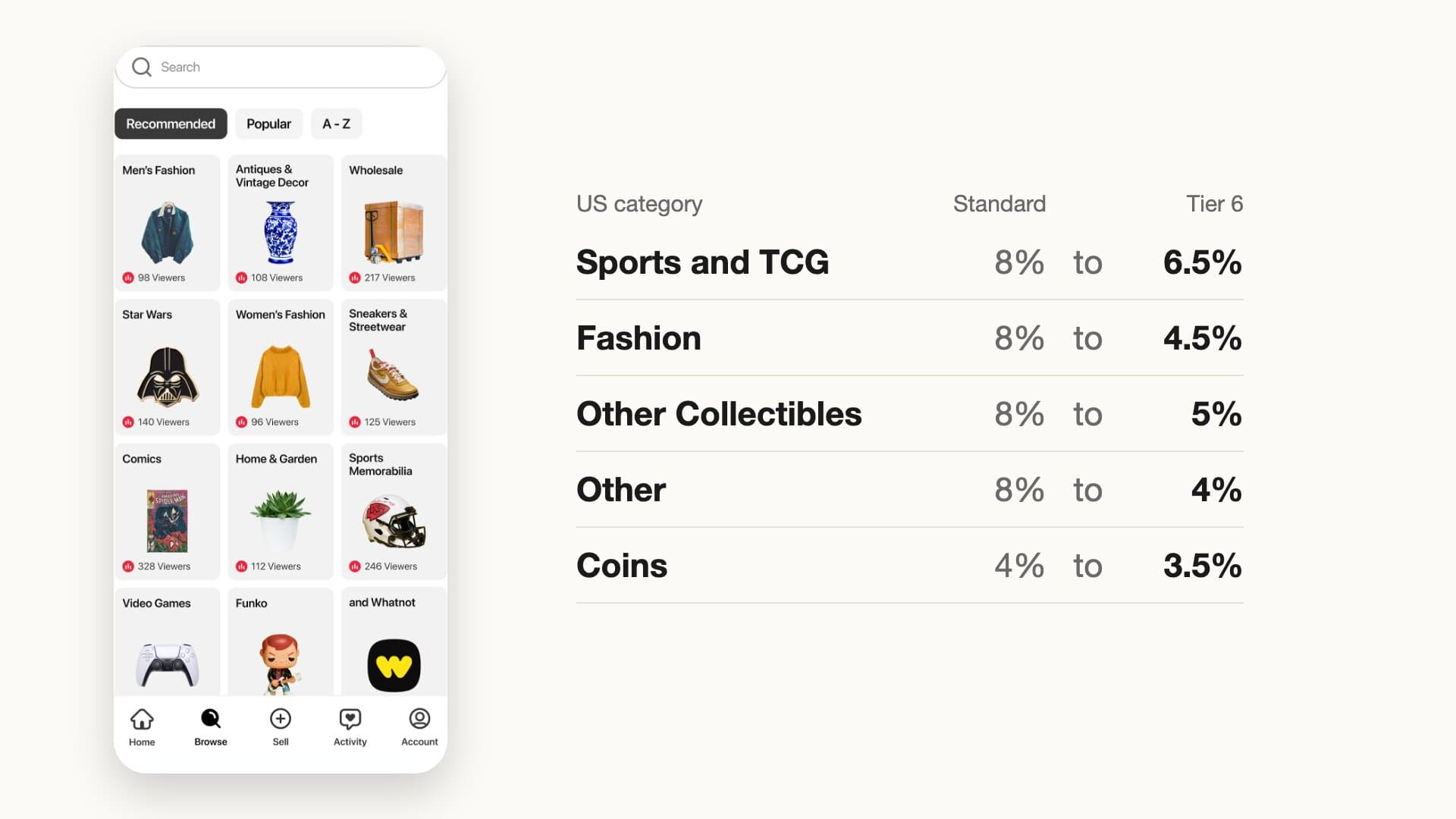
Whatnot's real Browse screen beside the US commission range for five category groups: Sports and TCG 8% to 6.5%, Fashion 8% to 4.5%, Other Collectibles 8% to 5%, Other 8% to 4%, Coins 4% to 3.5%
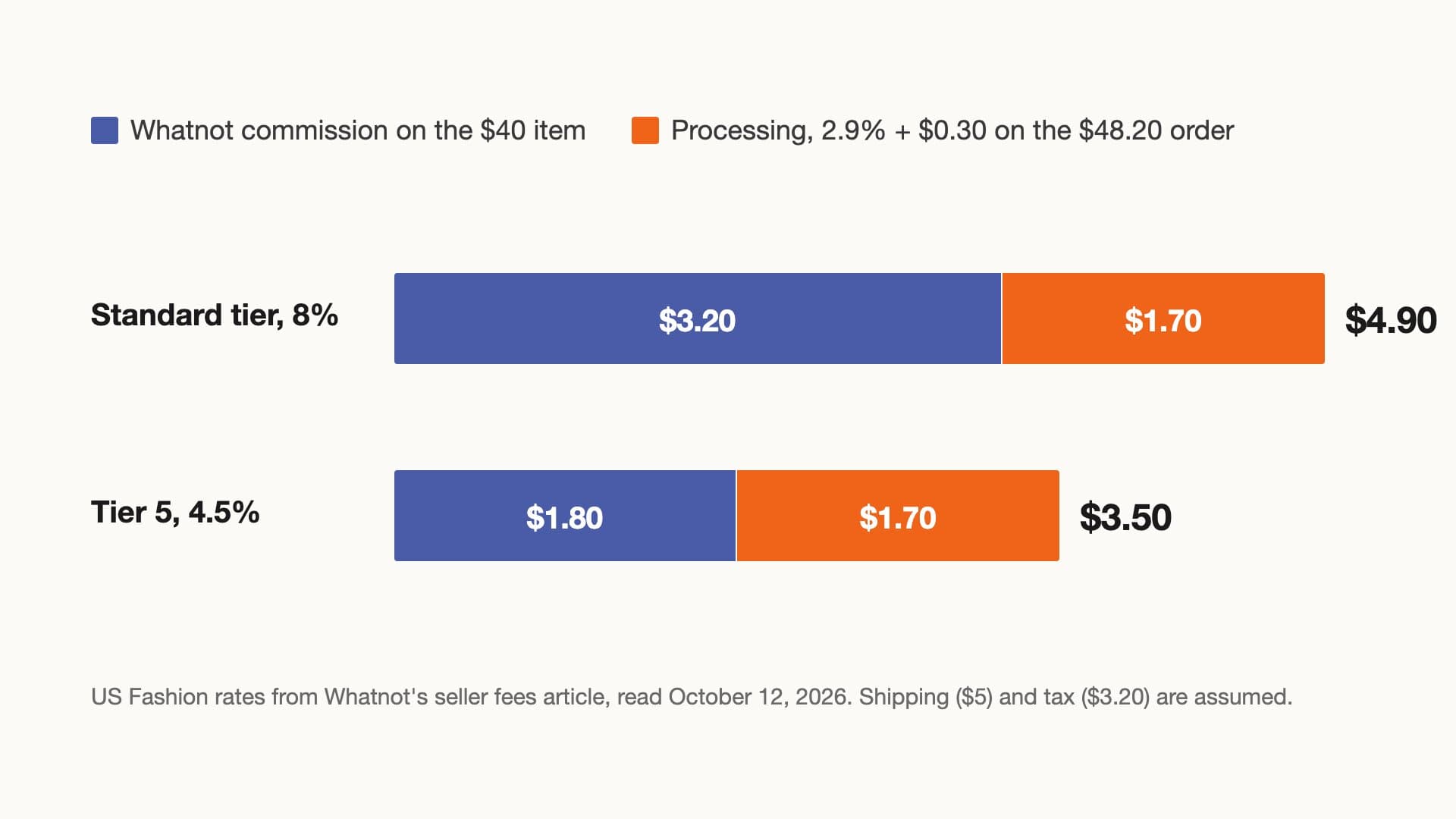
Canada, the UK, Australia and five EU countries have their own cards with different thresholds. Japan keeps a flat 8% (4% on Coins & Money) plus consumption tax. Whatnot sets each seller's tier from total completed sales inside one 28-day period. The rate is locked for that period, a tier earned now applies to the next period, and every new period begins counting from zero, with no carry-over between periods. The fees article is direct about it: "Every period starts from zero. The threshold has to be reached inside one four-week window. Sales don't carry over or stack across periods." Cancelled orders, private shows and local pickup orders come off your total. Sales on a second seller account count only on that account. That produces the number in our title. A Fashion seller who finishes a period at $14,999 pays 8% for the next 28 days. The same seller at $15,000 pays 7%. If the following period also brings in $15,000 of Fashion sales, the commission is $1,200 at 8% or $1,050 at 7%. The $150 gap goes to whoever sold one more dollar of inventory last month. Reaching $15,000 in 28 days takes about $536 in completed sales a day. Whatnot projects your finish by dividing sales so far by the days elapsed and multiplying by 28, and it shows the projection in Seller Hub so you can see whether one more show this week moves you up. Existing sellers did not start at zero on September 21. Whatnot placed each of them using sales from August 24 to September 20. New sellers pay Standard rates until their first full period closes. On a $40 Fashion item with $5 of buyer-paid shipping and $3.20 of sales tax, a US seller at the Standard tier pays $3.20 in commission and $1.70 in payment processing, $4.90 in all, or 12.25% of the item price. At Tier 5 the total drops to $3.50, because only the commission falls. Whatnot's fees article makes a fair point in its own favor. It charges commission on the item price, not on shipping and tax, and it shows a $10 item where 8% on the item ($0.80) beats a competitor's 6% on the whole $15.84 transaction ($0.95). What the example leaves out is Whatnot's own processing fee, which the same article says is calculated "on the total order value paid by the buyer, including the item price, buyer-paid shipping, and taxes, plus a fixed transaction fee." On that $10 sale it adds $0.76, for a total of $1.56. Here is the $40 order (our assumed shipping and tax, Whatnot's published rates) across the US Fashion tiers.
US Fashion tierCommission on $40Processing on $48.20Total feesShare of item price
Standard (8%)$3.20$1.70$4.9012.25%
Tier 1 (7%)$2.80$1.70$4.5011.25%
Tier 2 (6.5%)$2.60$1.70$4.3010.75%
Tier 3 (5.5%)$2.20$1.70$3.909.75%
Tier 4 (5%)$2.00$1.70$3.709.25%
Tier 5 or 6 (4.5%)$1.80$1.70$3.508.75%
The same $40 Whatnot order at the Standard and Tier 5 Fashion rates: commission falls from $3.20 to $1.80 while the $1.70 processing fee does not move
The pattern matters for planning. At the Standard tier, processing is about a third of your fees. At the top public Fashion tier it is almost half. Climbing the card cuts your fee bill by $1.40 on this order, but the floor is set by the card network, not by Whatnot, and a low-priced item feels the fixed $0.30 most. Shipping labels, packaging and the cost of the item itself come on top of all of this, as they do in any merch math. In the US, Canada and Japan, Whatnot makes earnings available up to 4 hours after the carrier confirms delivery, or as soon as a shipping label is generated for sellers eligible for Early Payout. A requested payout usually reaches a US bank in 1 to 2 business days. That is fast by marketplace standards. Our comparison of six creator payers found published waits from 4 days to 75 days, and ShopMy can keep a commission pending for up to 120 days. The exceptions are shipments without standard tracking. A USPS First-Class letter waits 10 days after label generation, and a seller's own label waits 7 days after the tracking number is entered. The UK, Netherlands, Belgium and Australia add a 96-hour settlement period after the sale. Canadian payouts take 3 to 4 business days to arrive. Premier Shop loses its commission discount on November 1. Until October 31, Premier Shop sellers get 10% off their tier rate, so 5% becomes 4.5%. From November 1, the badge keeps its visibility and support perks, but the rate is "set entirely by your sales tier." High-value orders pay no commission above $1,500. In Comics & Anime, Toys & Hobbies, Coins & Money, trading and entertainment cards, Sports Singles, Bags & Accessories and Jewelry & Watches, the high-value rule charges 0% on the part of an order above $1,500. Processing still applies to the full amount. Whatnot labels it a limited-time promotion it can end "at any time." Tips carry no commission. Under the Tips terms, the buyer pays the processing fee and the seller receives 100% of a tip of $1 to $100. A buyer can send at most $200 or 10 tips per seller per livestream and $500 a day, and sellers may not ask for tips outside the built-in feature. If you are a collector, reseller or thrift creator with 50K followers and a garage full of inventory, Whatnot is a strong fit. Your audience already likes watching you open, grade and price things, and the platform turns that into auctions with a payout within hours of delivery. Book shows on a regular schedule and watch the Seller Hub projection near the end of each period. If you sell your own branded merchandise, the math is closer. Whatnot's buyers come for discovery and deals, and even at the top Fashion tier the $40 order above still costs 8.75% of its price in fees. Compare it with your current store, and with what TikTok Shop is now doing at scale, before moving your catalog. If you sell expertise rather than objects, such as coaching, plans, recipes or lessons, Whatnot is not built for you. It is a marketplace for physical goods that ship. The new card rewards one thing: more sales inside each four-week window. A seller who takes a month off drops back toward 8%, and a seller who doubles output earns a lower rate for the following month. Nothing in the structure rewards a customer for coming back on their own. Revenue on Whatnot is earned show by show, the same pattern we described in why creator income resets to zero every month. That is not a flaw in Whatnot. It is what a live marketplace is. Buyers find you through Whatnot's feed, follow you inside Whatnot's app and pay through Whatnot's checkout, and the relationship lives on the platform. A creator who wants revenue that renews whether or not they are live needs a second product they own. That is the work we do at Built by Foundry, where we build the product, launch it and keep running it at $0 upfront. Use Whatnot if you have physical inventory, enjoy selling live and can hold a steady weekly show schedule. The audience is real, the payout is quick, and the new card lowers your rate as you grow. Plan around it carefully if your sales are seasonal or lumpy. Budget on the Standard rate plus processing, about 12% of item price on a typical order, and treat a lower tier as a bonus you re-earn each period. Check one thing first: open a past order in Seller Hub, under Receipt and earnings details, and confirm the commission and processing lines match the card for your category. Then check whether your account carried the Premier Shop discount, because that discount ends on November 1.
Our work

Creators who already did this

These are apps we designed, built, shipped, and still run today, with the creator keeping the code and the audience.

Ellie Fausett

Ellie Fausett

Founder & CEO of Vector Guard

Spot disease-carrying pests before they reach your family.

Top Health App
Read the case study
Vector Guard screenshots
Samantha Mae

Samantha Mae

Founder & CEO of NineLives

Cat health tracking from the world's most beloved Scottish Fold.

Top Health App150K+ followers
Read the case study
NineLives screenshots
Liv Merima

Liv Merima

Founder & CEO of Claim It

Custom affirmations that help millions choose themselves.

Top Lifestyle App150K+ followers
Read the case study
Claim It screenshots

Creator app strategy

Curious what your app could be?

Enter your handle and BUILT BY FOUNDRY will research your audience and present custom app concepts. Free.

Whatnot Review 2026: 7 Commission Tiers, a 28-Day Reset, and the $15,000 Line