
Platform Reviews

How Fast Do Creators Get Paid in 2026? 6 Payers, 4 Days to 75 Days

September 11, 2026
Share
How Fast Do Creators Get Paid in 2026? 6 Payers, 4 Days to 75 Days

Get Creator Revenue Insights

How creators are turning audiences into subscription businesses
Share
Key Takeaways:
  • Apple's App Store Connect help states that payments are made "within 45 days of the last day of the fiscal month in which the transaction was completed." Google Play's help states that a month's orders "will get paid out around the 15th of the following month"
  • Amazon is the slowest payer on this page. Associates Central states that "Commission income are paid by direct deposit approximately 60 days after the end of the month for which they are being paid"
  • Stripe publishes a 2 business day settlement time for United States accounts and Shopify publishes a 3 business day minimum for United States merchants, which puts an owned checkout at an average wait of about 4 days against Amazon's 75
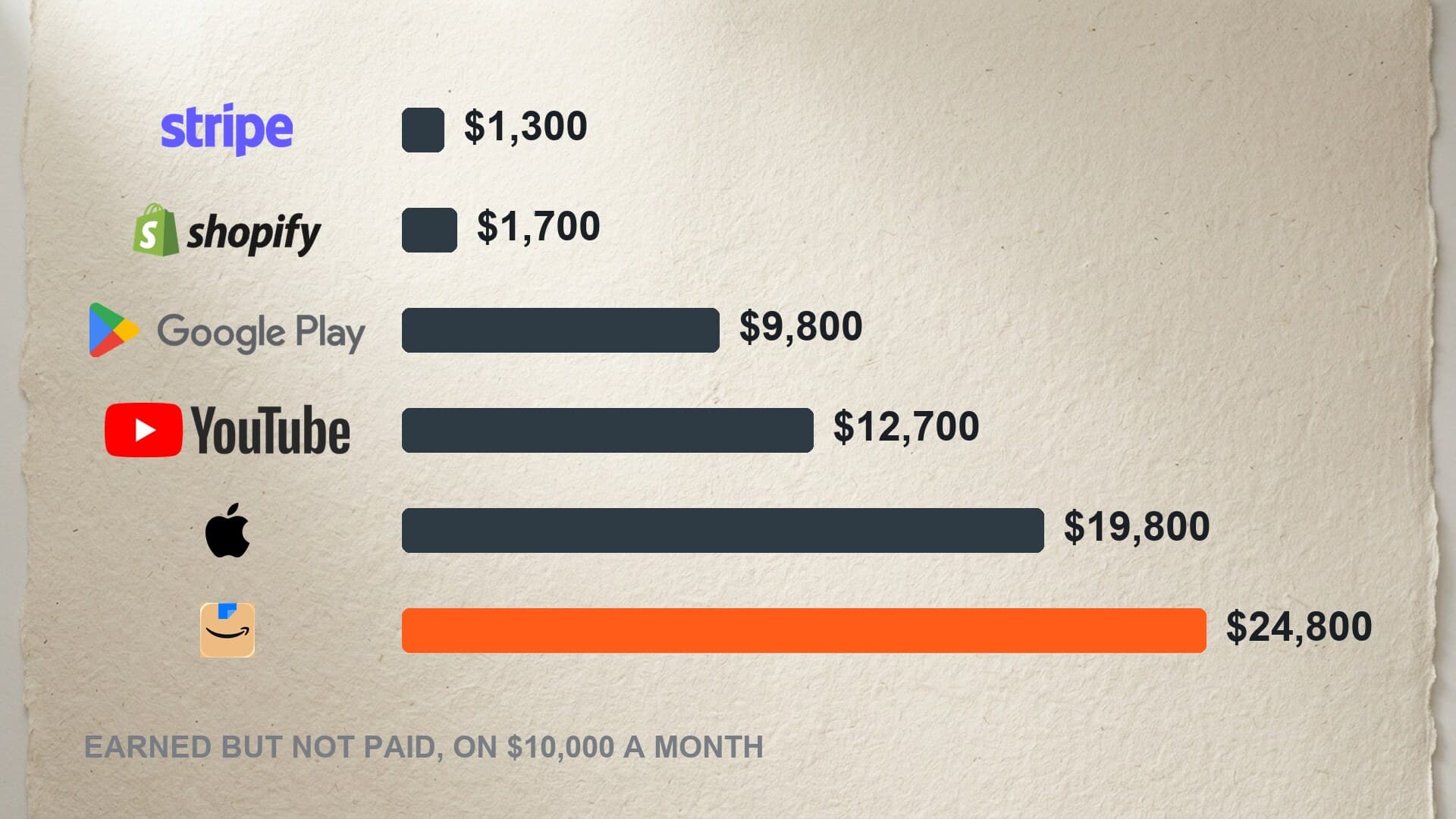
  • On a steady $10,000 a month, the average wait converts to a permanent parked balance: about $1,300 on your own Stripe checkout, about $19,800 at Apple's published commitment, and about $24,800 at Amazon
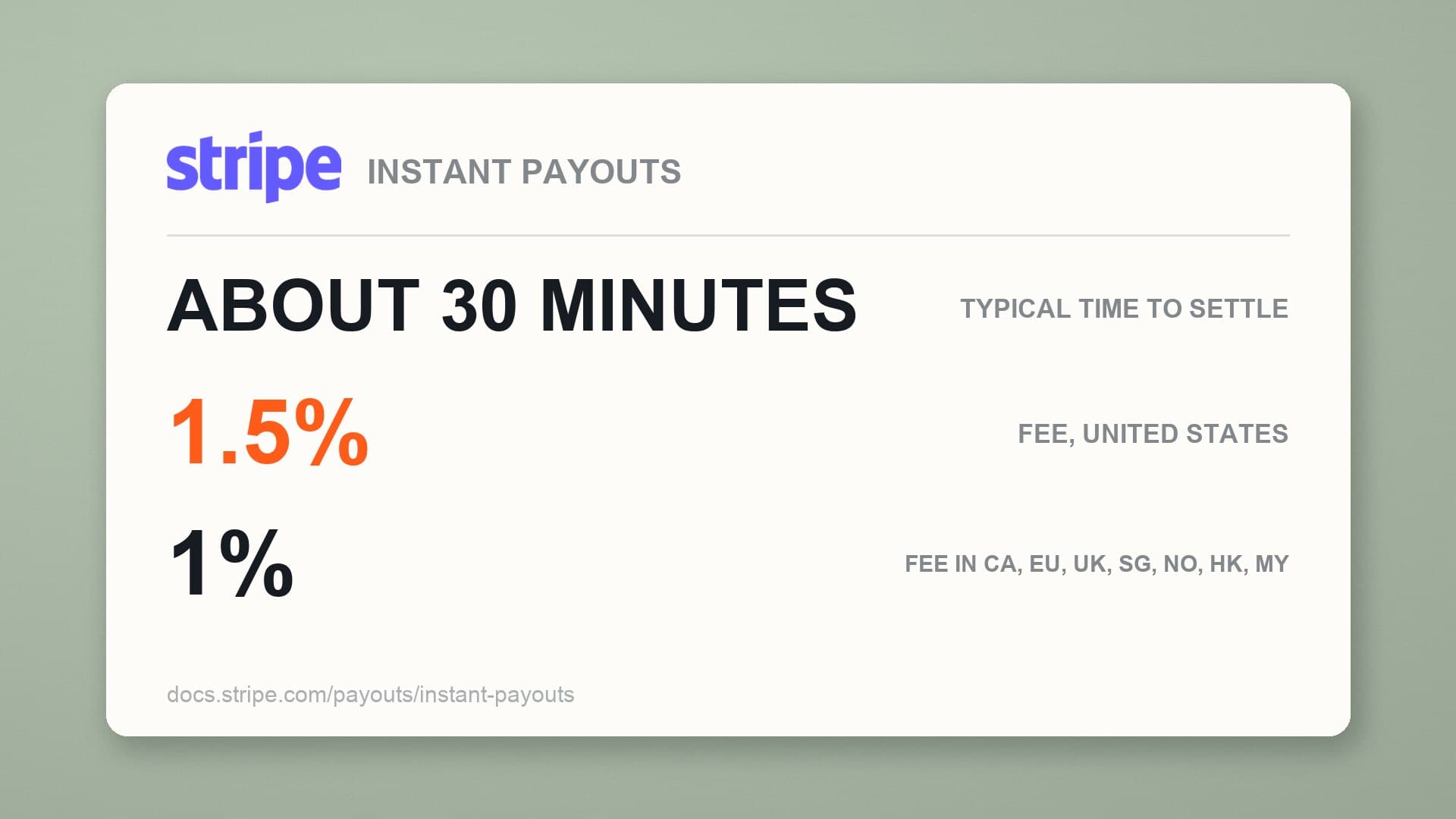
  • Stripe sells the way out of its own waiting period. Instant Payouts arrive in about 30 minutes for a 1.5% fee in the US, which is the only published price anyone puts on this problem
Every creator knows the fee. Fifteen percent, thirty percent, three percent, the number gets argued about in comment sections and on podcasts and in our own operating cost breakdown. Almost nobody knows the second number, which is how long the company holds the rest before it reaches a bank account. That second number is bigger than it looks, and unlike the fee it is not a percentage. It is a pile of your own money sitting somewhere else, permanently, for as long as the business runs. We priced six payers against one identical month: $10,000 in sales, spread evenly across a 30 day month, starting Tuesday, September 1, 2026. Every figure below is quoted from the company's own published help page, read on September 11, 2026. The spread between the first landing date and the last is 87 days.
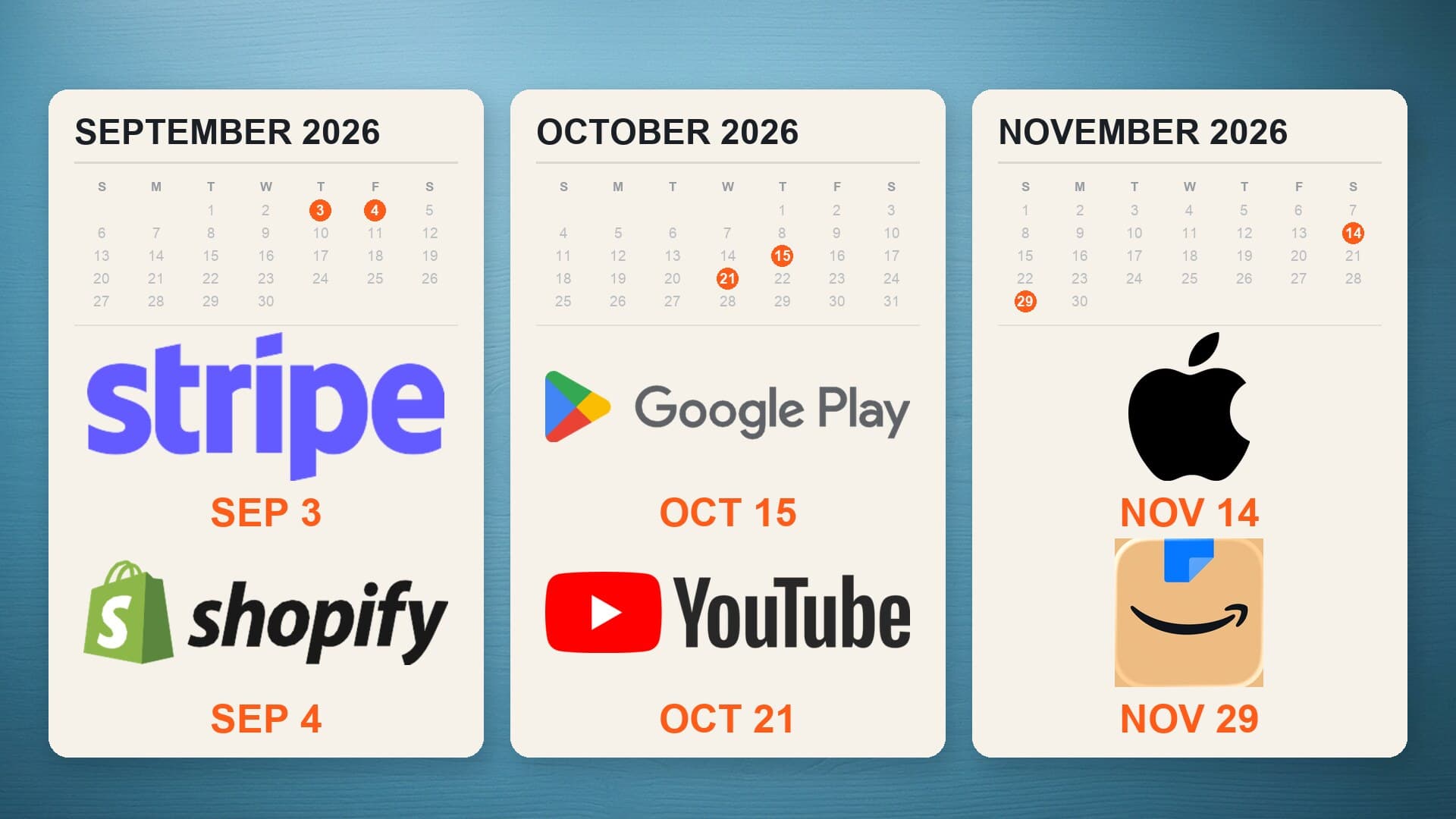
PayerPublished waitA sale made September 1, 2026 landsSource
Your own checkout, Stripe2 business daysSeptember 3Stripe payouts
Shopify Payments, US3 business days minimumSeptember 4Shopify payouts, United States
Google PlayAround the 15th of the following monthOctober 15Play Console help
YouTube and AdSenseIssued between the 21st and the 26th of the following monthOctober 21AdSense payment timelines
Apple App StoreWithin 45 days of the last day of the fiscal monthNovember 14App Store Connect help
Amazon AssociatesApproximately 60 days after the end of the monthNovember 29Associates Central
Two of those dates are in the same week as the sale. Four of them are in a different quarter. The last one, Amazon, falls 89 days after the customer's card was charged, on a Sunday, and Google warns on its own payout page that deposits are not initiated on weekends or banking holidays, so in practice the real dates slip further than the published ones. Patreon and Twitch are the honest omissions. Both companies' help pages refused an automated read on the day of writing, and a payout schedule we cannot quote from the source is a payout schedule we do not publish. Apple holds App Store revenue for up to 45 days after the fiscal month closes, Amazon holds affiliate commission for approximately 60 days after the calendar month closes, Google Play pays around the 15th of the following month, and YouTube pays between the 21st and the 26th. Stripe settles United States accounts in 2 business days and Shopify Payments in a minimum of 3. Apple's number is a commitment rather than a schedule. The App Store Connect help page states the 45 day limit and says nothing about a typical date, because Apple publishes no official payment calendar at all, which is why our own 2026 App Store payment date guide builds its forecast from the fiscal calendar and labels the dates as estimates. In practice developers see money sooner than 45 days. The point of the published number is that 45 days is the version Apple is willing to be held to, and you plan a business against the commitment, not the pattern. Google runs the tightest published schedule in the group and it is worth reading the sequence, because it explains why "next month" is really six weeks. AdSense finalizes the previous month's estimated earnings on the 3rd. Payment information has to be correct by the 20th. Payment is issued between the 21st and the 26th. So a video that earned on September 2 finalizes on October 3, clears its threshold check on October 20, and pays after October 21. Nothing went wrong in that sequence. That is the sequence working. Amazon is the outlier and it is the rail most creators are actually on. Sixty days after the end of the month means a January 2 purchase pays around March 1. We wrote about the 10 commission rates in Amazon's published fee schedule and what most creators actually earn on them, and the rate is only half the story. A 3.00% commission paid 89 days later is a different product from a 3.00% commission paid on Thursday. Stripe and Shopify are the two rails where the money is yours in the same week, and they are the only two on this page where nobody is deciding anything about your account once a month. Float is the balance you have earned but cannot touch, and it is permanent. On $10,000 a month spread evenly, an average sale waits about 4 days on your own Stripe checkout and about 75 days at Amazon Associates, which parks roughly $1,300 against roughly $24,800 of your own money in somebody else's account for as long as the business runs. The arithmetic is one line and you can check it. Take the average wait in days, divide by 30, multiply by your monthly revenue. For a payer that batches at month end, the average wait is the payer's published delay plus about 14.5 days, because the average sale happens in the middle of the month and has to wait for the month to finish before the clock even starts.
PayerAverage waitParked at $10,000 a monthParked at $40,000 a month
Your own checkout, StripeAbout 4 days$1,300$5,300
Shopify Payments, USAbout 5 days$1,700$6,700
Google PlayAbout 30 days$9,800$39,300
YouTube and AdSenseAbout 38 days$12,700$50,700
Apple App StoreAbout 60 days$19,800$79,300
Amazon AssociatesAbout 75 days$24,800$99,300
A bar chart showing money parked at each payer on a ten thousand dollar month, from one thousand three hundred dollars at Stripe to twenty four thousand eight hundred dollars at Amazon Associates, each bar labelled with the company's real logo
Read the Amazon row again. A creator doing $10,000 a month in affiliate commission has close to two and a half months of revenue sitting inside Amazon at all times. It never comes back, because the moment the oldest month pays, the newest month takes its place. The only day you see that money is the day you stop earning, and that is the worst possible day to receive a windfall. This is not a scandal and nobody is stealing anything. Every company on this page publishes its schedule and every one of them pays. It is simply a cost that never appears on an invoice, which is why creators optimize the 3% they can see and ignore the $24,800 they cannot. Sort the table by wait and you have accidentally sorted it by something else: how much of the customer relationship the payer keeps. Amazon is slowest, and Amazon keeps everything. The buyer's name, card, address, replenishment cycle, and reorder all belong to the retailer. Apple is second slowest, and Apple keeps the payment relationship and the subscription management screen while handing you the customer's usage. Google Play sits with Apple. YouTube is next, and it keeps the audience entirely. Stripe is fastest, and Stripe keeps nothing at all. It moves your money into your account and sends you an invoice for doing it. That is not a coincidence, it is the same fact stated twice. A company that owns the customer has no urgency about your cash, because you have nowhere else to take the relationship. A company that only processes a payment is competing on how fast it clears, because clearing is the entire product. It also means the payout wait is a useful proxy for a question that is harder to answer directly: how replaceable are you here? The rails that clear in days are the rails where you are the merchant. The rails that clear in months are the rails where you are the supplier. Consider the money you never receive at all, too. When a customer disputes a charge, the windows and the fees differ by rail, which we mapped in the creator refund and chargeback guide. A long payout hold and a long dispute window stack, and they stack in the same direction. Yes, on one rail, and the published price tells you what everyone thinks this is worth. Stripe's Instant Payouts settle in about 30 minutes and cost 1.5% of the payout in the United States, against 1% in Canada, the EU, the UK, Singapore, Norway, Hong Kong, and Malaysia. That 1.5% is the single most useful number on this page, because it is the only place anyone has put a price on waiting. Stripe is charging one and a half points to compress a two business day wait to half an hour. Nobody sells you a way to compress Amazon's 60 days, at any price, which tells you how that option would be priced if it existed.
The published Stripe Instant Payouts terms set large: about 30 minutes to settle, a 1.5 percent fee in the United States and 1 percent in Canada, the EU, the UK, Singapore, Norway, Hong Kong and Malaysia, beside the real Stripe wordmark
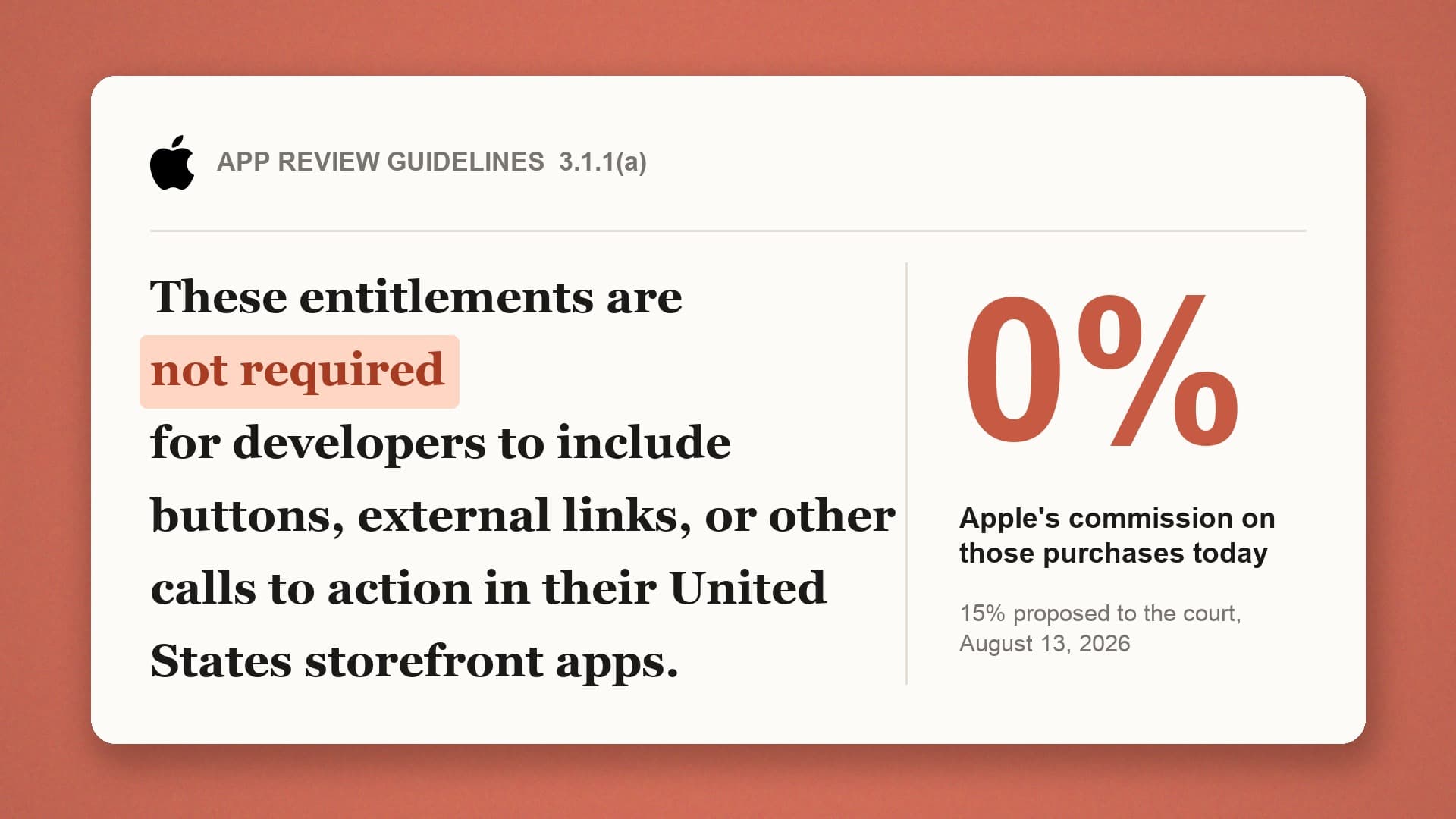
Compare that price to the alternative. Moving a $10,000 month from Amazon's rail to your own checkout releases about $23,500 of parked balance, one time, and then keeps you four days behind instead of 75 forever. Stripe would charge you $150 a month to shave two days. Owning the rail is free and shaves seventy. There is a second way to shorten the wait that most creators never consider, which is to change where the checkout happens rather than who processes it. Apple's own guidelines now allow United States apps to send customers to a web checkout, and we worked through the six rates and the break-even in a separate piece. The commission math there is close. The payout math is not close at all: a link-out sale settles through your own Stripe account in 2 business days instead of waiting on a fiscal month you do not control. If you are a creator with 50,000 or more engaged followers who already sells something, you have every one of these rails running right now and you have probably never added them up. You might have an Amazon storefront, a YouTube channel in the Partner Program, a Shopify store, and a Patreon. Four payers, four schedules, and no single view of what any of them is holding. Open each dashboard and write down two numbers: the balance that has been earned but not paid, and the date it is scheduled to arrive. Add the first column. That total is your float, it is your money, and it is the size of the loan you are currently making to four companies at zero percent. Then ask the harder question, which is not "how do I get it faster" but "which of these would still pay me if I stopped posting on Monday." Amazon would pay you for 60 more days and then stop forever, because the claim on a customer expires the moment the click does. YouTube would pay you for six weeks and then decline. A subscription business would keep billing, because a subscriber renews without being persuaded again. Every number in this post is published by somebody else and none of it is negotiable. Apple will not shorten 45 days for you. Amazon will not shorten 60. You cannot call Google and ask for the 15th to be the 5th. The one variable you control is which rails carry the majority of your revenue, and that is a product decision rather than a finance decision. A creator selling through a storefront is a supplier on 60 day terms. A creator selling a subscription inside their own product is a merchant on a two day cycle, with a customer list, a renewal, and a balance that is four days deep instead of two and a half months. BUILT BY FOUNDRY builds that version. We build a creator's software business in about three weeks, at $0 upfront, on a revenue share. The creator owns the business and the revenue. We run the payout reconciliation, the store relationship, and the product improvements after launch and permanently, because our side only works if the product keeps earning. The fee is what you argue about. The float is what you finance. Right now, somebody else is holding a chunk of your year, and they published exactly how long they intend to keep it. Apple's App Store Connect help page states that payments are made "within 45 days of the last day of the fiscal month in which the transaction was completed," provided the account has cleared the minimum monthly payment threshold for each country or region. Apple publishes no official calendar of payment dates, so 45 days after the fiscal month close is the only commitment a developer can plan against, even though payments often arrive earlier. Google's Play Console help states that "any orders processed, refunded, or charged-back from the 1st of a given month to the end of the month will get paid out around the 15th of the following month." The earned balance has to clear a minimum at payout time: US$1 for merchants receiving local-currency payouts and US$100 for merchants receiving USD wire transfers. Google also notes that deposits are not initiated on weekends or banking holidays. Amazon Associates Central states that "commission income are paid by direct deposit approximately 60 days after the end of the month for which they are being paid." A commission earned on January 2 therefore pays around March 1. That makes Amazon the slowest payer in this comparison by roughly two weeks over Apple and by more than two months over a direct Stripe checkout. Stripe publishes a 2 business day settlement time for United States accounts, meaning funds become available two business days after the charge, and the payout schedule then determines when they leave for your bank. Instant Payouts are available separately: funds typically settle within about 30 minutes for a 1.5% fee in the United States, or 1% in Canada, the EU, the UK, Singapore, Norway, Hong Kong, and Malaysia. Yes, as a permanent balance rather than a fee. The average sale waits the payer's published delay plus roughly half a month when the payer batches at month end, so on $10,000 of monthly revenue the parked amount runs from about $1,300 on a two business day rail to about $24,800 on Amazon's 60 day rail. That money is never lost, but it is never available either, because each month's payment is replaced by the next month's balance.
Our work

Creators who already did this

These are apps we designed, built, shipped, and still run today, with the creator keeping the code and the audience.

Brandon Whiteleather

Brandon Whiteleather

Founder & CEO of Freeze Dry Buddy

Freeze drying made foolproof, from a homesteader who's done it 1,000 times.

Top Food App1.4M+ followers
Read the case study
Kristen Donathan

Kristen Donathan

Founder & CEO of Stain Fix

Snap a stain. Get the fix in seconds.

Top Lifestyle App1.5M+ followers
Read the case study
Stain Fix screenshots
Ellie Fausett

Ellie Fausett

Founder & CEO of Vector Guard

Spot disease-carrying pests before they reach your family.

Top Health App
Read the case study
Vector Guard screenshots

Creator app strategy

Curious what your app could be?

Enter your handle and BUILT BY FOUNDRY will research your audience and present custom app concepts. Free.

How Fast Do Creators Get Paid in 2026? 6 Payers, 4 Days to 75 Days