
Turning Knowledge into Products

How Long Should a Free Trial Be? 4 Lengths, 17,000 Apps

October 1, 2026
Share
How Long Should a Free Trial Be? 4 Lengths, 17,000 Apps

Get Creator Revenue Insights

How creators are turning audiences into subscription businesses
Share
Key takeaways:
  • The right free trial length depends on which plan the trial sits in front of. RevenueCat's study of 17,000+ apps, published September 28, 2026, found different winners for weekly, monthly and annual plans
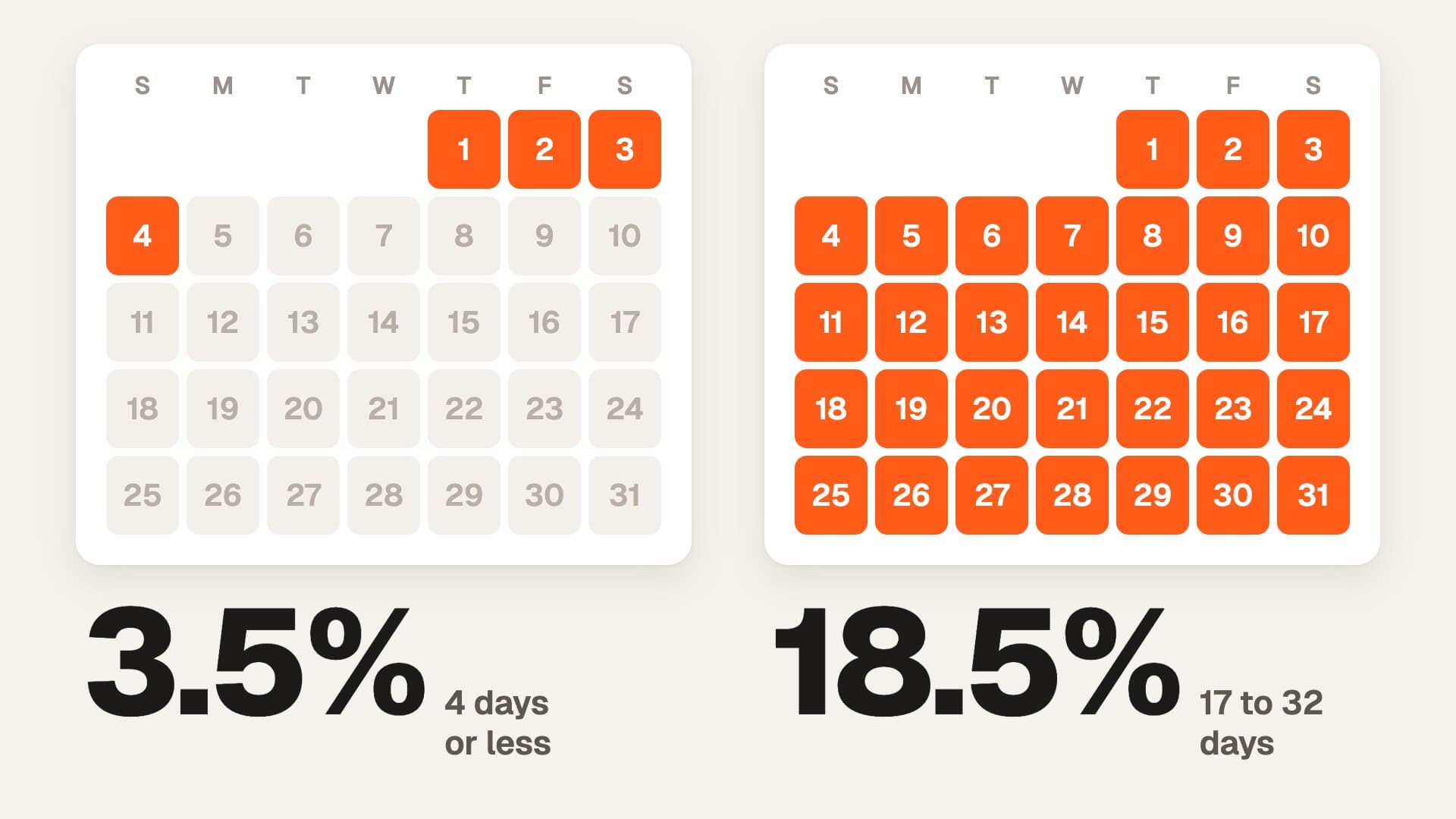
  • Annual plans: 3.5% of people who started a trial of 4 days or less paid and then renewed once. After a trial of 17 to 32 days, 18.5% did
  • Monthly plans: the share who paid and renewed rose from 18.5% to 30.6% at 10 to 16 days, then levelled off
  • Weekly plans: short trials are fine. The gap was small (11.8% versus 14.4%) and few apps run longer weekly trials
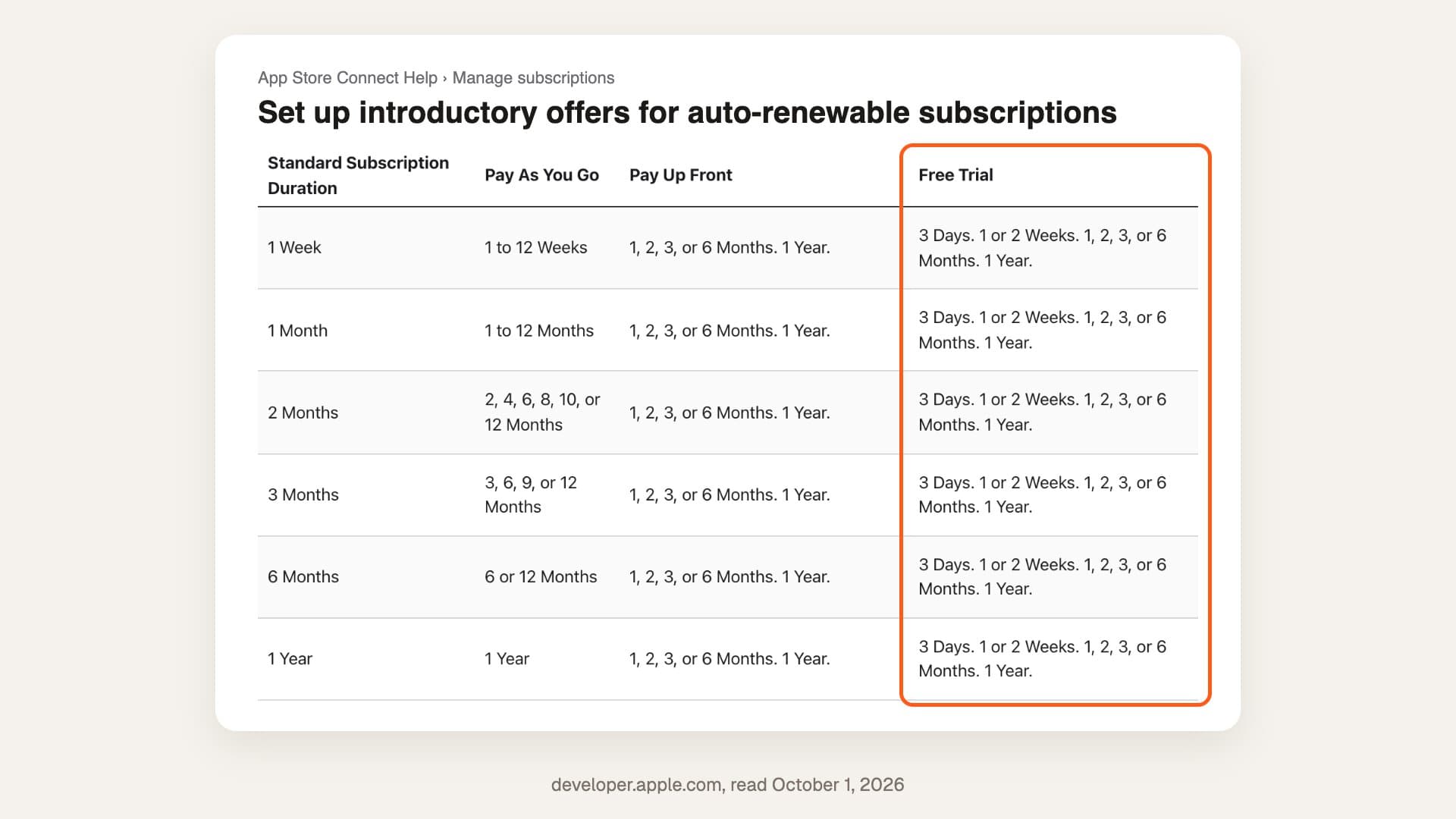
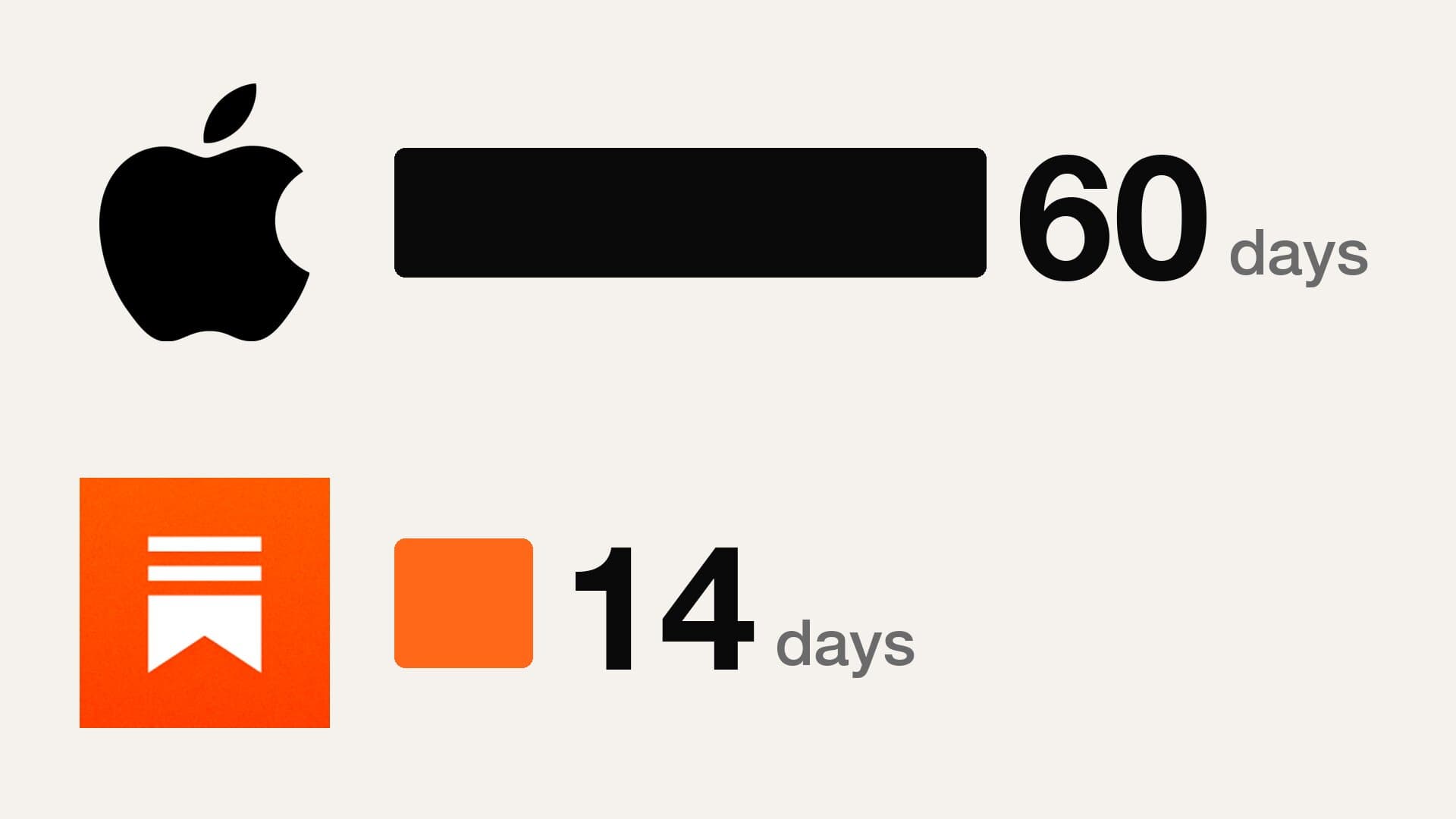
  • On the App Store you don't pick a number of days. You pick from Apple's fixed list: 3 days, 1 or 2 weeks, 1, 2, 3 or 6 months, or 1 year. Google Play allows anything from 3 days to 3 years
  • These are correlations. People still in a trial on day 25 are already more committed than people who leave on day 2. So test longer trials before you switch to them
Most subscription apps run short trials. When RevenueCat looked at the 100 apps with the most trial starts in each category, trials of four days or less were the norm on weekly plans, and monthly and annual plans leaned toward trials of nine days or less. Short trials get paid sooner, give ad campaigns faster feedback, and cost less to give away. Common advice says the same thing: keep the trial short so people decide while they're still keen. Two of this blog's own older guides said so too, and told creators to skip 14-day trials entirely. The new data doesn't support that rule for monthly or annual plans. Here is what it does support, what you can actually configure, and how to pick a length for an audience you already know. A free trial should last as long as your customer needs to see the product work, and the plan behind the trial changes the answer. On weekly plans a trial of a few days is enough. On monthly plans, renewals in RevenueCat's 2026 data peaked with trials of 10 to 16 days. On annual plans, the share of trial users who paid and renewed kept rising up to trials of 17 to 32 days. That answer comes from RevenueCat's analysis of 17,000+ apps on the App Store and Google Play, covering trials started between August 2025 and July 2026. It reports median app-level rates and splits the results by plan length, category, region, and whether the app is AI-based. The study measures something most dashboards skip: whether a trial user paid and then paid again. The first charge tells you how well the paywall worked. The second charge tells you whether the customer found the product worth keeping. A trial that wins on first payments and loses on second payments is just bringing the cancellations forward a month. On the App Store, you don't type a number of days. In App Store Connect, a free trial for an auto-renewable subscription is chosen from a fixed list, and Apple's introductory offer help page gives the same list for every plan length from one week to one year.
Apple's App Store Connect Help page Set up introductory offers for auto-renewable subscriptions, showing its table of offer durations. For every standard subscription duration from 1 week to 1 year, the Free Trial column lists the same options: 3 days, 1 or 2 weeks, 1, 2, 3, or 6 months, or 1 year
That makes RevenueCat's four groups easy to translate. On iPhone, each group corresponds to one of Apple's choices:
RevenueCat trial groupClosest App Store choice
4 days or less3 days
5 to 9 days1 week
10 to 16 days2 weeks
17 to 32 days1 month
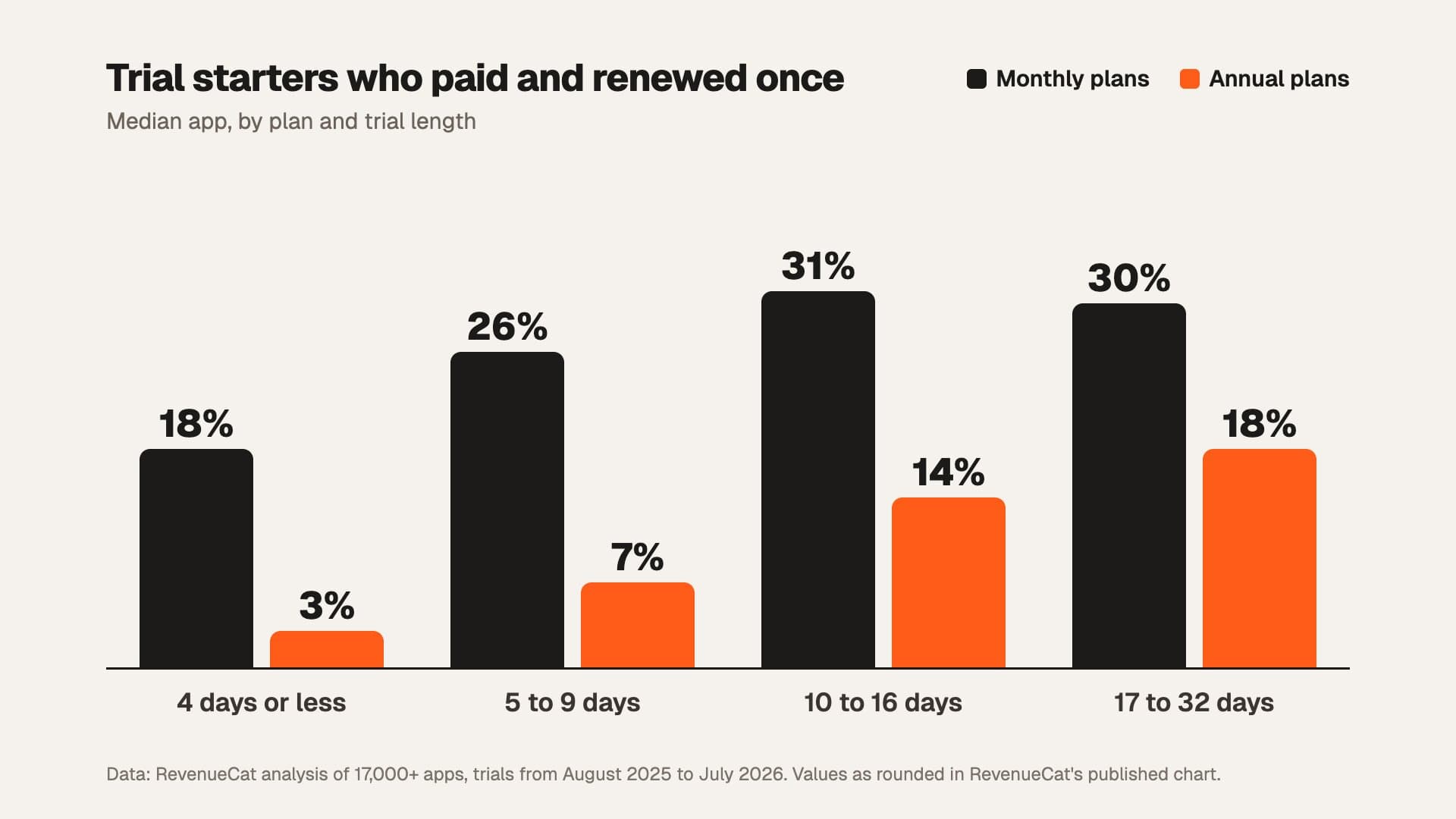
Google Play is more flexible. Its Play Console help says free trial phases "can range from 3 days to 3 years," set in days, weeks or months. Both stores limit how many trials one person gets. Apple says each customer can redeem one introductory offer per subscription group. Google's Play Console has an "Allow one free trial per app" setting that restricts users to one trial per app. In practice, most customers get one trial from you, so the length you choose for it matters. This is where the data departs most sharply from the usual advice. Among trial users on annual plans, the share who paid and then renewed once rose in every group: from 3.5% after trials of four days or less to 18.5% after trials of 17 to 32 days.
Bar chart of trial starters who paid and renewed once, median app, by plan and trial length. Monthly plans: 18% at 4 days or less, 26% at 5 to 9 days, 31% at 10 to 16 days, 30% at 17 to 32 days. Annual plans: 3%, 7%, 14% and 18%. Data from RevenueCat's analysis of 17,000+ apps, values as rounded in RevenueCat's published chart
Both steps improved. Annual conversion rose from 24% to 44.6% between the shortest and longest groups. First renewal among paying subscribers rose from 18.3% to 47.5%. RevenueCat offers a sensible explanation. An annual plan is a large charge that is hard to reverse, so a longer trial gives the buyer time to be sure. The buyers who pay after a month of use were probably less likely to cancel anyway. RevenueCat flags this directly: "Someone who's still in your trial on day 25 of a 30-day window is simply more likely to pay than someone who bails on day two." So read this chart as a reason to test, not a guarantee. If your best plan is annual and your trial is three days, you have chosen the length the data associates with the fewest second payments. On monthly plans, the two numbers that make up a trial's result move in different directions. That is why conversion-only dashboards can mislead.
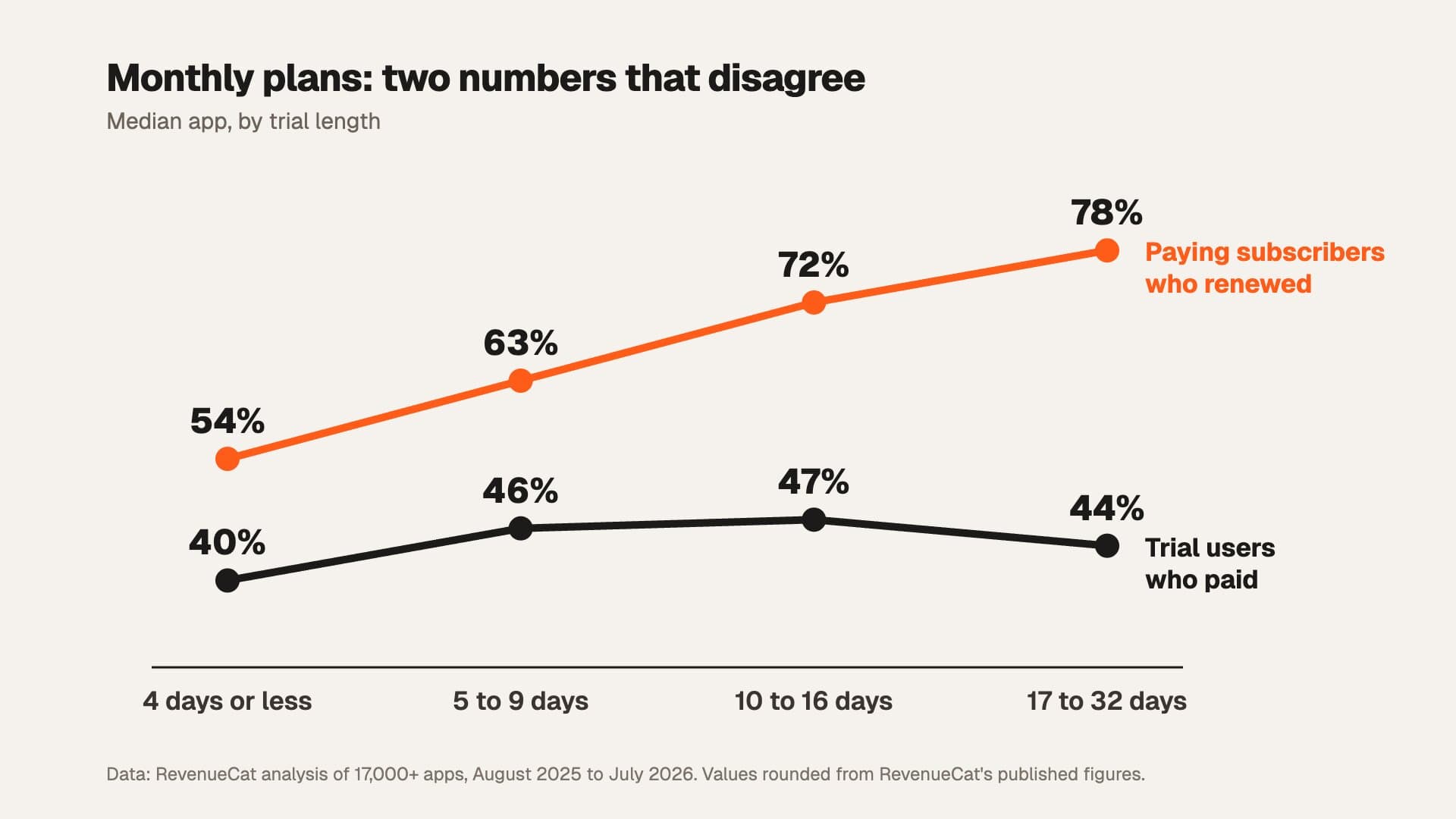
Line chart for monthly plans by trial length, median app. Trial users who paid: 40% at 4 days or less, 46% at 5 to 9 days, 47% at 10 to 16 days, 44% at 17 to 32 days. Paying subscribers who renewed: 54%, 63%, 72% and 78%. Data from RevenueCat's analysis of 17,000+ apps
Conversion peaks in the 10 to 16 day group at 46.6% and slips to 43.7% for trials of 17 to 32 days. First renewal keeps rising, from 54.2% after the shortest trials to 77.5% after the longest. Put together, the share of trial users who paid and renewed levels off: 30.6% after 10 to 16 days, and about the same (30% in RevenueCat's chart) after 17 to 32. For a monthly plan, then, the two-week trial is the one to beat in this dataset. It is also the option that two of our older guides told creators to skip. Short trials are common because they make money arrive sooner and make paid advertising easier to judge, not because the data shows they keep more subscribers. RevenueCat notes that its list of the 100 apps with the most trial starts shows what is popular at scale, not which length performs best. Those reasons are real. A business buying installs needs to know quickly whether an ad paid for itself, and a 30-day trial delays that answer by a month. An app with high costs per user, such as one running AI generation on every session, pays for every free day whether or not the person converts. RevenueCat's AI segment shows the limit: on monthly AI plans, trials of 17 to 32 days converted at 31.8%, below the 38.5% for trials of 10 to 16 days, with no gain in renewal. A creator's situation is often different. Much of a creator's audience arrives without paid ads, and many creator products cost little to deliver to one more person for a few more weeks. Those are the two strongest arguments for a short trial, and they often don't apply. On weekly and monthly plans, subscriptions that started without a trial renewed less often than those that started with one. On annual plans, no-trial subscriptions renewed better than short-trial ones and worse than long-trial ones. RevenueCat's first-renewal table, measured among paying subscribers:
Trial lengthWeeklyMonthlyAnnual
No trial35.9%49.5%26.6%
4 days or less57.9%54.2%18.3%
5 to 9 days65.9%62.8%25.3%
10 to 16 daysToo few apps72%36.4%
17 to 32 daysToo few apps77.5%47.5%
One row deserves attention. On annual plans, a three-day trial was associated with lower renewal (18.3%) than no trial at all (26.6%). If you are going to offer a short trial on an annual plan, the data says you might do better with no trial or a much longer one. The table doesn't tell you how many people buy when there is no trial, so it can't settle the question alone. RevenueCat links a case study where removing the trial, together with price and plan changes, made each paying customer worth enough to fund advertising. We cover the wider gating choice in free trial vs paywall. The creator apps we have profiled already run trials longer than the three-day default, and their programs suggest why. Each of these was read from the product's own page on October 1, 2026:
  • CGX, Caroline Girvan's training app, offers a 14-day free trial to new members on both its $12.99 monthly plan and its $99.99 annual plan. Its programs run six or ten weeks with five workouts a week, so two weeks of trial covers two full training weeks. Our profile of Caroline Girvan covers the business behind it.
  • EveryDollar, Dave Ramsey's budgeting app, offers a 14-day free trial to new users, then $79.99 a year or $17.99 a month. Our EveryDollar profile argues the product works because the budget is made each month. A two-week trial may not reach the first of the month, which is the moment that habit forms.
  • Sidekick, Sorted Food's meal-planning app, offers a 30-day free trial. Its page promises weekly shopping lists, so a month covers about four weekly shops. We profiled Sorted Food's move into an app earlier this year.
Jeremy Ethier's team at Built With Science made the trial part of the paywall itself. As our profile from this morning reports, they showed the annual plan first next to a day-by-day timeline of the trial, with a reminder on day 12, and their annual share rose from about 60% to 80%. Use the plan test. Choose a trial for the plan it sits in front of, long enough to cover one full cycle of what the customer repeats. Then judge it by the second payment.
  • Name the plan you want people to buy. If your paywall leads with annual, the annual results apply. Our guide to annual vs monthly subscriptions covers why most creator apps should lead with annual.
  • Count the days until your product proves itself. RevenueCat calls this time to value. For a creator it is usually one full cycle of the method: a training week, a weekly shop, a monthly budget, a full chapter of a course.
  • Pick the App Store option that covers that cycle. 1 week, 2 weeks or 1 month. Use the same length on Google Play so the offer is consistent.
  • Measure the second payment, not the first. A longer trial delays your first revenue by days or weeks. Wait for the first renewal before you judge it, and watch failed renewals as well as cancellations, since billing failures are a separate leak.
  • Change one thing at a time. A test that changes trial length and price together can't tell you which change worked.
If you're a fitness creator selling programs measured in weeks, a 3-day trial ends before the first training week does. RevenueCat's Health and Fitness results show the tension. Monthly conversion was higher at 5 to 9 days (46.8%) than at 10 to 16 days (40.4%), but first renewal rose from 51.5% after the shortest trials to 77.1% after the longest. Look at whether trial users keep completing workouts on days 8 to 14. If they do, the longer trial is giving the habit time to form. If they stop, it is only giving them time to lose interest. If your audience is global, check where they live. On annual plans, conversion kept improving with longer trials in North America and Western Europe, while Asia-Pacific dipped in the 17 to 32 day group. A trial length looks like a setting in App Store Connect, and it is easy to accept the default. It is really a promise to the customer about how long they get to decide, and on annual plans that promise appears to shape who is still paying a year later. That's the kind of decision that should come from your own audience's data. Built by Foundry builds the product with the creator and then keeps running it, which includes testing trial lengths, paywalls and pricing against real renewals. Here's how our model works.
See What We’d Build You →
There is no single best length. In RevenueCat's 2026 analysis of 17,000+ apps, trials of a few days were fine for weekly plans, trials of 10 to 16 days led monthly plans on paid-and-renewed share, and annual plans did best with trials of 17 to 32 days. All of these are correlations, so test before switching. For monthly subscriptions in RevenueCat's data, conversion was almost the same (45.9% for 5 to 9 days, 46.6% for 10 to 16 days), but first renewal was higher after 10 to 16 days (72.0% versus 62.8%). On annual plans, both conversion and renewal were higher in the 10 to 16 day group. Apple's App Store Connect offers free trials of 3 days, 1 week, 2 weeks, 1 month, 2 months, 3 months, 6 months or 1 year for auto-renewable subscriptions. Each customer can redeem one introductory offer per subscription group. Google Play allows free trials from 3 days to 3 years. Not in RevenueCat's 2026 data. On monthly and annual plans, paying subscribers who came through longer trials renewed more often, not less. Part of that is self-selection, because people who stay through a long trial were already more committed, so the effect should be tested in your own app. Sources verified October 1, 2026: RevenueCat, How long should your free trial be? Data from 17,000+ apps (published September 28, 2026; median app-level rates, trials from August 2025 to July 2026); App Store Connect Help, Set up introductory offers for auto-renewable subscriptions; Play Console Help, Understanding subscriptions and Create and manage subscriptions; cgxapp.com; ramseysolutions.com/money/everydollar; sortedfood.com/sidekick. Trial lengths and prices are set by each business and can change. Current-state claims require revalidation before later use.
Our work

Creators who already did this

These are apps we designed, built, shipped, and still run today, with the creator keeping the code and the audience.

Samantha Mae

Samantha Mae

Founder & CEO of NineLives

Cat health tracking from the world's most beloved Scottish Fold.

Top Health App150K+ followers
Read the case study
NineLives screenshots
Liv Merima

Liv Merima

Founder & CEO of Claim It

Custom affirmations that help millions choose themselves.

Top Lifestyle App150K+ followers
Read the case study
Claim It screenshots
Brandon Whiteleather

Brandon Whiteleather

Founder & CEO of Freeze Dry Buddy

Freeze drying made foolproof, from a homesteader who's done it 1,000 times.

Top Food App1.4M+ followers
Read the case study

Creator app strategy

Curious what your app could be?

Enter your handle and BUILT BY FOUNDRY will research your audience and present custom app concepts. Free.

How Long Should a Free Trial Be? 4 Lengths, 17,000 Apps