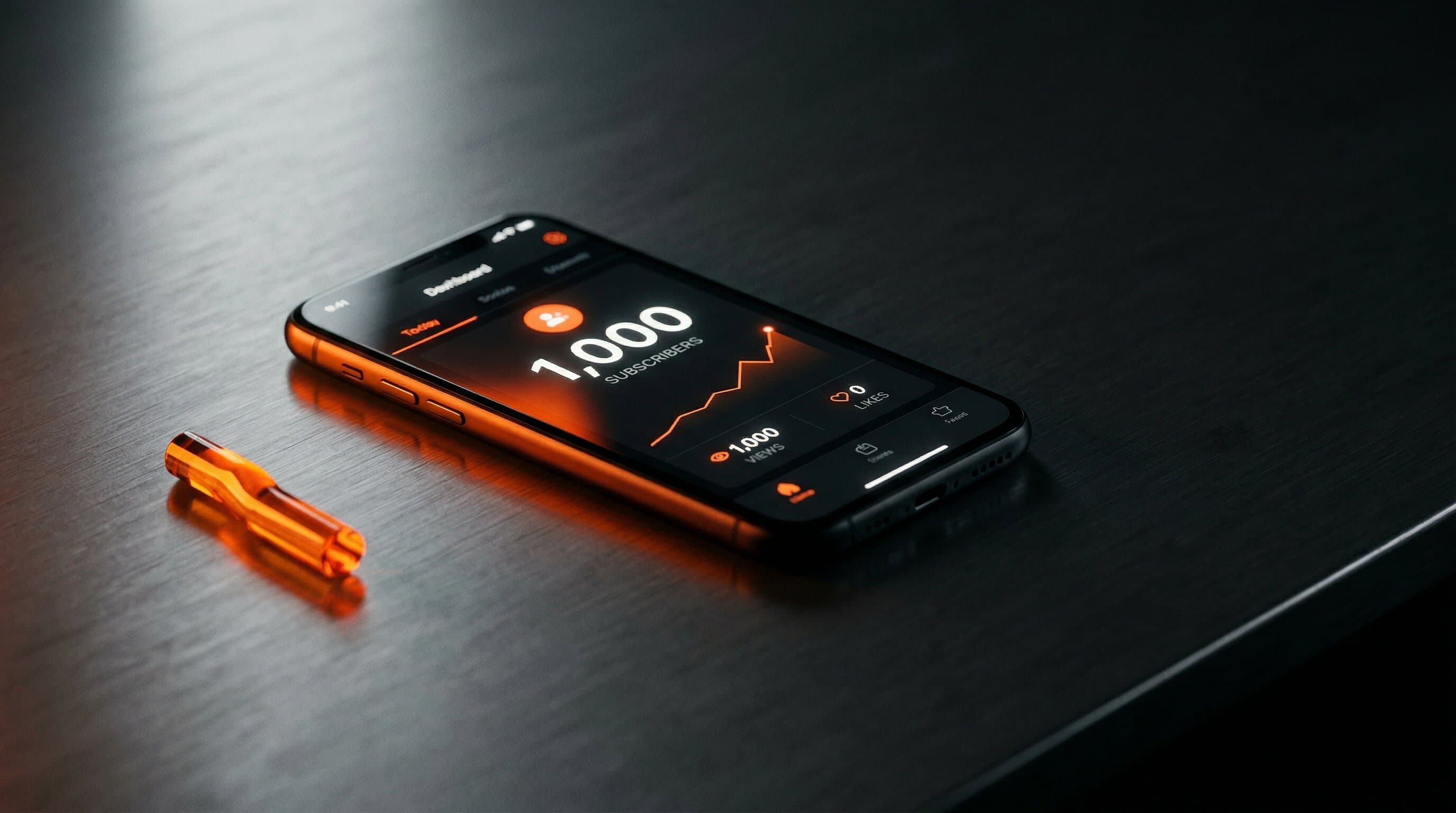


Free Trial vs Paywall: Which Wins for Creator Apps?

Free Trial vs Paywall: Which Wins for Creator Apps?

Foundry
May 15, 2026
You launch a creator app. The first decision that shapes every revenue number that follows is not pricing. It is gating: do you offer a free trial, or do you make people pay before they see anything? This is the question that quietly decides whether your app prints $2K MRR or $20K MRR with the same audience. Get it right and the math compounds. Get it wrong and you bleed through your launch window. Key Takeaways:
  • Free trials convert roughly 30 to 50% of starts into paying subscribers in the fitness and wellness categories, per RevenueCat's 2024 State of Subscription Apps.
  • Hard paywalls convert 1 to 5% of installs into paid users, but those users tend to retain 20 to 30% longer.
  • Creator apps with a warm audience usually win with a free trial because the audience already trusts the creator.
  • Cold App Store traffic often performs better behind a hard paywall with a low entry price.
  • Most apps should run a hybrid: short trial gated behind email or sign in, with a clear annual offer at the end.
A free trial lets a user open the app, use the core features for a fixed window (commonly 3 or 7 days), and only charges them if they do not cancel before the trial ends. It is the default model for fitness, meditation, and language apps. Apple's StoreKit handles the timer and the auto renewal. A hard paywall blocks the app behind a purchase screen. The user pays first and uses the product second. This is the model used by Headway, Stoic, and most utility apps where the value is immediate and the demo can happen in the App Store screenshots. A third option, the soft paywall or freemium, lets users access a limited slice of features forever and only charges for the good stuff. We are not focused on that here because it tends to underperform for creator apps, where the audience expects a premium product and discount-grade freemium kills the brand. Direct answer: in well run creator apps, 30 to 50% of trial starts become paying subscribers, with the median sitting near 32% for Health & Fitness apps per RevenueCat's published benchmarks. That number is doing a lot of heavy lifting, so unpack it:
  • The base rate assumes the user opened the app and started the trial. Install-to-trial start is its own conversion step, usually 40 to 70% depending on the onboarding.
  • Shorter trials (3 days) tend to convert at a higher rate than 7 day trials because the urgency is real. Apple itself promotes 3 day trials in its review guidelines.
  • Annual plans convert worse than monthly during the trial but generate 3 to 5x more revenue per subscriber, which is the only number that matters at the end of the year.
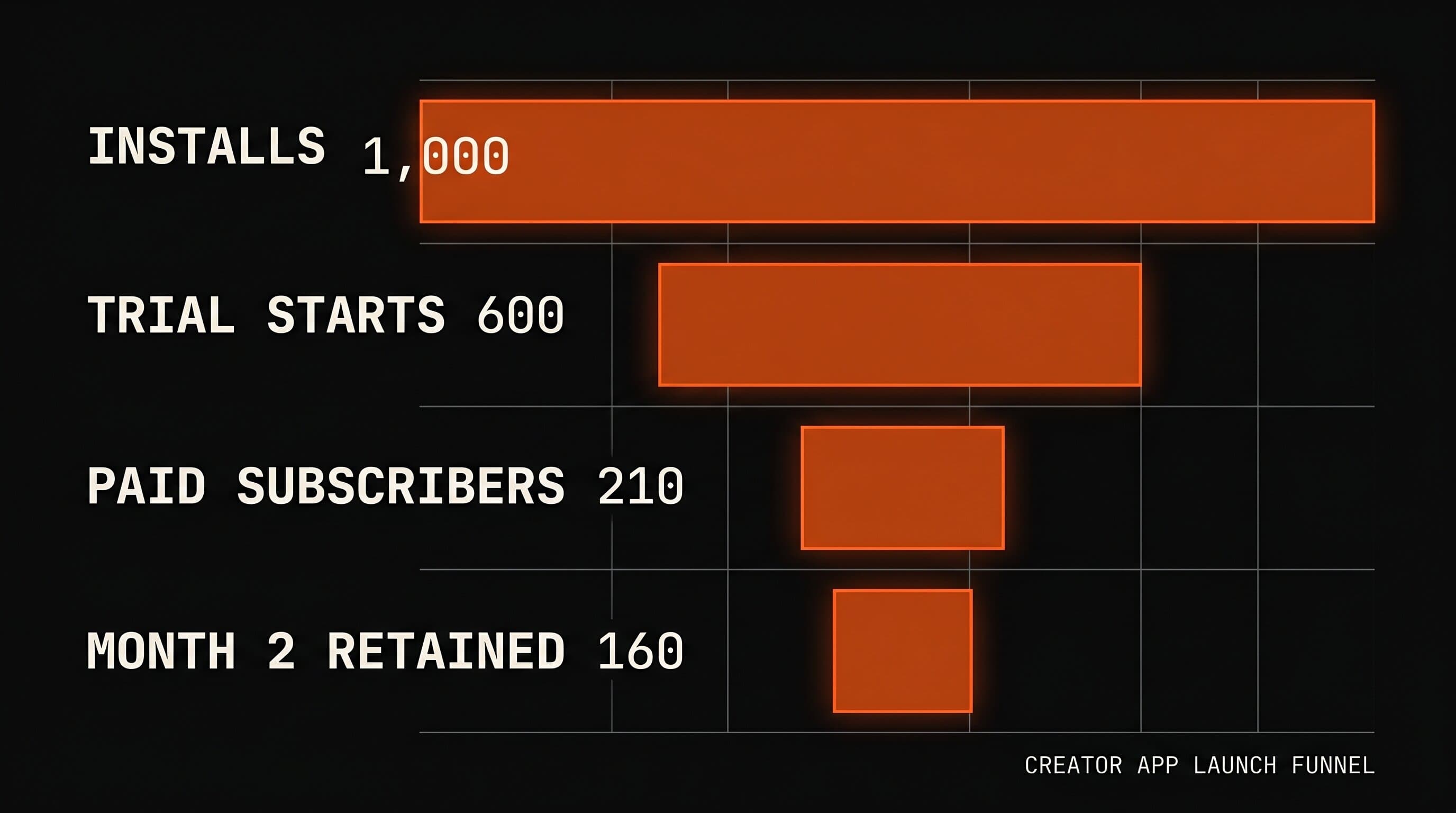
For a creator app with a warm audience and a clean onboarding, expect this funnel:
  • 1,000 installs from the creator's launch push
  • 600 trial starts (60% install to trial)
  • 210 paying subscribers (35% trial to paid)
  • At $9.99 per month, that is $2,100 in month one, then $1,600 plus in month two after some churn
That is one launch post on Instagram. Now imagine doing it every quarter.
Free trial conversion funnel for a creator app launch
Direct answer: hard paywalls convert 1 to 5% of installs to paid in most categories, but the users who do pay tend to retain 20 to 30% longer because they self selected on intent. The trade is volume for quality. A hard paywall sorts the audience instantly. Anyone who pays is telling you they believe the app will be worth it before they have proof. That belief becomes a retention asset. The hard paywall wins when:
  • Your App Store listing is strong enough to sell the product (screenshots, copy, reviews).
  • The first session value is hard to demo in 3 days (community apps, long arc coaching).
  • You have a low monthly price (under $5) that does not feel risky to test.
  • Your audience is cold or unknown, and you do not want trial abusers eating server costs.
The hard paywall loses when:
  • Your audience is warm and trusts the creator, but does not yet trust the app.
  • The core value is felt during a workout, lesson, or daily session that needs to happen first.
  • Your price is high (above $15 per month).
This is the part most creators get wrong. They look at hard paywall apps like Headway and copy the playbook, then wonder why their conversion is 2% with a $19.99 monthly price. Cold paywall apps with that price spend 6 to 12 months tuning the App Store funnel before it works. Creator apps short circuit that by using the creator's warmth as the trust layer, then the trial as the proof layer. Here is a comparison of the two models for a creator with 100K followers running a single launch push. Numbers reflect typical performance, not guarantees.
MetricFree Trial (7 day, $9.99/mo)Hard Paywall ($4.99/mo intro)
Installs from launch push5,0005,000
Trial starts or paid attempts3,000 (60%)n/a
Paying subscribers month 11,050 (35% trial to paid)150 (3% install to paid)
Month 1 revenue$10,490$749
Month 12 ARR if no churn$125,880$8,982
Likely 12 month retention40%60%
Realistic Year 1 revenue$63K to $80K$5K to $7K
The free trial wins on revenue for almost every creator scenario. The hard paywall only catches up when the audience is cold, the App Store listing is doing the selling, and the price is low enough that the install-to-paid rate climbs above 8%. If you are sizing up which monetization lever to pull next, the long form breakdown is in our guide to 5 pricing strategies for creator subscription apps, which walks through monthly versus annual, intro offers, and price laddering. The free trial decision sits on top of all of it. Pick a free trial when at least three of these are true:
  • You have a warm audience of 50K plus engaged followers who will install on the creator's say so.
  • The value happens inside the app during a workout, lesson, recipe, or daily session that takes a day or two to feel.
  • Your price is $7.99 or higher per month. At that point, the friction of a credit card upfront kills conversion faster than a trial does.
  • You want the App Store algorithm to favor you. Apple weights trial starts heavily in its conversion ranking, which boosts your organic discoverability beyond the creator's audience.
The trial length is its own decision. Shorter trials (3 days) are the new default for fitness and wellness because they force a real session. Seven day trials still win for habit and journaling apps where the user needs to feel a streak forming. We rarely recommend 14 day trials; they leak revenue. Pick a hard paywall when:
  • Your price is under $5 per month or you have an aggressive intro offer.
  • Your audience is cold and you are buying installs from ads or App Store optimization rather than from the creator.
  • The product is utility based with no recurring session (calculators, reference tools, on demand templates).
  • You have a strong App Store listing with social proof, ratings, and screenshots that can sell on their own.
If you are deciding between models because you are nervous about chargebacks or trial abuse, that is the wrong reason. Apple's StoreKit handles trial abuse better than you can. Pick the model that makes the audience economics work. The gating model changes the price ceiling. Free trial apps can carry a higher monthly price because the user has felt the value before paying. Hard paywall apps need lower prices or stronger discount anchoring to convert. A typical creator app with a free trial prices like this:
  • $9.99 per month monthly
  • $59.99 per year annual (50% effective discount)
  • 7 day free trial on both plans
  • Annual is the default selection on the paywall
A hard paywall creator app prices more like this:
  • $4.99 per month monthly
  • $29.99 per year annual
  • No trial, but a 14 day money back guarantee handled outside StoreKit
  • Aggressive lifetime discount banner on year two churned users
The pricing only works if it matches the gating. Mixing a hard paywall with a $14.99 monthly price is how you get a 0.8% conversion rate and a quiet launch. For more on what happens after the first dollar comes in, our breakdown of creator app retention and the 7 tactics that beat churn is the next thing to read. The launch is the easy part. Keeping people past month three is where the business is built.
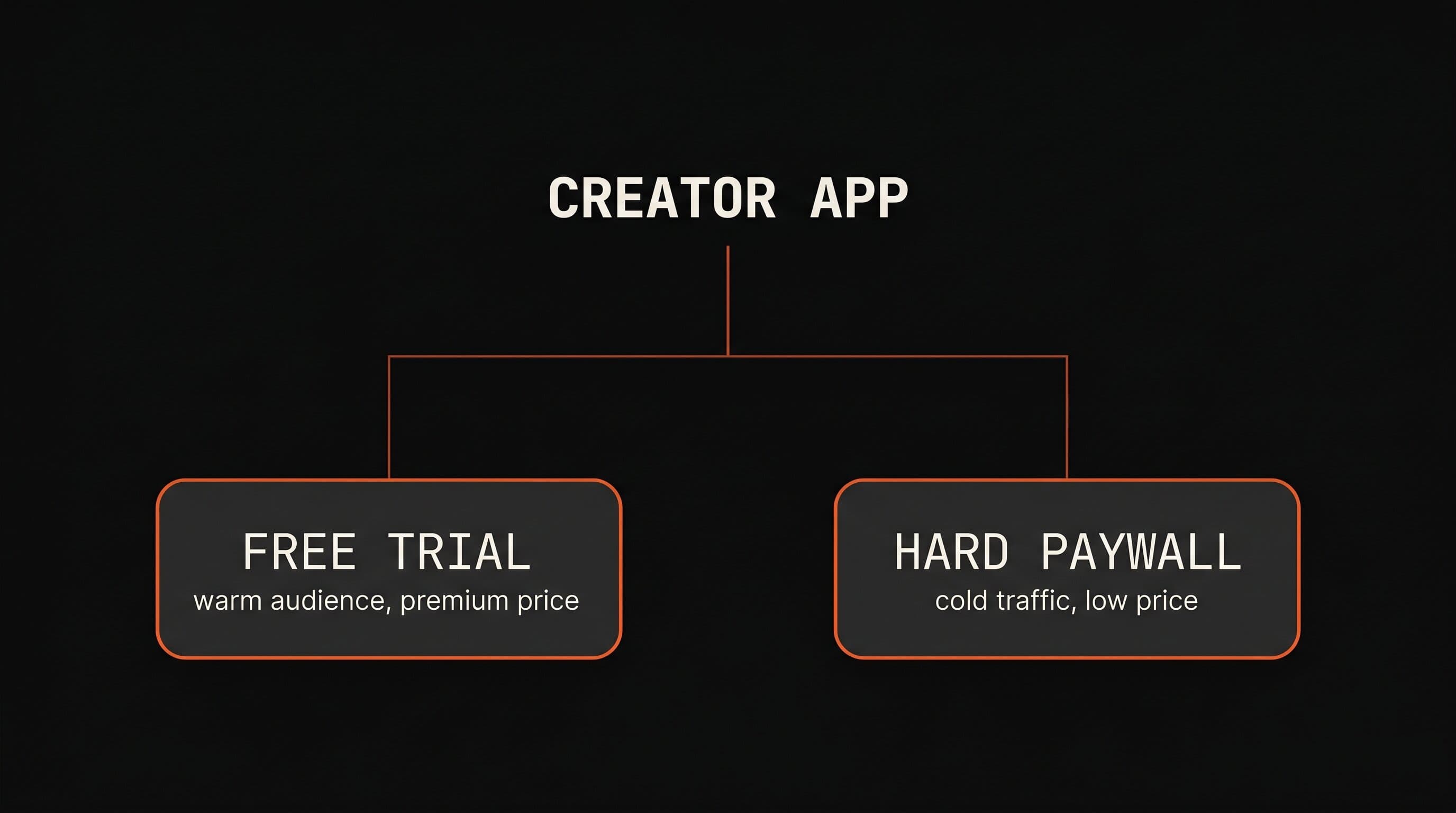
Decision tree showing when to pick free trial vs hard paywall for creator apps
Three patterns kill conversion across creator apps:
  • The 30 day trial. Apple no longer pushes long trials. Users churn the trial reminder and never come back. Three or seven days only.
  • The trial without a payment method. Some teams gate the trial behind email only, then ask for a card at the end. Conversion collapses to single digits. Always require the card upfront. Apple's UI does this gently and the conversion math is night and day.
  • The hard paywall with five plan options. Decision paralysis kills paid intent. Show one default (annual), one alternative (monthly), and a third option only if you are actively testing.
Most creator apps also forget the second paywall: the one users see after they cancel or after their first month ends. That paywall is where annual upsells happen. If you do not have it, you are giving up 15 to 25% of revenue you already earned. You do not need to guess. RevenueCat, Superwall, and Adapty all let you A/B test paywalls in production without a code push. The standard test is:
  • Run free trial 7 day vs free trial 3 day for 2,000 trial starts each.
  • Run free trial 3 day vs hard paywall at half price for 2,000 installs each.
  • Run annual default vs monthly default on the winning paywall.
Pick a winner on revenue per install, not on conversion rate. A paywall that converts 4% at $99 annual beats one that converts 12% at $9.99 monthly, every time. When getting your first 1,000 app subscribers, expect to run 6 to 10 paywall tests in the first three months. The compounding effect on lifetime value across thousands of subscribers turns small wins into the difference between a $10K MRR app and a $50K MRR app. This is also where ARPU stops being a vanity metric and starts being the number you optimize against. If average revenue per user is not on your weekly dashboard yet, that is the next thing to fix. Yes. Apple supports free trials through StoreKit on every subscription plan. The only changes in recent years have been around trial transparency in the paywall UI. Most creator apps run 3 day or 7 day trials on monthly and annual plans alike. For Health & Fitness creator apps, 30% trial to paid is roughly the median per RevenueCat's benchmarks. Top quartile apps hit 45 to 55%. Anything under 20% means your onboarding or paywall is broken. Yes. Trials without a card on file convert in the single digits. StoreKit's native trial flow gives users the option to back out, and Apple handles the renewal reminder. The conversion math without a card upfront does not work. Three days for fitness and wellness apps where the first session is the proof. Seven days for habit, journaling, or coaching apps where the user needs to feel a streak. Skip 14 day trials; they cost revenue without improving retention. Yes, and many apps do. New users see the new model and existing paid users are unaffected. Apple lets you change paywall configuration without resubmitting the app. The infrastructure side (StoreKit, RevenueCat) takes about a day to reconfigure. The Foundry team handles this for every app we run as part of ongoing app care. Yes. Apple's category rankings weight conversion and trial starts. Free trial apps with strong trial start rates rank higher in their category, which compounds with the creator's launch traffic. This is one reason a free trial usually wins for creator launches: it gives the App Store a reason to surface your app to people who never heard of the creator. The paywall decision is upstream of every other revenue lever you have. Free trial wins for warm audiences and premium pricing. Hard paywall wins for cold traffic and low prices. The hybrid (trial gated behind sign in, annual default at the end) is what most successful creator apps actually run. Pick the one that matches your audience, your price, and the moment the value lands. Then test, ship, and keep the math honest. If you are building a creator app and want a team that has run this decision for dozens of apps, that is exactly what Foundry does. We build, launch, and run the entire app, including paywall tests every week. See how we work. Stop reading. Start building.
Let's Build

Get Creator Revenue Insights

How creators are turning audiences into subscription businesses

You might also enjoy...

Free Trial vs Paywall: Which Wins for Creator Apps?