
Turning Knowledge into Products

What Is a Valuation Multiple? 36x Monthly, 3x Annual, Same Price

November 22, 2026
Share
What Is a Valuation Multiple? 36x Monthly, 3x Annual, Same Price

Get Creator Revenue Insights

How creators are turning audiences into subscription businesses
Share
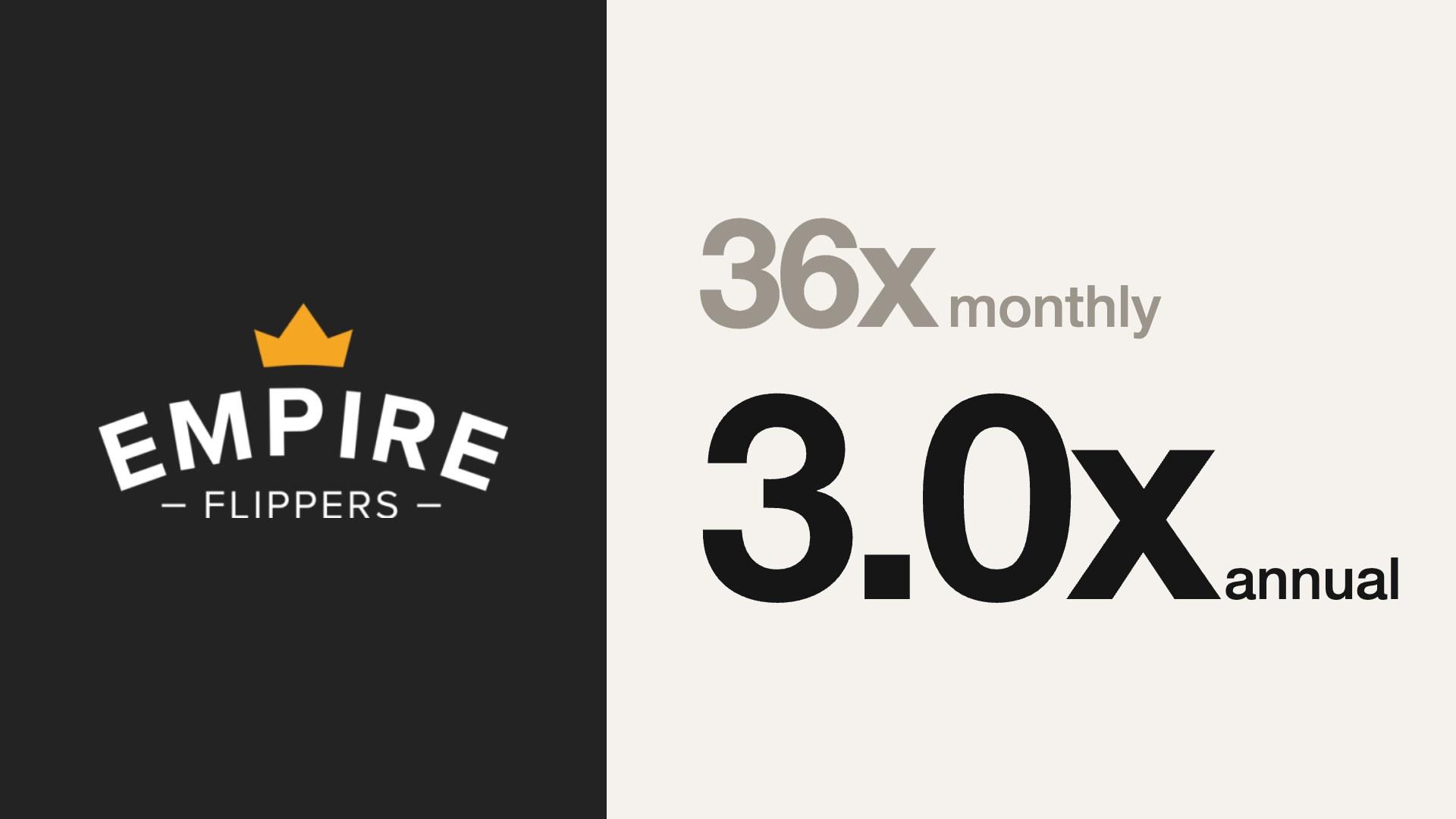
A valuation multiple is a business's sale price divided by a measure of its profit. If a business sells for $360,000 and earns $120,000 a year in net profit, its multiple is 3.0x. The number only means something once you know two things: which profit figure sits underneath, and whether that profit covers a month or a year. That second detail changed for one of the largest online business marketplaces this fall. On September 8, 2026, Empire Flippers announced that every multiple on its site would now be annual. Its own example: a business earning $10,000 a month, listed at $360,000, used to display as 36x. It now displays as 3.0x. Same business, same price. If you run a newsletter, a membership, a content site or an app, you will meet these numbers the first time someone asks what your business is worth. Here is how to read them. Key Takeaways:
  • A multiple is price ÷ profit. Monthly multiples are 12 times larger than annual ones for the same price, so divide a monthly multiple by 12 before comparing.
  • The profit underneath matters as much as the multiple. Small owner-run businesses are usually priced on seller's discretionary earnings (SDE), which adds the owner's pay back to profit. Larger businesses use EBITDA.
  • Empire Flippers' public scoreboard listed typical sales at 2.2x and premium sales at 2.4x trailing-twelve-month net profit when we checked on November 22, 2026.
  • In our illustrative creator newsletter, the same 2.2x multiple produces $308,000 or $528,000 depending only on which profit figure you divide by.
A multiple compresses a price into one comparable number. Instead of saying "this sold for $500,000 and that sold for $2 million," a buyer can say "both sold for about three years of profit." That lets someone compare a $40,000 recipe site with a $4 million software business on the same scale. The formula is simple: Valuation multiple = sale price ÷ profit Rearranged, it becomes a rough estimate: Estimated value = profit × multiple A multiple is a summary of what buyers were willing to pay, not a law. It moves with interest rates, buyer demand, the business's risk and how easily someone else could run it. Treat any published multiple as a range describing past deals. Because the profit figure can cover one month or twelve. Empire Flippers started out flipping small AdSense sites that earned around $20 a month and were often only months old. In its announcement, the company explains that it was known as the "20x Guys" because those sites sold for about 20 times monthly profit. Valuing a site against a year of profit it had not earned yet was not realistic, so monthly multiples made sense. As the marketplace moved upmarket, that format stopped matching the rest of the acquisition world. The announcement notes that most small businesses, online or offline, trade between 1x and 5x their annual SDE or EBITDA. Annual multiples make an Empire Flippers listing readable next to any other deal.
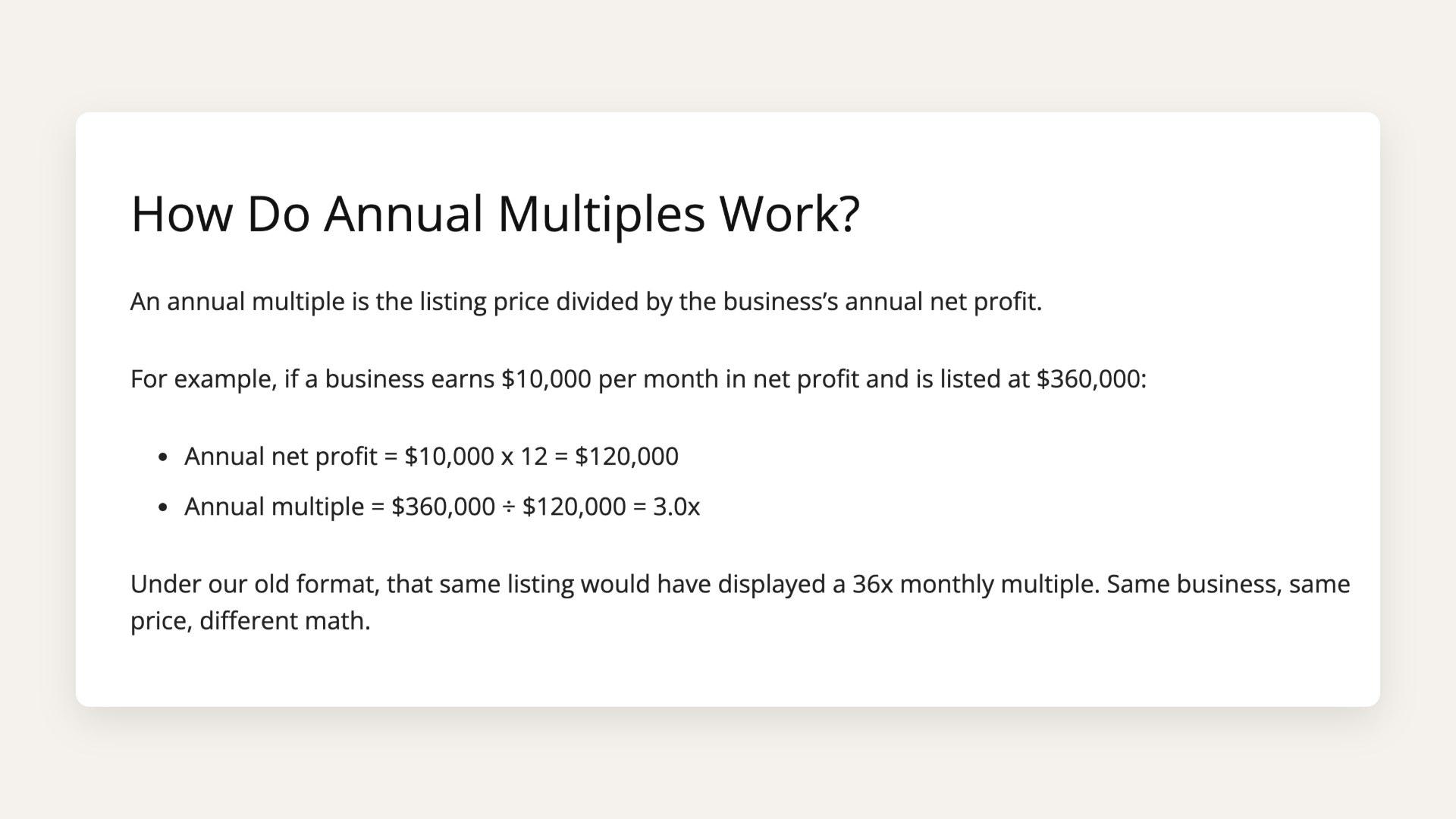
Empire Flippers' own worked example: a business earning $10,000 a month in net profit and listed at $360,000 has an annual net profit of $120,000 and an annual multiple of 3.0x, which the old format displayed as 36x.
Empire Flippers' worked example, captured from its September 8, 2026 announcement on November 22, 2026. The company published converted averages from its 2026 State of the Industry Report. These are listing multiples, which are asking prices rather than final sale prices:
Empire Flippers listing tierOld monthly multipleNew annual multiple
Distressed13.7x1.1x
Typical27.8x2.3x
Premium31.1x2.6x
7-figure premium41x3.4x
The marketplace's public scoreboard shows closed sales slightly lower, at 2.2x for typical businesses, 2.4x for premium businesses and 3.2x for premium businesses above $1 million, calculated on trailing-twelve-month net profit. The same page says businesses sold for an average of 86% of their listing price. Asking and selling are different numbers. The practical rule: before you compare a multiple from a forum thread, a broker pitch or an old article, ask whether it is monthly or annual. A "30x" you read in 2023 is roughly 2.5x on today's annual scale. This is where most confusion lives. Four denominators show up in creator business conversations:
DenominatorWhat it measuresUsually used for
Net profitRevenue minus all expensesMarketplace listings, simple sites
SDEProfit before tax and interest, plus one owner's pay and one-time or personal costsOwner-operated businesses
EBITDAEarnings before interest, tax, depreciation and amortization, with management already paidLarger businesses with a team
Revenue or ARRSales, before costsFast-growing subscription software
Corporate Finance Institute defines SDE as a cash-flow measure for an owner-operated business: profit before tax and interest, before the owner's benefits, non-cash expenses, one-time investments and income or expenses unrelated to the business. Only one owner's pay can be added back. It notes that SDE is used for smaller companies, while EBITDA is more common for larger ones. FE International's October 2026 guide draws the line at roughly $1 million of annual profit. Below it, owner-run content sites, blogs and newsletters are usually priced on SDE. Once a management team runs the business, buyers move to adjusted EBITDA. Revenue multiples are mostly reserved for fast-growing subscription software, which is why ARR gets so much attention in app conversations. The figures below are illustrative assumptions, not benchmarks or any creator's reported results. Imagine a newsletter business with $300,000 in annual revenue from sponsorships and paid subscriptions. Its expenses for the year:
  • Tools and platform fees: $12,000
  • Freelance editor: $36,000
  • Growth spending: $12,000
  • The creator's own salary: $90,000
  • A one-time site redesign: $6,000
  • A personal phone and car run through the business: $4,000
Net profit is $300,000 minus $160,000 in expenses, or $140,000. SDE adds back the creator's salary, the one-time redesign and the personal costs: $140,000 + $90,000 + $6,000 + $4,000 = $240,000. Now apply the same 2.2x multiple to each:
Profit figureAnnual amountAt 2.2xSame price as a monthly multiple
Net profit$140,000$308,00026.4x monthly
SDE$240,000$528,00026.4x monthly
A $220,000 gap, created entirely by the denominator. Neither number is wrong. They answer different questions. SDE tells an owner-operator buyer how much the business pays them if they do the creator's job. Net profit tells a buyer what is left after someone is paid to do it. That raises the question every creator business eventually faces. If readers come for one person's voice, can a buyer actually do that job? The $90,000 salary add-back assumes a replacement exists at that price. When nobody can replace the creator, buyers stop trusting the SDE figure. FE International's 2026 guide lists the risks buyers discount. Several apply directly to creators:
  • Owner dependence. In FE International's words, "a site whose readers come for one person's voice needs a succession plan before it needs a buyer."
  • Traffic concentration. Buyers ask how much revenue would remain if the largest traffic source disappeared. The guide calls this the factor that moves multiples most within a single business model.
  • Platform-locked audiences. A newsletter list a buyer cannot export or migrate is priced lower than one on an owned domain.
  • Partner concentration. One sponsor, ad network or affiliate program gives that partner pricing power over the business.
The same guide says subscription-funded newsletters price toward the top of the range, and sponsorship-funded ones land in the middle. Recurring revenue is easier to underwrite than a pipeline of deals that has to be resold every quarter. That logic sits behind our argument that a YouTube channel rarely sells but an app business can: a buyer pays for income that keeps arriving without the founder's face on every unit. Margins matter too. A buyer multiplies profit, not revenue, so a business with healthy gross margin turns more of each sale into the number that gets multiplied. Today we profiled Nate Rosen and the Express Checkout sale. Morning Brew Inc. bought the consumer goods newsletter outright in October 2026, but the price was not disclosed. That means nobody outside the deal can calculate its multiple, and any number you see attached to it is a guess. What the buyer did describe is useful anyway. It talked about a newsletter, a podcast, social video and live events, not just a subscriber count. Those are the things that reduce owner dependence and concentration risk, the same factors that move a multiple.
  • Monthly or annual? If the number is above 10x for a small online business, it is almost certainly monthly. Divide by 12.
  • Which profit? Net profit, SDE and EBITDA can differ by tens of thousands of dollars for the same business. Ask which one is underneath.
  • Asking or sold? Listing multiples describe hopes. Empire Flippers' own scoreboard shows sales averaging 86% of listing price.
  • Trailing or projected? A trailing-twelve-month figure is what the business earned. A forward figure is what someone hopes it will earn.
  • Whose data? Brokers and marketplaces publish most small-business multiples, and they earn fees when deals close. Their numbers are useful, but treat them as one side's evidence.
If you are still building, the valuation habit worth starting now is tracking clean monthly profit and recurring revenue. Our guides to MRR and churn explain the numbers a buyer will ask for first. What is a good valuation multiple for a small online business? Empire Flippers' scoreboard listed 2.2x annual net profit for typical sales and 2.4x for premium sales when we checked on November 22, 2026. FE International describes private content businesses as trading from roughly 3x to 10x annual earnings, with content sites and newsletters in the lower to middle part of that range. Quality, size and risk decide where a business lands. How do I convert a monthly multiple to an annual one? Divide by 12. A 36x monthly multiple equals 3.0x annual. A 24x monthly multiple equals 2.0x annual. Is SDE the same as profit? No. SDE starts from pre-tax, pre-interest profit and adds back one owner's pay plus one-time and personal expenses. It is usually higher than net profit for a business where the owner pays themselves. Can a creator sell a business built around their personal brand? Sometimes, but owner dependence lowers the price. Buyers pay more for revenue that continues without the founder, such as subscriptions, products and a team that runs operations. A multiple rewards the parts of a business that keep working when the founder steps back: recurring revenue, owned customers and operations someone else can run. Those are the pieces Built by Foundry builds and operates for creators. Learn how Built by Foundry works and what a revenue-share partnership includes.
Our work

Creators who already did this

These are apps we designed, built, shipped, and still run today, with the creator keeping the code and the audience.

Samantha Mae

Samantha Mae

Founder & CEO of NineLives

Cat health tracking from the world's most beloved Scottish Fold.

Top Health App150K+ followers
Read the case study
NineLives screenshots
Liv Merima

Liv Merima

Founder & CEO of Claim It

Custom affirmations that help millions choose themselves.

Top Lifestyle App150K+ followers
Read the case study
Claim It screenshots
Brandon Whiteleather

Brandon Whiteleather

Founder & CEO of Freeze Dry Buddy

Freeze drying made foolproof, from a homesteader who's done it 1,000 times.

Top Food App1.4M+ followers
Read the case study

Creator app strategy

Curious what your app could be?

Enter your handle and BUILT BY FOUNDRY will research your audience and present custom app concepts. Free.

What Is a Valuation Multiple? 36x Monthly, 3x Annual, Same Price