

What Is ARR? Annual Recurring Revenue for Creators

What Is ARR? Annual Recurring Revenue for Creators

Foundry
April 30, 2026
Annual Recurring Revenue (ARR) is the yearly value of a subscription business, calculated as monthly recurring revenue multiplied by twelve. For creators, ARR is the number that turns "I make money from sponsorships" into "I run a software company." Key Takeaways:
  • ARR = MRR × 12. If you have $10,000 in monthly subscription revenue, your ARR is $120,000
  • ARR is the headline metric investors, acquirers, and bankers use to value a creator app
  • A 1,000-subscriber creator app at $14.99/month is already a $179,880 ARR business
  • Sweat reportedly hit $100M+ ARR before its $400M acquisition. Calm reached around $300M ARR before its 2024 valuation reset
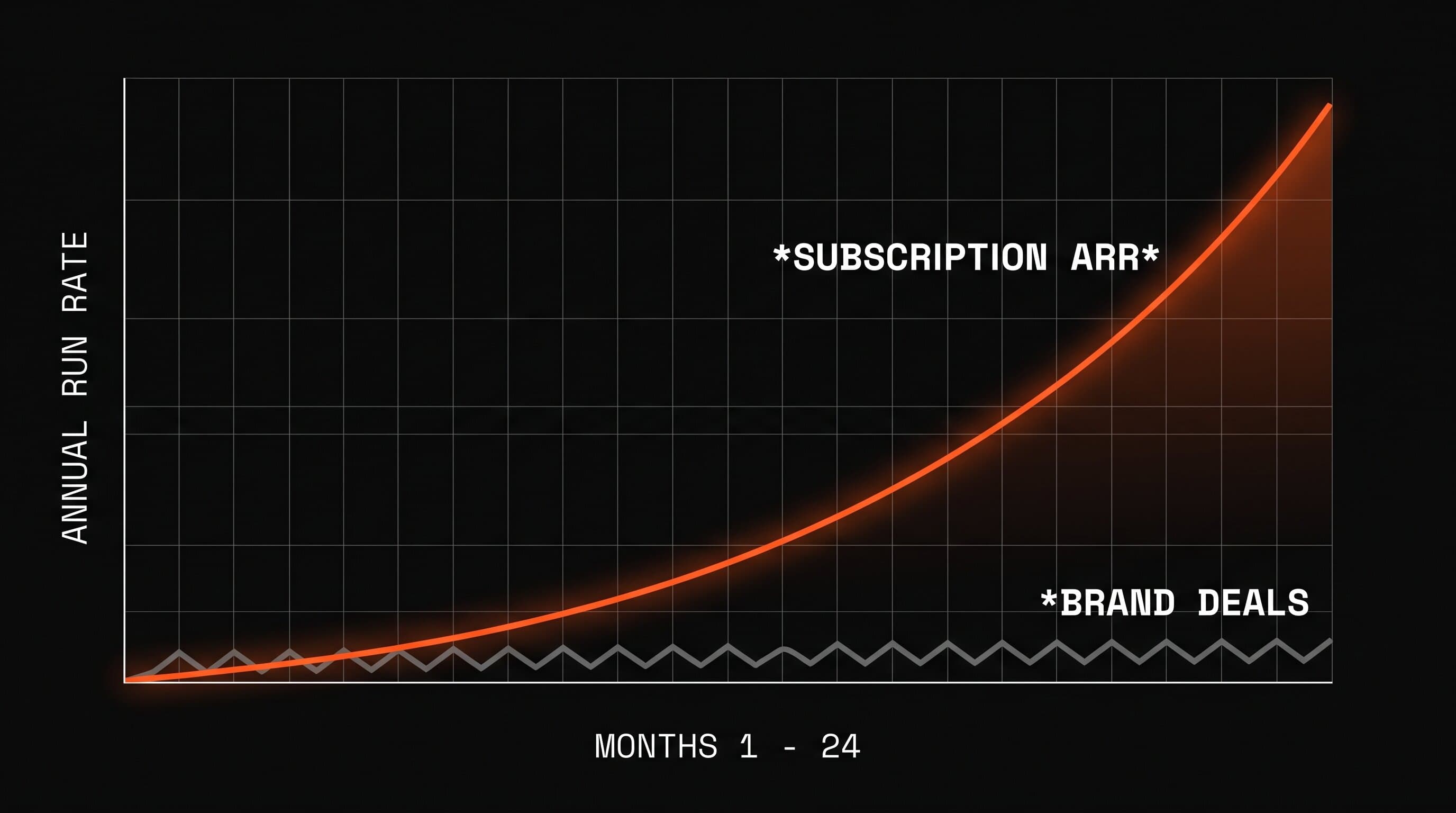
  • ARR is durable in a way brand deal income never is. It defaults to renewing, not to zero
ARR (Annual Recurring Revenue) is the total normalized value of a subscription business over twelve months, based on the contracts and active subscribers it has today. The formula is simple:
ARR = MRR × 12
Or, if you want to skip the MRR step:
ARR = (Active subscribers × Average monthly price) × 12
ARR exists because subscription businesses earn money in monthly drips, but they get judged in annual chunks. Boards talk in ARR. Acquirers talk in ARR. Press releases talk in ARR. When the Wall Street Journal reports that Calm crossed $300 million in revenue, that's ARR. When TechCrunch wrote up Sweat's $400M acquisition by iFIT, the number behind that valuation was ARR. It's the same business as MRR. It's just measured at the altitude where deals get done.
Most creators measure money in single transactions. A $5,000 brand deal. A $97 course launch. A $200 affiliate payout. Each one is a discrete event. ARR is the opposite. It measures the size of a thing that keeps existing. When a creator says "I have $20K MRR," that sounds like a freelancer's lucky month. When the same creator says "I have a $240K ARR business," investors lean in. The dollars are identical. The frame is not. This is why ARR matters for the second half of a creator's career. Sponsorships price you as talent. ARR prices you as a company. Talent gets paid by the post. Companies get acquired.
Income FrameWhat It Feels LikeWhat Happens If You Stop Posting
Brand dealsFreelance hustleIncome drops to zero in 30 days
Course launchesLumpy eventsNo new revenue until next launch
Affiliate linksPassive trickleDecays as audience moves on
Subscription ARROperating companyRevenue keeps renewing for months
Software People Love (the company behind Built by Foundry) exists because we believe the next generation of $10M creator businesses will be priced in ARR, not follower count.
Take your active paying subscribers. Multiply by what they pay each month. Multiply by twelve. That's ARR. Example 1: Single price tier
800 subscribers × $14.99/month × 12 = $143,904 ARR
Example 2: Mixed monthly and annual plans
600 monthly at $14.99 + 200 annual at $99.99/year Monthly side: 600 × $14.99 × 12 = $107,928 Annual side: 200 × $99.99 = $19,998 Total ARR: $127,926
Example 3: A small creator who underestimated themselves
350 subscribers × $9.99/month × 12 = $41,958 ARR
That last one is the number that should make most mid-tier creators uncomfortable. 350 paying users is not a content goal. It's a Tuesday. Most creators with 50K engaged followers can convert 350 fans into subscribers without straining. We made that case in why 50K engaged followers beats 5M passive ones. ARR benchmarks for creator apps:
Subscriber CountPrice PointARR
250 subscribers$9.99/mo$29,970
1,000 subscribers$14.99/mo$179,880
5,000 subscribers$14.99/mo$899,400
10,000 subscribers$14.99/mo$1,798,800
25,000 subscribers$19.99/mo$5,997,000
A creator who reaches 10,000 paying subscribers at $14.99/month is running a nearly $1.8M ARR business. That's a venture-backable software company, sitting inside what most people would call a content brand.
Both. They measure the same business at different time scales. Track MRR for operations. It moves every week. New subscribers, churned subscribers, upgrades, downgrades, trial conversions. MRR is the dashboard you check on Monday morning. Track ARR for narrative. It's what you put in the deck. It's what the press release says. It's what shows up in investor conversations and acquisition emails.
Rule of thumb: Use MRR with your team. Use ARR with the world.
A creator with $12,400 MRR has a $148,800 ARR business. The same business. Two ways to talk about it. The MRR number teaches you to optimize. The ARR number teaches you to think bigger.
Public reporting on private creator apps is incomplete, but the ones we know about land in distinct tiers. Sweat (Kayla Itsines). Reuters reported iFIT acquired Sweat for $400M in 2021. Earlier reporting from the Australian Financial Review put Sweat's revenue around $77M as of 2018. By acquisition, the app had crossed nine figures of recurring revenue. Calm. Once the gold standard for subscription wellness apps, Calm reached an estimated $300M+ in annual revenue at peak before cutting staff as growth slowed in 2023. Even after the reset, that's a creator-economy-adjacent business that most agencies will never touch. MacroFactor. The nutrition app co-owned by fitness creator Jeff Nippard reportedly generates over $30M ARR across iOS and Android, built on top of an audience that started as YouTube science content. Mid-tier creator apps. The unsung middle of the market, fitness creators, niche educators, finance personalities, sit at $500K to $5M ARR. They will not get a TechCrunch profile. They also will not have to negotiate another brand deal. You don't need to be Calm to win. You need to be the third tier. ARR compounds quietly while the rest of the creator economy is on the content treadmill.
Bar chart showing recurring revenue compounding monthly while one-off brand deals stay flat
Mistake 1: Counting one-time revenue as ARR. A $99 lifetime deal is not ARR. A $200 course bundle is not ARR. A $500 brand deal extension is not ARR. ARR only includes revenue you can reasonably expect to renew. Padding the number with one-offs feels good for a quarter and breaks the model the moment you try to sell or raise. Mistake 2: Ignoring churn when projecting ARR. ARR is not a static number. It is the net of new subscribers minus churned subscribers, times twelve. A creator who adds 200 subscribers a month but churns 150 is growing 50/month, not 200. The honest forward ARR uses net additions, not gross. Mistake 3: Stopping at MRR. A creator with $15K MRR keeps thinking small because they are looking at a small number. The same business is $180K ARR. That's a business. That's a hire. That's a story you tell at a dinner party that ends differently. Reframe it.
Three levers, in order of leverage. 1. Raise price, not promotion. Most creator apps under-price by 30 to 50 percent. Moving from $9.99 to $14.99 is a 50 percent ARR boost on every existing subscriber. We covered the full pricing math in 5 pricing strategies for creator subscription apps. 2. Add an annual plan. Annual plans collect twelve months of cash up front and cut churn dramatically because the renewal decision happens once a year, not twelve times. A typical creator app with 25 to 35 percent of revenue from annual plans grows ARR faster than one running on monthly only. 3. Lower churn before chasing new subscribers. It is cheaper to keep a $14.99 customer than to find a new one. Every saved subscriber is incremental LTV, which is what ARR ultimately rolls up into. The creators who hit $1M ARR are not the ones who got the most followers. They are the ones who shipped a real product, priced it like adults, and kept it running.
ARR is what your audience is worth as a business. The number is sitting there, in your follower count, waiting for somebody to collect it.
ARR only counts recurring subscription revenue, normalized to twelve months. Total revenue includes everything else: one-time digital product sales, brand deals, merch, ad revenue, sponsorships. ARR is a subset of total revenue, but it's the subset that compounds. No. ARR is a snapshot of your current run rate. It assumes today's subscribers keep paying for twelve months. Real next-year revenue depends on net new subscribers, churn, price changes, and plan upgrades. ARR is the floor, not the forecast. There is no single threshold, but $1M ARR is the common milestone where a creator app starts looking like a standalone company instead of a side project. At $1M ARR with reasonable margins, a founder can hire a small team, fund product development, and stop relying on sponsorship income. Yes. ARR is a function of paying subscribers and price, not follower count. A creator with 50K engaged followers who converts 2 percent at $14.99/month is running a $179,880 ARR business. The bottleneck is rarely audience size. It's whether the creator has shipped a product worth paying for. Creator apps with an existing engaged audience and a clear pricing strategy typically reach $1M ARR within 12 to 24 months of launch. The first $100K ARR is the hardest. Once the product, pricing, and onboarding are dialed in, growth tends to accelerate as App Store discoverability kicks in.

Get Creator Revenue Insights

How creators are turning audiences into subscription businesses

You might also enjoy...

What Is ARR? Annual Recurring Revenue for Creators