
Platform Reviews

Kit Review 2026: Is the Free Plan Really Free?

August 14, 2026
Share
Kit Review 2026: Is the Free Plan Really Free?

Get Creator Revenue Insights

How creators are turning audiences into subscription businesses
Share
Key Takeaways:
  • Kit's free Newsletter plan runs to 10,000 subscribers with unlimited broadcasts, unlimited landing pages, and the full commerce feature set. That is the most generous free tier in creator email software.
  • Selling costs 3.5% plus $0.30 per transaction on every plan, including the free one. The $0.30 is what makes a $5 product expensive and a $49 product cheap.
  • Paid plans start at $33 a month for Creator and $66 a month for Pro at 1,000 subscribers. Below 10,000 subscribers you are paying for automations and analytics, not for capacity.
  • Paid Recommendations, Kit's built-in growth channel, takes a 23.5% commission on what you earn from it.
  • Rating: 4 out of 5. Kit is the best place to own an email list. An email list is still a channel, not a product.
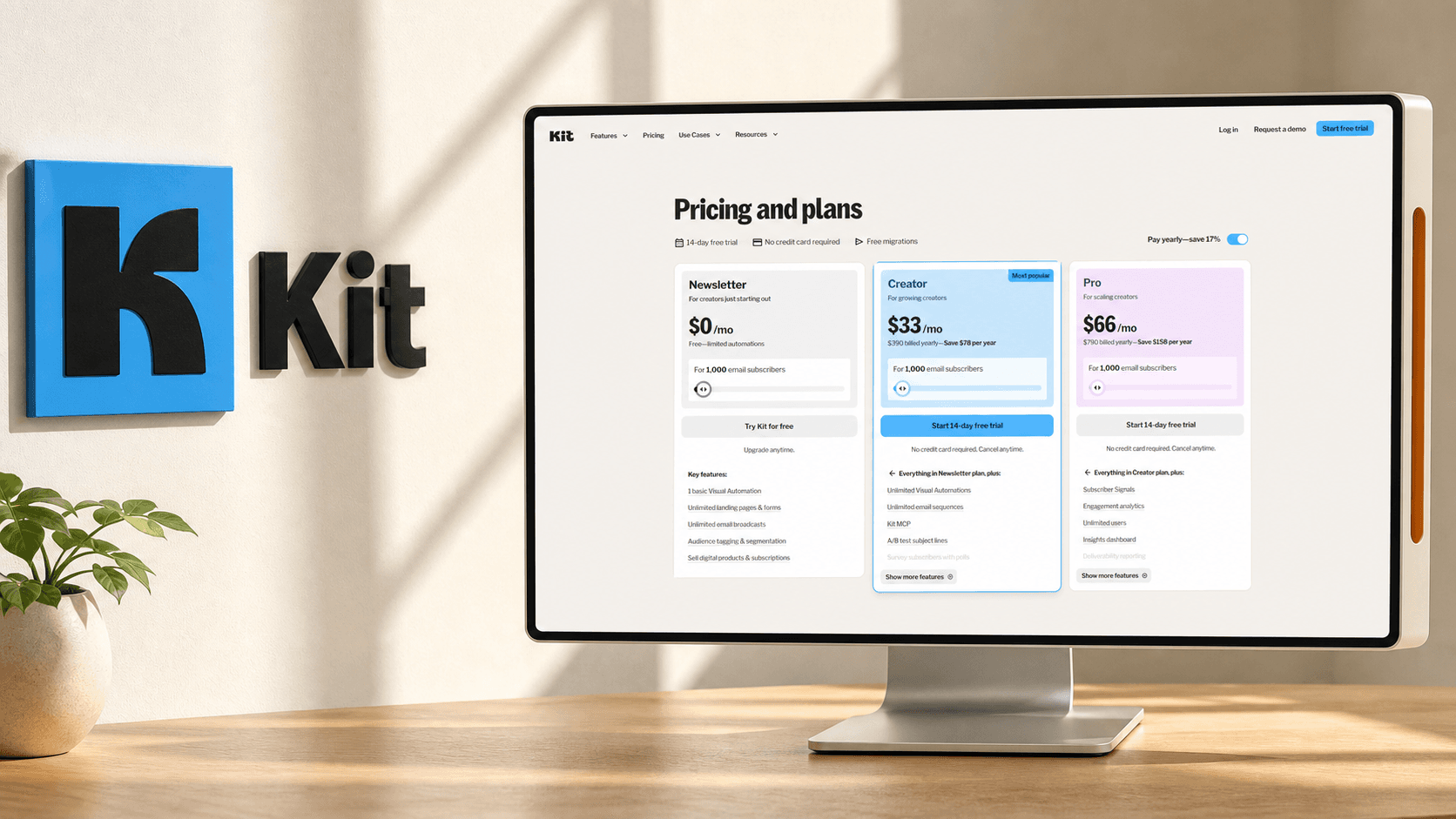
Verdict: Kit is worth it, and most creators should be on it. The free plan is genuinely free, the commerce fee is honest, the list is yours, and nothing about the pricing is designed to trick you. What Kit will not do is give you something a fan opens on a Tuesday morning. It moves messages and collects payments for things you already made. If your audience is paying for a result rather than a read, Kit is the distribution layer around that business, not the business. Kit is a creator marketing platform built around email, with landing pages, automations, and a built-in checkout for selling digital products and subscriptions. It launched as ConvertKit in 2013 and rebranded to Kit in 2024, positioning itself as what founder Nathan Barry called the operating system for the creator economy. Barry wrote publicly about the renaming decision while it was happening, which tells you something about how the company operates. The homepage claims "587M+ subscribers served" and 13 or more years of expertise. The product has stayed recognizably the same across that stretch: send email to people who asked for it, tag them by what they did, automate the follow-up, and sell them something without leaving the tool. Three things happen inside Kit. You collect email addresses through forms and landing pages. You send broadcasts and sequences to segments of that list. And through Kit Commerce you take money for digital products, one-time or recurring, with Stripe underneath. Everything else on the pricing page is a refinement of those three. Kit's Newsletter plan is free up to 10,000 subscribers, Creator is listed at $33 a month for 1,000 subscribers, and Pro is listed at $66 a month for 1,000 subscribers, with annual billing at $390 and $790 respectively. We verified this against Kit's live pricing page on August 14, 2026. Read those two numbers next to each other, because they do not behave the way pricing pages usually do. The free plan carries ten thousand subscribers. The paid plans quote their price at one thousand. So below 10,000 subscribers, the paid tiers are not selling you capacity. They are selling you features on a list Kit would have carried for nothing.
PlanListed monthly priceSubscriber ceilingCommerce fee
Newsletter$010,0003.5% + $0.30
Creator$33quoted at 1,0003.5% + $0.30
Pro$66quoted at 1,0003.5% + $0.30
What the free Newsletter plan includes, verbatim from the pricing page: one basic Visual Automation, unlimited landing pages and forms, unlimited email broadcasts, audience tagging and segmentation, and the ability to sell digital products and subscriptions. That last item is the one competitors do not match. Most platforms put the checkout behind the paywall. Kit does not. Creator adds unlimited Visual Automations, unlimited email sequences, A/B testing on subject lines, subscriber polls, SMS marketing, RSS campaigns, apps and integrations, the ability to remove Kit branding, and 24/7 email and chat support. Pro adds the analytics layer: Subscriber Signals, engagement scoring, a deliverability report, an insights dashboard, unlimited users, collaborative editing, a newsletter referral system, and content-level A/B testing. The honest way to describe the upgrade path is this. You move to Creator when a single automation stops being enough, which usually happens the first time you sell something with a real launch sequence behind it. You move to Pro when you have enough sends per month that a one-point deliverability difference is worth more than $33. One more line that deserves attention. Paid Recommendations, where other creators pay to be recommended inside your subscribe flow, carries a 23.5% commission to Kit on both Creator and Pro. That is not a transaction fee on your products. It is a cut of the growth revenue Kit routes to you, and it is the highest percentage on the entire pricing page. Kit charges 3.5% plus $0.30 per transaction on every plan, including the free one, and there is no monthly fee for Commerce. Kit's own help documentation states it plainly: "Selling in USD costs 3.5% + $0.30 per transaction," and "Commerce is available on every plan, including the free Newsletter plan." Stripe is the only supported processor. Payouts run weekly on Fridays, with the first one arriving 7 to 14 days after your first sale while the account clears review. Selling in euros costs 3.5% plus 0.25 euro, because the fixed component moves with the currency. That flat 3.5% is genuinely competitive. The part that changes your economics is the thirty cents.
Price pointFee (3.5% + $0.30)You keepEffective rate
$5$0.48$4.529.5%
$9$0.62$8.386.8%
$15$0.83$14.185.5%
$29$1.32$27.694.5%
$49$2.02$46.994.1%
$99$3.77$95.243.8%
A platform advertising 3.5% costs 9.5% on a $5 product and 3.8% on a $99 product. Same fee schedule, nearly triple the rate, decided entirely by what you charge. Cheap digital products are the worst thing you can sell through any per-transaction processor, and creators discover this after they have already built a $7 template business.
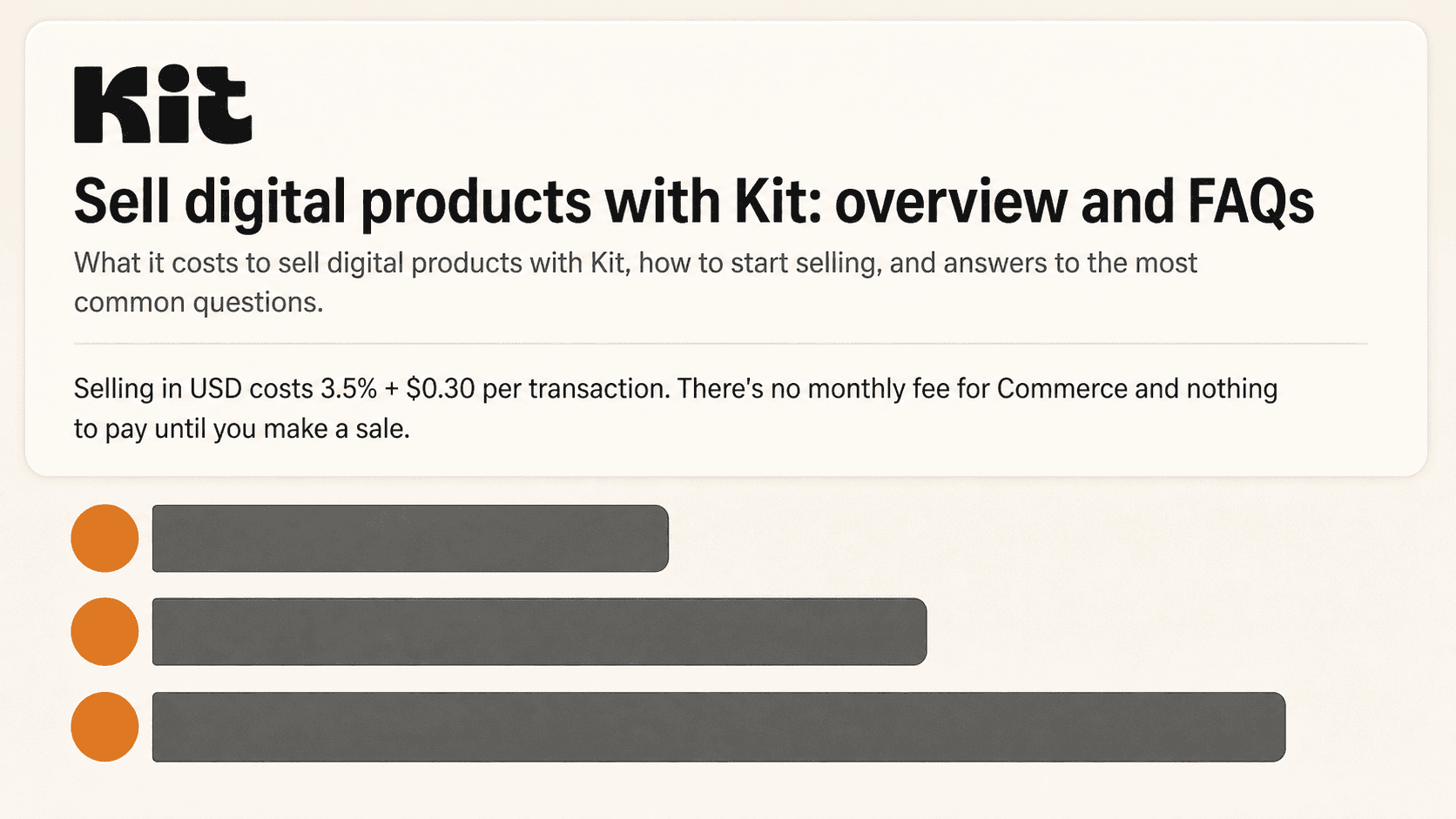
Kit's official Commerce fee statement above three increasing sale bars that each begin with the same fixed orange fee
Run it forward. A creator with 4,000 subscribers selling a $9 monthly paid newsletter to 200 of them grosses $1,800 a month. Kit takes 200 payments times $0.615, which is $123. The plan itself costs nothing, because 4,000 subscribers sits under the free ceiling. Total platform cost: $123 on $1,800, and no monthly bill in a month where nobody buys. There is not much to argue with there. Kit's real advantage is that the incentives point the same direction as yours: no monthly bill until you outgrow it, no cut of your list, and no algorithm between you and the people who subscribed. The free tier is not a trial. Ten thousand subscribers with unlimited broadcasts and a working checkout is a real business, not a demo. Plenty of creators earn five figures a year without paying Kit a subscription dollar. That is unusual enough that it deserves saying out loud rather than being treated as a marketing tactic. Tagging beats lists. Kit's core design choice, made over a decade ago, is that a subscriber is one person with tags rather than a row in five separate lists. It means you can send the launch email only to people who clicked the preview and skipped the purchase. Every serious email seller ends up wanting this, and most platforms bolt it on badly. Nothing stands between you and delivery. No feed ranking, no recommendation surface deciding who sees your work. A subscriber asked for the email and the email arrives. In a year when YouTube and X have both rewritten how creators get paid, owning the delivery path is worth more than it was two years ago. The pricing page does not lie to you. The commerce fee appears on the free plan's own feature list. The 23.5% recommendation commission is printed rather than buried in a help article. After reviewing enough creator platforms where the real rate takes an hour of reading to reconstruct, this is worth a point on its own. The limits are structural. Kit sends messages and collects payments. It does not create a thing your audience uses, and no feature release changes that. The 10,000 subscriber cliff arrives exactly when growth works. Below it, Kit is free. Above it, you are a paying customer whose bill scales with the number of people on the list, not with what those people earn you. That is the standard email pricing model, and it means a large list of casual readers costs the same as a large list of buyers. The CAC payback math gets uncomfortable when the cost side grows with attention instead of revenue. A newsletter is a thing you have to keep making. Stop sending for six weeks and the revenue does not stop immediately, but the engagement does, and the churn follows. This is the same treadmill as an income that resets to zero every month, just with better margins. Kit is an excellent tool for running on that treadmill. It is not an exit from it. Nobody discovers you inside Kit. There is no marketplace, no browse surface, no search ranking that brings a stranger to your product. Paid Recommendations is the one growth channel, and it costs 23.5%. Compare that to an App Store listing, where people who have never heard of you type a problem into search and find the app before they find the person.
Kit's real email automation ending in an inbox while an orange rail stops before an empty phone-shaped product space
Stripe only, and the payout is weekly. For most creators this is fine. For anyone in a country Stripe does not serve well, or anyone who needs faster cash cycles, it is a hard constraint rather than a preference. Yes, and it is probably the right first paid tool. It is also not the last one, and knowing which of the two you are buying changes what you build next. If you are a creator with 50,000 engaged followers who already sells something, here is the honest sequence. Put Kit under everything now, on the free plan. Move your audience off rented platforms and into a list you own. Sell one thing through Kit Commerce and watch what percentage of subscribers buy it. That number is the single most valuable piece of data you have, because it tells you whether your audience is an audience or a customer base. Then read the number. If 2% of your list buys a $29 product once, you have a content business with a merchandise arm. If 8% of your list will pay $9 every month for the same thing, you have a subscription business trapped inside an email tool. Those two results should lead to completely different next moves, and most creators treat them the same because the dashboard looks similar. The creators who stall are the ones who confuse a working newsletter for a finished business. The list keeps growing, the launches keep converting, and the amount of work required to earn next month never goes down. If that is the shape you are in, the alternatives worth looking at are not other email tools. No. Kit does not publish an app under your name on the App Store. Your subscribers read your work in an inbox and pay through a Kit-hosted checkout, and the discovery, the ranking, and the home screen icon do not exist. This is not a criticism of Kit for failing at something it never claimed. It is the boundary of the category. Email is the best owned channel available and it is still a channel: a way to reach people who already know you, on a cadence you have to maintain by hand. An owned app inverts all three constraints. The App Store listing ranks in search, so new customers find the product before they find you. Daily usage inside the app generates the raw material for the next week of posts, which quietly answers the hardest recurring question in a creator's calendar. And the subscription bills whether or not you shipped anything that month. If you are weighing an app against selling a course to your list, the revenue math is the place to start, and it is less close than most people expect. Run the same test on Kit that you would run on any platform. If this company tripled its price tomorrow, what would you still have? With Kit the answer is better than most: you would have your list, exportable, with tags and purchase history intact. That is real, and it is why Kit deserves 4 out of 5 rather than 3. What you would not have is the product. The thing people paid for still has to be made by you, again, next month, and the discovery still has to come from a feed you do not control. Built by Foundry builds the other half. We build a subscription software business for a creator in about three weeks, $0 upfront, on a revenue share. The creator owns the business and the revenue. We ship it and then we keep improving it after launch, because our side only earns when the product does. Keep Kit. Put it under everything. Then ask what your audience would open every day if you gave them something worth opening. Yes. Kit's Newsletter plan costs $0 and runs to 10,000 subscribers with unlimited email broadcasts, unlimited landing pages and forms, audience tagging, one basic Visual Automation, and full access to Kit Commerce for selling digital products and subscriptions. Selling still costs 3.5% plus $0.30 per transaction on the free plan. Kit's pricing page lists the Newsletter plan at $0, the Creator plan at $33 a month for 1,000 subscribers, and the Pro plan at $66 a month for 1,000 subscribers, with annual billing at $390 and $790. Paid plan prices scale with subscriber count above those tiers. 3.5% plus $0.30 per transaction in USD, on every plan including the free one. In euros it is 3.5% plus 0.25 euro. Kit's help documentation confirms there is no separate monthly fee for Commerce and nothing to pay until a sale happens. Yes. Kit's pricing page lists a 23.5% commission on Paid Recommendations earnings for both the Creator and Pro plans. That is a cut of what other creators pay to be recommended inside your subscribe flow, separate from the commerce transaction fee on your own products. Yes. Kit Commerce supports recurring products including paid newsletters, billed through Stripe, on every plan. Payouts go out weekly on Fridays, and the first payout takes 7 to 14 days after your first successful sale while the account is reviewed. No. Kit has no facility for publishing an app under your own name on the App Store or Google Play. Subscribers read your emails in their inbox and buy through a Kit-hosted checkout page. A branded app listing requires building your own product.

Creator app strategy

Curious what your app could be?

Enter your handle and Built by Foundry will research your audience and present custom app concepts. Free.

Kit Review 2026: Is the Free Plan Really Free?