
Turning Knowledge into Products

Turn a Discord Community Into an App: 5-Step Guide

July 20, 2026
Share
Turn a Discord Community Into an App: 5-Step Guide

Get Creator Revenue Insights

How creators are turning audiences into subscription businesses
Share
Key Takeaways:
  • Discord Server Subscriptions cap you at three tiers priced $2.99 to $199.99, take a 10% platform fee, and require a US bank account and US government ID, which locks out most of the world (Discord, 2024)
  • On iOS, Apple's fee stacks on top, so a subscriber's dollar can lose 40% before it reaches you in year one
  • The paid-membership platform market is projected to grow from $7.66B in 2025 to $8.92B in 2026, a 16.5% clip, which is exactly why owning your slice matters (Research and Markets, 2026)
  • Creators on subscription-based models average $94,731 a year versus $67,196 for mixed models (Circle, 2026)
  • Five steps move you from "paid Discord server" to "subscription app you own, on the App Store, discoverable by people who've never heard of you"
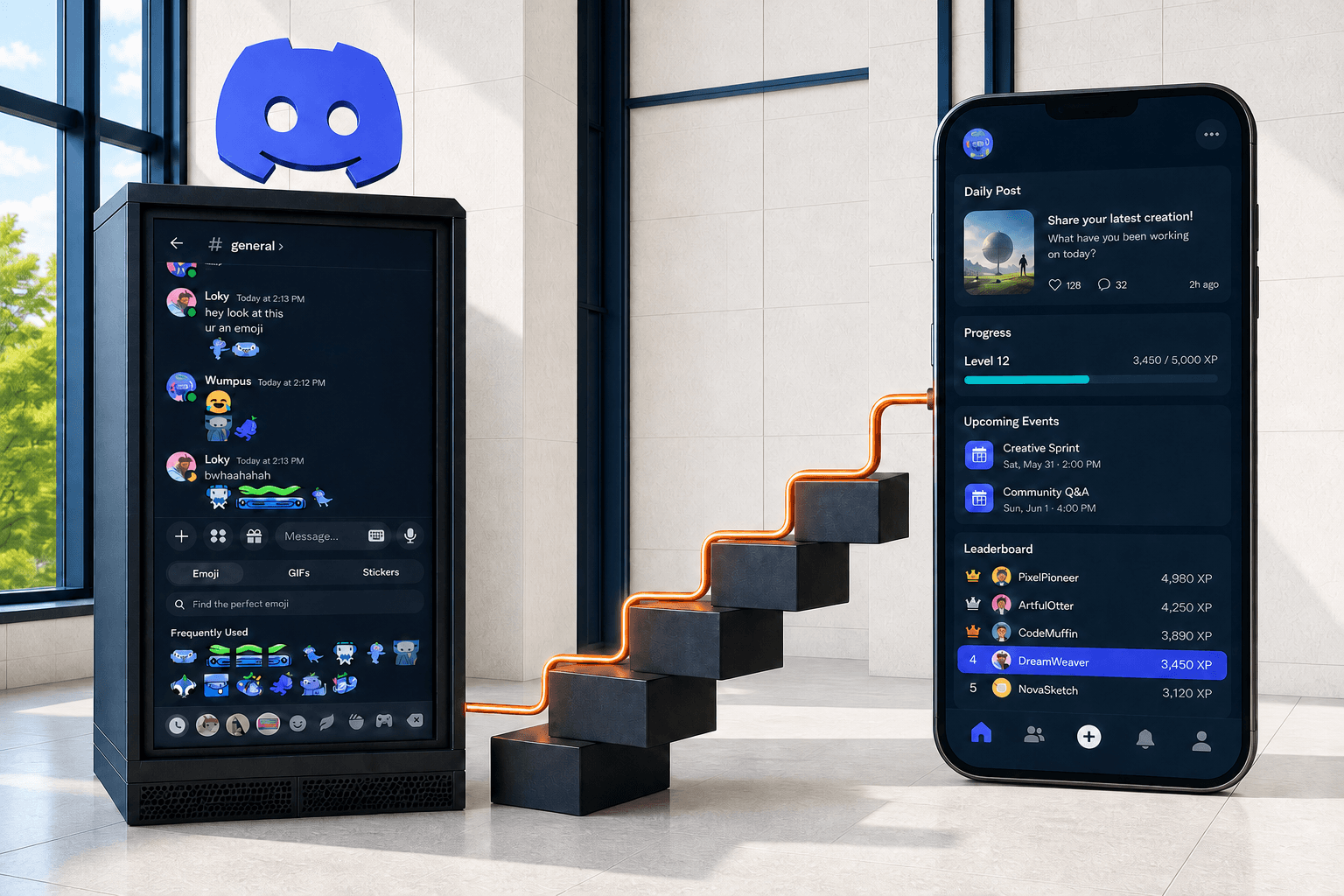
What is a Discord community app? A Discord community app is a creator-owned mobile product that takes the rituals, tools, and access people already pay for inside your server and turns them into a standalone app on the App Store and Google Play. You own the members, the billing, the data, and 100% of the revenue minus standard store fees. You built a community that people show up to every day. They pay for a role, they trade tips in the good channels, they hit the weekly voice call. It works. And Discord skims a tenth of every dollar, caps you at three tiers, and, if you don't live in the US, won't let you charge at all. That's a business running on land you rent. Here's how to move it to land you own. Discord was built for gaming chat, not for running a real subscription business, and its monetization tools show it. Server Subscriptions let you gate channels behind a monthly fee, but the guardrails are tight: a maximum of three tiers, prices locked between $2.99 and $199.99, and a flat 10% platform cut on top of payment processing (Discord, 2024). Then there's the wall most creators hit first. Native Discord subscriptions require US residency, a US bank account, and a US government ID verified through Stripe (Business of Apps, 2026). If you're a creator in London, Lagos, or Manila, the door is closed. And when a fan subscribes through the iOS app, Apple's 30% fee stacks on top of Discord's 10%. Here's what your take-home looks like on a $10 subscription:
Checkout PathPlatform FeesYou Keep (est.)
Desktop / web~10% + processing~$8.40
iOS, year one~30% Apple + 10%~$6.00
iOS, year two+~15% Apple + 10%~$7.50
You built the audience. You run the community. You make the content. And in a bad month, four dollars of every ten never reach you. This is the same trap we broke down in why creators are leaving Patreon for their own apps. A Discord community app takes the value your server already delivers and repackages it as a product you own outright. Not a bot. Not a paid role. A real app with your name on the App Store listing. The difference is ownership. On Discord, the platform owns the billing relationship, the churn data, and the discovery. When a paid member leaves, you usually don't learn why, and you can't win them back because you never had their contact info. On your own app, you own the customer, the subscription, the usage data, and a store listing that pulls in new members who've never seen your server. This is the leap from renting an audience to owning a business, the same one we mapped in you can't sell a YouTube channel, you can sell an app. Before you build anything, name the job. Not the topic. The job your members hire the community to do. A trading community doesn't sell "market chat." It does "tell me what to do before the bell so I don't panic." A fitness community doesn't sell "workout talk." It does "keep me accountable so I actually show up." A language-learning server does "give me people to practice with so I don't quit." The job is the reason someone opens the app instead of scrolling something else. Your app should do that exact job, with persistence and structure a chat window can't offer:
Community TypeThe Real JobThe App Does It Better By
Trading / investing"Tell me what to do today"Daily alerts, watchlists, tracked calls
Fitness / coaching"Keep me accountable"Streaks, check-ins, progress logs
Creative / skill-building"Help me improve"Lesson paths, challenges, feedback threads
Fandom / niche interest"Give me my people"Events, leaderboards, member profiles
If you can't write that one-line job statement, you don't have a product yet. Get it right before you spend a dollar. We go deeper on this in how to turn a course into a subscription app, and the same discipline applies here. The mistake most creators make is trying to clone Discord's chat inside an app. That's the one thing you don't need to rebuild. What you need to move over are the rituals: the recurring moments that make people show up. Look at what actually retains members in your server and build the app around those:
  • The daily drop. The morning alert, the market open note, today's prompt. This is the reason someone opens the app before coffee.
  • The tracked progress. Streaks, logs, scores, before-and-after. A chat forgets what you did yesterday. An app remembers, and that memory is what pulls people back.
  • The event. The weekly call, the monthly challenge, the live session. Put it on a calendar inside the app with a push reminder.
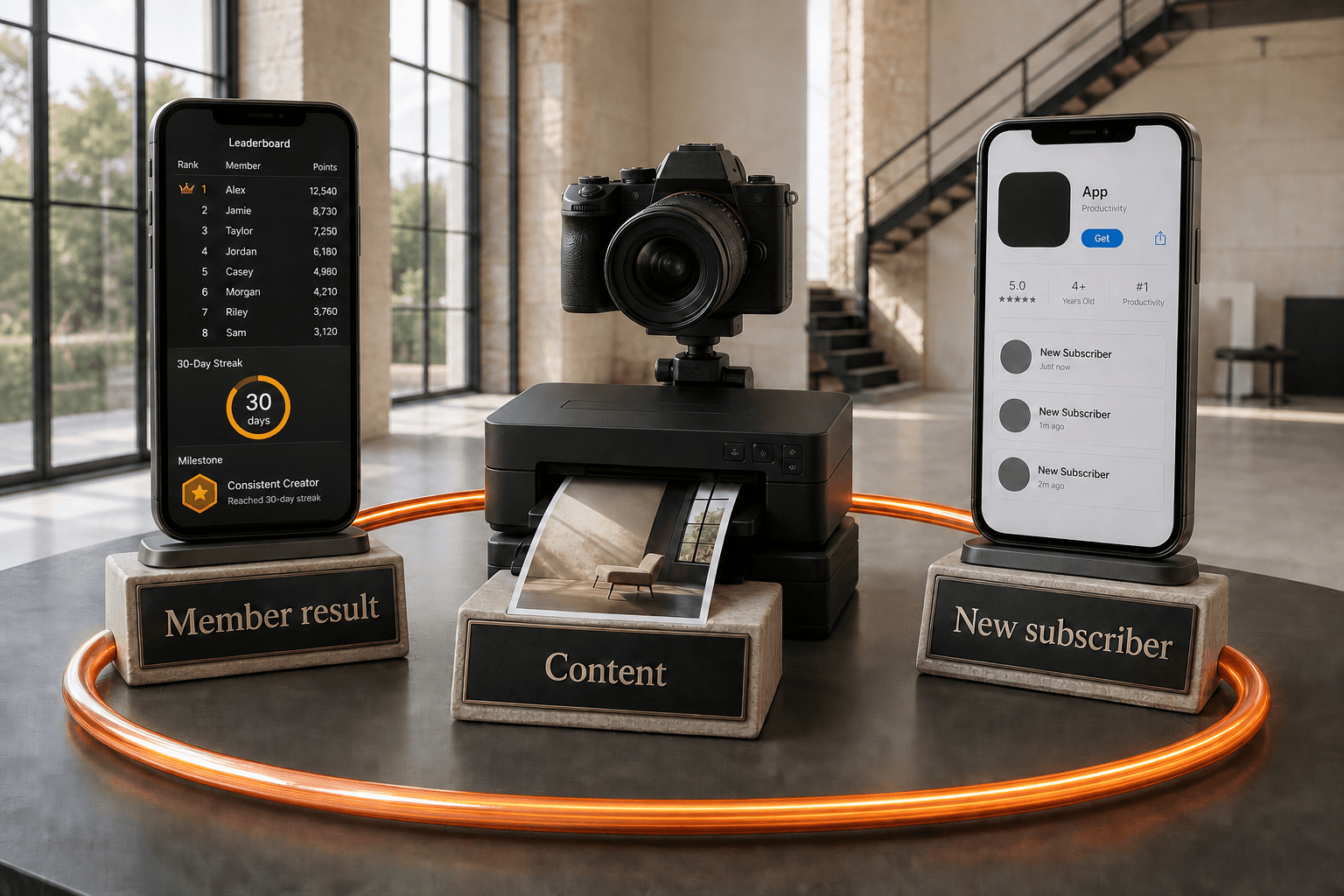
  • The status. Roles, badges, leaderboards, member tiers. People pay to belong and to be seen belonging.
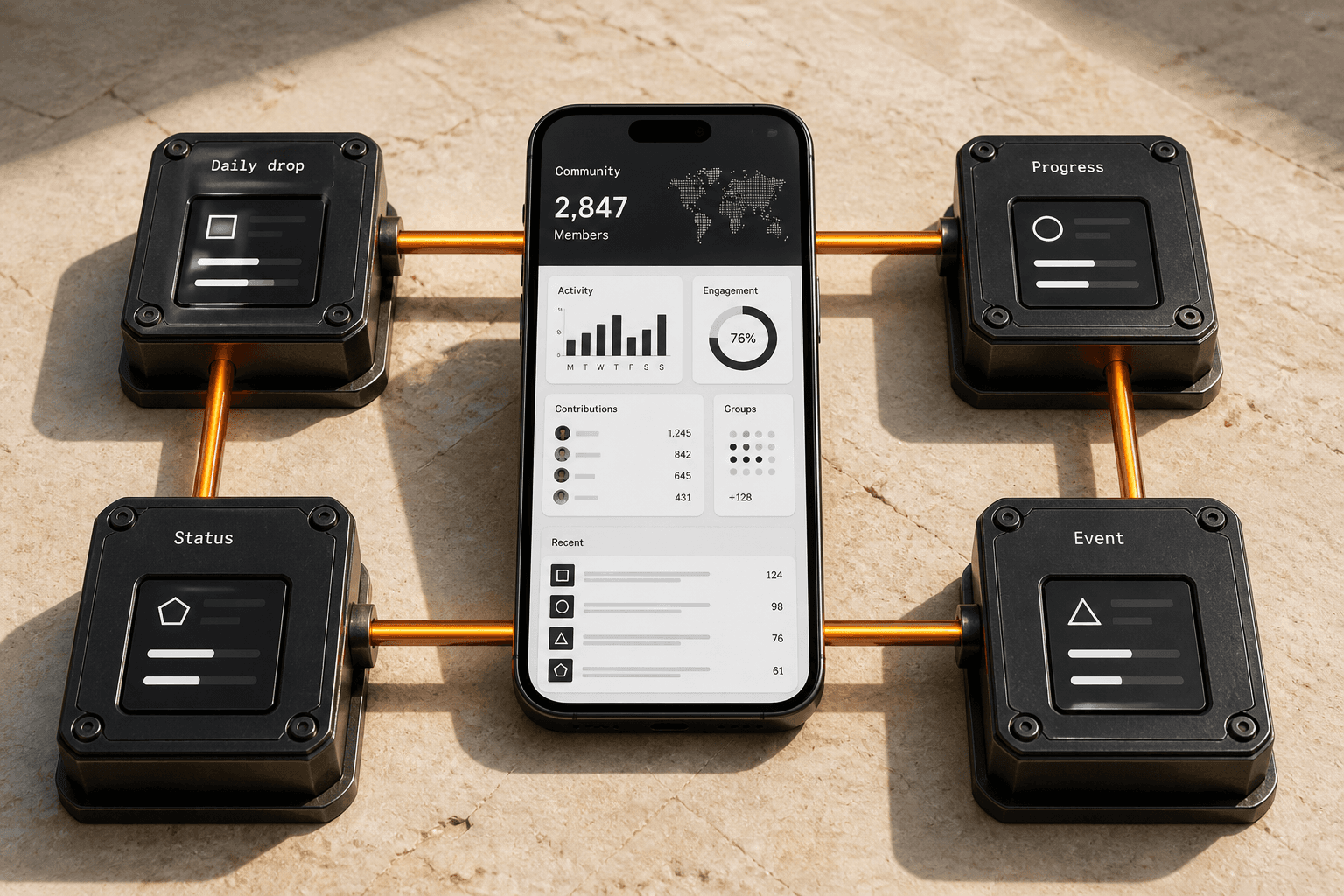
The strongest community apps stack two rituals. A daily drop plus tracked progress. An event plus a leaderboard. One gives a reason to subscribe. The second gives a reason not to cancel.
Diagram showing four Discord community rituals feeding into a single owned subscription app
Stop pricing like a Discord role. Start pricing like a product. Most creators anchor to whatever their server charged, often $4.99 for a color and a locked channel. But an app that does a real job is worth more than a role. The right zone for most community apps is $7.99 to $19.99 a month, with an annual plan at 30% to 40% off. If a topic drives real financial or professional value, the ceiling is higher. For the full framework, read how to price a creator subscription app. Here's what the math looks like at a few community sizes, assuming a realistic conversion from free members to paid app subscribers:
Active MembersRealistic ConversionPrice PointMRR
1,0005% to 8%$9.99$500 to $800
5,0005% to 8%$9.99$2,500 to $4,000
20,0004% to 7%$9.99$8,000 to $14,000
50,0003% to 6%$9.99$15,000 to $30,000
A 5,000-member community converting 6% at $9.99 is roughly $3,000 in MRR, recurring, that keeps earning whether you post today or not. That's the case we ran in full in brand deals vs subscription apps: the creator math. Don't announce to your whole server on day one. Build the conversion habit with your most loyal members first. Pull the top 5%: the people who reply in every thread, show up to every call, and answer other members' questions for free. Offer them founding-member pricing locked in forever. That cohort becomes your proof, your testimonials, and the people who find the bugs before everyone else. Then roll out to the full community in three waves:
  • Story wave. A few posts explaining why you built the app, who it's for, and what it does that Discord can't. The story is the marketing.
  • Demo wave. Show a real member using it. A 60-second screen recording of one person's daily loop converts better than any pitch about yourself.
  • Offer wave. A clear founding deal with a real deadline. "$6.99/month locked in forever, until August 1." Scarcity that's actually true.
The worst move is a permanent "check out my app" pin that members learn to ignore. Treat the launch like a campaign, not a footer. Chani Nicholas did a version of this, moving an audience into a daily-use product that now earns as the CHANI astrology app. The hardest part of running a community isn't the members. It's feeding the machine. Every day you need a reason for people to show up, and every week you need something to post about to bring new people in. A subscription app solves both at once. Every feature people use becomes content. The weekly leaderboard is a roundup post. A member's before-and-after is a transformation story. The most-asked question in the app is your next tutorial. The app generates the material you promote it with.
Split image contrasting a rented Discord server on the muted left with an owned subscription app on the warm-lit right
This is the compounding loop most creators miss. The app isn't a second thing to maintain alongside the community. The app's activity writes your content, the content drives signups, and the two feed each other. The same engine works whether you started with a course or a newsletter. Most creators who monetize a community reach for Discord or a hosted platform like Circle because they're easy. Easy has a long-term price, and the price is ownership.
PlatformTake RateOwns CustomerOn App StoreStore Discovery
Discord Subscriptions~10% + processingDiscordReader app onlyNone
Circle / hosted~4% to 10% + feesThe platformShared appNone
Your Own App~15% Y1, ~15% Y2+YouYes, your listingApp Store + Google Play
The take rate is only half the story. The other half is who owns the customer. On Discord and Circle, when a member cancels you don't get their email, their reason, or the right to win them back. On your own app you own all of it, plus a store listing that brings in members who never found your server. That's the line between renting an audience and owning a business, which we made in full in why the next 10K fans won't come from social media. This is the most common objection, and it's wrong. A 1,000-member community converting 6% at $9.99 a month is about $600 in MRR, or $7,200 a year of recurring revenue you didn't have, from a community most creators think is too small to matter. By year two, with App Store discovery bringing in subscribers who never joined your server, it compounds. You don't need 100,000 members to ship an app. You need a few hundred people who would pay for a daily product. If your server is active, you already have them. And the market is moving your way: paid-membership platforms are projected to grow past $8.9 billion in 2026 (Research and Markets, 2026), with subscription-based creators out-earning mixed models by nearly $28,000 a year (Circle, 2026). Traditional agencies charge $50K to $200K upfront. Built by Foundry charges $0 upfront and takes a revenue share, so we only earn when your app does. Most creators ship in three weeks. Yes, and most creators should. Keep the free server as your top-of-funnel and community hub. The app becomes the paid product where the daily rituals, tools, and tracking live. The two work together. Your most active members will move first, especially with founding-member pricing. Communities convert well because the members already pay for access and show up daily. That habit is the hardest thing to build, and you already built it. They cap you at three tiers, take 10% plus processing, and require a US bank account and US government ID, which excludes most creators worldwide. You also never own the customer or the App Store listing that drives new signups. No. Built by Foundry handles design, development, App Store submission, and ongoing updates. You approve the vision and bring the community. We build and run the rest. Every day your members show up, you feed an asset you don't own. Discord takes its cut, owns the billing, caps your tiers, and, for most of the world, won't let you charge at all. You did the hard part already. You built the room people want to be in. The fix is shipping the product that room was always pointing at. Five steps. Three weeks. A subscription business that earns whether you post this week or not. Want to turn your community into an app you own? We build custom subscription apps for creators. $0 upfront, three-week delivery, and we run the tech forever.
See What We’d Build You →
Creator app strategy

Curious what your app could be?

Enter your handle and Built by Foundry will research your audience and present custom app concepts. Free.