

Turning Knowledge into Products

How to Turn a Course Into an App: 6-Step Guide

Built by Foundry
July 5, 2026
Share
How to Turn a Course Into an App: 6-Step Guide

Get Creator Revenue Insights

How creators are turning audiences into subscription businesses
Share
What does it mean to turn a course into a subscription app? It means taking the knowledge you sell once as a one-time course and rebuilding it as a mobile product students pay for every month. Instead of a video library people buy and abandon, you own an app that delivers your method, tracks progress, and earns recurring revenue on autopilot. Key Takeaways:
  • The median online course completion rate is about 12.6%, and most free courses land between 5% and 15% (Jordan, Open University MOOC study). People buy your course, quit, and never pay again.
  • A course is a one-time sale. A subscription app charges every month for the same knowledge, so lifetime value compounds instead of resetting to zero.
  • Higher-priced subscription apps generate roughly 7x the lifetime value of cheap ones ($55.21 vs $8.08 per user, per RevenueCat).
  • Six steps move you from "I sold a course once" to "I run a subscription business."
  • Building it yourself runs $50K to $150K plus 15% to 20% a year to maintain. A revenue-share partner does it for $0 upfront.
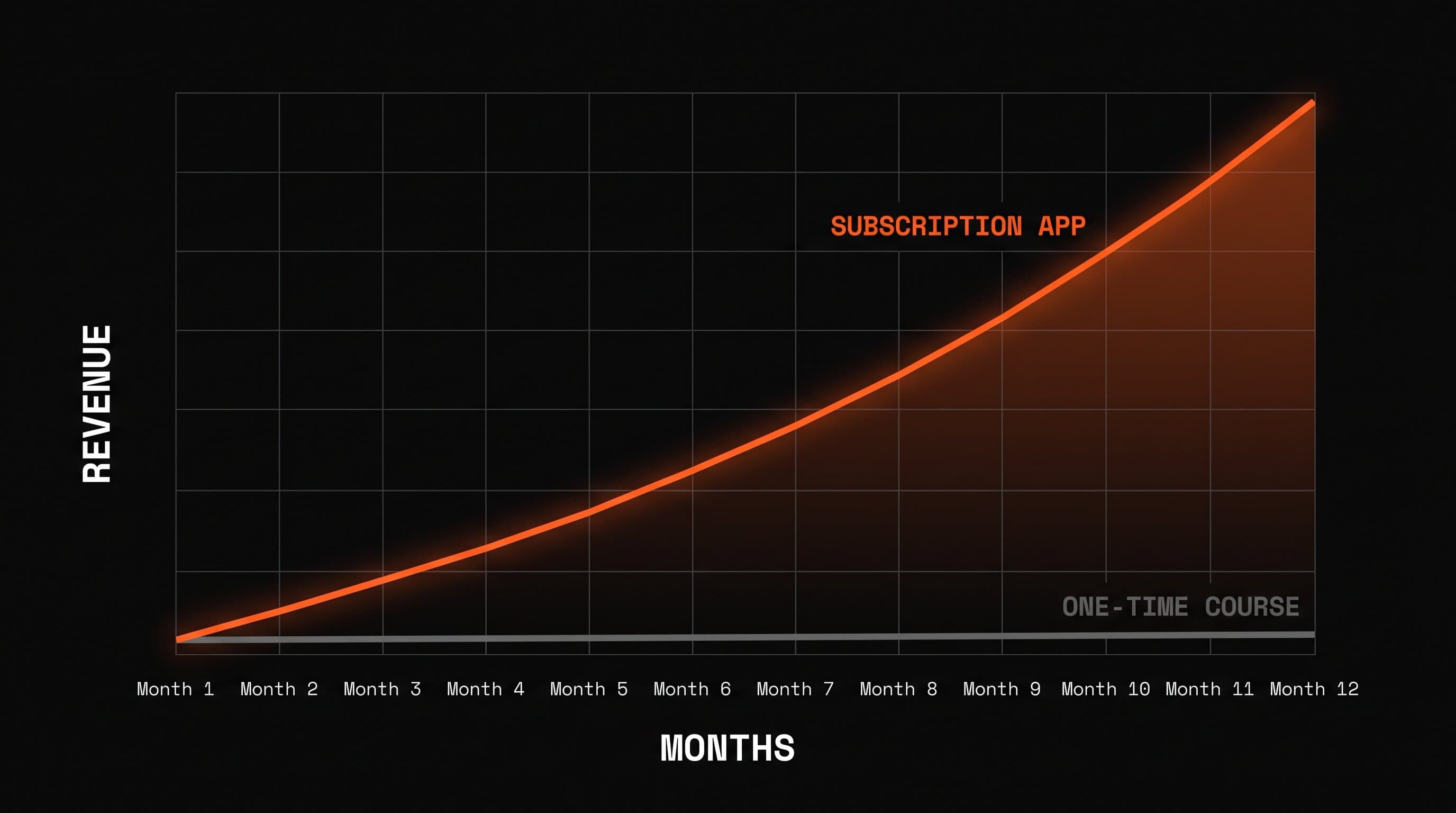
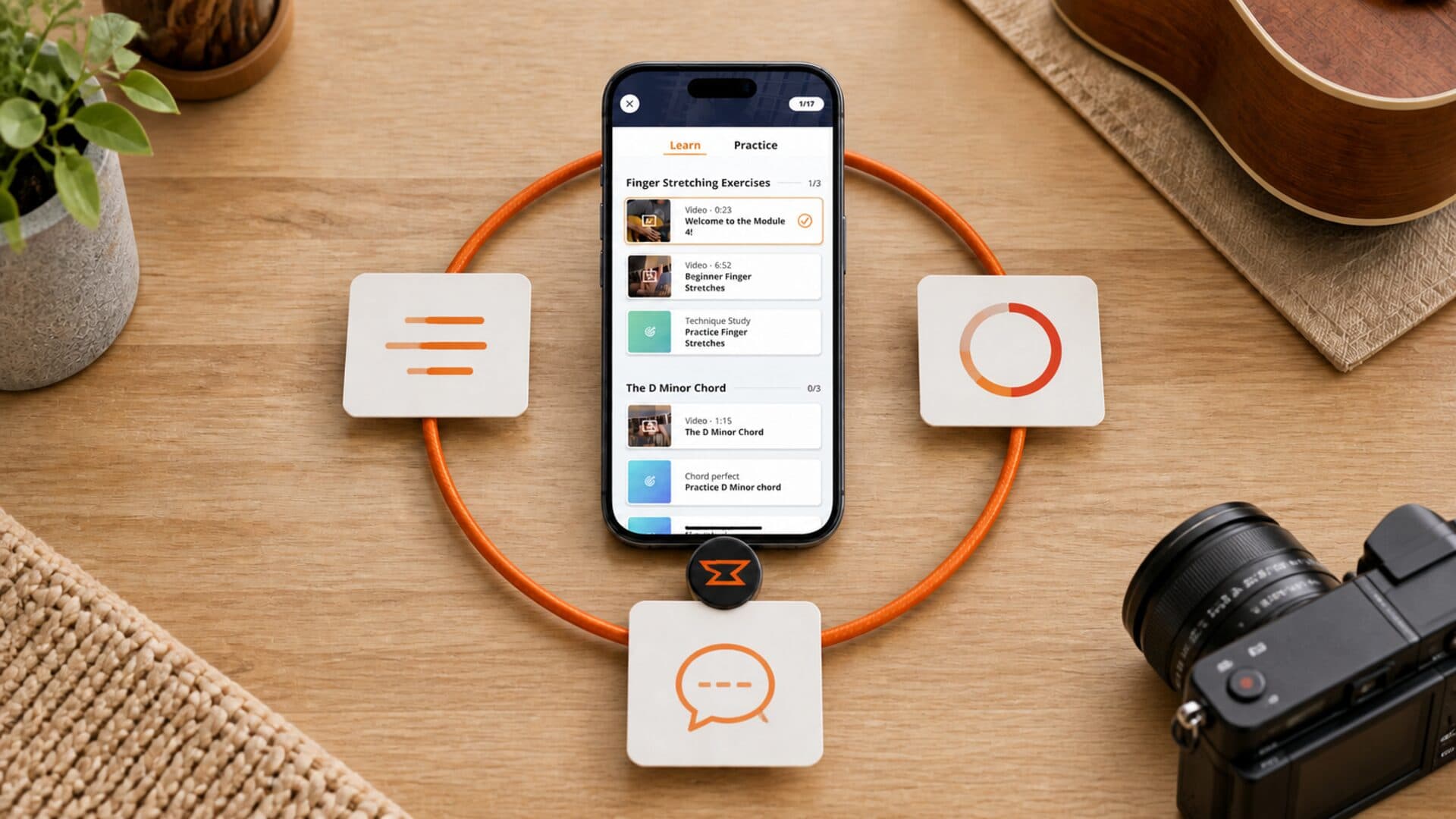
You already did the hard part. You packaged your expertise, recorded the lessons, and got people to pay. Then the sale ended, the student disappeared, and you had to go find the next one. That's the course trap: you keep selling the same thing to new people because the people you already sold to are gone. Turning a course into a subscription app fixes that. The knowledge stays the same. The business model flips from one-time to recurring. And the students who used to vanish after checkout become subscribers who pay you month after month. Here's how to make the switch. Because a course sells once and an app sells forever. That's the entire pitch, and the numbers back it up. Start with the ugly truth about courses: almost nobody finishes them. The median completion rate across online courses sits around 12.6%, and free courses run between 5% and 15%, according to a widely cited Open University study on MOOC completion. Your student paid, watched two modules, closed the tab, and moved on. You got one payment. They got a fraction of the transformation you promised. Nobody wins the second month, because there is no second month. A subscription app is built around the opposite behavior. Instead of a finish line, it has a reason to open the app tomorrow: a plan that updates, a streak to keep, a next lesson unlocked by progress. You stop selling information and start selling ongoing results. That shift is why creators are leaving the course model behind, a trend we broke down in 5 reasons creators choose apps over courses. JustinGuitar is the clearest proof. Justin Sandercoe gave away free lessons for years, then packaged his teaching method into an app that structures practice, tracks progress, and keeps players coming back. As we covered in how JustinGuitar became an app empire, the app did what a course never could: it turned one-time learners into daily users. An app makes more, and it isn't close, because recurring revenue compounds while one-time sales reset. A $199 course sells once and you're back to zero. A $14.99 app charges that student every month they stay. Run the comparison on lifetime value. Higher-priced subscription apps generate about 7x the lifetime value of cheap apps, $55.21 versus $8.08 per user, according to RevenueCat's State of Subscription Apps 2025. And that value grows roughly 60% from month one to month twelve as subscribers stick around. A course can't compound. It's a single transaction with a hard ceiling. Here's how the two models stack up side by side:
ModelTypical PriceHow Often You Get PaidRevenue Ceiling
Online course$99 to $499 one-timeOnce per studentResets to zero per sale
Cohort program$500 to $2,000Once per launchCapped by launch cycles
Subscription app$9.99 to $29.99 / monthEvery month, per studentCompounds every month
We ran the full breakdown in our app vs course revenue math for creators, and the pattern holds at every price point: recurring beats one-time once your students stay past month three. Before you build anything, find the problem that comes back. A course teaches something once. A subscription app has to solve something that never fully goes away, because that's what keeps someone paying. A fitness course teaches workouts. The recurring problem is "I need a plan that changes as I get stronger." A finance course teaches budgeting. The recurring problem is "I need to stay on track every month." A guitar course teaches chords. The recurring problem is "I need to keep practicing and see I'm improving." Write your recurring problem in one sentence, in your student's words. If your course solves a problem that's truly one-and-done, the app version needs a layer that repeats: tracking, updates, community, or accountability. That repeating layer is what turns a finished course into a reason to keep paying.
A bar chart comparing flat one-time course income against rising monthly recurring revenue from a subscription app over twelve months
Your course is already structured. Modules, lessons, worksheets, a logical order. That structure is your product spec. You're not inventing an app from scratch. You're re-shaping content you already own into something interactive. Map each piece of the course to an app feature:
  • The intro module becomes an onboarding quiz that personalizes the experience
  • Each lesson becomes a bite-sized daily unlock instead of a 45-minute video nobody finishes
  • The worksheet becomes an in-app tracker or log
  • The "do this every day" advice becomes streaks, reminders, and push notifications
  • The Facebook group you run on the side becomes a native community tab
The goal is to break the long-form course into small, repeatable actions. Micro-learning units under two hours complete at 80% to 90%, while 40-hour courses complete at 5% to 10%. Your app should feel like the former: small wins, every day, not a giant library the user has to conquer alone. The instinct is to charge once because that's what courses do. Kill that instinct. Your app delivers ongoing value, so it should charge on an ongoing basis. Most creator apps land between $9.99 and $29.99 a month. Where you sit depends on how much of the transformation the app delivers on its own. A light tracker sits at the bottom. An app that fully replaces a $499 course plus coaching sits near the top. Annual plans, priced at roughly 8 to 10 months of the monthly rate, pull cash forward and cut churn. We walk through the full framework in how to price a creator subscription app. Run the math before you pick a number. At $14.99 a month, 1,000 subscribers is about $15,000 in monthly recurring revenue, or $180,000 a year, from a course you already recorded. Your old course would have needed to sell 900 copies at $199 to match that, every single year, forever. You don't need to code, and you don't need to spend a year on it. You need a product partner who turns your course into a real, shippable app and then keeps it running. This is where most course creators stall. They try an AI app builder or a no-code tool, get a demo that looks fine on screen, then hit the wall: it can't take payments, can't send push notifications, and can't pass App Store review. A demo is not a product. The gap between them is subscriptions, accounts, data, updates, and the ongoing app care that keeps a live product healthy. At Built by Foundry, we own all of it. We build the whole product, ship it to the App Store, and run it forever, so you never touch a line of code or a bug ticket. You approve the vision. We build and operate the business. Read how our model works for the full breakdown of the $0-upfront, revenue-share approach. Your first subscribers already bought from you once. Don't launch to strangers. Launch to your course buyers, your email list, and your community. Offer them the app at a founding rate. Frame it honestly: the same method they already trust, now in their pocket, updated constantly, for a fraction of what a new course costs. A meaningful share will convert, because they already believe in the transformation. That early cohort gives you day-one revenue plus the reviews and usage data the App Store needs to start recommending your app to strangers. That App Store discovery is the part course creators underestimate. On a course platform, you have to drive every sale yourself. An app store is a search engine with a billion users. Your next thousand subscribers won't all come from your list, many will find the app by searching for the problem you solve, then discover you. We covered this shift in how the App Store became a growth channel. Once the app is live, it solves the problem every creator wrestles with daily: what do I post next? Every student milestone is a post. Every before-and-after is a testimonial you didn't script. Every leaderboard, streak, or aggregate result is content the app generated for you. Your product stops being something you market and becomes something that markets itself. The same flywheel powers the creators profiled in how to turn a coaching business into an app: product creates content, content brings users, users create more content. A course sits on a hard drive. An app runs, gathers data, and hands you your content calendar for free. Built the traditional way, a lot. Building a custom app with a U.S. agency runs $50,000 to $150,000 for a production-ready first version, with senior developers billing $150 to $250 an hour, according to GoodFirms' app development cost data. Then you pay to keep it alive: annual maintenance typically runs 15% to 20% of the build cost every year for OS updates, bug fixes, and security patches. On top of that come the fees nobody mentions upfront. Apple and Google take 15% of subscription revenue for developers under $1 million a year, per RevenueCat's guide to the App Store small business program, plus annual developer accounts and backend hosting. Here's the real picture:
CostDIY / Agency RouteFoundry Route
Upfront build$50,000 to $150,000$0
Annual maintenance15% to 20% of build cost$0
App Store submissionYour problemHandled
Ongoing updatesYou hire and manageHandled forever
That's why the revenue-share model exists. Instead of paying six figures to build an app before you know it works, a partner builds it, ships it, and runs it, then takes a share of the revenue it earns. You risk nothing upfront. We only make money when you make money. Want to turn your course into an app? We build custom apps for creators. $0 upfront, three-week delivery, and we handle all the tech forever.
Let's Build →
Yes. Your course content, structure, and worksheets become the foundation. The app reshapes them into daily lessons, trackers, and reminders. You keep the expertise. The format changes from a passive library into an interactive product people use every day. Building it with an agency costs $50K to $150K plus 15% to 20% a year to maintain. Built by Foundry charges $0 upfront. We build the app and take a revenue share, so we only earn when you earn. For most creators, yes, once students stay past a few months. A course pays once. An app charges every month, so lifetime value compounds instead of resetting to zero after each sale. There's no hard minimum, but existing course buyers and an email list give you day-one subscribers, early reviews, and usage data. Those signals help the App Store surface your app to new users who never took your course. Traditional agencies take 6 to 12 months. Built by Foundry ships in about three weeks. We handle design, development, App Store submission, and ongoing updates so you stay focused on teaching.

Creator app strategy

Want us to review your creator business?

Apply for a Foundry Creator App Review. We'll tell you whether there is a real app opportunity hiding in your audience.

How to Turn a Course Into an App: 6-Step Guide