
Platform Reviews

Event Ticket Fees in 2026: 6 Fee Stacks on the Same $20,000 Night

September 5, 2026
Share
Event Ticket Fees in 2026: 6 Fee Stacks on the Same $20,000 Night

Get Creator Revenue Insights

How creators are turning audiences into subscription businesses
Share
Key Takeaways:
  • Eventbrite publishes "3.7% + $1.79 service fee per ticket" plus "2.9% payment processing fee per order" on its organizer pricing page. On a $40 ticket that is $4.43, and the same page says those fees "are paid by your buyers by default"
  • Luma charges 5% on the free plan and 0% on Luma Plus at $59 a month billed annually, both on top of Stripe. Humanitix charges 2.1% + $0.99 plus processing. Eventzilla Basic charges $1.50 per registration with processing billed separately
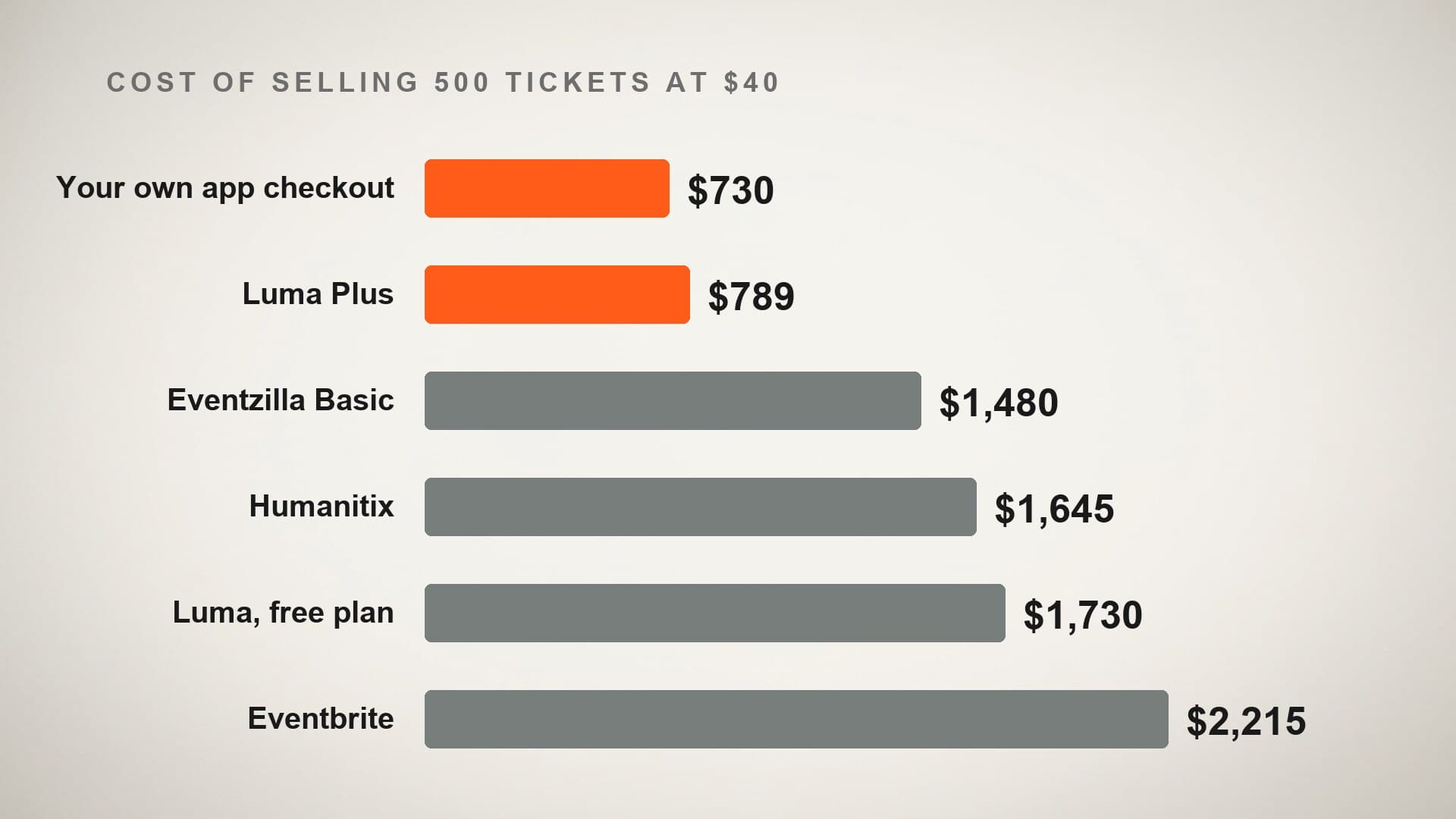
  • On 500 tickets at $40, the six stacks cost between $730 and $2,215 for the same night. That is a spread of $1,485, or a factor of three, for identical work
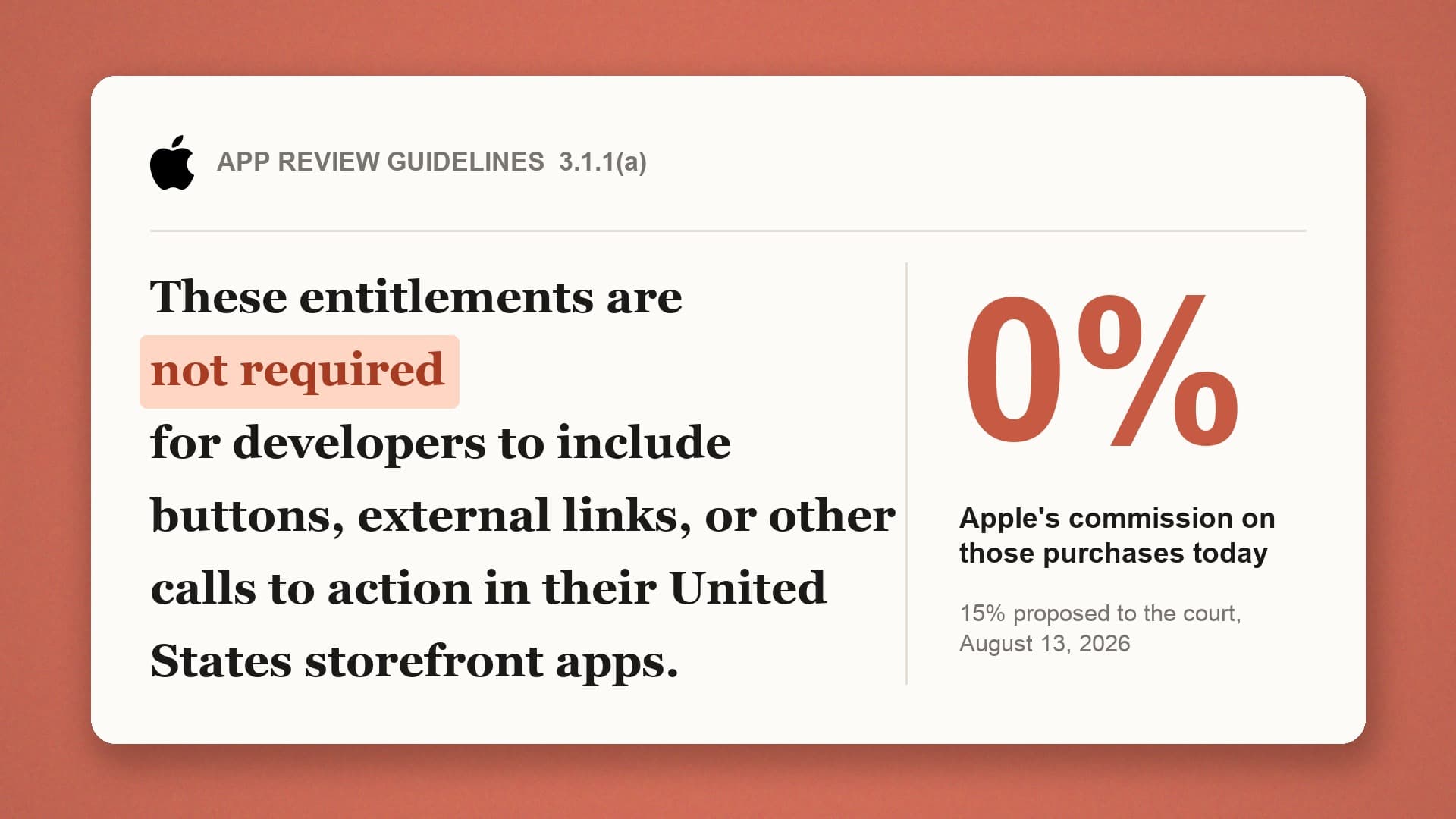
  • Apple takes nothing. Its App Review Guidelines state that an app selling "physical goods or services that will be consumed outside of the app" must use "purchase methods other than in-app purchase," which makes an owned app the cheapest ticket rail on this page at Stripe cost
  • The fee is the small number. The large one is that 500 people bought from you once and every platform here hands you a spreadsheet instead of a reason for them to come back
A sold-out night is the most flattering revenue a creator ever earns and the most temporary. Five hundred people paid, showed up, and went home. The next morning the business is back at zero and the only asset created was a CSV. Before that, though, there is a checkout, and six companies would like to run it. Their published rates look close enough to ignore and are not. We priced all of them against one identical event: 500 tickets at $40, which is $20,000 gross, one ticket per order. Every figure below comes from the company's own published pricing page, checked on September 5, 2026. The gap between the cheapest and most expensive stack is $1,485 on a single night. The more useful finding is where the cheapest one lives, because it is not a ticketing company at all.
OptionPublished feeCost per $40 ticketCost on 500 tickets
Eventbrite3.7% + $1.79 service per ticket, plus 2.9% processing per order$4.43$2,215
Luma, free plan5% platform fee, plus Stripe 2.9% + $0.30$3.46$1,730
Humanitix2.1% + $0.99 booking, plus 2.9% + $0.30 processing$3.29$1,645
Eventzilla Basic$1.50 per registration, processing billed separately$2.96$1,480
Luma Plus$59 a month billed annually, 0% platform fee, plus Stripe$1.46 plus $59$789
Your own app checkoutStripe 2.9% + $0.30, no App Store commission$1.46$730
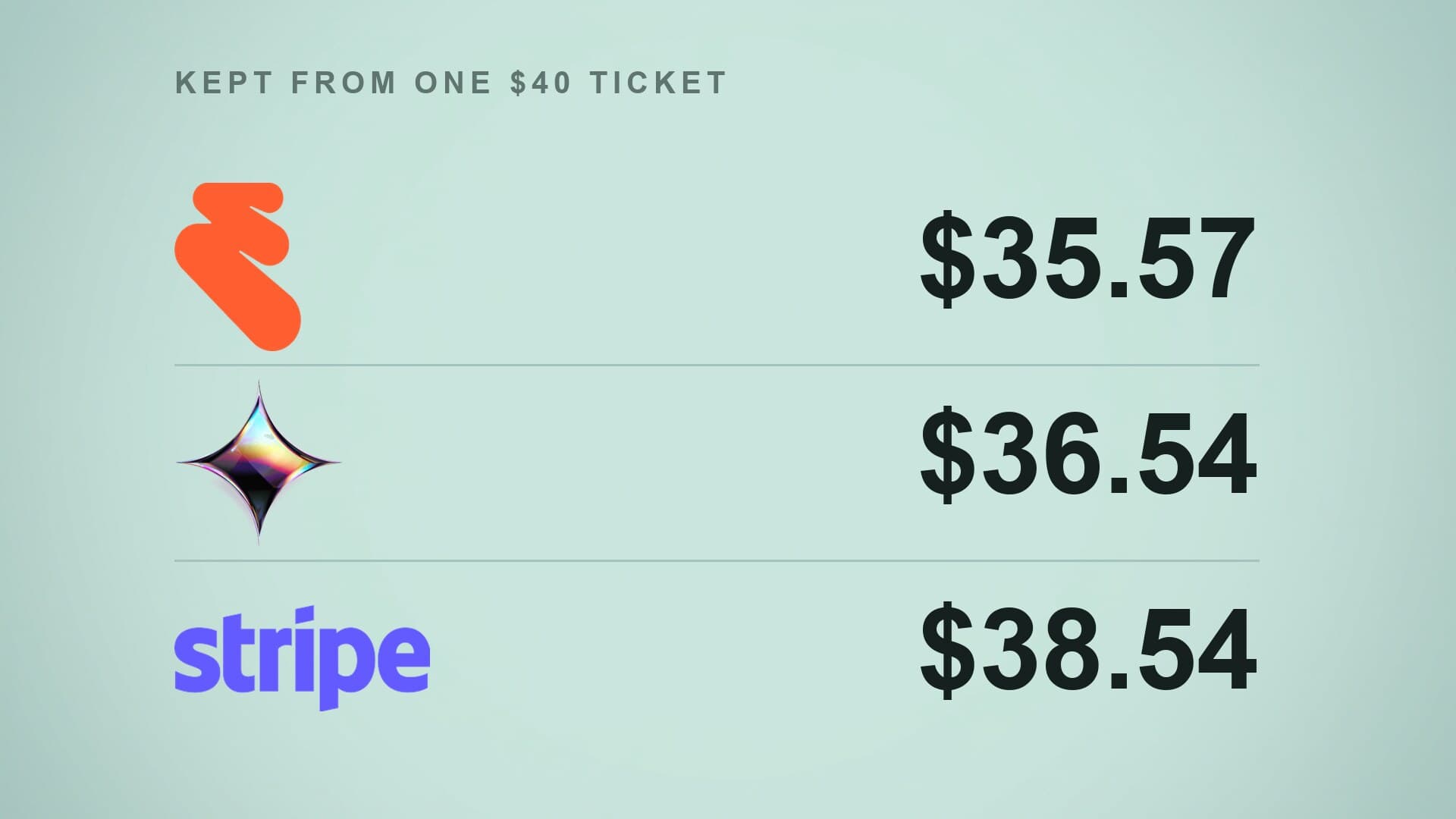
Read one ticket at a time, the same table says this: the organizer keeps $35.57 through Eventbrite, $36.54 through Luma's free plan, and $38.54 through their own checkout. Eventzilla states plainly that its "platform fees does not include payment processing fees," so its row and the Luma rows use the same benchmark, Stripe's published US rate of 2.9% + $0.30. Applying one processing rate evenly is the only way these pages compare at all, because each company draws the line between "our fee" and "the bank's fee" in a different place. Ticket Tailor is the honest omission. Its pricing page refused an automated read on the day of writing, and a fee we cannot quote from the source is a fee we do not publish. Eventbrite charges 3.7% plus $1.79 per ticket in service fees and 2.9% per order in processing. Luma charges 5% on its free plan or 0% on Luma Plus at $59 a month billed annually, both plus Stripe. Humanitix charges 2.1% plus $0.99 in booking fees plus 2.9% plus $0.30 in processing. Eventzilla Basic charges a flat $1.50 per registration with processing billed separately. Eventbrite is the most expensive stack here and the only one with two percentage fees running at once. Free events cost nothing: the page says "publish unlimited free events at no cost." Paid events carry the service fee, the processing fee, and an optional $15 a month for Eventbrite Pro email sending. It is also the only company on the page charging a flat fee near $1.79, which is where most of its advantage over Luma disappears at low ticket prices and where most of it survives at high ones. Luma runs the cleanest model. Five percent on the free plan, zero on Luma Plus, Stripe underneath either way, and the money moves through your own Stripe account rather than a platform wallet. That last detail is worth more than the percentage, because it means the payment records and the payout schedule are yours. Humanitix is the outlier with a reason. Its booking fee is the lowest percentage in the group at 2.1% plus $0.99, charities and schools pay 1% plus $0.99, and the company states that it "has transformed over $10M of those annoying booking fees into education, healthcare and more," with a counter on its about page reading $13,822,038 donated to charity. You are choosing a cause alongside a checkout, which is either the best or the worst reason to pick a vendor depending on who your audience is. Eventzilla is the only one that will sell you a flat fee with no percentage attached. Basic is $1.50 per registration. Pro adds 1.9% on top of the same $1.50 and Plus adds 2.9%, which means Eventzilla's cheapest plan is its simplest and the upgrades buy features rather than savings. Your own checkout, at $1.46 per ticket or 3.7% effective, because Stripe is the only fee in the stack. Among ticketing companies, Luma Plus is cheapest at $789 for the night, and Eventbrite is the most expensive at $2,215. The spread across all six is $1,485 on 500 tickets. Converted to a single effective rate on $20,000 of ticket sales, the field sorts like this.
OptionCost on the nightEffective rateOrganizer keeps
Your own app checkout$7303.7%$19,270
Luma Plus$7893.9%$19,211
Eventzilla Basic$1,4807.4%$18,520
Humanitix$1,6458.2%$18,355
Luma, free plan$1,7308.7%$18,270
Eventbrite$2,21511.1%$17,785
A horizontal bar chart of six event ticketing fee stacks on a twenty thousand dollar night, running from seven hundred and thirty dollars for an owned checkout to two thousand two hundred and fifteen dollars for Eventbrite
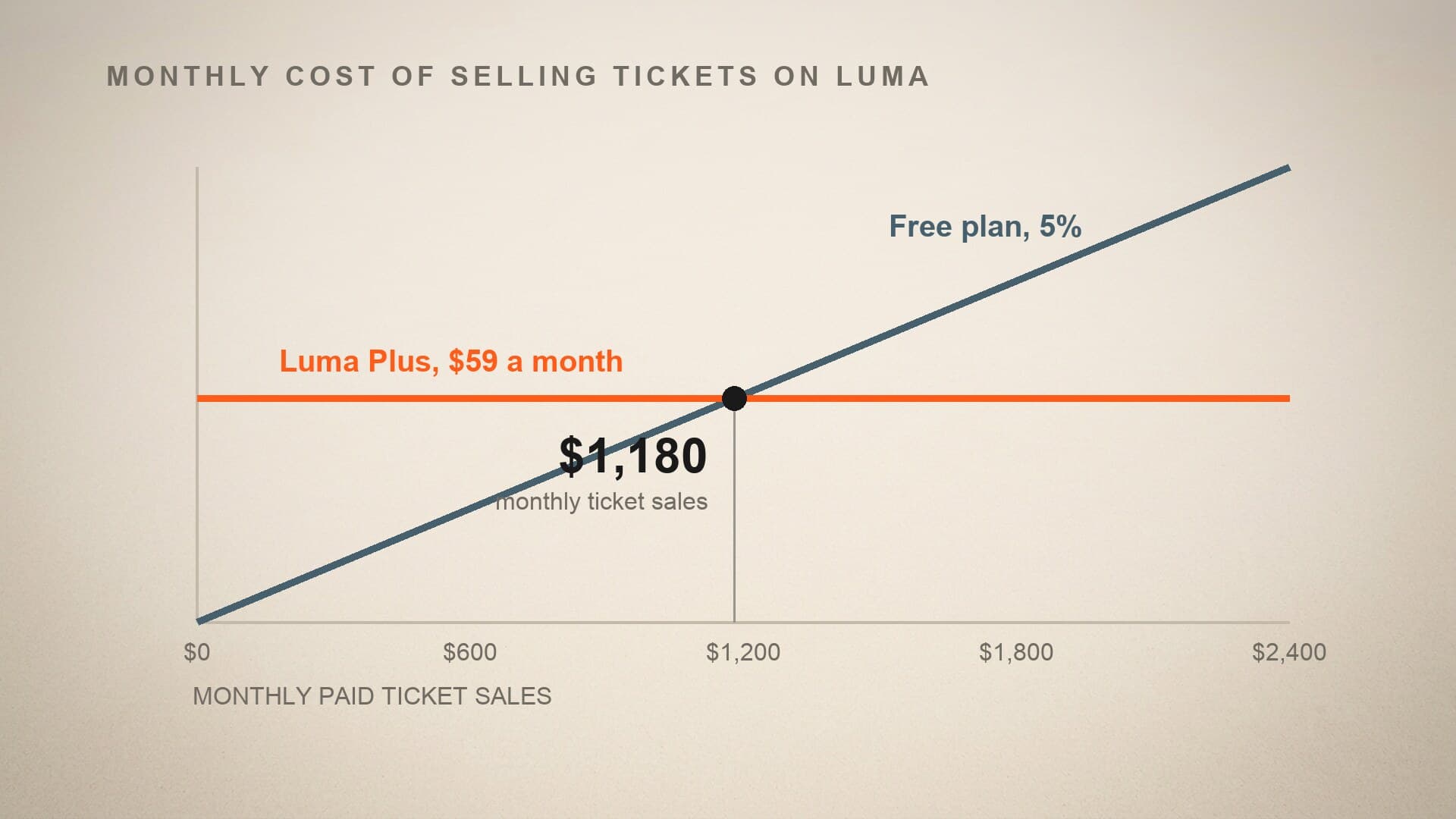
Two things jump out of that column. The first is that the ticketing companies cluster hard once you remove Eventbrite and Luma Plus: three of them sit between 7.4% and 8.7%, a band of 1.3 points, which is $260 on the night. Nobody should move platforms for $260. The second is that the flat fees swing wildly with price. Eventzilla's $1.50 is 15% of a $10 community meetup ticket and 1% of a $150 workshop seat. Eventbrite's $1.79 behaves the same way. The cheapest platform in this category is a function of what you charge, not a property of the platform, which is exactly the trap a fee comparison is supposed to catch and usually does not. Your buyer, on most of these platforms, by default. Eventbrite's pricing page states that "event ticket fees are paid by your buyers by default, or you can choose to absorb them when you set up your ticket types," which means a $40 ticket rings up at $44.43 unless you change a setting. This is the part of ticketing economics that a margin comparison misses entirely. A fee your buyer pays does not come out of your revenue. It comes out of your conversion rate. Five hundred buyers paying $4.43 each is $2,215 of extra price sitting in a checkout that your audience already had to be talked into. Nobody abandons a cart over 11%, until the ticket is $18 and the fee is $2.46 and the whole thing suddenly reads as a rip-off invented by somebody who is not you. The name on the fee line is the platform's. The reputational cost is yours. The pass-through option is also why Eventbrite's headline rate has survived so long above the rest of the market. When the fee is invisible to the seller, price competition stops working. That is a mechanism worth recognizing anywhere it appears, and we traced the same pattern through subscription billing in our comparison of six podcast paywalls. No. Apple's App Review Guidelines require the opposite. Guideline 3.1.3(e) states: "If your app enables people to purchase physical goods or services that will be consumed outside of the app, you must use purchase methods other than in-app purchase to collect those payments, such as Apple Pay or traditional credit card entry." Read that twice, because it inverts the assumption every creator brings to this question. A live event is a service consumed outside the app. Apple does not merely permit you to take that payment on your own rail; it forbids you from using in-app purchase for it. The commission on an event ticket sold through an app you own is zero, and the only fee left is the card processing you were going to pay anyone. That makes an owned app the cheapest ticketing option on this page by a clear margin, and it is the one comparison none of these vendors will run for you. It also sits alongside the other Apple rate every creator should know: subscriptions inside the same app fall under the Small Business Program at 15% for developers under $1 million in prior-year proceeds, and links out to your own web checkout carry their own published commission schedule. So one app can sell a $40 ticket at Stripe cost, sell a $9.99 monthly subscription at 15%, and never touch a ticketing company's fee schedule again. If you run events more than once, Luma's two plans resolve into one piece of arithmetic. The free plan takes 5% of paid ticket sales. Luma Plus takes 0% and costs $59 a month billed annually. Set them equal and the crossover is $1,180 of paid ticket sales in a month.
A line crossover chart showing Luma free at five percent of ticket sales meeting the fifty nine dollar Luma Plus monthly cost at one thousand one hundred and eighty dollars of monthly paid ticket sales
Thirty tickets at $40 clears it. One workshop a month clears it. Which means almost any creator selling tickets on purpose, rather than by accident, should be on the paid plan, and the free plan is a trial that quietly costs more than the subscription within a single event. Run the same test on any percentage-versus-subscription pricing page you meet. Divide the monthly fee by the percentage it removes. The answer is the volume at which the vendor stops being cheap, and it is almost always lower than the vendor's own marketing implies. If you are a creator with 50,000 engaged followers who already runs live events, retreats, workshops, or meetups, this is the specific position you are in. You can fill a room. You have proven that people will pay you money on a date, in advance, without a discount. That is the hardest thing in this business and you have already done it. And then it ends. The night is over, the venue is paid, the platform is paid, and your revenue for the month resets to zero, which is the pattern we described in your income resets to zero every month. Everyone who bought a ticket bought exactly once, from a page that belongs to somebody else, which is the same reason creator product buyers never come back. Ask the ownership question about each option in the table. If this company doubled its fee tomorrow, what would you still have? On five of the six you would have an export of email addresses and a Stripe account. You would not have the listing, the push notification, the search placement, the reviews, or any reason for a person who came in March to open anything in April. An owned app changes the shape of that night. The ticket is the introduction, not the transaction. The 500 people who came have a product to open the next morning, the event generates the material you post about for a month, and strangers find the listing in App Store search before they find you. The night stops being the business and becomes the marketing. BUILT BY FOUNDRY builds that version. We build a creator's software business in about three weeks, $0 upfront, on a revenue share. The creator owns the business and the revenue, and we keep improving it after launch, because our side only works if the product keeps earning. The ticketing companies are all competent at collecting money for a night you were going to sell out anyway. None of them has any interest in what happens on the 364 other days. Eventbrite's organizer pricing page lists a 3.7% plus $1.79 service fee per ticket and a 2.9% payment processing fee per order for paid events, with free events published at no cost. On a $40 ticket that is $4.43 in total fees. The page states that ticket fees are paid by buyers by default unless the organizer chooses to absorb them. Yes, at every ticket price we tested. On a $40 ticket, Luma's free plan costs $3.46 including Stripe processing against Eventbrite's $4.43, and Luma Plus at $59 a month billed annually removes the platform fee entirely, leaving $1.46 per ticket. On 500 tickets that is $789 for Luma Plus against $2,215 for Eventbrite. Among ticketing companies, Luma Plus is lowest at 3.9% effective on a $20,000 night, because its $59 monthly fee replaces the percentage. Selling tickets through your own app checkout is lower still at 3.7%, since Stripe's 2.9% plus $0.30 is the only fee and Apple charges no commission on services consumed outside an app. No. Apple's App Review Guideline 3.1.3(e) requires apps selling physical goods or services consumed outside the app to use payment methods other than in-app purchase, such as Apple Pay or credit card entry. Apple takes no commission on those transactions, so an event ticket sold inside an app costs only the card processing fee. On Eventbrite, fees are passed to buyers by default and absorbing them is a setting on each ticket type. Most other platforms in this comparison offer a similar choice. Passing fees on protects your margin and raises the checkout price, which moves the cost from your revenue to your conversion rate rather than removing it.
Our work

Creators who already did this

These are apps we designed, built, shipped, and still run today, with the creator keeping the code and the audience.

Creator app strategy

Curious what your app could be?

Enter your handle and BUILT BY FOUNDRY will research your audience and present custom app concepts. Free.

Event Ticket Fees in 2026: 6 Fee Stacks on the Same $20,000 Night