

Turning Knowledge into Products

9 Moves for Your Creator App's First 90 Days

Foundry
May 27, 2026
Share
9 Moves for Your Creator App's First 90 Days

Get Creator Revenue Insights

How creators are turning audiences into subscription businesses
Share
Key Takeaways:
  • Most creator apps lose 60 to 80 percent of installs in the first 30 days. The first 90 days set the retention curve for the next two years.
  • Launch traffic is a one-shot resource. Use it for App Store reviews, paid trial signups, and content footage, not for vanity install counts.
  • Pricing, paywall placement, and the trial-to-paid handoff almost always need a second pass by day 60. Plan for it.
  • Apple Editorial reads a 90-day signal. Featured placement decisions are made on retention and rating quality, not launch-week downloads.
  • Every move below maps to one of three goals: keep users, convert them, or generate content the creator can post about all year.
A creator app does not fail at launch. It fails in the 90 days after launch, when the founder gets bored, the install spike fades, and nobody has a written plan for what to do next. We have shipped enough apps to know what that quiet stretch looks like. The first 30 days are a sugar high. The next 60 are where the business actually gets built or quietly dies. Below are the nine moves a creator and their team should make in that window, in roughly the order they happen. Direct answer: The first 90 days set the retention curve, the App Store rating, and the editorial signal that Apple and Google use to decide whether to feature your app. Get them right and the next 12 months compound. Get them wrong and you spend a year repairing the launch. Sensor Tower and data.ai both put median 30-day retention for new consumer subscription apps in the 20 to 40 percent range. A creator app with an existing audience should beat that, but only if the founder treats the first 90 days like a product, not a victory lap. The patterns are well established. We covered some of them in 7 retention tactics that beat churn for creator apps, and this post is the operational layer that sits on top.
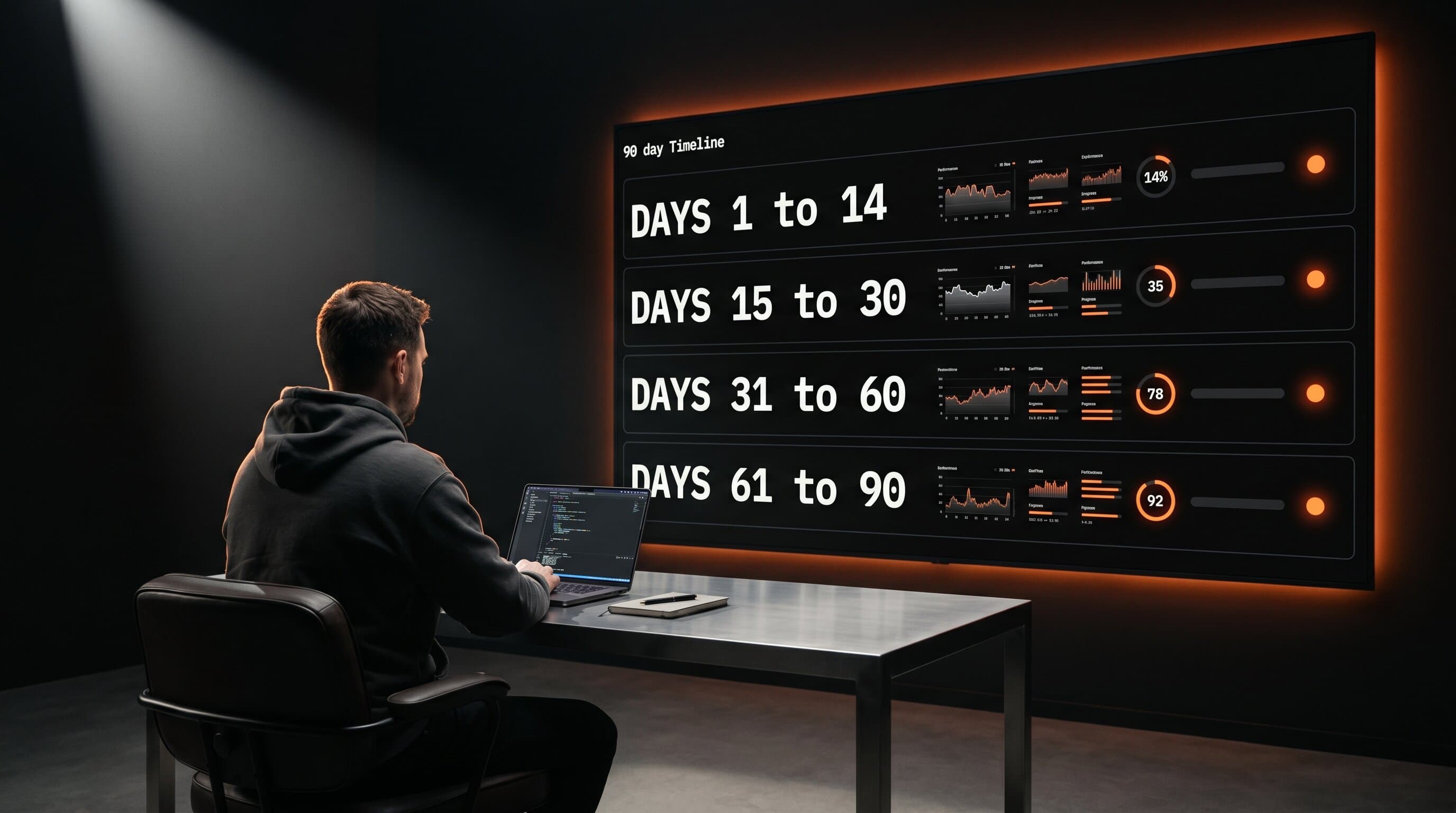
A control room of dashboards tracking a creator app launch.
Most creators launch an app and then ask, the next morning, what they should post about it. That is one of the more expensive mistakes we see, because launch week is the only week your app is novel. A reasonable launch-week calendar has eight to twelve pieces of content already written, recorded, or filmed before the app goes live. That includes the "I built an app" announcement, a behind-the-scenes build video, a walkthrough, two or three testimonials from beta users, a deal post, and at least one piece of content per platform you actually post on. The point is not volume. The point is that you decide once, then execute, instead of waking up every morning of launch week deciding what to film. This is one of the first principles of why a creator app is also a content engine. The app is the content prompt. Decide the prompt in advance. Pick one number. Watch it every morning for 30 days. Almost any number is better than no number. For most creator apps, the right number is daily active subscribers, or, if you have a 7-day trial, daily trial-to-paid conversions. Vanity installs are a bad pick because they lie. App Store opens, push opt-in rate, day-1 retention, and trial start rate are all defensible. What matters is that the founder, not the agency, looks at it every day. Founders who watch a number daily catch problems in 48 hours. Founders who check monthly catch them in eight weeks. Eight weeks is enough time to bleed a quarter of your subscribers. Apple's algorithm and Apple Editorial both read review velocity. A new app with 4.6 stars from 8 reviews behaves very differently in search than a new app with 4.7 stars from 80 reviews. The second one looks like a real business. Set a target: 50 reviews in 30 days, all from real users. The simplest way to hit it is a polite in-app prompt that fires on the third successful session, plus one post per platform asking your most engaged followers to rate the app. Do not buy reviews. Do not run a giveaway tied to reviews. Apple does enforce, slowly and bluntly, and the damage from a delisting is far worse than a flat 30 days. If you do not have a system for review prompts, App Store Optimization basics for creators is the right starting point. Ship a real update by day 14. Not a hotfix. A visible, "we listened, here is what changed" update with release notes the user can read. This serves three functions at once. It signals to App Store reviewers that the app is actively maintained. It gives the creator a fresh content beat ("v1.1 is out, here is what we added"). And it forces a small operational rhythm, because if your team cannot ship a small update by day 14, you will not be able to ship a serious one by day 90 either. The mistake we see most often: founders sit on user feedback for the first month because they want to "see what comes in." The cost of waiting is higher than the cost of shipping the wrong thing. Ship the small thing, watch the numbers, and ship again. The launch paywall is a guess. A good guess, hopefully, but a guess. By day 30 you have enough trial starts to run a real test. This is a question with a math answer. We covered the structural choice in free trial vs paywall for creator apps and the pricing math in 5 pricing strategies for creator subscription apps. By day 30 you should know your trial-to-paid conversion rate, your week-1 retention, and roughly what fraction of trials hit the paywall a second time. If trial-to-paid is below 30 percent, the paywall is broken. If retention is fine but conversions are weak, the paywall copy or pricing is wrong, not the product. Here is the 90-day operating cadence we run for our own creator partners:
WindowPrimary goalOne thing to watch
Days 1 to 14Launch content, real reviews, first updateTrial start rate
Days 15 to 30Paywall and pricing pass, churn forecastTrial-to-paid conversion
Days 31 to 60Retention, push, content loopDay-30 retention
Days 61 to 90Editorial pitch, second feature, second updateRating count and quality
By day 30, you should know who installed, who started a trial, who paid, who churned, and who never came back. That is enough data to build a lifecycle plan. The skeleton is small. A welcome sequence for trial starts. A day-3 re-engagement push for trials that have not opened the app. A day-6 paywall reminder for trials about to expire. A cancel-flow email that asks one question. A win-back push 14 days after cancel. None of these are clever. They are simply non-negotiable. Most creator apps lose 5 to 10 percent of recoverable subscribers every month by not having these in place. Compound that for two years and the business is half its potential size. By day 60 the launch buzz is gone. Now you find out whether the app is actually a content engine, or whether the creator quietly slid back into thinking up posts from scratch. The discipline is twice a week, minimum, in perpetuity. Pick two regular formats and stick to them: a weekly "leaderboard" or "results" post that the app itself generates, and a "this user did this" post that comes from real user activity. The format matters less than the cadence. We unpacked this in why your next 10K fans will not come from social media, and the App Store distribution flywheel only spins if the social content keeps feeding it.
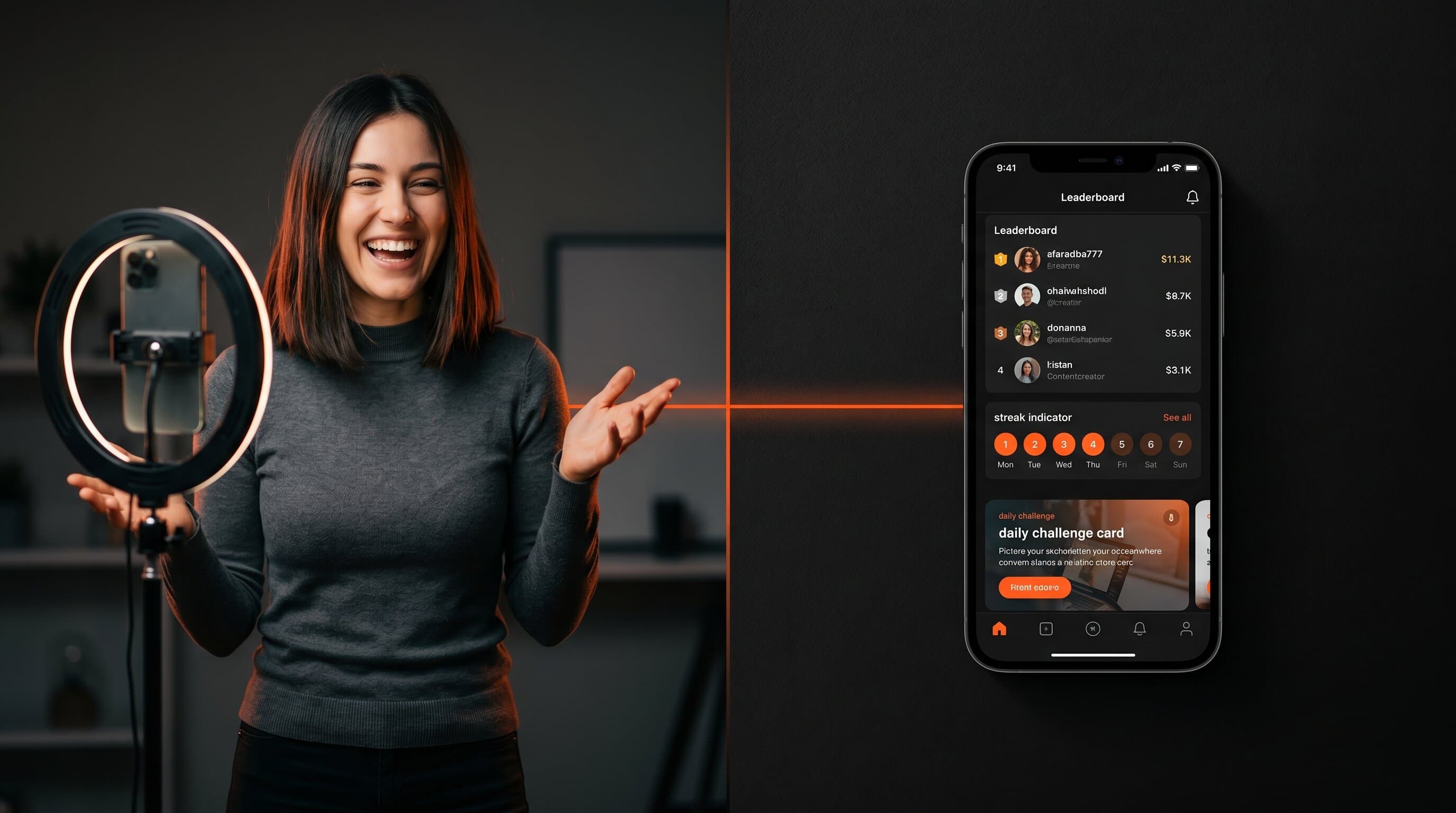
A creator on the right and an app dashboard on the left, both lit with warm orange light.
Apple Editorial considers featured placement on a rolling basis. The decision is partly algorithmic and partly human, and the human side cares about three things: a clean launch with good reviews, a clear creator story, and an app that fits a current editorial theme (wellness in January, productivity in September, and so on). By day 60 you have what you need. You have a star rating, a review count, a few weeks of stable retention, and a real backstory. Submit a pitch through the App Store Connect "Nominate Your App" form with a short, specific story and a list of editorial themes the app fits. Then submit again two weeks later under a different theme. We wrote up the full pitch playbook in how to get a creator app featured by Apple in 2026. A feature is not a winning lottery ticket. It is the result of a 60-day setup. On day 90, sit down with a printed dashboard and decide three things: what is working, what is not, and what gets the next quarter of effort. This is the moment most creators skip, because day 90 feels like the launch is finally over. It is not. Day 90 is the start of the real product cycle. The decisions made here, which feature to expand, which user segment to ignore, which channel to double on, set the next two quarters of revenue. Founders who do this review at 90 days, and again at 180, build apps that compound. Founders who do not, end up with a flat MRR line by month six and no idea why. The good news: by day 90 the data is unambiguous. You know your retention curve. You know your conversion rate. You know which content posts moved installs and which did not. There is nothing left to guess. A creator app with a 50K to 500K follower starting audience can reasonably target $5K to $20K MRR in its first 90 days, then compound from there. The arithmetic is straightforward. A subscription that retains for 18 to 36 months at $10 to $20 a month, with reasonable App Store discovery on top, gets you there. The variable is execution in this window. We sketched the long-term math in the $10K brand deal vs $10K MRR breakdown. The 90-day playbook is what turns that math from a spreadsheet into a real business.
#MoveWindowWhy it matters
1Lock launch-week content calendarPre-launchLaunch novelty is a one-shot resource
2Pick a north-star metric, read dailyDays 1 to 30Daily readers catch problems in 48 hours
350 real App Store reviewsDays 1 to 30Review velocity drives search ranking
4Ship a real updateDay 14Signals an active product to Apple and users
5Re-test pricing and paywallDay 30Launch paywall is always a guess
6Build push and email skeletonDays 31 to 60Lifecycle drives 5 to 10 percent of MRR
7Twice-weekly content loopDays 31 to 90App-generated content feeds App Store discovery
8Pitch Apple EditorialDays 60 to 90Feature is a 60-day setup, not luck
990-day review and double-downDay 90Sets the next two quarters of revenue
The pattern across all nine moves: a creator app rewards operators, not posters. The creator's audience and method get you to launch. The 90-day operating cadence is what turns the launch into a business. This is the part most creator dev shops never do with you. They ship the build, hand over the keys, and disappear. We built Built by Foundry so that does not happen. We build the app and then we run the post-launch playbook, the App Care operation, the editorial pitches, the pricing tests, all of it, for as long as the app exists. 90 days. By the end of week 13 you have a stable retention curve, a real paywall conversion rate, and at least one full cycle of content driving installs. Apps that look good at day 30 and bad at day 90 are common. Apps that look good at day 90 almost always compound from there. For most creator apps it is daily trial-to-paid conversions if you have a free trial, or daily active subscribers if you do not. Both numbers are honest. Installs and App Store opens lie because they include curious followers who never had buying intent. 50 real reviews in 30 days is the working target. Below that, the App Store algorithm does not have enough signal to surface the app in search. Above 100, you start showing up in suggested searches and category lists. Do not buy reviews under any circumstance. Day 30. Earlier than that you do not have enough trial starts to read the test. Later than that you have already left money on the table. The first paywall is a guess. The day-30 paywall is the one informed by actual data. Apple features creator apps regularly, but the decisions are made on the 60 to 90-day signal, not on launch-week downloads. A 4.6-star app with 200 reviews and a clear story has a real shot. A 4.8-star app with 8 reviews does not, regardless of the creator's follower count. Want a team that runs all nine of these moves with you? We build creator apps in 3 weeks, $0 upfront, then operate the 90-day playbook and every quarter after that.
Let's Build →

Creator app strategy

Want us to review your creator business?

Apply for a Foundry Creator App Review. We'll tell you whether there is a real app opportunity hiding in your audience.

9 Moves for Your Creator App's First 90 Days