
$10K Brand Deal vs $10K MRR: The Real Math

$10K Brand Deal vs $10K MRR: The Real Math

Foundry
May 13, 2026
A protein brand emails you. The deal is $10K for one Reel, one Story, one usage clip. You'll do it in an afternoon. The money hits your bank in 30 days, minus a 20% agency cut. Easy yes. The same week, a friend texts you about a different number: their fitness app passed $10K in monthly recurring revenue last month. Same $10K. Same time period, roughly. Most creators look at those two numbers and see a tie. They are not tied. They are not even in the same conversation. Key Takeaways:
  • $10K once and $10K MRR look identical at month one and diverge brutally by month 36.
  • A $10K brand deal is a closed loop. $10K MRR is a starting line that compounds.
  • The average creator with 50K to 500K followers gets paid $1K to $10K per sponsored post (Influencer Marketing Hub, 2024). They can't run that play forever without burning the audience.
  • A creator with 1,200 paying app subscribers at $8.99 per month is already past $10K MRR, and most creator app churn rates run 5 to 8% monthly, meaning the base keeps growing if you add faster than you lose.
  • The math creators run is "what does this pay me this month?" The math founders run is "what does this pay me every month for the next five years, plus what is it worth if I sell it?"

A struck match burning briefly next to a steady forge of orange embers, illustrating one-time payments versus compounding monthly revenue
Let's run the most generous possible scenario for brand deals. You're a fitness creator with 200K followers and decent engagement. You're getting two real $10K deals per quarter. That's $80K a year before agency cuts, taxes, and the time you spend negotiating, shooting, editing, and reshooting because brand X wants the lighting redone. Now the app version. You launch a paid app in January at $8.99 per month. By month one, 200 people subscribe. By month six, you're at 1,000 subscribers and $8,990 MRR. By December, you're at 1,400 subscribers and $12,586 MRR. Your annualized run rate by year end is around $150K, but your actual cash collected in year one is closer to $70K because you spent the first six months ramping. Year one cash:
  • Brand deals: $80K, minus $16K agency, minus content production costs. Take home around $55K.
  • App: $70K collected, minus App Store's 15 to 30% cut, minus any partner fees. Take home around $50K.
These look basically the same. A creator with rent due in 30 days picks the brand deal every time. This is the trap. Now let's run year three. The brand deal creator did $80K again in year two. In year three, that protein brand cut its influencer budget because their CMO changed. Half the deals dried up. They did $50K in year three. They are running on the same treadmill at a slight incline. The audience is also tired. Engagement per post is down 30% because every other Reel is sponsored. The app creator kept shipping. Their subscriber base went from 1,400 at end of year one to 4,200 at end of year two to 9,000 at end of year three. At $8.99 per month, that's $80,910 MRR. Year three cash collected is around $700K. The annualized run rate going into year four is nearly $1M. Three years in, the brand deal creator has earned roughly $185K total. The app creator has earned roughly $850K, and they own a business worth multiples of revenue if they ever want to sell it. You can't sell a YouTube channel. You can sell an app. This is the gap.
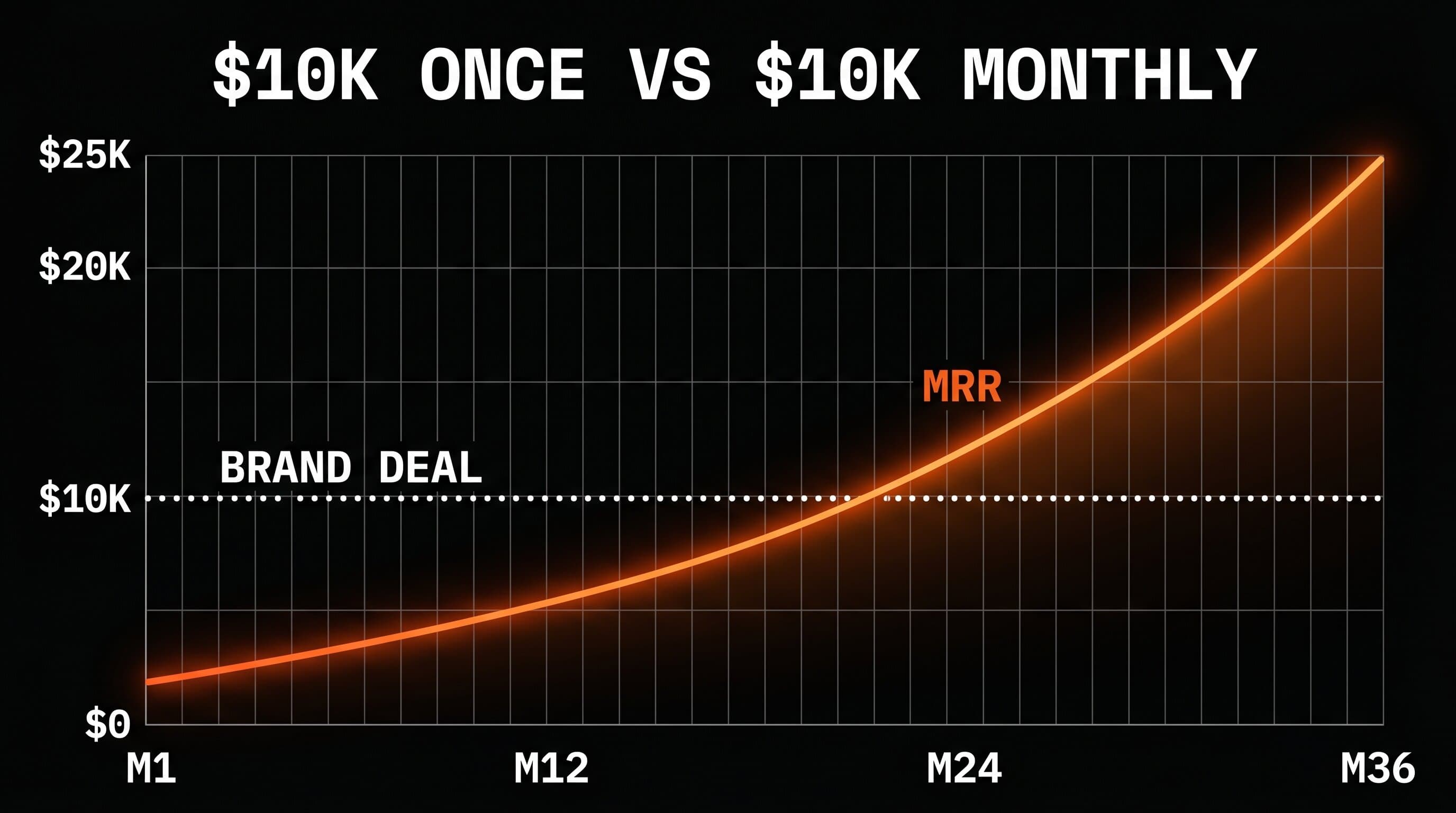
Line chart on a dark background showing a flat brand deal line at $10K versus an MRR curve rising from $2K to $25K over 36 months
A brand deal is a transaction. You do the work, you get paid, the cash event is closed. The next deal starts at zero. Your follower count went up, sure, but the brand sets the price, and there is a ceiling on what any single CPG sponsor will pay a fitness creator with 200K followers. That ceiling has barely moved in five years. MRR is a state. Every paying subscriber from last month is presumed paying this month, unless they cancel. New subscribers add to the base. Your job stops being "find the next deal" and becomes "keep what you have, add a little, repeat." The base does the heavy lifting. Here is what compounding actually looks like in numbers:
YearBrand Deals (Annual)App MRR (End of Year)Annual App Cash
Year 1$80,000$12,586~$70,000
Year 2$80,000$37,758~$300,000
Year 3$50,000$80,910~$700,000
Year 5$40,000$180,000+~$1.5M
The brand deal column is fragile. One CMO change, one bad press cycle, one new platform takes the spend, and the column collapses. The MRR column is anti-fragile. Subscribers don't read TechCrunch. They open the app, get value, and the charge hits silently every month. This is the same compounding that took Sweat from a $69 PDF to a $400M acquisition. The pattern is not new. Most creators just refuse to start. There are creators in every niche who already crossed $10K MRR. We've profiled some of them. Sam Harris built Waking Up into a meditation app that processes millions in annual subscription revenue from his philosophy and neuroscience audience. He still posts. He just posts knowing the income doesn't depend on the post. The MRR stack of a creator who has crossed the threshold usually looks like this:
  • 80% of monthly cash from the app subscription base.
  • 10 to 15% from one or two carefully chosen brand deals, picked because they fit the audience, not because rent is due.
  • The rest from one-off launches, affiliate links, or speaking fees.
The brand deal didn't disappear. It got demoted from "the business" to "one line item." The creator can say no to deals that don't fit. The audience can feel the difference and trusts the recommendations more, which feeds back into the app. This is also why creators are leaving Patreon to build their own apps. Patreon is one rung up from a brand deal. It's still a platform you rent. Your own app is a platform you own. The math compounds harder when the platform compounds with you. You can. Most successful app creators run both for a while. The honest version is that most creators only have time and attention to do one of them well, and the brand deal hustle is what eats the attention. Here's the time math. A $10K brand deal eats roughly 12 to 20 hours of real time across negotiation, shoot, edit, revision, posting, and reporting. Done eight times a year, that's 100 to 160 hours. That is the same number of hours required to do the things that grow an app's MRR: respond to user feedback, ship one new feature a month, run a launch on TikTok every quarter, and write a referral campaign. When you do both, the app usually loses. The deal has a deadline. The app does not. Founders learn to give the app the deadline by making the MRR target the only number that matters for the quarter. Worth noting: customer acquisition cost for app subscribers is a real expense, but for creators it's effectively zero. You already pay it in content you'd be making anyway. The creator runs this math: "What's my best month this year?" The founder runs this math: "What's my floor? What is the worst month I can have and still pay everyone? And what's the asset worth if I stop showing up tomorrow?" A brand deal cannot answer either founder question. The floor is zero, because the next deal might not come. The asset is worth nothing, because there is no asset, just a personal services contract that ends when you do. An app answers both. The floor is roughly last month's MRR times your retention rate. The asset is worth a multiple of your annual revenue. A creator app doing $1M ARR with healthy retention typically sells for $3M to $8M to a strategic acquirer or a holdco, sometimes more. That is the gap between a creator and a founder. It is not talent. It is not audience size. It is the shape of the income. Stop counting this month. Start counting every month after this one. Learn more about how we partner with creators to build these businesses. Yes, if the audience is engaged and the product solves a real problem. At $9.99 per month, you need around 1,000 paying subscribers to hit $10K MRR. That is a 2% conversion rate from a 50K-follower base. Top creator apps regularly hit 3 to 8% conversion of an engaged audience. Most creator apps that hit $10K MRR get there within 6 to 12 months of launch, assuming the creator already has an audience and the app solves a clear pain point. Apps that fail to hit $10K MRR usually fail because the launch was weak or the app doesn't have a daily reason to open. The opposite. Brand deals are one of the most fragile income streams in the creator economy, because they depend on advertiser budgets that swing 30 to 50% year over year (Influencer Marketing Hub State of Influencer Marketing report). App subscriptions churn at 5 to 8% per month and can be re-acquired. You can model them. You cannot model when the next CMO will cut your line item. No. The right play is to keep doing the deals that fit your audience while you launch the app, then naturally let the app take over as MRR grows. By month 12 to 18, most of the creators we work with are saying no to deals they would have said yes to in month one. Yes. We design, build, and ship a custom subscription app to the App Store in roughly three weeks. We take $0 upfront. We share revenue with the creator. Then we run, optimize, and maintain the app forever, so the creator only has to think about the audience. Your best brand deal is worse than your worst month of MRR. The math doesn't care how you feel about it.
Let's Build →

Get Creator Revenue Insights

How creators are turning audiences into subscription businesses

You might also enjoy...

$10K Brand Deal vs $10K MRR: The Real Math