

Trial to Paid: 5 Levers for Creator App Conversion

Trial to Paid: 5 Levers for Creator App Conversion

Foundry
May 4, 2026
Key Takeaways:
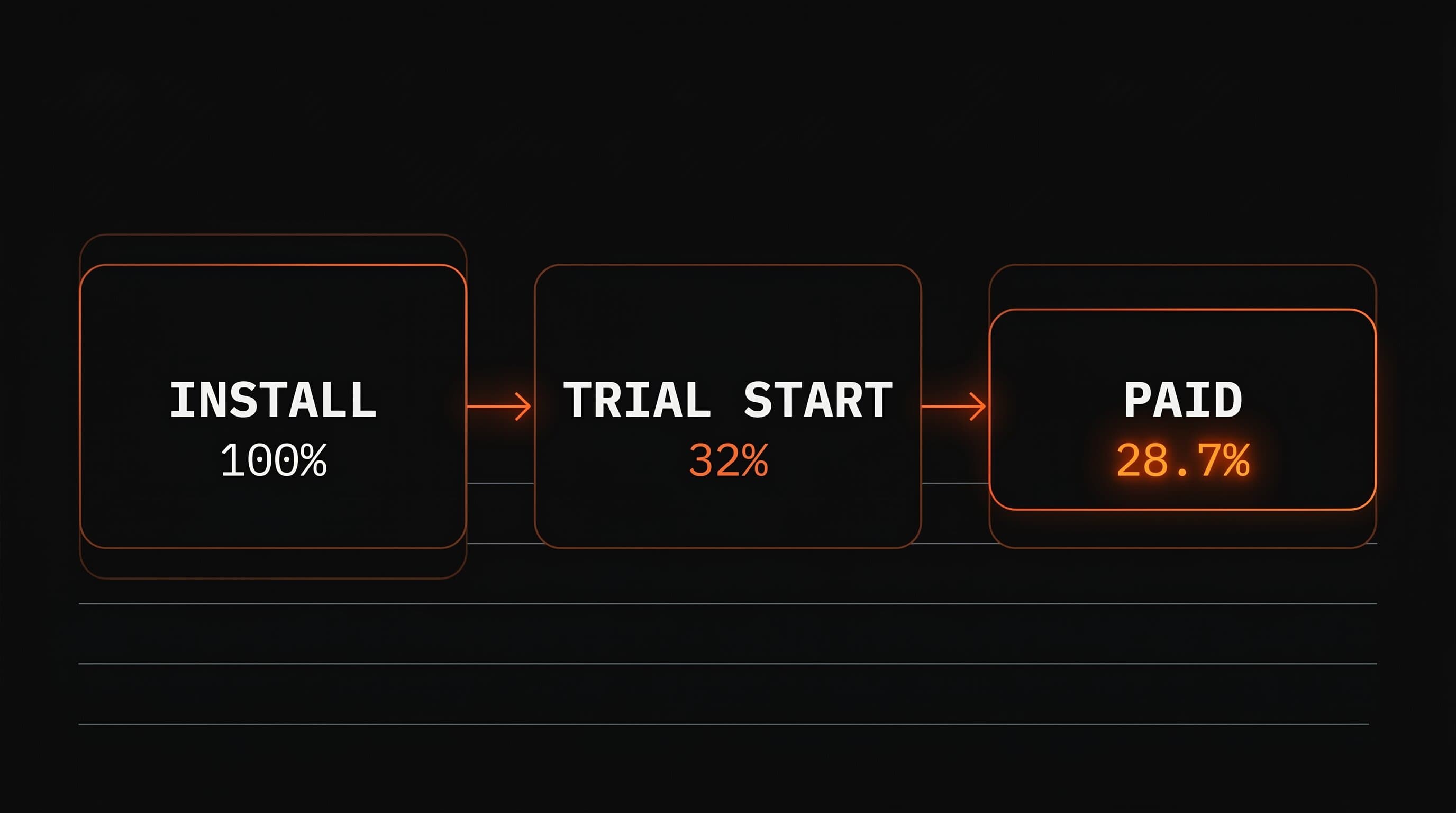
  • The median trial to paid conversion rate for consumer subscription apps is 28.7%, according to RevenueCat's 2024 State of Subscription Apps report
  • Apps that gate the paywall behind a 30-second onboarding flow convert 2 to 3x better than apps that show the paywall on launch
  • 3-day trials and 7-day trials outperform 14-day trials by a wide margin in fitness and creator categories
  • A push notification on day 6 of a 7-day trial lifts conversion by 8 to 15 percentage points
  • Annual plan opt-in at the paywall boosts lifetime revenue by 50 to 70% versus monthly-only
What is trial to paid conversion? Trial to paid conversion is the percentage of users who start a free trial of your subscription app and continue paying after the trial ends. It is the single most important metric in a subscription app business because it determines how much of your acquisition spend actually compounds into recurring revenue. You can spend $50,000 driving installs to your creator app and end up with zero subscribers. The install is not the win. The trial start is not the win. Only the paid conversion is the win, because only paid users compound into monthly recurring revenue. This is the math creators get wrong when they look at their first dashboard. 10,000 downloads sounds like a launch. If 200 of those start a trial and 60 convert, you have a $600/month business, not a 10,000-download business. The funnel is the business. Here's how to fix it. Every creator app lives or dies on this number. RevenueCat's 2024 State of Subscription Apps report found that the median consumer subscription app converts 28.7% of trial starts to paid subscribers. The top quartile clears 40%. The bottom quartile sits below 15%. The gap between a 15% and 40% trial conversion rate is not a small optimization. It is the difference between a $5,000 MRR app and a $13,000 MRR app at the same install volume. Same audience, same creator, same content. The funnel does the work. Here is what those funnels look like at scale:
Trial Conversion RateTrials Needed for 1,000 SubscribersCost Per Subscriber at $4 CPI
15%6,667$26.67
28%3,572$14.28
40%2,500$10.00
At $9.99/month with 6 months of average tenure, a subscriber is worth roughly $60 in lifetime revenue. A $26 acquisition cost leaves you almost no margin. A $10 acquisition cost is a real business. This is why we tell creators that the paywall and the trial flow are the entire business model. Get them right or stop building. Three days. Seven days at most. Fourteen days kills more trials than it converts. This counterintuitive finding shows up in almost every subscription benchmark. Apple's App Store performance documentation and multiple RevenueCat datasets show that 3-day and 7-day trials produce higher conversion than 14-day trials, even though longer trials sound more generous. The reason is human, not technical. A 14-day trial gives the user 13 days to forget. They install on a motivated Sunday, miss the day-3 reminder, get busy, and the email that says "your trial ends tomorrow" feels like an ambush they want to escape. They cancel out of guilt. A 3-day trial creates urgency. The user knows they have one weekend to decide. They use the app. They feel the value. They convert or they don't, but they decide while the install motivation is still warm. Use the data:
Trial LengthMedian Conversion RateBest For
3 days32 to 38%Fitness, productivity, daily-use apps
7 days28 to 33%Most creator apps, including content libraries
14 days18 to 24%Complex B2B tools, NOT creator apps
No trial (hard paywall)5 to 8% conversion of installsPremium brands with strong demand
Pick 3 days if your app delivers daily value (a workout, a meditation, a meal plan). Pick 7 days if your app needs a week to show its value (a course library, a community feature). Skip 14 days entirely. Not on the home screen. Not on the splash. Not before the user has touched anything. The two paywall placements that work for creator apps are the post-onboarding paywall and the value-gated paywall. Both put a small amount of value in the user's hands before asking them to commit. Post-onboarding paywall. The user opens the app, answers 3 to 6 onboarding questions ("What's your goal? How experienced are you? When can you train?"), and sees a paywall on a screen that says "Your personalized plan is ready." The questions create sunk cost. The paywall feels like the next logical step, not an interruption. Value-gated paywall. The user gets one free workout, one free meditation, one free episode, or one free tool use. The paywall appears when they try to access the second one. They have already felt the product, so the trial start is a continuation, not a leap. Apps that show a hard paywall on the very first screen typically convert installs to trials at 8 to 12%. Apps that use a 30 to 60 second onboarding before the paywall convert installs to trials at 25 to 40%. Same install. Three to five times more revenue. For an example of this done well, see how Melissa Wood structured the MWH Method app's onboarding flow before asking for the subscription. The paywall comes after the user has already imagined themselves using it. Stop selling features. Sell the after-state. The paywall is not a pricing page. It is the last sales pitch your app gets to make. The headline matters more than the bullet list. The visuals matter more than the price stack. The annual plan position matters more than the monthly price. The five elements that move conversion in real creator apps:
  • One-line value headline. Not "Unlock Premium." Not "Get Pro." Something specific: "Train with Pamela 5 days a week" or "Build the body you came here for." The reader should see themselves in the sentence.
  • Annual plan as the default. Pre-select annual. Show monthly as a small link below. Annual default lifts annual adoption by 40 to 70% with no other changes.
  • Anchor pricing. Show the monthly equivalent of annual ("$5.83/month, billed annually as $69.99") next to the monthly price ($9.99/month). The math does the selling.
  • Social proof above the buttons. Three real testimonials, a star rating, or a subscriber count. Not stock photos. Real users.
  • Trial CTA, not subscribe CTA. The button says "Start Free Trial" not "Subscribe Now." Lower the felt commitment to the click.
The bad paywalls do the opposite. They list features in checkmarks, default to monthly, hide the annual savings, skip social proof, and use scary words like "Subscribe" or "Pay Now." Every one of those is a percentage point you give back.
A 3-step trial-to-paid funnel diagram showing onboarding, paywall, and post-trial conversion stages with conversion rates at each step
Yes, and they are the single highest-leverage thing you can do after the install. A 7-day trial without any messaging converts at the lower end of the range. The same trial with three well-timed pushes and one email converts 8 to 15 percentage points higher. That is not a tweak. That is the difference between a healthy app and a struggling one. The schedule that works for most creator apps:
  • Hour 1: Welcome push or in-app message guiding the user to the first valuable action ("Start your first workout in 90 seconds")
  • Day 2: Re-engagement push with a specific reason to return ("Your day 2 plan is ready")
  • Day 5 or 6: Conversion push tied to value already received ("You've completed 4 sessions. Lock in your plan before your trial ends")
  • Final day email: Plain-text reminder with the renewal price and the cancel link, because honesty converts better than tricks
The day 6 push is the workhorse. RevenueCat data and Mixpanel benchmarks both show single-digit to double-digit lifts from one well-timed reminder. If you ship nothing else, ship that one. The mistake most creators make is treating push as a marketing channel rather than a product channel. Don't push "we miss you." Push the specific next action the user came for. Around 8 to 12% of trial conversions fail at the moment of charge. The card declines, the bank flags it, the family card hits a daily limit. Without recovery, those subscribers are gone. App Store and Google Play both run a built-in retry window (Apple calls it "Billing Grace Period," Google calls it "Account Hold"). You can extend the recovery rate further by:
  • Enabling Grace Period in App Store Connect (16-day window where the user keeps access while the system retries)
  • Sending a polite in-app message asking the user to update their payment method
  • Pricing in a backup tier (a cheaper monthly that the system can fall back to is a topic for a future post, but worth knowing)
Recovered failed payments add 3 to 8% to your top-line subscriber number with zero acquisition cost. Most creators leave it on the floor. Five patterns we see in almost every audit of an underperforming creator app:
  • Showing the paywall too early. Before any value, before any onboarding, before the user has done anything. Conversion drops 50 to 70% versus a post-onboarding paywall.
  • Defaulting to monthly billing. Annual default is the easiest 40% lift in lifetime value you will ever ship.
  • Long trials. 14 days converts worse than 7 in almost every category.
  • No reminder push or email. A 7-day trial without messaging is a 7-day forgetting curve.
  • Generic copy. "Premium" and "Pro" do not sell. "Train with [creator]" sells.
We've broken down the parallel side of this funnel (why subscribers cancel and how to stop it) so you can think about retention and conversion as one continuous system, not two. We design the funnel before we write the code. The trial length, paywall placement, copy, push schedule, and annual default are all decided in week one of every build. Then we instrument every step in RevenueCat and PostHog, so you can see the funnel from install to paid in real time. When the data tells us a paywall is converting at 18%, we don't shrug. We rewrite it, ship it that week, and watch the number move. The creators we work with don't manage this. We do. Forever. That's what App Care means. The model is simple: $0 upfront, three weeks to App Store, revenue share. We earn when you earn. So we have every reason to ship the funnel that converts. Read more about how the partnership works. A good benchmark is 28 to 35% on a 7-day trial for a creator subscription app in fitness, education, or wellness. Top performers clear 40%. If your app converts below 20%, the paywall, trial length, or onboarding is broken, and the fix is usually structural, not cosmetic. Three days for daily-use apps (fitness, meditation, productivity), seven days for content libraries and community apps, and never 14 days. Longer trials feel generous but produce more cancellations because users have more time to forget the value they felt at install. Yes for most creator apps. Card-required trials convert lower at the start (fewer trials begin) but convert higher at the end (those trials are real). No-card trials inflate vanity metrics and convert at 1 to 3% to paid. App Store and Google Play both make card-required the default for a reason. Day 6 of a 7-day trial, in the morning local time, tied to a specific user action ("You've finished 4 workouts. Lock in your plan before tomorrow"). One well-timed push outperforms a barrage of generic ones every time. Most agencies take 6 to 12 months and skip the funnel entirely. Built by Foundry ships the full app, paywall, trial logic, and analytics in 3 weeks at $0 upfront, and we run and optimize the funnel forever. Your trial funnel is your business.
Let's Build →

Get Creator Revenue Insights

How creators are turning audiences into subscription businesses

You might also enjoy...

Trial to Paid: 5 Levers for Creator App Conversion