

Stan Store Review 2026: Is It Worth It?

Stan Store Review 2026: Is It Worth It?

Foundry
March 22, 2026
Our verdict: Stan Store is the fastest way to sell digital products from your social bio. The $29/month Creator plan with zero transaction fees is a great deal for creators just getting started. But Stan is a storefront, not a business. No SEO, no native mobile app, no recurring revenue engine. Once you outgrow one-time product sales, you'll need something bigger. Rating: 3.5/5. Key Takeaways:
  • Stan Store grew from $0 to $28.3M ARR in four years, with 30,000+ creators on the platform (Forerunner Ventures)
  • Two plans: Creator at $29/month and Creator Pro at $99/month, both with zero platform transaction fees
  • The platform is a one-page storefront, not a website. No blog, no SEO, no multi-page navigation
  • Course tools are basic: no quizzes, no certificates, no student progress tracking
  • Stan Store is excellent for selling your first $1,000 in digital products. It's not built to get you to $10K/month in recurring revenue

Stan Store is a link-in-bio commerce platform that lets creators sell digital products, bookings, courses, and memberships directly from their social media profiles. John Hu founded Stan in 2020 with a simple pitch: replace your Linktree with a store that actually makes money. Instead of linking followers to a page of links, Stan lets you link them to a page of products. Followers tap your bio, see your offers, and buy without leaving the checkout flow. The approach worked. Stan crossed $28.3M ARR by the end of 2024, doubling from $14.7M the year before (HubSpot Startups). Steven Bartlett joined as an investor and co-owner in May 2025. Over 30,000 creators use the platform to sell everything from fitness guides to Notion templates. Stan earns a 4.7/5 rating on Trustpilot with 200+ reviews. The praise is consistent: easy to set up, clean interface, fast support.
CategoryScore
Ease of setup4.5/5
Product sales4/5
Pricing value4/5
Course tools2.5/5
Marketing & email2.5/5
Analytics2/5
SEO & discoverability1/5
Mobile app0/5
Ownership & portability2/5
Overall3.5/5
Stan scores high on speed, simplicity, and value for money. It loses points on everything a creator needs to build a business that grows beyond their existing followers: SEO, analytics, mobile apps, and audience ownership. Stan keeps pricing simple. Two plans, no hidden tiers, no per-student caps.
FeatureCreator ($29/mo)Creator Pro ($99/mo)
Annual price$300/year ($25/mo)$948/year ($79/mo)
Transaction fees0%0%
Digital product salesYesYes
Course builderYesYes
Booking & calendarYesYes
MembershipsYesYes
Email marketingNoYes
Funnels & upsellsNoYes
Discount codesNoYes
Affiliate linksNoYes
Tracking pixelsNoYes
Custom domainNoYes
Payment processing fees still apply: Stripe charges 2.9% + $0.30 per transaction. But Stan itself takes nothing on top. Compare that to Teachable's Starter plan at $39/month with a 7.5% transaction fee, and Stan's pricing looks generous. You pay a flat monthly rate and keep everything else. The Creator Pro upgrade is worth it if you plan to run email campaigns, build funnels, or track ad performance. If you just want to sell a few products, the $29 plan does the job. Stan earned its 30,000+ creators by being genuinely good at a few things. Setup speed is unmatched. You can go from zero to selling in under an hour. Pick a color scheme, add your products, connect Stripe, drop the link in your bio. No templates to customize, no pages to build, no code to write. If you can post an Instagram story, you can launch a Stan Store. The checkout converts. Stan's purchase flow is mobile-first and frictionless. Buyers see the product, tap buy, enter payment info, and get instant delivery. No account creation, no cart abandonment, no confusion. For impulse purchases from social traffic, this matters. Zero commission means you keep your money. Unlike Gumroad's variable fees or Teachable's 7.5% starter tax, Stan charges a flat monthly rate and nothing else. Sell $10,000 in a month and you keep $10,000 (minus Stripe's processing fees). That's a real advantage for creators doing volume. The product range is solid. Digital downloads, coaching calls, online courses, memberships, lead magnets. Stan covers most of what a creator wants to sell in one place. You won't need three separate tools for your ebook, your 1:1 calls, and your email list. Stan is honest about what it is: a storefront. But that honesty doesn't change the limitations. No SEO, no organic discovery. Your Stan Store lives at stan.store/yourname. There's no blog, no landing pages, no way to rank in Google. Every sale depends on you driving traffic from social media. Stop posting, stop selling. This is the biggest structural limitation for creators who want revenue that isn't tied to their daily content output. Course tools are surface-level. You can create courses with modules and lessons, but there's no quiz builder, no completion certificates, no cohort scheduling, and no student progress tracking. Creators who teach seriously will hit these walls fast. Platforms like Teachable and Kajabi are years ahead here. Analytics are basic. Stan shows you visits, leads, and revenue. That's about it. No conversion funnels, no cohort analysis, no lifetime value tracking. You can't answer questions like "which social platform drives the most revenue?" or "what's my repeat purchase rate?" without plugging in external tools. No native mobile app. Stan Store is a mobile-responsive website, not a mobile app. Your customers can't download your store from the App Store. You can't send push notifications. You don't show up in App Store search results. You miss an entire acquisition channel. Limited customization. You get one page. You choose colors and fonts. That's the extent of design control. Creators with strong brands who want their store to feel like their world will find Stan restrictive. Stan Store is the right tool if you check most of these boxes:
  • You have an active social media following (10K+ engaged followers)
  • You want to sell digital products, bookings, or courses directly from your bio
  • You want to start selling this week, not this quarter
  • You're focused on one-time product sales, not recurring subscriptions
  • You're OK with social media as your only traffic source
Stan is excellent as a first step. The problem isn't the first step. It's the ceiling. No. And it's not trying to. Stan Store is a single-page storefront optimized for social media traffic. It does not support multiple pages, blog content, custom URLs, or search engine indexing. You can't build a brand presence on Stan the way you can on a standalone website. If you're comparing Stan Store to Kajabi, the difference is clear: Kajabi tries to be your entire business platform (website, courses, email, community). Stan tries to be the fastest path from "follower sees link" to "follower buys thing." Both approaches have trade-offs. Kajabi charges $149+/month and takes weeks to set up. Stan costs $29/month and takes an afternoon. But if you want people to find you through Google, Stan can't help. Here's the math that Stan Store's founders would probably agree with: one-time product sales are a treadmill.
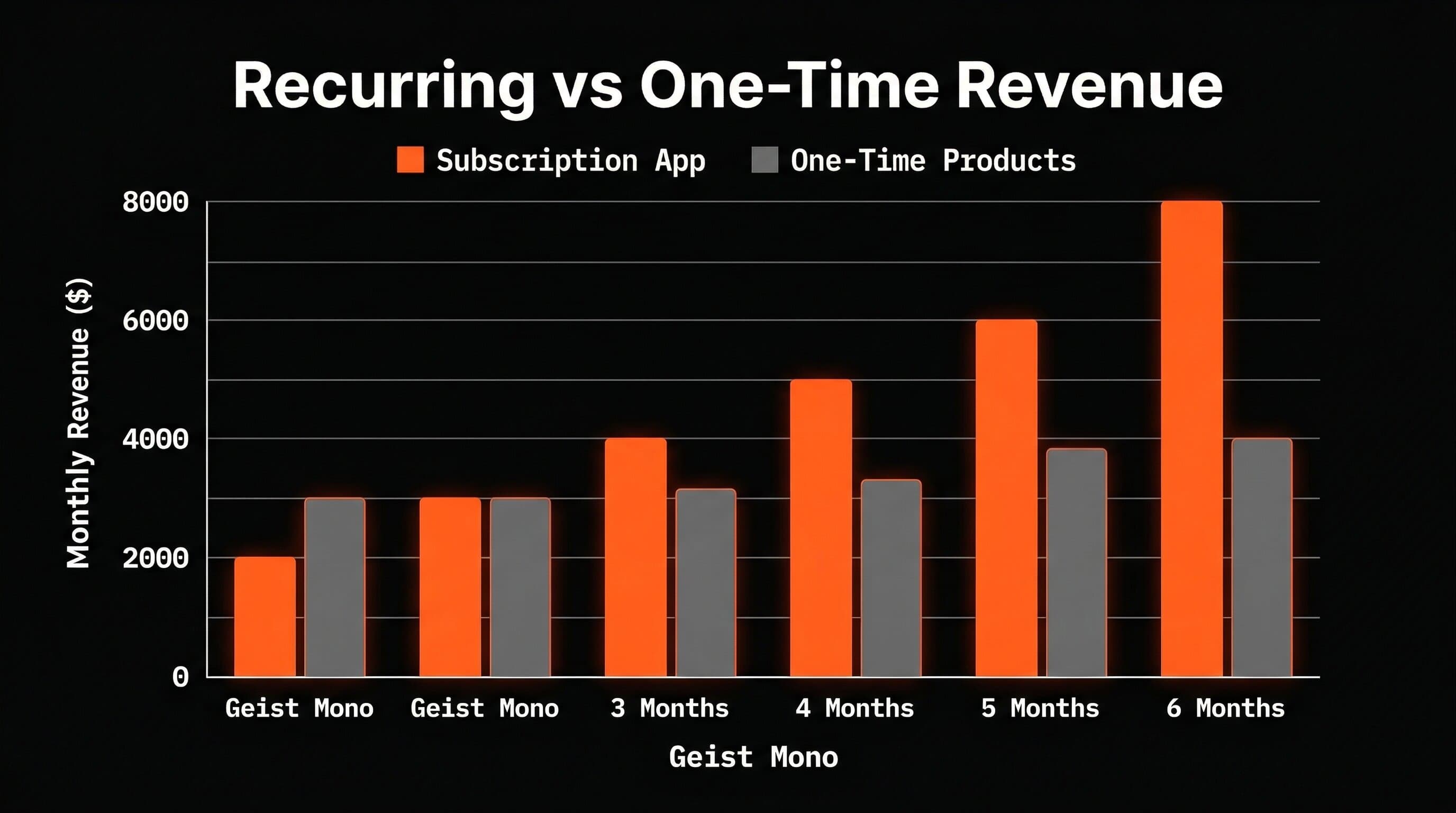
Recurring subscription revenue compounds monthly while one-time product sales stay flat
Sell a $27 ebook to 200 people and you make $5,400. Great. But next month, you need 200 new buyers. And the month after that. Your revenue resets to zero every 30 days unless you keep launching new products and driving new traffic. Compare that to a subscription app at $9.99/month. Get 200 subscribers and you're earning $1,998/month. Month two, those subscribers are still paying, and you're adding new ones on top. By month six, you could be at $4,000+/month without launching a single new product. This is the shift from storefront to business. We wrote about it in detail: Stan Store is the best version of selling digital products. But selling digital products has a structural revenue ceiling that subscriptions don't. Creators like Kayla Itsines started with PDF workout guides (the 2015 version of a Stan Store product). She switched to a subscription app and built a business worth $400M. The product didn't change. The model did. When you're ready to make that shift, you need a product partner, not another platform. Built by Foundry builds subscription apps for creators at $0 upfront, launches in three weeks, and runs everything forever. You go from selling PDFs to owning a software business. No. Stan Store offers a 14-day free trial, then charges $29/month (Creator) or $99/month (Creator Pro). There is no free tier. Both plans include zero platform transaction fees; you only pay Stripe's standard processing fees of 2.9% + $0.30 per transaction. For selling products, yes. Linktree is a link aggregator. Stan Store is a commerce platform. If you want people to buy things when they tap your bio link, Stan is the better tool. If you just need to organize links, Linktree is simpler and has a free tier. You can, but with limitations. Stan's course builder supports modules and lessons with video, text, and file uploads. It does not support quizzes, certificates, student progress reports, or cohort scheduling. For a simple course, Stan works. For a serious education business, you'll need a dedicated course platform. Stan Store charges 0% transaction fees on both plans. However, the payment processor (Stripe or PayPal) still charges its standard fees: 2.9% + $0.30 per transaction for Stripe, varying rates for PayPal. If you want recurring subscription revenue, you need a different model entirely. A storefront sells products one at a time. A subscription app charges monthly and compounds. Built by Foundry builds custom subscription apps for creators at $0 upfront with a revenue-share model. Stan Store earned its reputation. For creators who want to start selling digital products from their bio link today, it's the fastest and most affordable option. But if your goal is a business that earns while you sleep, compounds monthly, and reaches customers who've never seen your content, you need more than a storefront. You need your own product.
Let's Build →

Get Creator Revenue Insights

How creators are turning audiences into subscription businesses

You might also enjoy...