
Turning Knowledge into Products

Which 1099 Do Creators Get in 2026? 5 Payers and 3 Thresholds

September 6, 2026
Share
Which 1099 Do Creators Get in 2026? 5 Payers and 3 Thresholds

Get Creator Revenue Insights

How creators are turning audiences into subscription businesses
Share
Key Takeaways:
  • Two thresholds moved for payments made after December 31, 2025. The general information-return threshold went up, and the payment-app threshold went back up much further, so a creator earning the same money in 2026 will receive fewer forms than in 2025
  • The general threshold is now $2,000. IRS Publication 1099 states that "for tax years beginning after 2025, the minimum threshold amount for reporting certain payments required to be reported on certain information returns and/or perform backup withholding on those payments increased to $2,000 and will be adjusted for inflation beginning in calendar year 2027"
  • The Form 1099-K threshold reverted to the pre-2021 rule. Payment apps and marketplaces are "not required to file Forms 1099-K unless the gross amount of reportable payment transactions to a payee exceeds $20,000 and the number of transactions exceeds 200," per the IRS release IR-2025-107 of October 23, 2025
  • Platforms publish their own numbers and they have not all caught up. Apple states it issues a 1099-K at $5,000 of unadjusted gross sales, and Google's AdSense help page still publishes $600 for services and $10 for royalties
  • None of this changes what you owe. The IRS Gig Economy Tax Center requires you to report income even when it is "Not reported on an information return form," and Schedule SE applies at $400 of net self-employment earnings at a 15.3% rate
  • The useful thing on a 1099 is not the dollar figure. It is the name in the first box, because that name is the person who decided to pay you
Every January a working creator's mailbox fills with paper from companies that have never met them. A brand from a March campaign. An ad network. A payment processor. A marketplace. Each envelope reports a number, and none of them agree with the creator's own bookkeeping, because each one is describing a different slice of the same year. For the 2026 tax year that pile gets smaller, and it gets smaller for a reason that has nothing to do with earning less. Congress changed two reporting thresholds, both effective for payments made after December 31, 2025, and both in the direction of fewer forms. This is the working map of which document arrives from whom, checked against IRS and platform pages on September 6, 2026. It is general information rather than tax advice, and every figure below links to the page it came from so you can hand the link to whoever does your return. The last section is the one worth your time. It has nothing to do with filing. Three forms cover almost everything a creator earns. Form 1099-NEC reports fees a business paid you for services, such as a brand deal or a sponsorship, at a new threshold of $2,000. Form 1099-MISC reports royalties at $10 and other income like prizes and rent. Form 1099-K reports money that moved through a payment card or a third-party network such as an app store, a payment processor or a marketplace, and for 2026 the federal trigger is more than $20,000 in gross payments and more than 200 transactions.
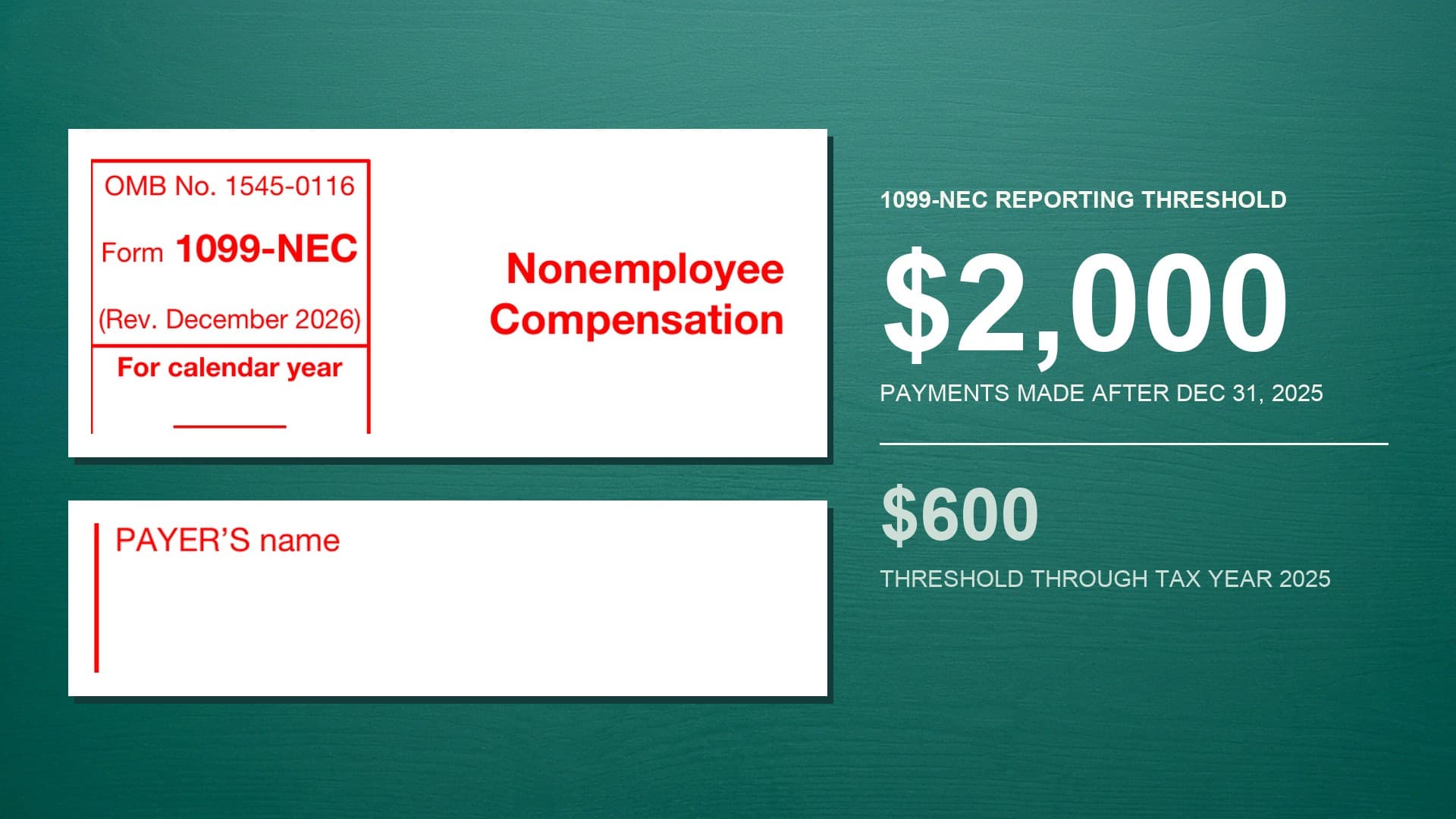
The real IRS Form 1099-NEC, revision December 2026, with its first field labelled PAYER'S NAME, shown beside the reporting threshold rising from $600 to $2,000 for payments made after December 31, 2025
The distinction between them is not the amount of money. It is who handled it. A 1099-NEC comes from a business that paid you directly out of its own account. A 1099-K comes from an intermediary that settled somebody else's payment to you. The IRS puts it plainly on its 1099-K page: "If your customers or clients pay you directly by credit, debit or gift card, you'll get a Form 1099-K from your payment card processor no matter how many payments you got or how much they were for." Card transactions have no threshold at all. Two numbers moved, and they moved for different reasons. The general information-return threshold had sat at $600 for decades. Under the statutory amendments the IRS attributes to the One, Big, Beautiful Bill, it is $2,000 for payments made after December 31, 2025, with an inflation adjustment beginning in calendar year 2027. That covers Form 1099-NEC and the 1099-MISC boxes that ran on the same trigger. The Form 1099-K threshold went on a longer journey. The American Rescue Plan Act of 2021 cut it to $600 with no transaction minimum, the IRS delayed that rule repeatedly, and the 2025 law reversed it outright. The IRS release describes the effect in one line: the law "retroactively reinstated the reporting threshold in effect prior to the passage of the American Rescue Plan Act of 2021."
FormWhat it reportsThreshold for 2026Source
1099-NECNonemployee compensation, such as a brand fee$2,000IRS Publication 1099
1099-MISCRoyalties$10IRS Publication 1099
1099-MISCOther income, rent, prizes, awards$2,000IRS Publication 1099
1099-KThird-party network paymentsOver $20,000 and over 200 transactionsIRS IR-2025-107
1099-KPayment card transactionsNo minimumIRS Form 1099-K guidance
The practical consequence is that a creator who took four $1,500 brand deals in 2025 received four forms and a creator who takes the same four deals in 2026 receives none. The money is identical. The paper trail is not. The payer's own published policy decides, and the published policies do not currently agree with the federal minimums. Apple issues a 1099-K to US developers whose unadjusted gross App Store sales reach $5,000 and explicitly does not issue a 1099-MISC. Google issues a 1099-NEC at $600 of service payments and a 1099-MISC at $10 of royalties. Stripe issues a 1099-K on the federal test of more than $20,000 and more than 200 transactions. A brand that hires you directly issues a 1099-NEC. A bank or card processor issues a 1099-K with no floor at all.
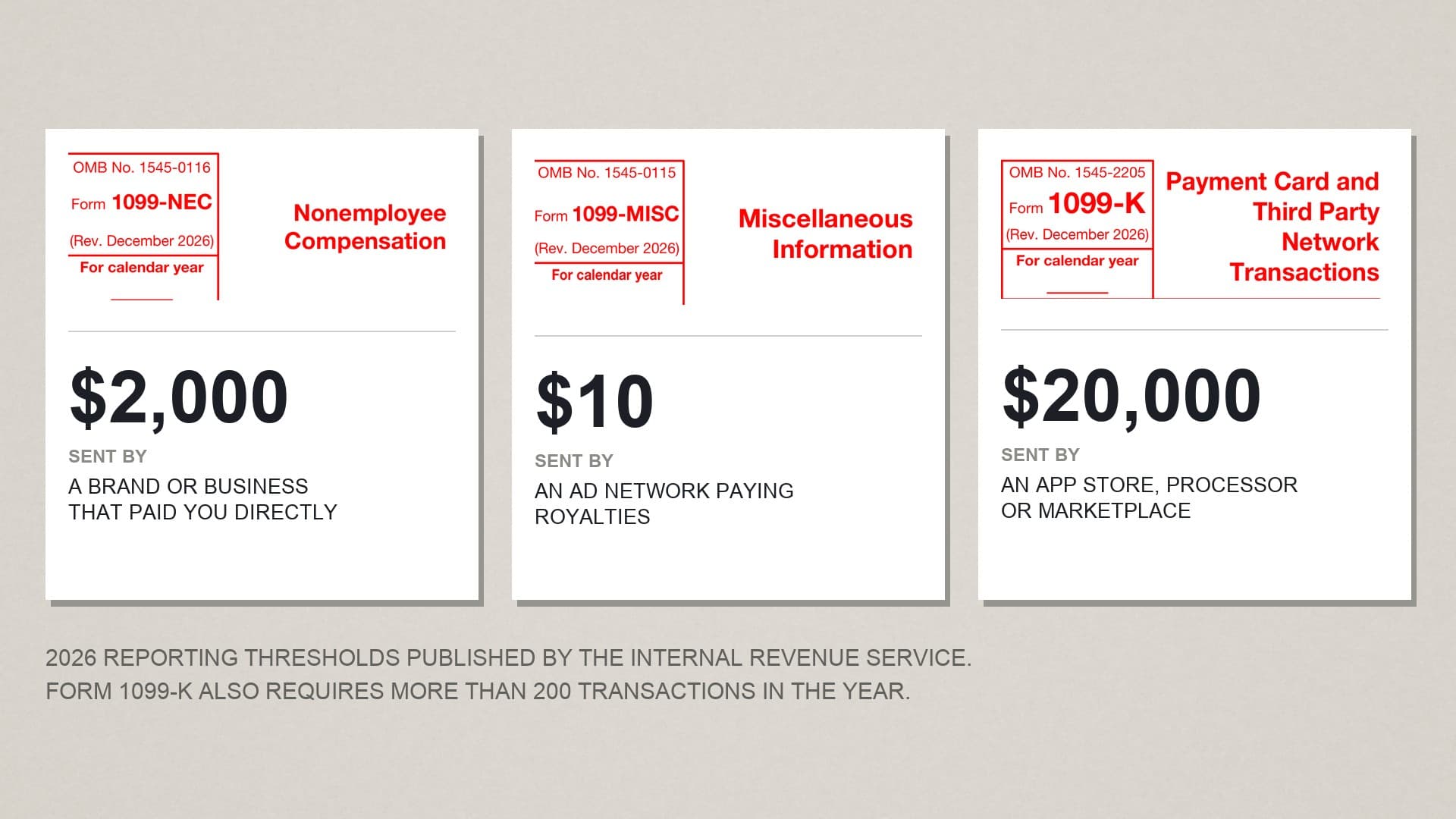
The real IRS Forms 1099-NEC, 1099-MISC and 1099-K set side by side, each labelled with the 2026 threshold that triggers it and the kind of payer that sends it
Here are the five payers a working creator actually hears from, with each company's own published rule.
PayerForm it sendsThreshold as publishedWhere it says so
Apple, for App Store sales1099-K$5,000 unadjusted gross sales, mailed by January 31App Store Connect Help
Google, for AdSense and YouTube ad revenue1099-NEC for services, 1099-MISC for royalties$600 services, $10 royaltiesAdSense Help
Stripe, for your own checkout1099-KOver $20,000 and over 200 transactionsStripe Support
A brand paying you directly1099-NEC$2,000 for payments after December 31, 2025IRS Publication 1099
A card processor or bank1099-KNo minimum on payment card transactionsIRS 1099-K guidance
Two of those five rows are stricter than the federal law requires. Apple's $5,000 and Google's $600 are company policies, published on company pages, and a company is free to report more than the statute demands. The lesson for your own accounting is short: you cannot predict from the law which forms will show up, so do not use the arrival of a form as a signal that income exists. No. A reporting threshold governs what a third party must tell the IRS about you. It has no effect on what is taxable. The IRS Gig Economy Tax Center states that you must report income earned from the gig economy on a tax return even if that income is "Not reported on an information return form" such as a Form 1099-K, 1099-MISC, 1099-NEC or W-2, and even if it was "Paid in any form, including cash, property, goods, or virtual currency." This is the single most expensive misunderstanding in the creator economy, and the 2026 change makes it more likely rather than less. Four $1,500 brand deals with no forms attached still produce $6,000 of reportable income. The only thing that changed is that nobody else is now obliged to mention it. There is a second bill sitting underneath the first one. Self-employment tax applies to net earnings of $400 or more, at a rate the IRS publishes as 15.3%, made up of 12.4% for Social Security and 2.9% for Medicare. That is charged on top of income tax, it starts at a number most creators clear in a weekend, and it does not care how many forms arrived. Apple says you did. Its App Store Connect tax page states: "Apple won't issue a US 1099-MISC tax form. Sales on the App Store are between you and the customer. You're the seller of copyrighted works, and we make payments to you for products or goods, which are specifically exempt from reporting on Form 1099-MISC. However, these payments may still be reportable on Form 1099-K and may be taxable income to you." Read that again with a business owner's eyes rather than a filer's. The largest software distribution channel in the world describes its own role as a payment intermediary between you and your customer. Not a client. Not a sponsor. Not a network buying your attention wholesale and reselling it. The customer is yours and the sale is yours, which is why the paperwork behaves the way it does. Compare that to the form a brand sends. A 1099-NEC has a box labelled PAYER'S NAME, and it names a company that made one decision in a meeting you were not in. That is the entire nature of the asset. You performed a service, a business paid a fee, and the relationship closed when the invoice cleared. The economics of that trade are only half the story; the ownership is the other half. Put the two forms next to each other and look at the boxes rather than the numbers. Form 1099-NEC reports a single figure in box 1a, nonemployee compensation. There is no box for how many people were involved, because the answer is always one. Form 1099-K has box 3, labelled "Number of payment transactions," and boxes 5a through 5l breaking the year out month by month. It is built to describe many payments from many people spread across a calendar. The IRS designed the form that way because that is what settlement traffic looks like.
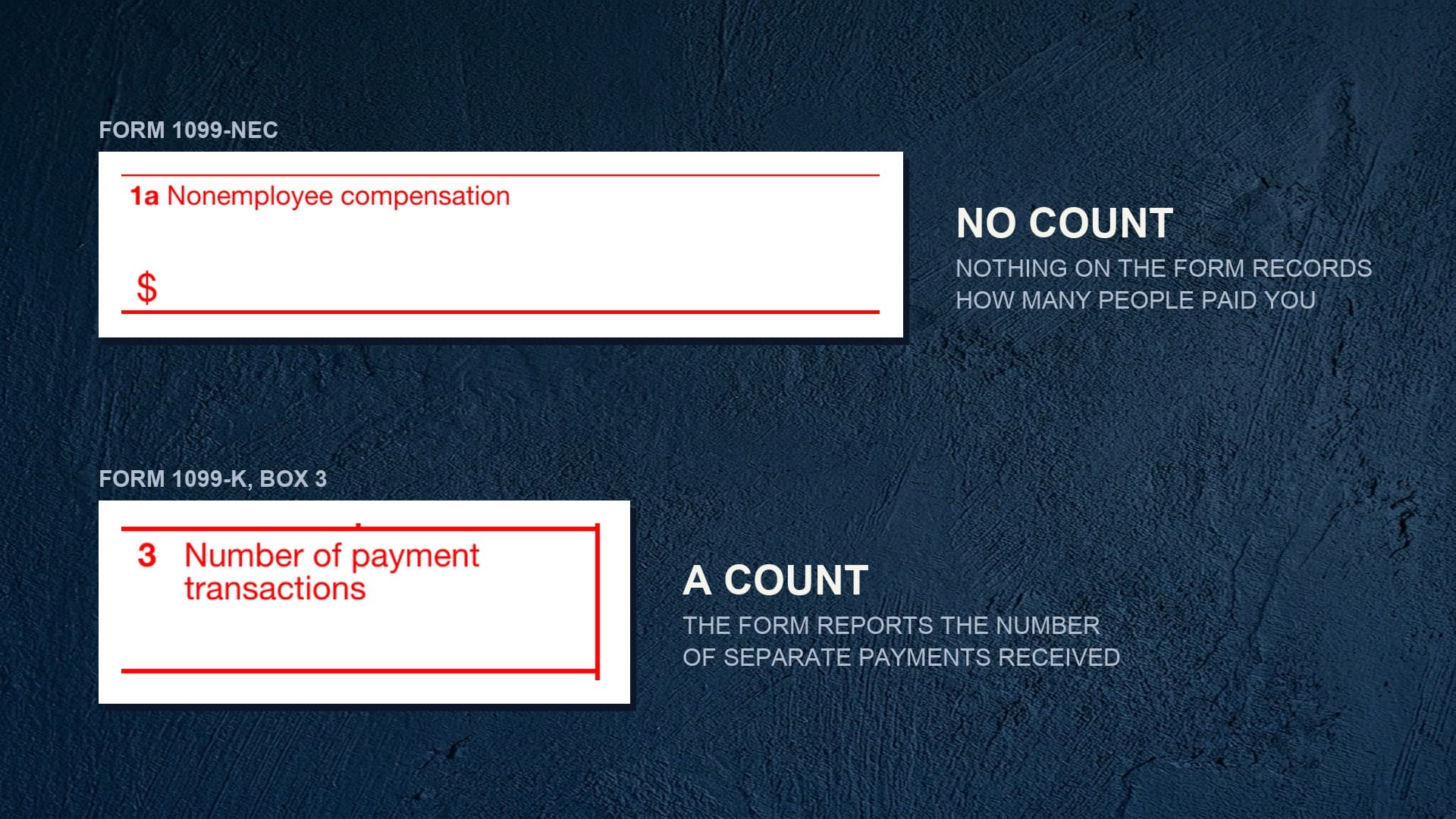
Box 3 of the real IRS Form 1099-K, labelled Number of payment transactions, set against Form 1099-NEC box 1a, which reports one figure and counts nothing
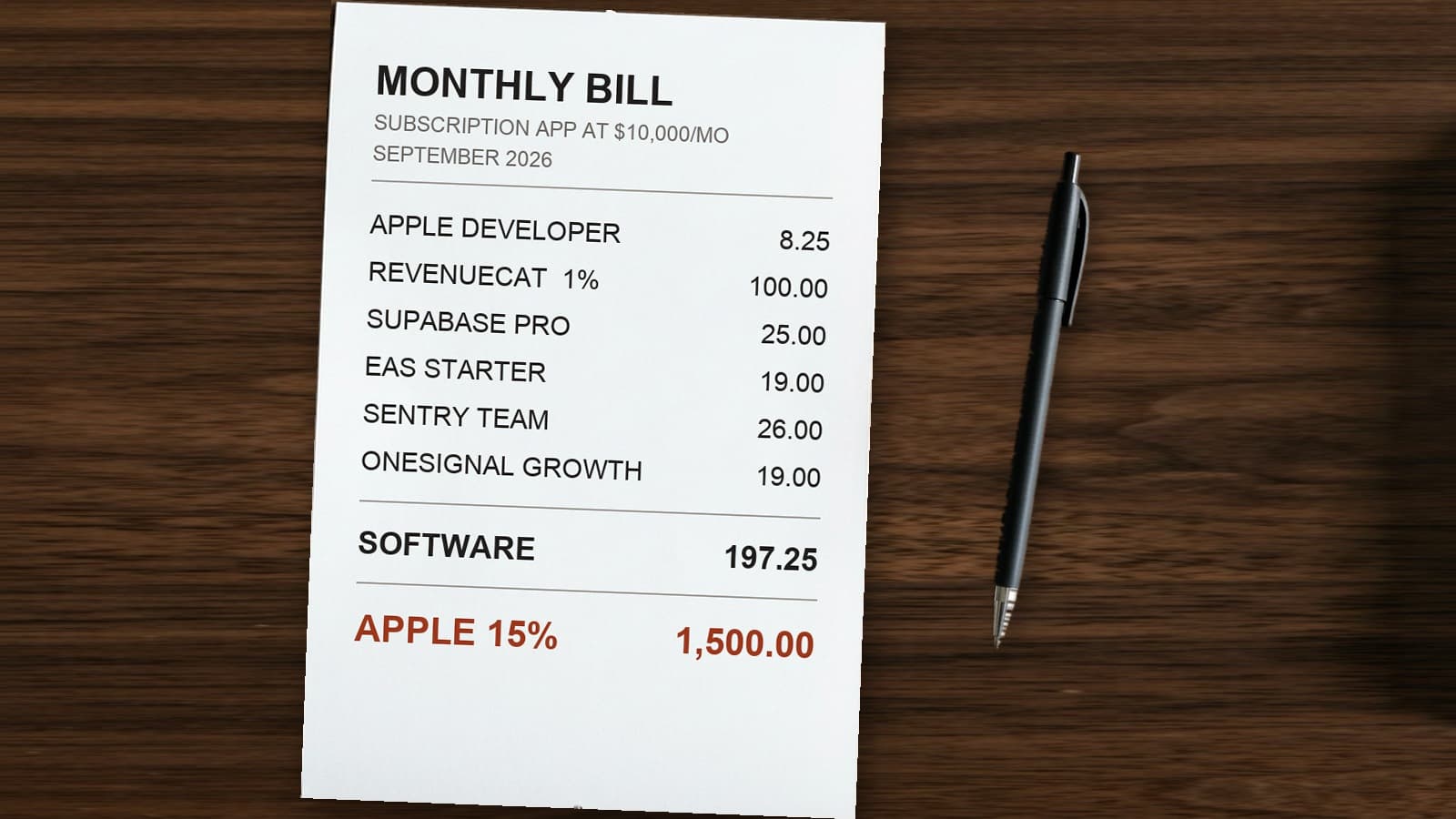
That difference is a business diagnosis printed on a government form. One document is the receipt for somebody else's decision. The other is a count of your customers. Ask the question the way an acquirer would. If you are a fitness creator with 80,000 followers and three brand contracts, your annual revenue rests on three renewal conversations, and the same concentration risk survives no matter how many platforms you post on. If the same revenue arrives as 1,400 subscriptions at $9.99, it rests on 1,400 independent decisions, none of which can be lost in a reorganization. Only one of those two revenue lines has a transaction count, and only one of them can be sold. The falsifiable exercise takes ten minutes and needs nothing but last year's paperwork. Lay out every form you received. Beside each one, write the number of separate decisions it represents. A brand fee is one. An ad network payment is one, because a single platform sets a rate you do not negotiate. A payment processor's 1099-K is whatever number sits in box 3. Most creators find that six figures of income traces back to fewer than ten decisions, and that the decision-makers are all companies rather than fans. That is not a tax problem. It is the whole business problem, described accurately, by the government, for free. The fix is not another platform. Adding a sixth channel to a portfolio funded by advertisers adds reach and changes nothing about who signs the cheque. The fix is a product your audience buys directly, on a schedule, through a channel that reports a transaction count. Which is what a subscription app actually costs to run and what the store keeps when it sells one, both of which are smaller numbers than most creators assume. BUILT BY FOUNDRY builds the product your audience already asks you for in about three weeks, at $0 upfront, on a revenue share. You own the business and you own the revenue, and we keep running it after launch, including the store listing, the pricing and the reporting. You have spent years being a line item on somebody else's information return. Next January, be the one with a transaction count. Yes. The IRS Gig Economy Tax Center states that gig income must be reported on a tax return even when it is "Not reported on an information return form" such as a 1099-K, 1099-MISC, 1099-NEC or W-2. The reporting threshold controls whether a third party is required to file a form about you. It does not control whether the money is taxable, and the increase from $600 to $2,000 means more creators will receive no form for income they still owe tax on. More than $20,000 in gross payments and more than 200 transactions, and both conditions must be met. The IRS states that third party settlement organizations are "not required to file Forms 1099-K unless the gross amount of reportable payment transactions to a payee exceeds $20,000 and the number of transactions exceeds 200." That reinstates the rule that applied before the American Rescue Plan Act of 2021. Payment card transactions are separate and carry no minimum at all. Apple issues a Form 1099-K, not a 1099-MISC. Its App Store Connect help page states that forms are mailed by January 31 of the following year to US-based individuals or entities whose unadjusted gross sales for the calendar year were at least $5,000, measured before Apple's commissions, fees, refunds and other adjustments. Apple's page also states that it will not issue a US 1099-MISC because "sales on the App Store are between you and the customer." Google's AdSense help page states that it issues a Form 1099-NEC for service payments of $600 or more and a Form 1099-MISC for royalty payments of $10 or more, both to US citizens and residents. Those are Google's published thresholds as of September 6, 2026, and they are lower than the $2,000 federal minimum that took effect for payments after December 31, 2025, which a company is permitted to do. If your net earnings from self-employment are $400 or more, the IRS requires you to file Schedule SE. The self-employment tax rate is 15.3%, consisting of 12.4% for Social Security and 2.9% for Medicare, and it is charged in addition to income tax. This applies whether or not any payer sent you an information return. Because the federal number is a floor on what a payer must report, not a ceiling on what it may report. Apple's published $5,000 App Store trigger and Google's published $600 AdSense trigger both sit below the current federal minimums. Treat every form as a partial view of one payer's records rather than as your accounting, and reconcile against your own bank deposits instead.
Our work

Creators who already did this

These are apps we designed, built, shipped, and still run today, with the creator keeping the code and the audience.

Creator app strategy

Curious what your app could be?

Enter your handle and BUILT BY FOUNDRY will research your audience and present custom app concepts. Free.

Which 1099 Do Creators Get in 2026? 5 Payers and 3 Thresholds