
Turning Knowledge into Products

Passion.io vs Kajabi: 7 Costs Compared

August 4, 2026
Share
Passion.io vs Kajabi: 7 Costs Compared

Get Creator Revenue Insights

How creators are turning audiences into subscription businesses
Share
Key Takeaways:
  • Kajabi is the better all-in-one web business platform. Passion.io is the stronger app-first course and coaching platform.
  • Kajabi starts at $143 a month billed annually. Passion.io starts at $119, but an App Store listing requires its $599 Expand plan.
  • Kajabi's cheapest branded App Store route is Basic plus the $199 app add-on, or $342 a month billed annually. The app is included in Kajabi Pro at $399.
  • Passion.io charges a 1.9% to 3.9% PassionPayments fee. Kajabi Payments starts at 2.9% plus $0.30 in the United States, with extra fees for third-party processors on new plans.
  • Both products rent you a white-label system. Neither gives you custom product logic or portable software ownership.
Searching for "Passion.io vs Kajabi" means you have moved past the first course sale. You need a system that can sell, deliver, and retain customers without turning your week into platform administration. The verdict: Choose Kajabi when email, landing pages, funnels, and web checkout run the business. Choose Passion.io when the paid experience belongs on a phone and interactive lessons, community, and push notifications drive retention. Choose a custom app when your product needs to do more than deliver content inside somebody else's template. We reviewed Passion.io and Kajabi separately. This comparison uses their live 2026 pricing and current mobile app documentation to put the real decision on one page.
DecisionPassion.ioKajabi
Starting price, annual billing$119/month$143/month
Monthly billingAnnual billing saves 20%$179/month starting price
Branded App Store listingExpand, $599/monthBasic plus app, $342/month
Core strengthMobile learning and engagementEmail, funnels, websites, and courses
Public product limitsUnlimited on Expand5 Basic, 50 Growth, unlimited Pro
PaymentsPassionPayments fee plus processingKajabi Payments processing, or extra third-party fee
Best fitApp-first coaching or membershipsWeb-first knowledge business
Software ownershipRented white-label platformRented white-label platform
The cheapest subscription is not the useful comparison. A creator who needs an App Store product should compare Passion.io Expand at $599 a month with Kajabi Basic plus the Branded App at $342, Kajabi Growth plus the app at $398, or Kajabi Pro at $399. All four figures assume annual billing for the base plan. Passion.io costs $119, $279, or $599 per month billed annually. Kajabi costs $143, $199, or $399 per month billed annually, with monthly prices of $179, $249, and $499. Passion.io's live pricing page lists Launch, Scale, Expand, and custom-priced Passion Plus. Annual billing saves 20%. Launch and Scale provide a branded experience, but Passion.io says a real Apple App Store and Google Play listing begins on Expand at $599 a month. Done-for-you submission sits on Passion Plus. Kajabi's live pricing page lists Basic, Growth, and Pro. The Kajabi Branded App documentation prices the app at $199 a month on Basic and Growth, while Pro includes it.
App Store routeMonthly platform costAnnual platform costWhat is included
Kajabi Basic plus Branded App$342$4,1045 products, 2,500 contacts, branded app
Kajabi Growth plus Branded App$398$4,77650 products, 25,000 contacts, branded app
Kajabi Pro$399$4,788Unlimited products, 100,000 contacts, branded app
Passion.io Expand$599$7,188Unlimited products, store listing, push, offline mode
That makes Kajabi Pro the sharpest public bundle if you need both a mature web stack and a branded app. It costs $12 more per year than Growth plus the app, yet raises product limits from 50 to unlimited and contacts from 25,000 to 100,000.
Four metal access keys arranged along an orange rail toward one app platform lock
Plan price is only the first cost. These seven decide whether the platform still feels smart after your first 500 customers.
  • The base subscription. Passion.io undercuts Kajabi at entry, $119 versus $143 a month on annual billing. The comparison reverses when you require a public App Store listing.
  • The branded app. Passion.io requires Expand at $599. Kajabi starts at $342 for Basic plus its app add-on. Both are white-label products maintained by the platform.
  • Payment fees. Passion.io says PassionPayments fees range from 3.9% on Launch to 1.9% on Passion Plus, with Apple, Google, or Stripe charges added where relevant. Kajabi Payments lists U.S. card rates from 2.9% plus $0.30 on Basic to 2.7% plus $0.30 on Pro. Using another processor can add 2%, 1%, or 0.5% based on the Kajabi plan in regions where Kajabi Payments is available.
  • The missing stack. Kajabi includes unlimited marketing emails, landing pages, and funnels. Passion.io connects to tools such as Zapier, Calendly, and Stripe, but an email engine can become another subscription and another integration to maintain.
  • Product and contact ceilings. Kajabi's Basic plan allows 5 products and 2,500 contacts. Growth allows 50 and 25,000. Passion.io Expand lists unlimited products and users, although AI messages stay metered.
  • App store economics. Purchases inside either native app can trigger Apple or Google commissions. Kajabi's own documentation says those fees generally run from 15% to 30%. A lower platform fee does not erase store economics.
  • Switching and ownership. You can export content and customer data. You cannot export the platform itself. The screens, workflows, and product behavior disappear when the subscription ends.

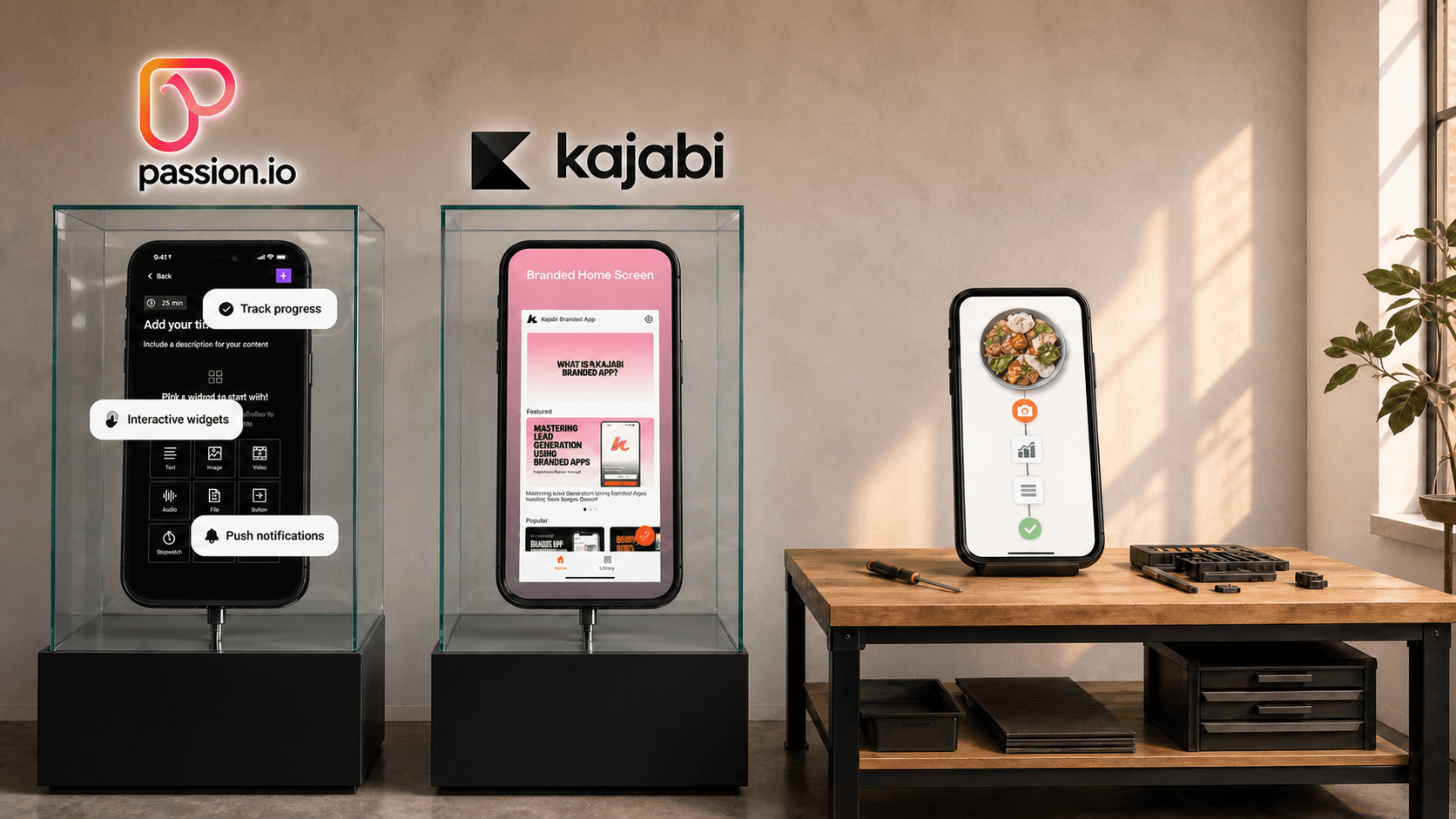
At $20,000 in monthly recurring revenue, a single 2% fee is $400 every month. That is larger than Kajabi's Basic subscription before the app add-on. Serious creators model the fee on revenue, not the price card. Passion.io builds the stronger mobile learning experience, while Kajabi builds the stronger mobile extension of an existing web business. Passion.io starts from the behavior after purchase. Its current feature set emphasizes interactive courses, quizzes, onboarding, mobile communities, direct messaging, push notifications, drip content, offline access, audio, and an AI customer coach trained on the creator's material. That makes sense for fitness, music, language, wellness, and coaching products where the customer returns several times a week. Kajabi starts from the business system. Its Branded App carries courses, cohort courses, coaching, podcasts, and community into an app with custom screens, in-app purchases, targeted push notifications, and App Store listings. Kajabi says its team handles initial approvals and ongoing maintenance, with publication typically taking 6 to 8 weeks. Both are real apps. Both can put your icon on a fan's home screen. Neither gives you custom logic such as a nutrition scanner, adaptive workout generator, assessment engine, or niche marketplace. A branded course container is an app. It is not automatically a software product. Kajabi wins for creators whose acquisition and sales system depends on email, funnels, landing pages, affiliate programs, and a flexible web checkout. One login replaces a real stack. Kajabi connects the lead form, email sequence, webinar funnel, checkout, course, community, and customer record. Its Growth and Pro tiers add advanced automations, affiliate programs, webhooks, API access, and more admin capacity. That operational depth is the reason established course businesses tolerate the price. Kajabi also wins the public branded-app price comparison. Pro at $399 a month includes the app, unlimited products, 100,000 contacts, 3 websites, and 3 communities. Passion.io Expand costs $200 more each month before payment fees. If your best launch still happens through a five-email sequence and a webinar, Kajabi fits the machine you already run. Do not buy an app-first platform and then rebuild Kajabi from six integrations. Passion.io wins when customer progress, repeat usage, mobile community, and guided action matter more than a sophisticated website funnel. Passion.io treats the product as the place customers do the work. Interactive lessons and mobile-first communities give creators more raw material for transformation posts, member wins, challenges, and before-and-after content. The product becomes an evergreen content engine because customer activity tells you what to publish next. Its context-aware AI coach is also aimed at the customer, not only the creator. That matters when 500 members ask versions of the same question. But the included message allowance is capped at 3,000 on Launch, 7,500 on Scale, and 20,000 on Expand. Engagement can force an upgrade or a support decision, so model the meter before promising 24-hour guidance. Choose Kajabi if you already sell courses, coaching, or memberships through email and web funnels. Basic is enough for a small catalog. Growth fits a larger list and automation-heavy team. Pro becomes the rational tier as soon as you want a branded app because it costs only $1 more per month than Growth plus the app add-on. Choose Passion.io if the phone is the product's natural home. A fitness creator whose members train daily, a music teacher whose students practice in short sessions, or a coach whose community needs direct prompts will get more from its mobile-first design. Start only after accepting that the public App Store product costs $7,188 a year on Expand. Choose neither as the final product when your audience needs a unique mechanism. If your promise depends on personalization, generation, tracking, scanning, matching, or a proprietary workflow, templates turn your differentiation into a settings menu. Read the course versus app revenue math and the five App Store review failures creators must avoid before calling a white-label shell an owned software business. Passion.io and Kajabi are capable platforms. The hard truth is that both make you a tenant. An owned creator app earns subscription revenue under your business, turns daily use into new stories and posts, and gives people who have never followed you a way to find the product in the App Store. It can also contain the thing templates cannot: your method expressed as software. Built by Foundry builds that business with creators in about 3 weeks for $0 upfront on a revenue share. We design the product, ship it, handle App Store submission, and provide ongoing App Care after launch. You keep the brand and the business. We keep earning only when the product earns. Kajabi makes creators better operators. Passion.io makes creators better app builders. An aligned product team lets the creator stay the founder. Passion.io is cheaper at entry, $119 per month billed annually versus Kajabi Basic at $143. Kajabi is cheaper when you need a branded App Store listing: Basic plus the Branded App costs $342 per month, while Passion.io Expand costs $599. Yes. Kajabi's Branded App has its own Apple App Store and Google Play listing with the creator's name, icon, content, in-app purchases, and push notifications. It costs $199 per month on Basic or Growth and is included with Pro. Yes, starting with the Expand plan at $599 per month billed annually. Launch and Scale provide an app experience, but Passion.io's pricing page reserves a public Apple App Store and Google Play listing for Expand and Passion Plus. Passion.io is the stronger template platform for fitness creators because interactive courses, offline access, push notifications, and mobile community match daily training behavior. A custom app is the stronger long-term choice when workouts need adaptive programming, tracking, scanning, or proprietary logic. You own your brand, content, customer relationships, and developer accounts, subject to each platform's terms. You do not own the underlying software. The app depends on the platform subscription and cannot operate independently if you leave.

Creator app strategy

Curious what your app could be?

Enter your handle and Built by Foundry will research your audience and present custom app concepts. Free.

Passion.io vs Kajabi: 7 Costs Compared