
Creator Economy Trends

What Is GMV? 3 Definitions, and a $10 Sale That Can Count as $15.84

November 27, 2026
Share
What Is GMV? 3 Definitions, and a $10 Sale That Can Count as $15.84

Get Creator Revenue Insights

How creators are turning audiences into subscription businesses
Share
GMV, short for gross merchandise value (Shopify says gross merchandise volume), is the total value of goods sold through a platform in a period, counted before the platform's fees, the seller's costs or any profit. It measures how much buying happened. It does not measure what anyone earned, and companies disagree about what goes into it. Black Friday is today, and next week the sales totals will start arriving. Shopify announced last year's on December 2, 2025: a record $14.6 billion over the Black Friday to Cyber Monday weekend. Live shopping apps and social storefronts will post their own records. Almost all of these figures are GMV or something close to it, and the definitions behind them vary more than the headlines suggest. Key Takeaways:
  • GMV is the value of goods sold, before fees and costs. Every company that reports it says some version of what Shopify's 2025 annual report says: GMV "does not represent revenue earned by us"
  • Whatnot's seller fee page defines GMV as "the sale price of the item." Shipping and taxes paid by the buyer are left out
  • Shopify's GMV includes shipping and handling, duty and value-added taxes, net of refunds. Etsy's equivalent, GMS, excludes shipping and is net of refunds
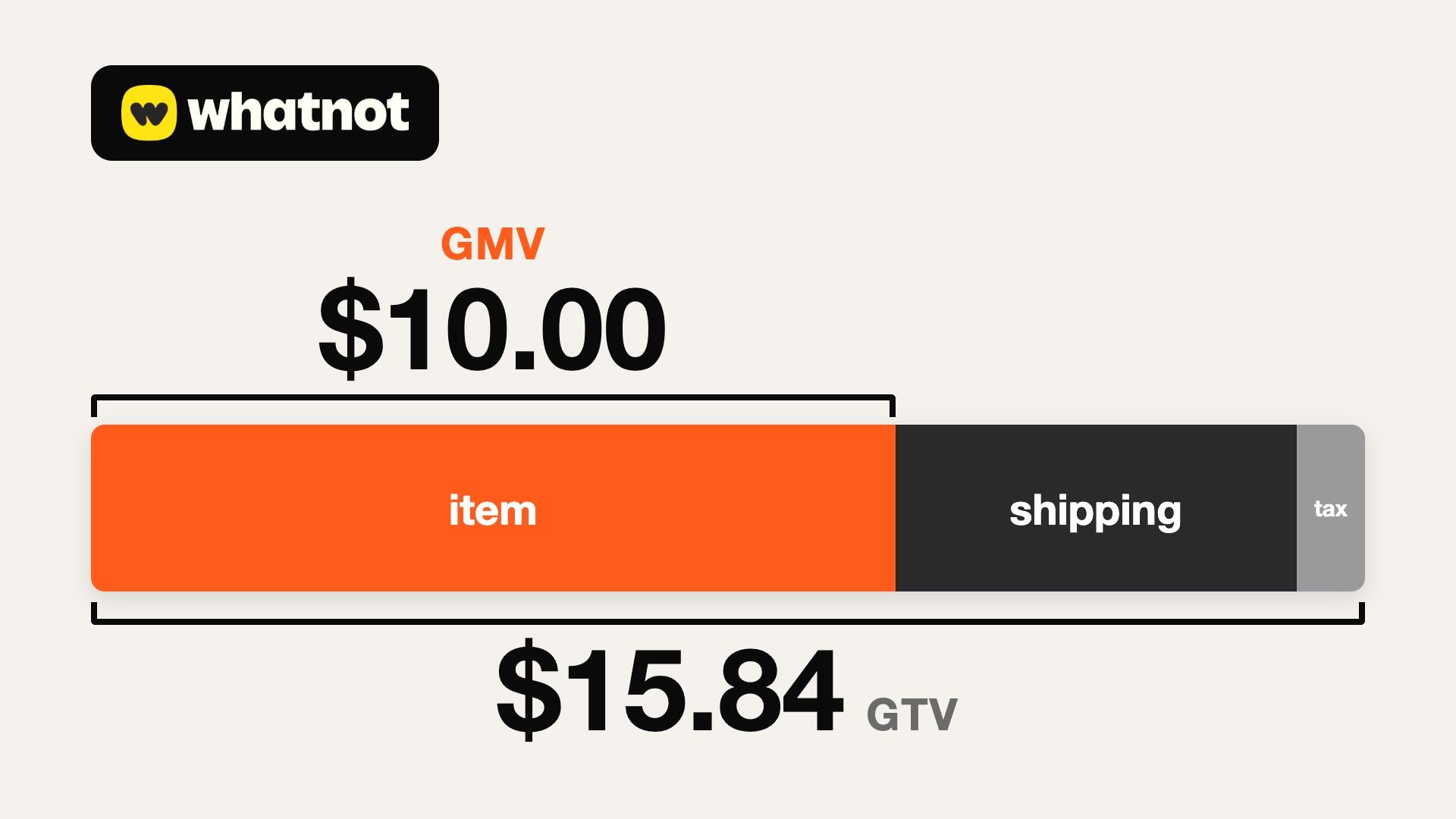
  • Whatnot's own example: a $10 item with $4.99 shipping and $0.85 tax is $10 of GMV and $15.84 of what Whatnot calls gross transaction value (GTV)
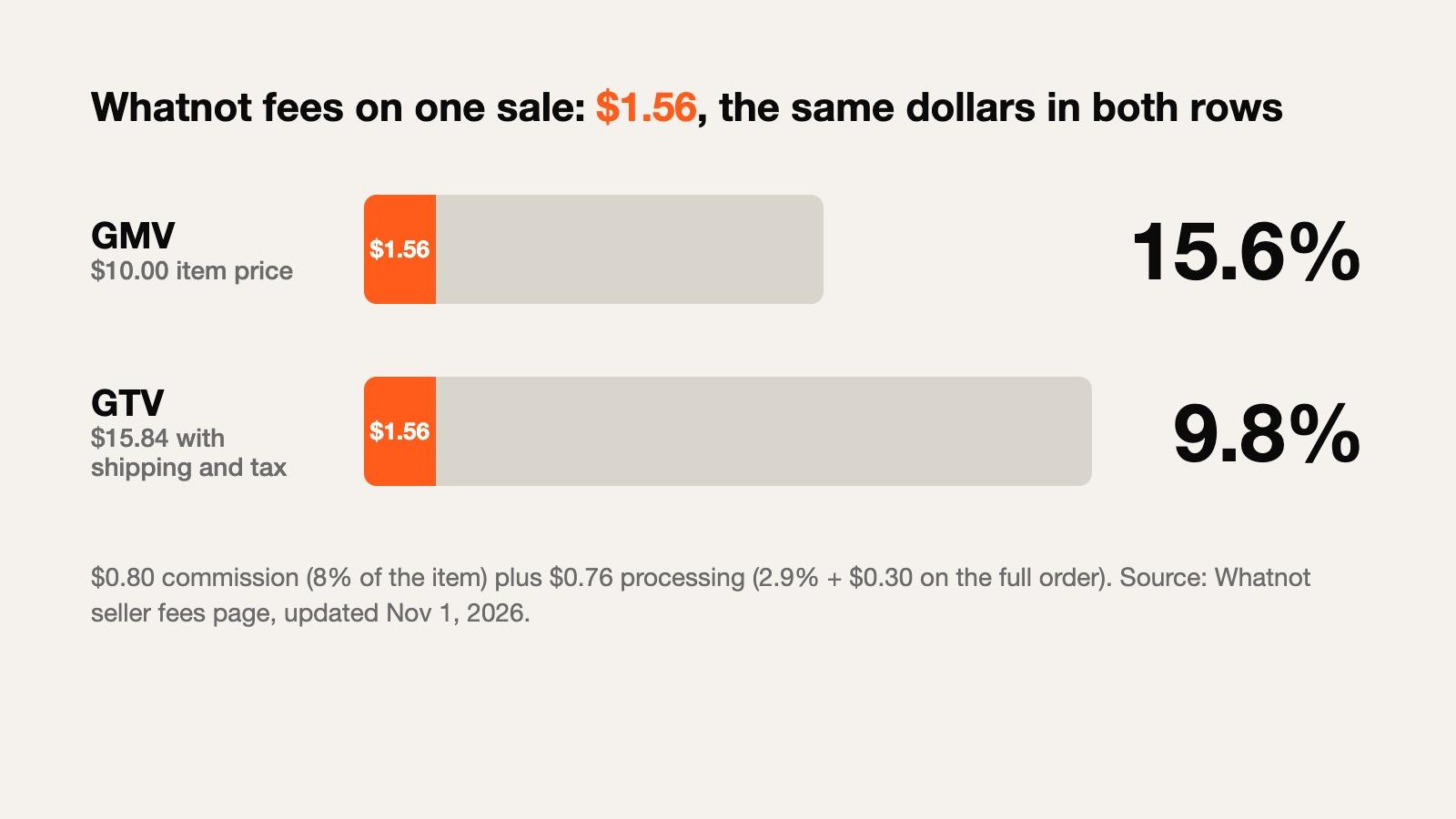
  • The same $1.56 in Whatnot fees on that sale is 15.6% of GMV or 9.8% of GTV. The denominator changes the percentage without changing the dollars
  • In 2025, Shopify's revenue was about 3.1% of its GMV and Etsy's was 24.2% of its GMS. Those take rates are not comparable without reading each definition
GMV is the total price of everything sold through a marketplace or commerce platform over a period, added up before the platform takes its fee and before the seller pays for goods, shipping labels or anything else. A platform uses it to show how much commerce passes through it. A seller uses it to describe the size of their shop. The word "gross" is doing real work. GMV sits at the top of a stack of subtractions. Below it come refunds, then the platform's commission and payment processing, then the seller's cost of goods, packaging and labor, and only then profit. Our glossary entry on gross margin covers the middle of that stack. GMV is the line above all of it. That is why two businesses with the same GMV can be in very different health. A shop that sells $100,000 of trading cards at a 10% margin and one that sells $100,000 of its own digital planners at an 80% margin report the same GMV. Only one of them has $80,000 left to work with. Whatnot draws the line on its own fee page: GMV is the item's sale price, while gross transaction value, or GTV, "can include the item price plus additional costs like shipping and taxes." It uses the distinction to explain why its commission is charged on less of the order than some competitors'. Whatnot's example, from its fee page as updated November 1, 2026 (the live page blocked automated reads today, so we used the Internet Archive's November 4 copy):
Part of the orderAmountCounted in Whatnot's GMV?Counted in GTV?
Item price$10.00YesYes
Buyer-paid shipping$4.99NoYes
Sales tax$0.85NoYes
Total$15.84$10.00$15.84
Whatnot then compares its 8% commission on the $10 item ($0.80) with "another marketplace" charging 6% on the full $15.84 ($0.95). The lower headline rate costs more because it is charged on the bigger number. The comparison leaves one thing out. The same page says Whatnot's payment processing, 2.9% plus $0.30 in the US, is charged on "the total order value paid by the buyer, including the item price, buyer-paid shipping, and taxes." On $15.84 that is $0.76. Whatnot's total fee on the sale is $1.56. Here is the part worth remembering. $1.56 is 15.6% of the $10 GMV and 9.8% of the $15.84 GTV. Both percentages describe the same dollars. Whenever someone quotes a fee "as a share of sales," ask which sales.
The same $1.56 in Whatnot fees on one sale, shown against two bases: 15.6% of the $10.00 GMV and 9.8% of the $15.84 GTV
Whatnot is private and publishes its definition on a help page. Shopify and Etsy are public companies, so their definitions sit in their annual reports to the SEC. We read all three on November 27, 2026.
CompanyTermIncludes item priceIncludes shippingIncludes taxesRefunds
WhatnotGMVYesNoNoNot stated
EtsyGMS (gross merchandise sales)YesNoNot statedNet of refunds
ShopifyGMV (gross merchandise volume)YesYes, plus handlingDuty and value-added taxesNet of refunds
Etsy's wording is "the dollar value of items sold in our marketplaces, excluding shipping fees and net of refunds." Shopify's is "the total dollar value of orders facilitated through our platform including certain apps and channels for which a revenue-sharing arrangement is in place in the period, net of refunds, and inclusive of shipping and handling, duty and value-added taxes."
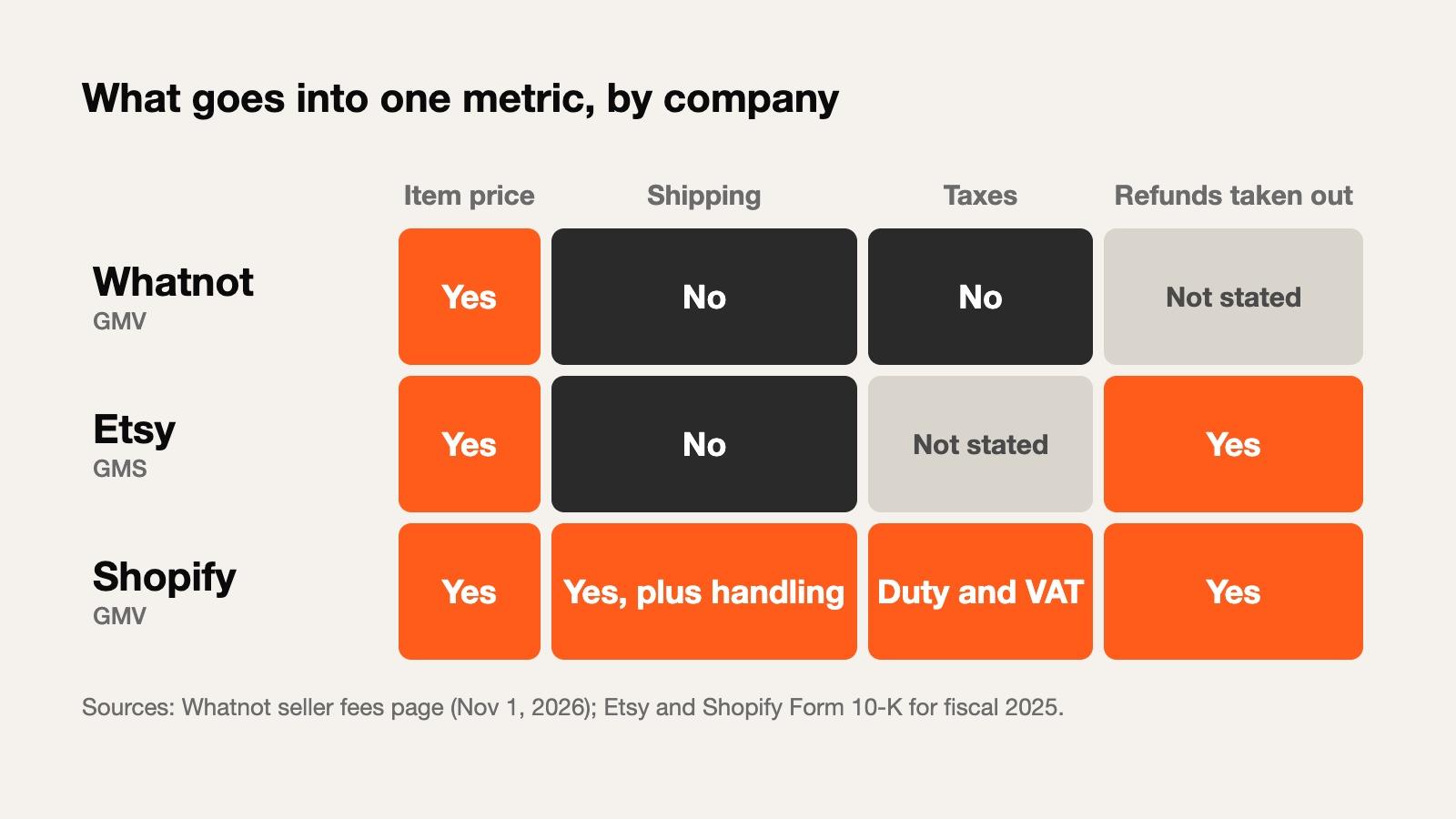
Three definitions of the same metric: Whatnot's GMV counts the item price only, Etsy's GMS counts items net of refunds without shipping, and Shopify's GMV adds shipping, handling, duty and value-added taxes, net of refunds
None of these is wrong. Shopify sells software to merchants who run their own stores, so the whole order is the natural unit. Etsy and Whatnot charge commission on items, so the item is the natural unit. The trouble starts only when numbers built on different definitions are put side by side. No. GMV is what buyers spent. Revenue is the part a company keeps as its own income. For a marketplace, revenue is mostly fees. For a seller, revenue is closer to GMV, but it still has the platform's fees and refunds taken out before it becomes money in the bank. Both public companies say so in plain words. Shopify: "GMV does not represent revenue earned by us." Etsy: "GMS does not represent revenue earned by us." On the Whatnot example, the seller's side of the $10 sale looks like this. Assuming the buyer's $4.99 covers the shipping label and the tax is collected and passed on, $8.44 of the item's price is left after Whatnot's $1.56 in fees. The cost of the item itself, the packaging and the hours spent selling it all come out of that $8.44. That gap is also why nobody buys a business on GMV. When a creator business is sold, buyers price it on profit, as our glossary entry on valuation multiples shows. A large GMV with thin margins can be worth less than a small one with wide margins. A platform's take rate is its revenue divided by its GMV. Etsy reports it directly. For Shopify, we worked it out from figures in the same annual report.
Company, full year 2025RevenueGMV or GMSRevenue as a share
Etsy$2.88 billion$11.92 billion24.2% (Etsy's reported "revenue take rate")
Shopify$11.56 billion$378.4 billionAbout 3.1% (our calculation)
The gap looks enormous, and part of it is real. Etsy is a marketplace that charges transaction fees and sells ads and services to sellers. Shopify mostly charges merchants for software and payment processing on stores they run themselves. Part of the gap, though, is the denominator. Shopify's GMV includes shipping and taxes. Etsy's GMS leaves shipping out. If Shopify counted only item prices, its GMV would be smaller and its percentage higher. We cannot say by how much, because neither company publishes the other's version. Expect the next few days to bring records, many of them GMV. Three habits make them useful rather than impressive.
  • Read the footnote. Shopify's 2025 release called its figure "sales" and added that all data "is approximate and is based on various assumptions," "is unaudited and is subject to adjustment," and that "prior year results are not directly comparable to current results." It also said the data covers "online and offline sales."
  • Check whose estimate it is. Private platforms usually don't publish audited GMV. TikTok Shop's widely quoted US figures, which we covered in our TikTok Shop numbers post, come from research firms' estimates, not from a filing.
  • Ask what the seller kept. A platform's GMV record is a record for buyers and for the platform's fees. For a seller, the number that matters is the one after commission, processing, the cost of goods and refunds.
Ask what the number includes, who measured it, and what was left after fees and costs. Creators meet GMV in three places. In an affiliate or live shopping dashboard. Commission is usually paid on a defined base. Find out whether that base includes shipping, tax and discounts, and whether refunds come back out. Our Whatnot review walks through one platform's full fee card. In a brand or agency pitch. "Our creators drove $2 million in GMV" describes buyer spending. It says nothing about returns, margins or what the creators were paid. In your own business. GMV is a fine way to track demand, and a poor way to judge whether a product is working. Revenue after fees, gross margin and, for a subscription, how many customers pay again next month tell you more. A one-time order is counted in GMV once. A subscriber who renews counts again every month they stay. That last difference is the reason Built by Foundry builds recurring businesses with creators. You can read more about how we work on our about page. GMV stands for gross merchandise value. Shopify uses gross merchandise volume, and Etsy uses a close equivalent called GMS, gross merchandise sales. All three describe the total value of goods sold through a platform before fees and costs. It depends on the company. Whatnot's GMV is the item's sale price, without shipping or tax. Etsy's GMS excludes shipping fees. Shopify's GMV includes shipping and handling, duty and value-added taxes. Shopify and Etsy both say their figures are net of refunds. Whatnot's fee page does not say either way for GMV, though it subtracts cancelled orders, private shows and local pickup orders when it adds up a seller's sales for its commission tiers. On Whatnot's definition, GMV is the item price and GTV adds buyer-paid shipping and taxes. On a $10 item with $4.99 shipping and $0.85 tax, GMV is $10.00 and GTV is $15.84. A take rate is a platform's revenue divided by its GMV. Etsy reported a 24.2% revenue take rate for 2025. Shopify's revenue was about 3.1% of its GMV in the same year by our calculation. Each company defines GMV differently, so the two percentages are not a like-for-like comparison.
Sources: Whatnot Help Center, Whatnot seller fees (updated November 1, 2026; Internet Archive copy of November 4, 2026, because the live page returned an access block); Shopify Inc., Form 10-K for fiscal 2025 and Black Friday Cyber Monday release, December 2, 2025; Etsy, Inc., Form 10-K for fiscal 2025. All read November 27, 2026.

Our work

Creators who already did this

These are apps we designed, built, shipped, and still run today, with the creator keeping the code and the audience.

Brandon Whiteleather

Brandon Whiteleather

Founder & CEO of Freeze Dry Buddy

Freeze drying made foolproof, from a homesteader who's done it 1,000 times.

Top Food App1.4M+ followers
Read the case study
Kristen Donathan

Kristen Donathan

Founder & CEO of Stain Fix

Snap a stain. Get the fix in seconds.

Top Lifestyle App1.5M+ followers
Read the case study
Stain Fix screenshots
Ellie Fausett

Ellie Fausett

Founder & CEO of Vector Guard

Spot disease-carrying pests before they reach your family.

Top Health App
Read the case study
Vector Guard screenshots

Creator app strategy

Curious what your app could be?

Enter your handle and BUILT BY FOUNDRY will research your audience and present custom app concepts. Free.

What Is GMV? 3 Definitions, and a $10 Sale That Can Count as $15.84