


What Is ARPU? Average Revenue Per User for Creators

What Is ARPU? Average Revenue Per User for Creators

Foundry
May 14, 2026
ARPU (Average Revenue Per User) is the monthly revenue your app generates divided by the number of active users in that month. For creators building subscription apps, ARPU is the number that tells you whether your audience is paying you like fans, or paying you like a business. Key Takeaways:
  • ARPU = Total Monthly Revenue / Total Active Users (paying and free combined)
  • ARPPU = Total Monthly Revenue / Total Paying Users (paying only)
  • The median ARPU for the top quartile of subscription apps is $7.69/month, while the bottom quartile sits at $0.32 (RevenueCat, 2026)
  • Health and fitness apps lead all categories with a median payer ARPU of $16.44/month
  • A creator app with 500 paying users at $20 ARPU = $10,000/month in recurring revenue
ARPU stands for Average Revenue Per User. It is the total revenue your app generates in a month divided by every user who opened the app in that month, whether they paid or not. It is the single number that tells you how much each person in your audience is worth to your business. There are two flavors creators need to know: ARPU counts everyone, paying and free. It tells you how well your whole funnel monetizes, including the freeloaders. ARPPU (Average Revenue Per Paying User) counts only paying subscribers. It tells you how well you are pricing the people who already said yes. A free user counts as a $0 contribution to ARPU. A $9.99/month subscriber counts as $9.99. A $79.99/year annual subscriber counts as $6.67 (the annual price spread across 12 months). Mix them all together, divide by total users, and that is your ARPU. The math is simple:
ARPU = Total Monthly Revenue / Total Monthly Active Users
Example: your app makes $25,000 in a month. You had 5,000 active users. ARPU = $5. Now split that out. Of those 5,000 users, 1,000 were paying subscribers at $25/month. The other 4,000 were on the free tier. ARPPU = $25,000 / 1,000 = $25 per paying user Same revenue. Two different numbers. Both matter. ARPU tells you how well your free-to-paid conversion is working. ARPPU tells you how well your pricing is working.
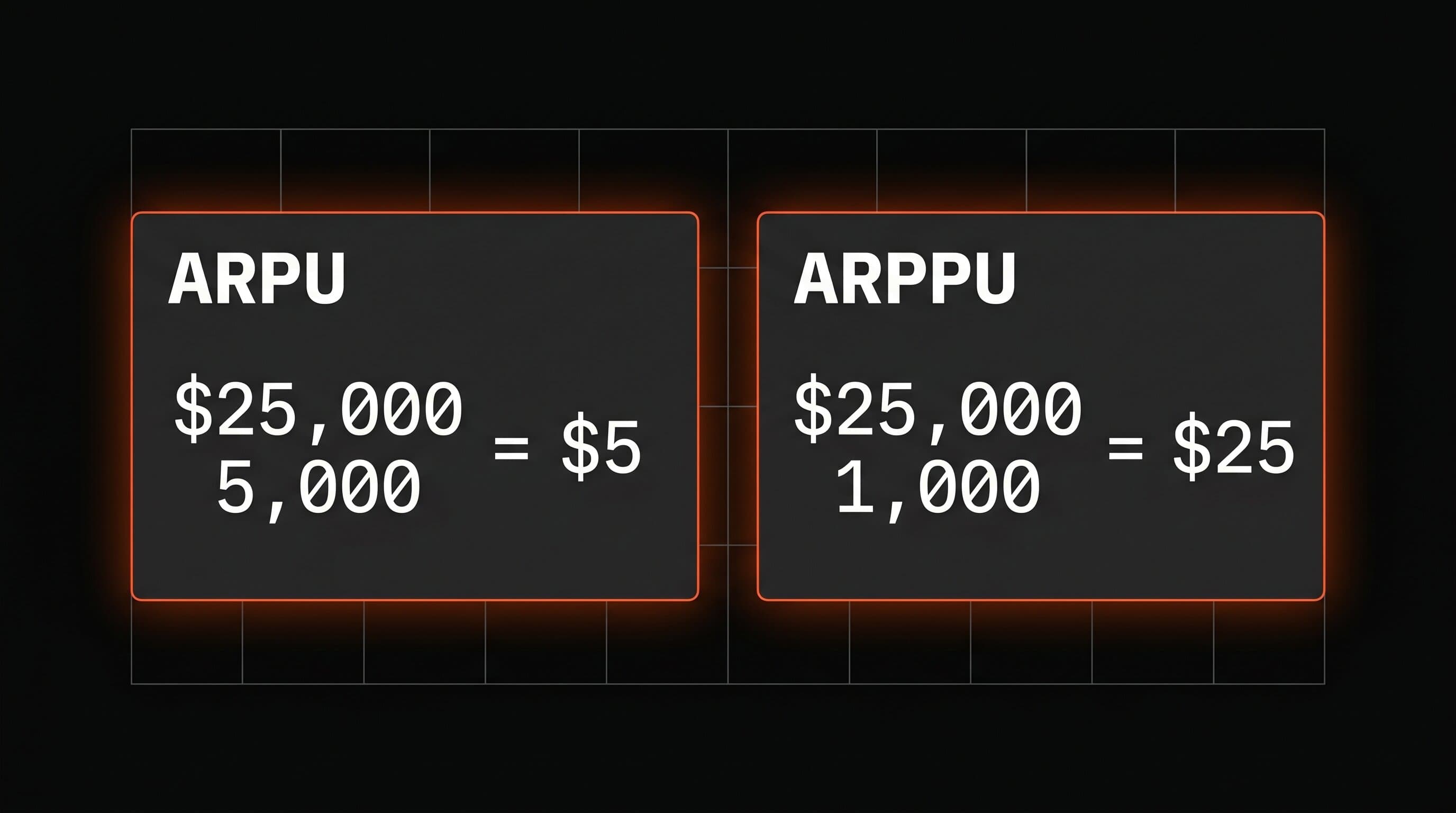
A clean dark dashboard showing ARPU and ARPPU calculations side by side with revenue and user totals
Creators count followers. Founders count ARPU. The two numbers tell different stories. A creator with 1 million followers and a $0.50 ARPU is making $500K/month before costs. A creator with 50,000 engaged followers and a $20 ARPU is making $1M/month if 100,000 of them subscribe through App Store discoverability. Followers are an audience. ARPU is a business. Here is what ARPU actually controls:
  • How big your business can get. A $2 ARPU app needs 5,000 users to clear $10K/month. A $20 ARPU app needs 500. Same revenue. One tenth the audience.
  • How much you can spend to acquire a customer. If your ARPU is $5 and a subscriber stays 10 months, you can spend up to $50 acquiring them before you lose money. Higher ARPU means higher customer acquisition cost (CAC) tolerance, which means you can run paid ads other creators cannot.
  • How quickly recurring revenue compounds. ARPU x active users = MRR. MRR x average subscriber lifespan = LTV. Every other subscription metric flows downstream from ARPU.

This is why a $10K brand deal loses to $10K MRR every time. A brand deal pays once and resets to zero. ARPU compounds every month a subscriber stays. The answer depends on category, but the data is unambiguous. RevenueCat's 2026 State of Subscription Apps report analyzed over 115,000 apps and $16 billion in revenue. The top quartile of apps generates a median ARPU of $7.69/month. The bottom quartile sits at $0.32. That is a 24x gap between the apps that win and the apps that do not. Category matters too. Here is the median payer ARPU by category from the same report:
CategoryMedian Payer ARPUWhy It Wins
Health & Fitness$16.44/monthHigh intent, daily use, results creators can charge premium for
Education$13.21/monthSkill-based learning justifies subscription pricing
Productivity$11.85/monthB2B-adjacent users have higher willingness to pay
Photo & Video$9.40/monthPro tools command pro pricing
Lifestyle$7.12/monthBroad appeal, lower urgency
Entertainment$4.85/monthHigh volume, low price points
Health and fitness apps lead all categories because their users come in with a problem they urgently want solved. A creator selling generic motivation will struggle to clear $3 ARPU. A creator selling a specialized training program for runners over 40 will clear $20. Three levers move ARPU. Pull them in this order. 1. Raise the price. This is the lever creators are most afraid of and the one that matters most. RevenueCat found that high-priced apps generate nearly 7x the median LTV of low-priced apps. Most creators underprice by 2-3x because they are pricing for their existing followers instead of pricing for the value they deliver. A specialized expertise is worth $20/month, not $4.99. 2. Push annual plans. Annual subscribers retain at 44% after 12 months versus 17% for monthly plans. Annual ARPU is higher because the cash arrives upfront and the user is locked in. Apps that sell heavy on annual see ARPU jump 30-50% without changing the sticker price. 3. Sell something more than once. Subscription is the base layer. On top of it you can add tiers (premium content, 1-on-1 coaching), one-time purchases (workout plans, ebooks), or family plans. Each additional revenue stream lifts ARPU without acquiring new users. The math of pricing strategies for creator apps is brutal: small price changes compound into huge revenue differences. ARPU and MRR are the same data viewed from two angles. MRR is the total. It tells you what your business is generating this month in recurring revenue. ARPU is the per-user slice. It tells you what each individual contributes on average. You need both. A founder with $50K MRR and a $2 ARPU has a scale problem (too many free users dragging down monetization). A founder with $50K MRR and a $50 ARPU has a growth problem (high price, low volume, hard to scale). The math is the same. The diagnosis is different.
MetricWhat It MeasuresWhat It Tells You
ARPURevenue per user per monthHow well you monetize each person
ARPPURevenue per paying user per monthHow well you price your converted users
MRRTotal monthly recurring revenueHow big your business is right now
LTVTotal revenue per user over lifetimeWhether your unit economics actually work
"More users always means higher revenue." Not if ARPU is low. Acquiring 10,000 free users at $0.50 ARPU generates $5,000/month. Acquiring 500 paying users at $20 ARPU generates $10,000/month. Half the audience, double the revenue, one-twentieth the support load. "Lowering price will increase ARPU because more people convert." Almost always false. Price elasticity in subscription apps is weaker than creators assume. Dropping price from $20 to $10 rarely doubles conversion. It usually halves your revenue per paying user without moving the needle on volume. "ARPU is the same as ARPPU." No. ARPU includes free users dragging the average down. ARPPU isolates paying users. Free-heavy apps look healthier in ARPPU than in ARPU. Both are valid, but reporting only one is how creators fool themselves. A creator with a 100K-follower Instagram account who chases brand deals at $2,000 each is running a business with a $0.02 ARPU on their audience. A creator with the same 100K followers, a subscription app, and 1,500 paying users at $20/month is running a business with a $0.30 ARPU on their audience. That difference (15x revenue per follower) is the entire pitch for building software instead of selling sponsored posts. ARPU is the metric that proves the model. Followers do not pay you. Subscribers do. A strong ARPU for a creator subscription app is $5 to $20 per month for the full active user base, and $15 to $30 for paying users (ARPPU). Health and fitness apps lead the field with a median payer ARPU of $16.44/month. Below $2 ARPU usually means you are priced too low or your free tier is too generous. ARPU is per-user. MRR is total. MRR tells you how much your app generates each month overall. ARPU tells you how much each individual user contributes on average. You need both. ARPU shows whether your monetization is healthy. MRR shows whether your business is growing. Track both. ARPU includes free users, which tells you how well your conversion funnel monetizes the top of the funnel. ARPPU isolates paying users, which tells you how well your pricing performs once someone says yes. Founders who only track one fool themselves about which lever to pull. Three moves, in order: raise the subscription price, push more users onto annual plans, and add second revenue streams (tiers, one-time purchases, family plans). Most creators underprice by 2-3x because they price for their existing followers instead of pricing for value. Annual plans alone can lift ARPU by 30-50%.
Your audience is a business. ARPU is how you prove it. Built by Foundry builds and runs subscription apps for creators. $0 upfront, revenue share, three weeks to the App Store. We handle everything, including the ongoing app care that keeps ARPU rising.
Let's Build →

Get Creator Revenue Insights

How creators are turning audiences into subscription businesses

You might also enjoy...

What Is ARPU? Average Revenue Per User for Creators