
What Is CAC? Customer Acquisition Cost for Creators

What Is CAC? Customer Acquisition Cost for Creators

Foundry
May 7, 2026
Customer Acquisition Cost (CAC) is the total amount you spend to win one paying customer. For creators running subscription apps, CAC is the number that decides whether your business compounds or quietly bleeds out. Key Takeaways:
  • CAC = Total Acquisition Spend / Number of New Paying Customers
  • Mobile subscription apps in 2025 paid roughly $52 to acquire one trial user via Meta and Google Ads (Adjust, 2025)
  • A healthy CAC to LTV ratio for subscription apps is 1:3 or better, so a $50 CAC needs $150+ in lifetime value
  • Creators who acquire subscribers from their own audience often hit a CAC under $5 because the traffic is already paid for
  • Paid CAC is rising 18% year over year on iOS, making creator audiences the most undervalued acquisition channel in software
CAC is what it costs you, in real money, to convert one stranger into a paying customer. Add up every dollar spent on ads, content, sponsorships, tools, and team time. Divide by the number of new paying customers those dollars produced. That number is your CAC. It is the most honest metric in software. Marketers can fudge impressions, downloads, even active users. Nobody fudges CAC, because it ties directly to the bank account. If you already understand LTV (Lifetime Value), think of CAC as its mirror. LTV is what a customer pays you. CAC is what you pay to get them. The gap between those two numbers is your business. The formula is simple. The discipline of running it is not.
CAC = Total Acquisition Spend / Number of New Paying Customers
Total acquisition spend includes:
  • Paid ads (Meta, TikTok, Apple Search Ads, Google)
  • Influencer partnerships and sponsorships
  • Content production costs allocated to top-of-funnel
  • Acquisition team salaries
  • App Store fees on free trials that converted
  • Tool costs for analytics, attribution, and creative
Example: a creator app spends $10,000 on TikTok ads and Apple Search Ads in March. That spend produced 200 new paying subscribers. CAC = $10,000 / 200 = $50 per paying customer That number tells you everything. If your average subscriber pays $20/month and stays 14 months, the LTV is $280. So a $50 CAC produces a 5.6:1 LTV to CAC ratio. That is a healthy business. If your LTV is $80 and CAC is $50, you have a leaking bucket. Followers are free to acquire and free to lose. Subscribers cost real money to acquire and produce real money in return. CAC forces creators to think like founders.
ChannelCost per Paying SubscriberQualityScalability
Paid social ads (cold)$50 to $150MixedHigh
Apple Search Ads$30 to $80HighMedium
Influencer partnerships$20 to $100HighMedium
Creator's own audience$0 to $5HighestLimited by audience size
App Store organic (ASO)$0 to $10HighCompounds over time
Creators who already have an audience start with a CAC most software companies would kill for. The traffic is paid for in followers, attention, and trust earned over years. Converting 1% of a 100K follower audience into paying subscribers at the cost of a few Reels is not a marketing expense, it is a redeployment. That is the unfair advantage. The same way Justin Welsh turned a LinkedIn audience into a $12M empire, creators who own attention can pump subscribers into a subscription app at near-zero CAC. Software companies pay $50 to $150 per paying user. Creators pay zero, then keep paying zero forever. A good CAC depends entirely on LTV. The benchmark is the ratio, not the dollar amount. The standard rule of thumb across SaaS and subscription apps: LTV should be at least 3x CAC. If your LTV is $300, you can afford a CAC of $100 and still build a healthy business. If LTV is $300 and CAC is $200, you are running on fumes. Adjust's 2025 mobile benchmark report tracked cost per install across major ad networks and found mobile subscription apps paid roughly $52 to acquire one trial user via Meta and Google Ads in 2025, with iOS CAC rising 18% year over year. Trial-to-paid conversion then takes another bite out of those numbers, which is exactly why trial conversion is the highest-impact metric in a subscription app. Healthy subscription benchmarks:
Business TypeTypical CACTarget LTVHealthy Ratio
Consumer subscription app$30 to $80$150 to $3003:1 to 4:1
Premium creator app$5 to $30$250 to $6008:1 to 20:1
B2B SaaS$200 to $1,500$5,000+3:1 to 5:1
Creator apps live in the second row. The model only works because creators arrive with a paid-for audience. Without that audience, CAC math looks like row one and the business is much harder to scale. Three reasons creator-led apps win the CAC fight: 1. Trust pre-pays the cost. A creator's audience already trusts the recommendation. A new app from a stranger needs ads, social proof, and reviews to earn that same trust. The creator skipped ten years of brand-building. 2. Content is the ad. Every post, video, and story is potential acquisition media. The fitness creator demoing a workout in their app is not running ads. They are creating a Reel that converts. App Store discovery compounds this further, because new users find the app organically once it is well optimized. 3. The next subscriber is cheaper than the last. Word of mouth in a niche audience accelerates over time. Cold paid acquisition gets more expensive as you exhaust the highest-intent prospects first. Creator audiences are the opposite: as the app becomes part of the community, the marginal cost per subscriber drops. According to a16z's analysis of consumer subscription apps, the apps that scale to $50M+ ARR almost always have a built-in distribution advantage. Creator audiences are exactly that advantage, prepaid and ready to convert.
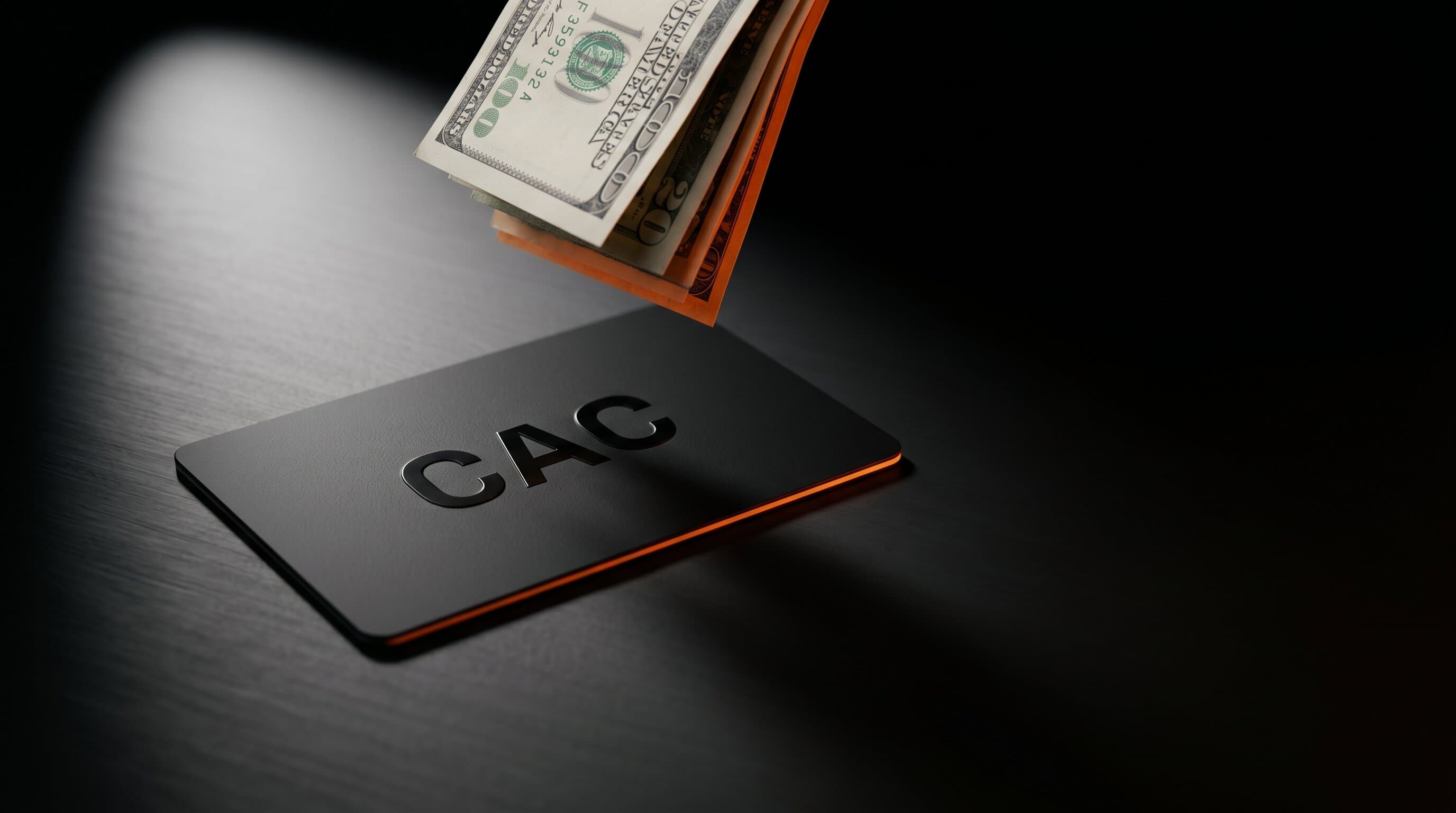
Phone with a glowing orange creator audience ribbon flowing in from the right while crumpled dollar bills sit in shadow on the left, illustrating the gap between paid acquisition and free creator audience CAC
CAC alone tells you nothing. LTV alone tells you nothing. The ratio tells you everything.
LTV to CAC = What a customer is worth / What they cost to acquire
This single ratio decides whether you have a business or a hobby. Some examples:
ScenarioCACLTVRatioVerdict
Cold paid app, low retention$80$1201.5:1Unhealthy, will burn cash
Average consumer app$50$2004:1Healthy, scalable
Creator-led premium app$5$40080:1Printing money
Course launch (one-time sale)$40$1203:1Works once, then resets
A creator app at 80:1 is not a typo. When the audience is the channel, CAC drops to near zero, and any LTV above $50 becomes pure margin. This is why subscription apps built on creator audiences quietly compound past $1M ARR while VC-backed competitors spend $20M to get the same revenue. Three levers control CAC: 1. Use audiences you already own. Email lists, SMS lists, podcast audiences, YouTube subscribers, Instagram followers. Every owned channel costs zero to broadcast to and converts at 3 to 10x the rate of paid traffic. 2. Optimize the App Store. ASO is free CAC. An app ranking on page one for its category gets daily organic installs that bypass ads entirely. 3. Build features that create content. When users post results, leaderboards, and before-and-afters from your app, every share is a free ad. The app becomes a content machine, and the content drives more installs at zero marginal cost. The creators who hit $20K to $50K MRR fastest are not the ones with the biggest followings. They are the ones who turned their owned audience into the acquisition engine and kept CAC under $10 from day one. CPI (Cost Per Install) is the cost to get someone to download your app. CAC is the cost to convert that person into a paying customer. CAC is always higher because most installs never pay. A $5 CPI with a 10% trial-to-paid conversion produces a $50 CAC. Allocate the time and tools used for acquisition. If a creator spends 10 hours/month making app-related content, value that time at their hourly rate, add tool costs, and divide by new paying subscribers. Even when the answer rounds to "almost zero," running the calculation makes hidden costs visible. For consumer subscription apps, the goal is to recover CAC within 6 to 12 months of subscriber lifespan. Annual subscriptions usually pay back CAC immediately. Monthly plans take longer, which is why most apps push annual pricing hard during onboarding. Apple's privacy changes (App Tracking Transparency, SKAdNetwork) made paid attribution harder, which forced ad platforms to spend more impressions to find converting users. The trend has held steady since 2021 and is the single biggest reason organic and creator-led acquisition outperforms paid acquisition on a unit economics basis.
Your audience is the lowest CAC in software. Most creators never use it. Built by Foundry builds subscription apps for creators. $0 upfront, revenue share, three weeks to the App Store.
Let's Build →

Get Creator Revenue Insights

How creators are turning audiences into subscription businesses

You might also enjoy...

What Is CAC? Customer Acquisition Cost for Creators