
Platform Reviews

Kit vs beehiiv in 2026: 10,000 Free Subscribers or 2,500, and the Re-Subscribe Test

October 18, 2026
Share
Kit vs beehiiv in 2026: 10,000 Free Subscribers or 2,500, and the Re-Subscribe Test

Get Creator Revenue Insights

How creators are turning audiences into subscription businesses
Share
Key Takeaways:
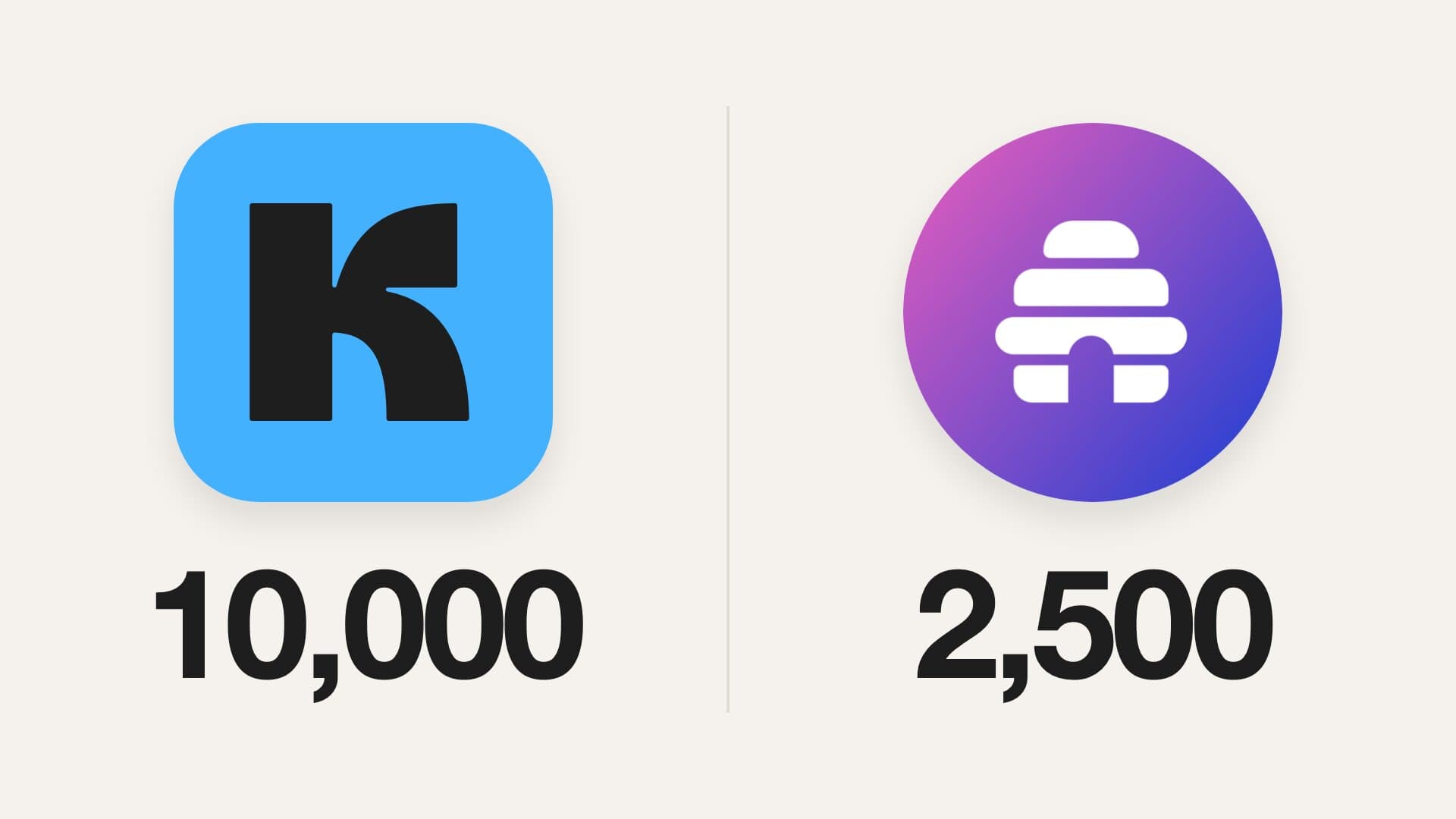
  • Kit's free plan carries 10,000 subscribers and can sell subscriptions. beehiiv's free plan stops at 2,500 and cannot take paid subscriptions at all; that starts on Lite at $49 a month billed yearly
  • Kit charges 3.5% + $0.30 per sale with card processing included, which Kit describes as a 0.6% cut. beehiiv takes 0% and you pay Stripe's 2.9% + $0.30
  • A newsletter with 8,000 readers and 200 paying $8 a month costs about $1,392 a year on Kit Free, $2,582 on Kit Creator and $2,705 on beehiiv Lite. At 75,000 readers and 1,500 paying, beehiiv Lite is about $1,900 a year cheaper
  • Kit's own beehiiv migration guide says paid subscriptions cannot move over conveniently: cancel them and ask readers to re-subscribe. Ask that question of any platform before your first paid reader
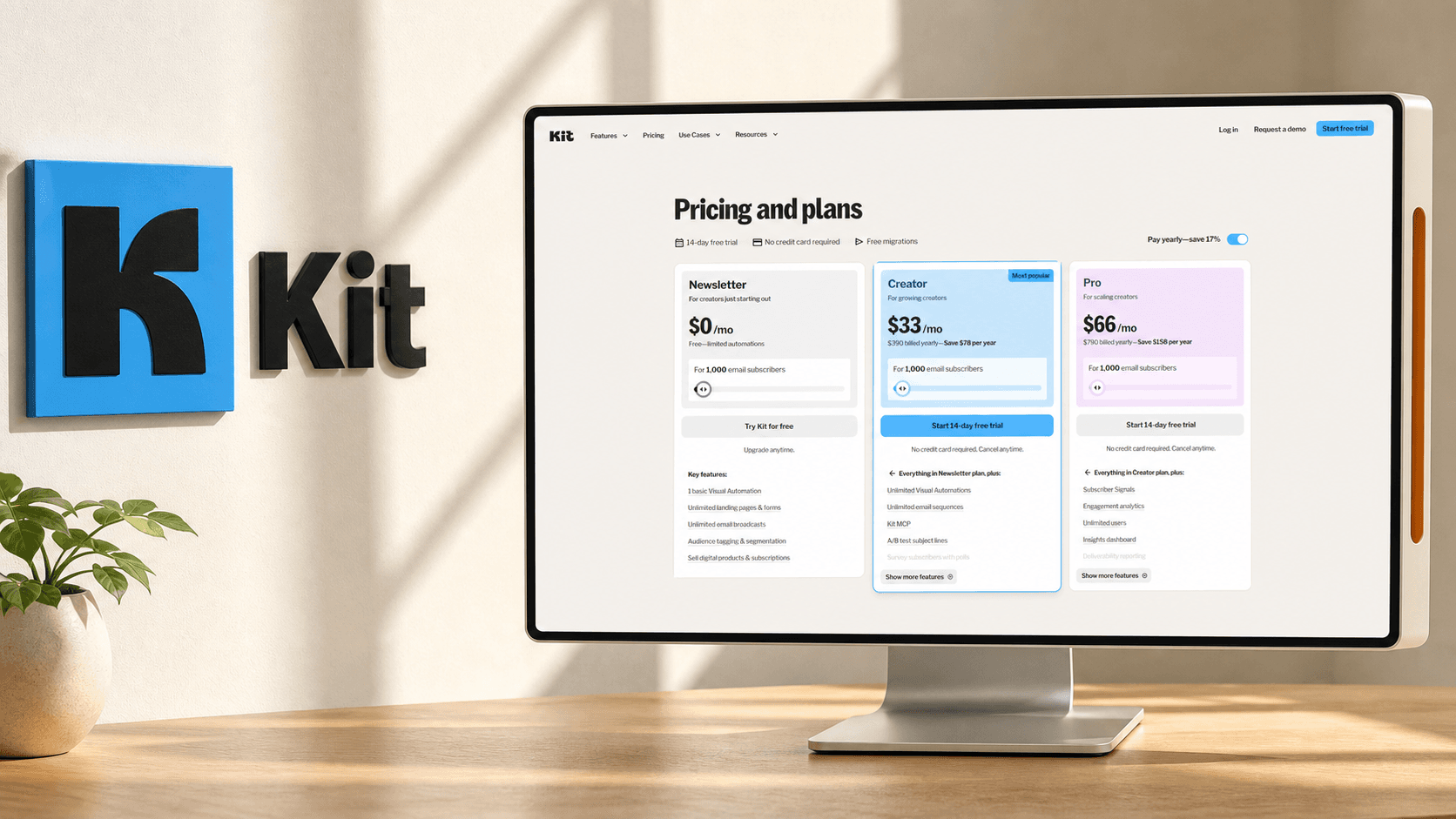
Kit and beehiiv are the two email platforms creators most often shortlist once a list gets serious. Their pricing pages are built to make opposite cases. Kit leads with a free plan that carries a large list. beehiiv leads with a 0% fee. Both are true, and which one is cheaper depends on two numbers you already know: how many people are on your list, and how many of them pay you. We read both live pricing pages on October 18, 2026, moved every subscriber slider, and opened the help-center articles each company links from its fine print. No account was run on either platform. Kit is cheaper below 10,000 subscribers, the two entry plans tie between 10,000 and 25,000, and beehiiv Lite is cheaper for large lists with many paying readers. The free plans are not close: Kit's carries four times as many subscribers and can sell.
TermKitbeehiiv
Free plan ceiling10,000 subscribers2,500 subscribers
Paid subscriptions on free planYesNo (Lite and up)
Entry paid plan, 1,000 subscribers, billed yearlyCreator, $33 a month ($390 a year)Lite, $49 a month
Same plan, billed monthly$39$59
Plan that removes the platform's brandingCreator ($33)Pro ($95)
Fee on each sale3.5% + $0.30, card processing included0%, plus Stripe's 2.9% + $0.30
Who holds the payment accountA Kit-managed Stripe Express accountA Stripe account connected to your publication
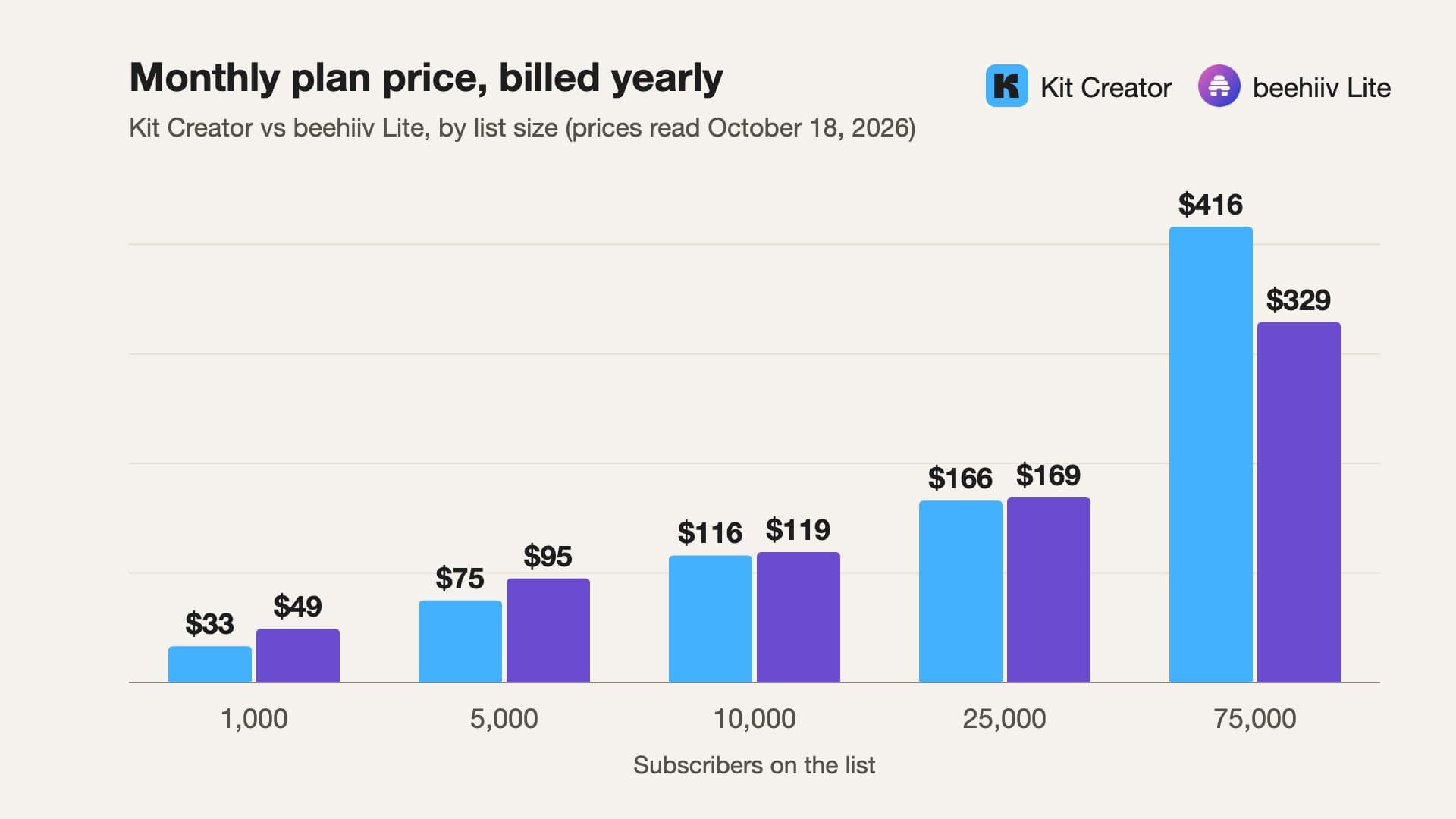
Sources: Kit pricing, beehiiv pricing, Kit's payments setup article and beehiiv's paid subscriber import article, all read October 18, 2026. Two details hide in that table. Kit's Pro plan currently shows a first-year discount (25% off, then the standard rate), so the numbers below use Kit's standard prices. And beehiiv's FAQ says yearly billing saves "up to 20%," while Kit's says 17%, so compare like billing with like. At 10,000 and 25,000 subscribers, Kit Creator and beehiiv Lite are within $3 a month of each other. Below that Kit is cheaper; at 75,000 beehiiv is. These are the five list sizes where both sliders stop, billed yearly, per month.
SubscribersKit FreeKit CreatorKit Probeehiiv Litebeehiiv Pro
1,000$0$33$66$49$95
5,000$0$75$116$95$169
10,000$0$116$158$119$199
25,000Not available$166$233$169$299
75,000Not available$416$553$329$499
Grouped bar chart of monthly plan price billed yearly at five list sizes: Kit Creator $33, $75, $116, $166 and $416 against beehiiv Lite $49, $95, $119, $169 and $329 at 1,000, 5,000, 10,000, 25,000 and 75,000 subscribers
The fair pairing depends on what you need. If you want your emails without the platform's logo, Kit gives you that on Creator and beehiiv only on Pro, which makes Kit cheaper by $62 to $133 a month at every size up to 25,000. beehiiv's own Kit comparison page prices 100,000 subscribers at $399 on beehiiv and $679 on Kit. Read closely: $679 is Kit's month-to-month price for its 105,000 tier, and $399 is beehiiv's yearly price. Billed the same way, it is $566 against $399 yearly, or $679 against $469 monthly. beehiiv still wins at that size, by less than its page shows. For a newsletter with 8,000 subscribers and 200 readers paying $8 a month, Kit Free costs about $1,392 a year and beehiiv Lite about $2,705. Plan price plus payment fees, billed yearly:
SetupPlan per yearFees per yearTotal per year
Kit Free$0$1,392$1,392
Kit Creator (8,000 tier)$1,190$1,392$2,582
beehiiv Lite (10,000 tier)$1,428$1,277$2,705
beehiiv Pro (10,000 tier)$2,388$1,277$3,665
The $1,600 a month in subscriptions is 200 payments. Kit's fee is 3.5% ($56) plus $60 in per-payment charges, so $116 a month. Stripe's on beehiiv is 2.9% ($46.40) plus the same $60. The $0.30 is identical on both and does more damage than either percentage at an $8 price, which is the same lesson our Kit review found for small products. One line to check on beehiiv: its FAQ names only Stripe's 2.9% + $0.30. Stripe's Billing pricing page lists 0.7% of Billing volume on pay-as-you-go accounts. Neither beehiiv page says whether that applies to your publication, so read the fee column on your first Stripe payout. If it does apply, beehiiv's per-payment cost is slightly higher than Kit's, and Kit wins every pairing at this size. beehiiv Lite wins once your list is large and your paid revenue is high, because 0.6% of a big number outgrows a small plan difference. The same $8 newsletter at 75,000 subscribers with 1,500 paying ($12,000 a month):
SetupPlan per yearFees per yearTotal per year
Kit Creator$4,990$10,440$15,430
beehiiv Lite$3,948$9,576$13,524
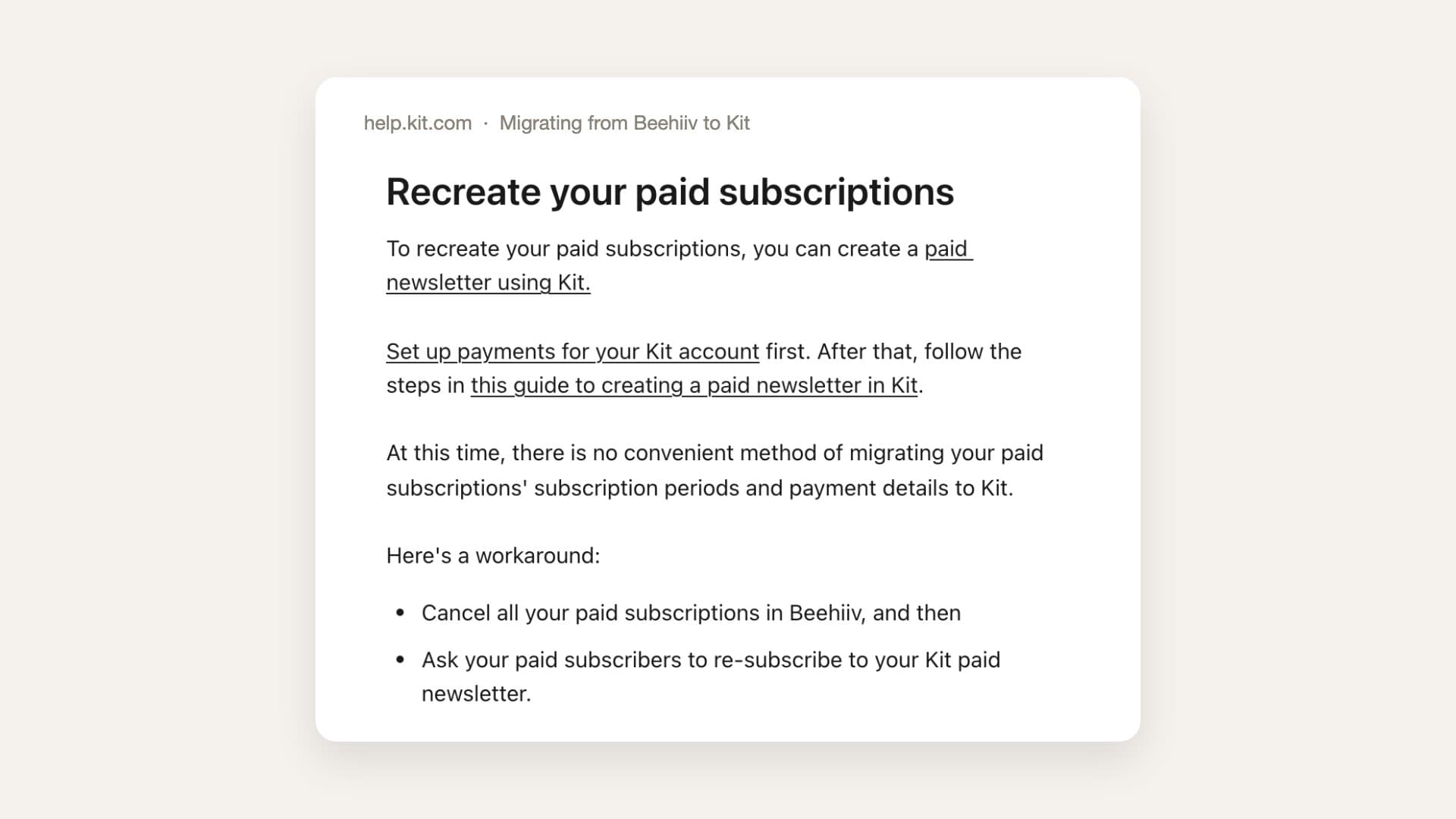
That is $1,906 a year in beehiiv's favor, or about $900 if Stripe's 0.7% Billing fee applies. At 10,000 and 25,000 subscribers, where the plans are $3 apart, beehiiv Lite pulls ahead once paid revenue passes about $500 a month (assuming no Billing fee). At 1,000 subscribers the line is about $2,700 a month, and at 5,000 about $3,300, because Kit's plan is $16 to $20 cheaper there. beehiiv also includes podcast hosting and multiple publications (three on Lite, ten on Pro), neither of which Kit offers. If you run more than one newsletter, that alone can settle it. Referral programs exist on both, but Kit's comes only with Pro, through a free SparkLoop plan. Price is what you pay to stay. The re-subscribe test asks what you pay to leave: if you switched platforms tomorrow, how many of your paying readers would have to type their card in again? Each answer here comes from the companies' own help pages. Kit's guide to migrating from beehiiv is direct: "At this time, there is no convenient method of migrating your paid subscriptions' subscription periods and payment details to Kit." Its workaround is to cancel every paid subscription in beehiiv and ask readers to re-subscribe, warning them first so the cancellation is not a shock.
Kit's help center article Migrating from Beehiiv to Kit, section Recreate your paid subscriptions, saying there is no convenient method of migrating paid subscriptions and recommending you cancel them in Beehiiv and ask subscribers to re-subscribe
Every reader you ask to re-subscribe is a reader who might not. That makes the person holding the card the question that matters before your first sale. Going the other way, beehiiv's comparison page answers "Can I transfer paid subscribers from Kit to beehiiv?" with "Yes. You can transfer premium subscriptions seamlessly." Its import tool, available on paid plans, keeps each reader's existing price and billing date. It asks for two things from the old Stripe account: its account ID and a restricted API key created under Developers, API Keys. Kit's native checkout, though, runs through "a separate Kit-managed Stripe Express account." Stripe's description of the Express Dashboard covers balances, payouts, payments, refunds, reports and settings, and does not mention API keys. We have not tested the move. If portability matters to you, get the answer from Kit support in writing before you build a paid tier there. Kit does offer a different route. Its Stripe app connects a Stripe account you already own, syncs existing subscriptions and tags paying readers, so a creator who bills from their own Stripe keeps the cards in their own account. That trades Kit's built-in checkout for portability. Our membership migration guide covers the other four tests worth running before a move. Kit Free has no automated email sequences, no visual automations and no way to remove Kit branding. beehiiv Free has no paid subscriptions, no automations, and a 30-day analytics window. Both include unlimited sends, landing pages and a recommendation network. The practical difference: on Kit Free you can charge readers from day one but cannot send a welcome sequence. On beehiiv Free you can sell digital products (its FAQ includes them on every plan) but not a subscription until you pay $49 a month. For a creator testing whether anyone will pay, Kit Free answers that question at no fixed cost.
  • Under 10,000 subscribers, testing a paid tier: Kit Free. Nothing else on either page lets you sell at $0 a month.
  • 5,000 to 25,000 subscribers, want a clean brand and sequences: Kit Creator. It is $62 to $133 a month cheaper than beehiiv Pro, the beehiiv plan that removes branding.
  • 50,000 or more subscribers, with paid revenue in the thousands: beehiiv Lite. The plan is cheaper and the 0% fee compounds.
  • Several newsletters or a podcast: beehiiv, for multiple publications and hosting.
  • Any size, if leaving later matters: whichever lets the cards sit in a Stripe account you control. Ask before the first sale, not after the thousandth.
If you are also weighing Substack or Ghost, our beehiiv vs Substack and Ghost vs Substack comparisons run the same math on revenue-share pricing. Kit and beehiiv both move a message from you to a reader and collect a payment for it. They are good at that. What neither builds is the thing a reader opens on a day you have not written: a workout plan that adjusts, a recipe planner, a practice tool built on what you teach. Built by Foundry builds that kind of business with creators: a subscription product, often an app, built in about three weeks for $0 upfront on a revenue share. The creator owns the business and the customer list, and App Store search brings in people who have never seen the newsletter. After launch we keep running and improving it, because our share depends on the product continuing to earn. The newsletter stays, and becomes the channel that tells readers what is new. Below 10,000 subscribers, Kit is usually cheaper, because its free plan carries 10,000 subscribers and can sell subscriptions. At 10,000 and 25,000, Kit Creator and beehiiv Lite are $3 a month apart, so payment fees decide. For large lists with high paid revenue, beehiiv Lite is cheaper: at 75,000 subscribers it costs $329 a month billed yearly against Kit Creator's $416, and it takes no cut of sales. No. beehiiv's pricing FAQ says it takes 0% of paid subscription and digital product revenue, and you pay Stripe's processing fee of 2.9% + $0.30 per transaction. Paid subscriptions require the Lite plan or higher, starting at $49 a month billed yearly for 1,000 subscribers. Kit charges 3.5% + $0.30 per transaction on every plan, including the free one. Kit's pricing page says the fee includes card processing, so its own share is 0.6%. Kit's Paid Recommendations carry a separate 23.5% fee. Not conveniently, according to Kit's own migration guide. It recommends canceling paid subscriptions in beehiiv and asking readers to re-subscribe to your Kit paid newsletter. Kit's Stripe app can instead sync subscriptions billed from a Stripe account you own. beehiiv says yes, and its import tool keeps each reader's price and billing date. The tool asks for the old Stripe account's ID and a restricted API key. Kit's built-in checkout runs on a Kit-managed Stripe Express account, so confirm with Kit support that you can provide those before relying on the move.
Our work

Creators who already did this

These are apps we designed, built, shipped, and still run today, with the creator keeping the code and the audience.

Liv Merima

Liv Merima

Founder & CEO of Claim It

Custom affirmations that help millions choose themselves.

Top Lifestyle App150K+ followers
Read the case study
Claim It screenshots
Brandon Whiteleather

Brandon Whiteleather

Founder & CEO of Freeze Dry Buddy

Freeze drying made foolproof, from a homesteader who's done it 1,000 times.

Top Food App1.4M+ followers
Read the case study
Kristen Donathan

Kristen Donathan

Founder & CEO of Stain Fix

Snap a stain. Get the fix in seconds.

Top Lifestyle App1.5M+ followers
Read the case study
Stain Fix screenshots

Creator app strategy

Curious what your app could be?

Enter your handle and BUILT BY FOUNDRY will research your audience and present custom app concepts. Free.

Kit vs beehiiv in 2026: 10,000 Free Subscribers or 2,500, and the Re-Subscribe Test