
Turning Knowledge into Products

Is Your App Niche Too Crowded? 12 Searches and 3 Numbers

August 31, 2026
Share
Is Your App Niche Too Crowded? 12 Searches and 3 Numbers

Get Creator Revenue Insights

How creators are turning audiences into subscription businesses
Share
An App Store niche is crowded when the top result for the phrase your audience would actually type already holds six figures of ratings, and it is open when the top result holds fewer than about a thousand. The number of apps in a category tells you almost nothing. The rating count on the first result tells you how much distribution a competitor has already banked, and that is the only thing a creator has to beat. Key takeaways:
  • Ratings are the score of a distribution race that has been running for years. A leader with 100 ratings has not won that race yet.
  • The test takes five minutes and one URL. Anyone can rerun it and get the same answer.
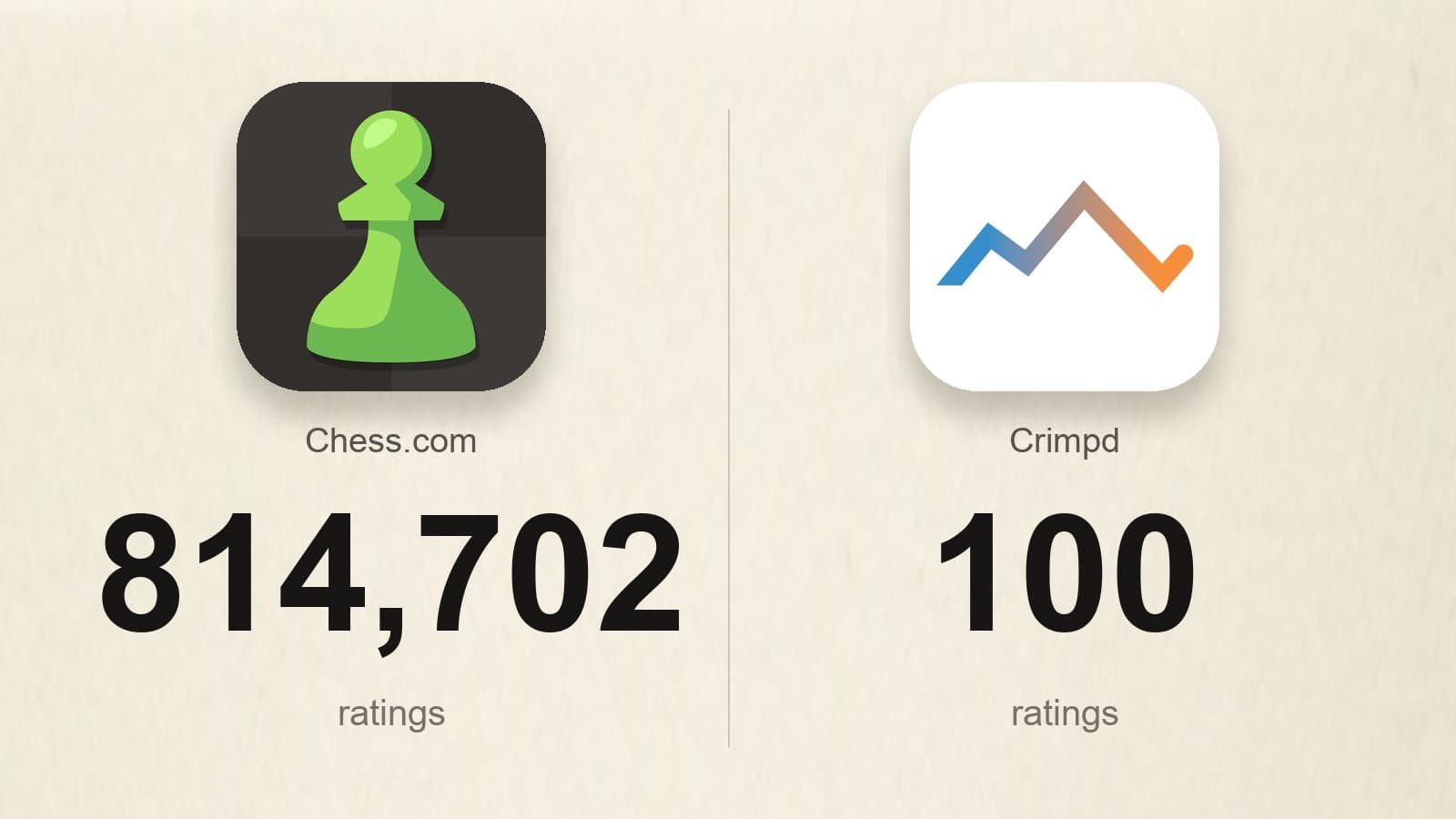
  • Searching "chess" returns a leader with 814,702 ratings. Searching "climbing training" returns a leader with 100.
  • Broad topic words are crowded. The specific practice your audience performs on a schedule usually is not.
  • An empty search result proves nobody has built it. It does not prove anyone wants it, which is a separate test.
Every creator who has ever considered building a product has hit the same wall. You search the App Store for your subject, you see a screen full of apps, and you conclude the space is taken. That conclusion is usually wrong, because the screen is not showing you what you think it is showing you. Read three numbers on the top three results: the rating count, who publishes it, and whether the search phrase names a topic or a practice. Rating count measures accumulated downloads over an app's whole life. A publisher name tells you whether you are up against a funded company or one person. And the phrase itself decides the other two, because "chess" and "climbing training" are not the same kind of question even though both look like a niche. The mistake is counting apps. Apple returns dozens of results for almost anything, and a list of fifty apps feels like a closed market. But most of those apps have never been downloaded by anyone the searcher would recognize. What matters is the ceiling on the first screen, because that is the number your product has to climb toward before it appears above them. Ratings also decay upward only. An app cannot lose them. So a leader sitting at 100 ratings after several years on the store is telling you something specific and useful: nobody with real distribution has entered this space yet. Apple publishes a free, public Search API that returns the same results the store does, in a form you can read. No account, no tool, no signup.
  • Write down the exact phrase your audience would type. Not your category. The phrase.
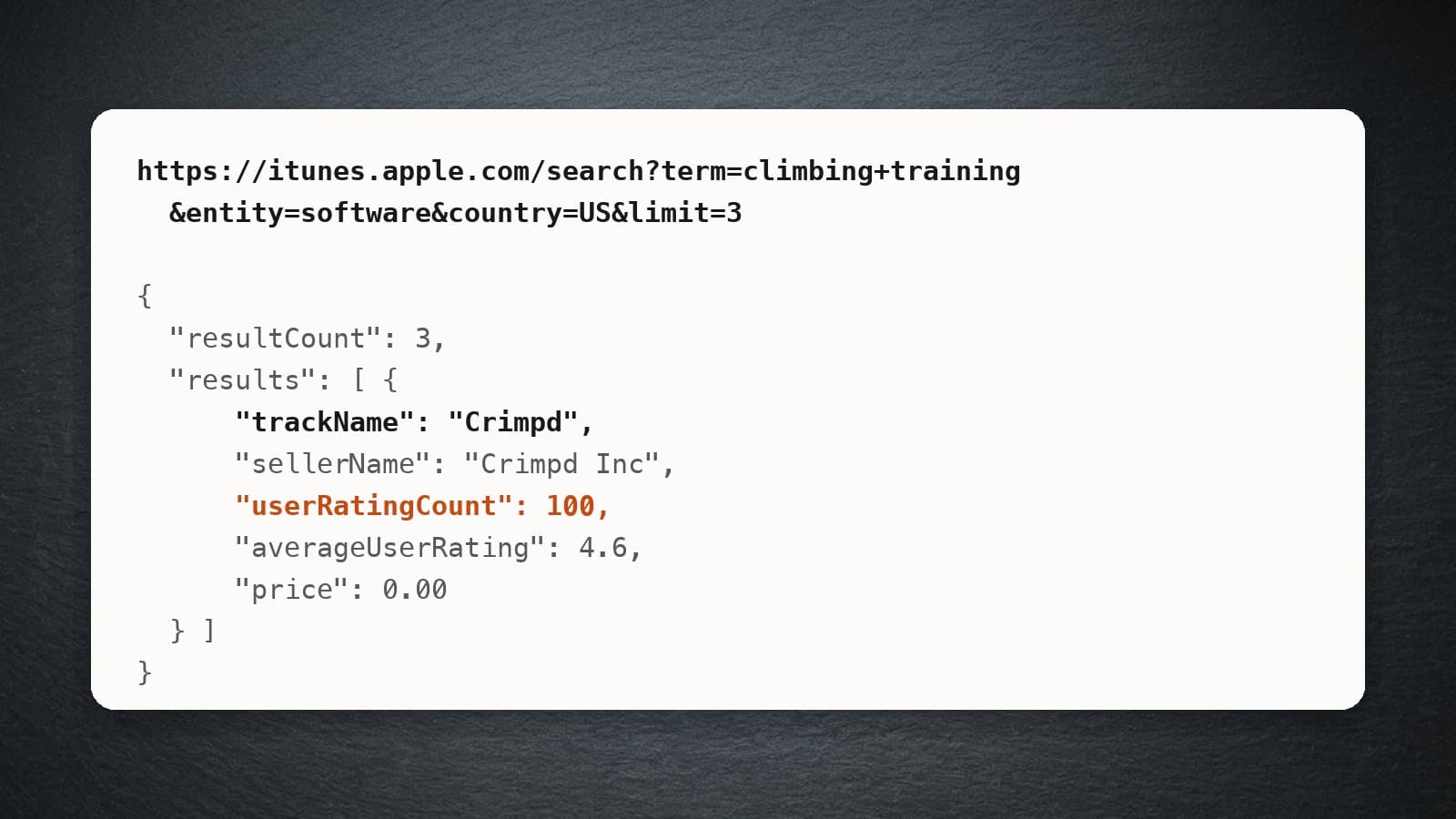
  • Paste https://itunes.apple.com/search?term=YOUR+PHRASE&entity=software&country=US&limit=5 into a browser, replacing the phrase.
  • Find userRatingCount and sellerName on the first three results.
  • Repeat with the two or three other phrases the same person might type instead.
  • Compare the top rating count against the thresholds in the next section.
Do this before you talk to a developer, price anything, or design a screen. It costs nothing and it will change what you build.
The public Apple Search API response for the climbing training query, showing the rating count field on the top result
Here is that test run against twelve phrases on 2026-08-31. Every number came from the API on the day this was published, and rerunning it will move them.
Search phraseTop resultPublisherRatings
language learningDuolingo: Language LessonsDuolingo, Inc5,413,215
meditationCalmCalm.com, Inc.1,977,371
chessChess.com - Play and LearnChess.com, LLC814,702
guitar practiceSimply GuitarSimply Ltd393,206
astrologyCo-Star Personalized AstrologyCo-Star Astrology Society205,605
birdingMerlin Bird ID by Cornell LabCornell University111,502
dog trainingWoofz - Puppy and Dog Trainingnove8 LTD55,518
knittingLoopsy - Crochet & KnittingSpringtown Labs Inc.15,018
woodworkingWoodSense: Wood Plans & GuidesNext Vision Limited11,012
sourdoughLoaflo: Sourdough StarterNo Worries Lifestyle, LLC483
fly fishingFly Fishing Simulator HDPaul Halter373
climbing trainingCrimpdCrimpd Inc100
A rating count measures how many people an app has reached over its entire lifetime, not how good it is. Apple prompts for ratings inside the app, so the number is roughly a function of installs multiplied by years on the store. It is a distribution scoreboard wearing a quality costume. That distinction is the whole point for a creator. Chess.com has 814,702 ratings because it spent seventeen years acquiring players, not because a better chess app is impossible. Nobody with an audience is going to out-acquire it from a standing start. But Crimpd leads "climbing training" with 100 ratings. The second result, ClimbingCoach Training, has 53, and it is published by one named person. A climbing coach with 50,000 engaged followers can move more people into an app in a launch weekend than the current category leader has collected in years. That is not optimism, it is arithmetic. The number that looked like a wall is a head start of 100 people. The same read applies where the leader is large but foreign to the audience. "Dog training" is led by Woofz, published by nove8 LTD, at 55,518 ratings. That is a real competitor, and it is also a company no dog owner has ever heard of, run by nobody they trust. Trust is the asset a creator brings, and it is the one asset that number cannot buy. Any phrase whose top result holds fewer than roughly a thousand ratings is open, because a single creator launch can exceed it. Here is how to read your own result against the numbers above.
Top result ratingsWhat it meansWhat to do
Under 1,000Nobody has distribution here yetBuild; one launch to a real audience can pass the leader
1,000 to 25,000A real product exists, serving a general audienceBuild for one specific segment, not the whole query
25,000 to 250,000Funded competition with paid acquisitionOnly worth it if you own a named community inside it
Over 250,000A household brand owns the queryChange the phrase, not the plan
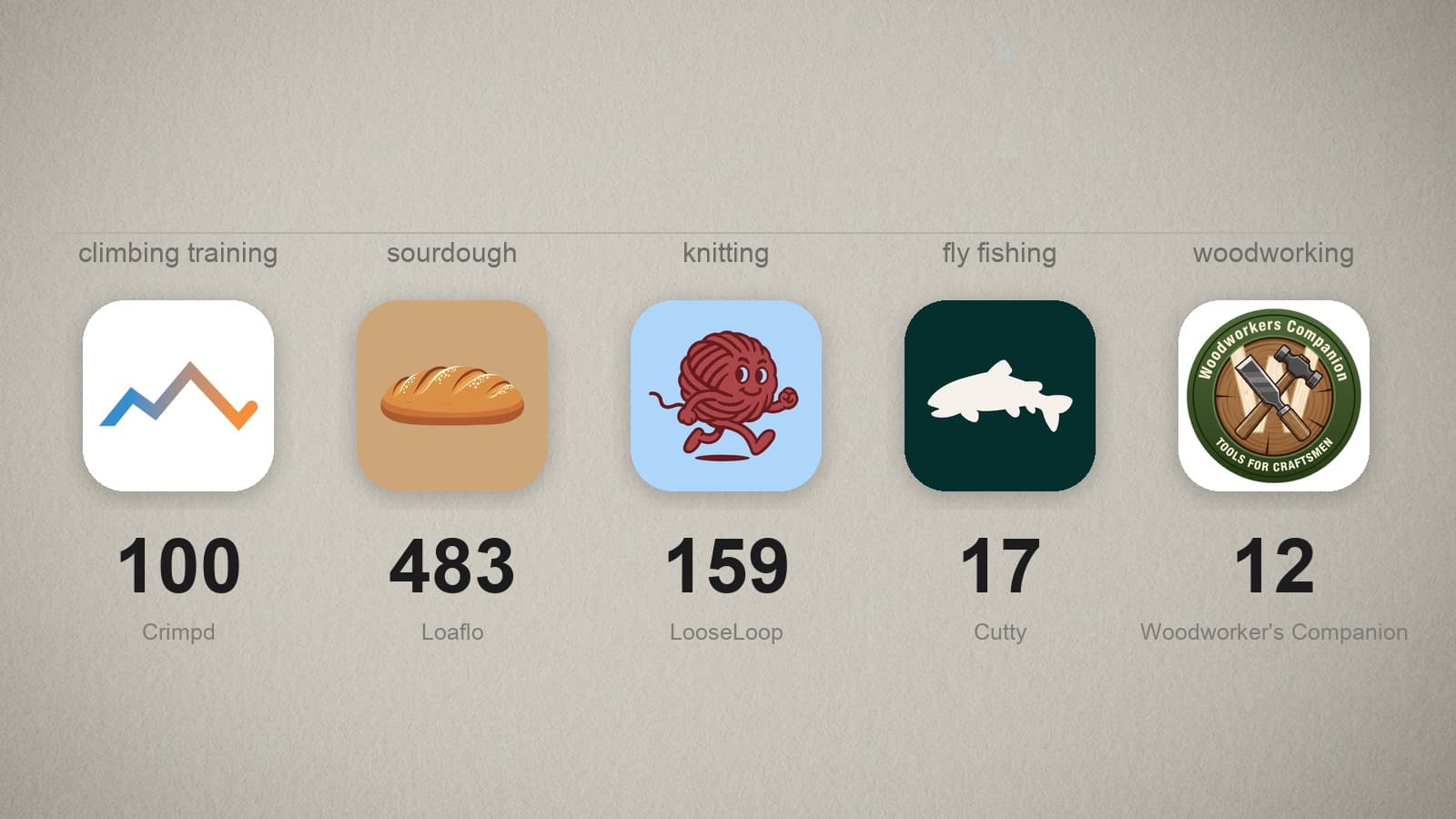
Notice that the bottom two rows of the earlier table are not obscure subjects. Sourdough baking, fly fishing, and climbing are large, obsessive, well-monetized hobbies with enormous creator audiences on YouTube and TikTok. The apps simply are not there yet. In woodworking, the top result is a plans library from an anonymous publisher, while the actual practice companion, The Woodworker's Companion, sits at 12 ratings. Knitting shows the same split: a general pattern library has 15,018 ratings, and LooseLoop - Craft Companion has 159.
Real App Store icons returned by five practice-niche searches, each labeled with its actual rating count
This is the pattern behind why niche creator apps beat big tech. Nobody at a large company will ever staff a product for hangboard protocols or starter feeding schedules. The market is too small for them and exactly the right size for one creator with a real audience. Emptiness has two causes, and only one of them is good news. Either nobody has built the product yet, or people have tried and there is no demand to find. The rating count cannot tell you which. A second test can. Ask how many times a year your audience performs the thing the product would serve. A sourdough baker feeds a starter daily. A climber trains on a schedule written weeks ahead. A fly angler checks conditions before every outing. Those are scheduled, repeating actions, which is what a subscription attaches to. Compare that with a search like "pottery," where the top results are games rather than tools, because throwing a pot is a studio activity that a phone cannot usefully sit inside. Then check whether money already moves. If your audience buys courses, plans, guides, or gear for this activity, the willingness to pay is proven and you are only changing the container. That combination, a scheduled action plus existing spend, is what creator-product fit actually means, and it is worth more than any search result. The rest of the pre-build work belongs to validating the idea against real behavior.
The public Apple Search API response for the climbing training query, showing the rating count field on the top result
If you have 50,000 engaged followers in a specific practice, run the test on the five phrases your audience uses, and take the one with the lowest top rating count where the activity happens weekly or more. That combination is your product, and it is usually not the broad word you would have picked. Not "fitness" but "hangboard training." Not "cooking" but "sourdough starter." Not "birding" but the county list your community argues about every spring. The general query is a war with a funded company. The specific practice is a room your audience already lives in, where the incumbent has 100 ratings and no relationship with anyone. What follows is worth being precise about. A product that sits inside a weekly practice earns money whether you posted this week or not, which is the difference between income and a paycheck you have to re-earn every month. It generates a constant stream of material, because every question a user asks inside it is a video. And it turns passive followers into daily participants while App Store search introduces the product to people who have never heard of you. CHANI, the astrology app, now sits at 57,998 ratings in a category led by Co-Star, which is what an audience-first product looks like a few years in. Every number in this post is a URL away, and every one of them will be different next year. That is the useful part: the test is not a claim you have to trust, it is an instrument you can point at your own subject this afternoon. Apple even publishes the downstream numbers, exposing retention, conversion, and proceeds in App Store Connect Analytics once the product ships. Run the five phrases. Find the one where the leader has 100 ratings. That number is not a warning, it is a vacancy, and it has your audience's name on it.
Our work

Creators who already did this

These are apps we designed, built, shipped, and still run today, with the creator keeping the code and the audience.

Creator app strategy

Curious what your app could be?

Enter your handle and BUILT BY FOUNDRY will research your audience and present custom app concepts. Free.

Is Your App Niche Too Crowded? 12 Searches and 3 Numbers