
Turning Knowledge into Products

What Is Creator-Product Fit? 5 Signals Your Audience Will Pay

August 27, 2026
Share
What Is Creator-Product Fit? 5 Signals Your Audience Will Pay

Get Creator Revenue Insights

How creators are turning audiences into subscription businesses
Share
Creator-product fit is evidence that a creator's audience has one repeated problem, wants that creator's method for solving it, and will pay for a product they can use without waiting for the next post. It is the bridge between “my followers liked the idea” and “customers use this every week.” Key takeaways:
  • Likes and comments show interest. Purchases, repeat use, and referrals show product fit.
  • The strongest product solves a problem the audience already tries to solve on a schedule.
  • A waitlist is weak evidence until people take a costly action such as paying a deposit, completing a detailed test, or returning several times.
  • The first version should prove one result for one segment. More features make a weak signal harder to read.
  • Creators should test demand before a three-week build, then measure activation, retention, and revenue after launch.
Creator-product fit is the match between a creator's trusted expertise, an audience's repeated problem, and a paid product that solves that problem often enough to support a business. All three parts matter. An audience without a problem produces applause. A problem without creator trust produces a commodity. A useful product without repeat use produces a launch spike. The phrase adapts product-market fit to a creator's unusual starting point. Most founders begin with a market they need to reach. A creator already has reach, language, and a public record of what the audience asks for. That advantage shortens discovery. It does not remove it. Y Combinator's guide to product-market fit warns founders against hiring, increasing spend, and optimizing before they know what customers want. Creators face the same trap with a different costume: a polished launch, a large email blast, and hundreds of comments can hide the fact that nobody returns in week two. Product-market fit asks whether a market pulls a product into growth. Creator-product fit asks an earlier and narrower question: does this audience want this creator's solution enough to pay and return?
TestCreator-product fitProduct-market fit
Starting assetTrust and direct audience accessA reachable market
Core questionWill this audience pay for this creator's method?Will the broader market keep pulling the product?
Early evidenceDeposits, completed tests, repeat useRetention, organic growth, expanding demand
Main riskConfusing attention with intentScaling before demand is durable
Next moveBuild the narrowest useful productExpand acquisition and operations
Creator-product fit can lead to product-market fit. A fitness creator may begin with a strength program for women returning after pregnancy, then discover that the product works for customers who never followed her. That is the moment the business starts acquiring people through its own reputation, search presence, referrals, and App Store discovery.
SignalEvidence to collectFalse positive to ignore
1. The same problem repeatsSimilar questions across posts, DMs, search, and sales callsOne viral comment thread
2. People already spendPurchases of a course, template, session, or adjacent tool“I would buy this” comments
3. The need has a scheduleDaily, weekly, seasonal, or event-driven useA problem solved once
4. The result is specificOne customer can describe the before and afterA broad promise such as “feel better”
5. Users return without a postRepeat sessions, saved progress, referrals, renewalsTraffic caused by launch-week promotion
The five signals work together. Existing purchases prove willingness to pay. A schedule creates the reason to return. A specific result gives the customer a reason to start. Unprompted return behavior proves the product has begun to stand on its own.
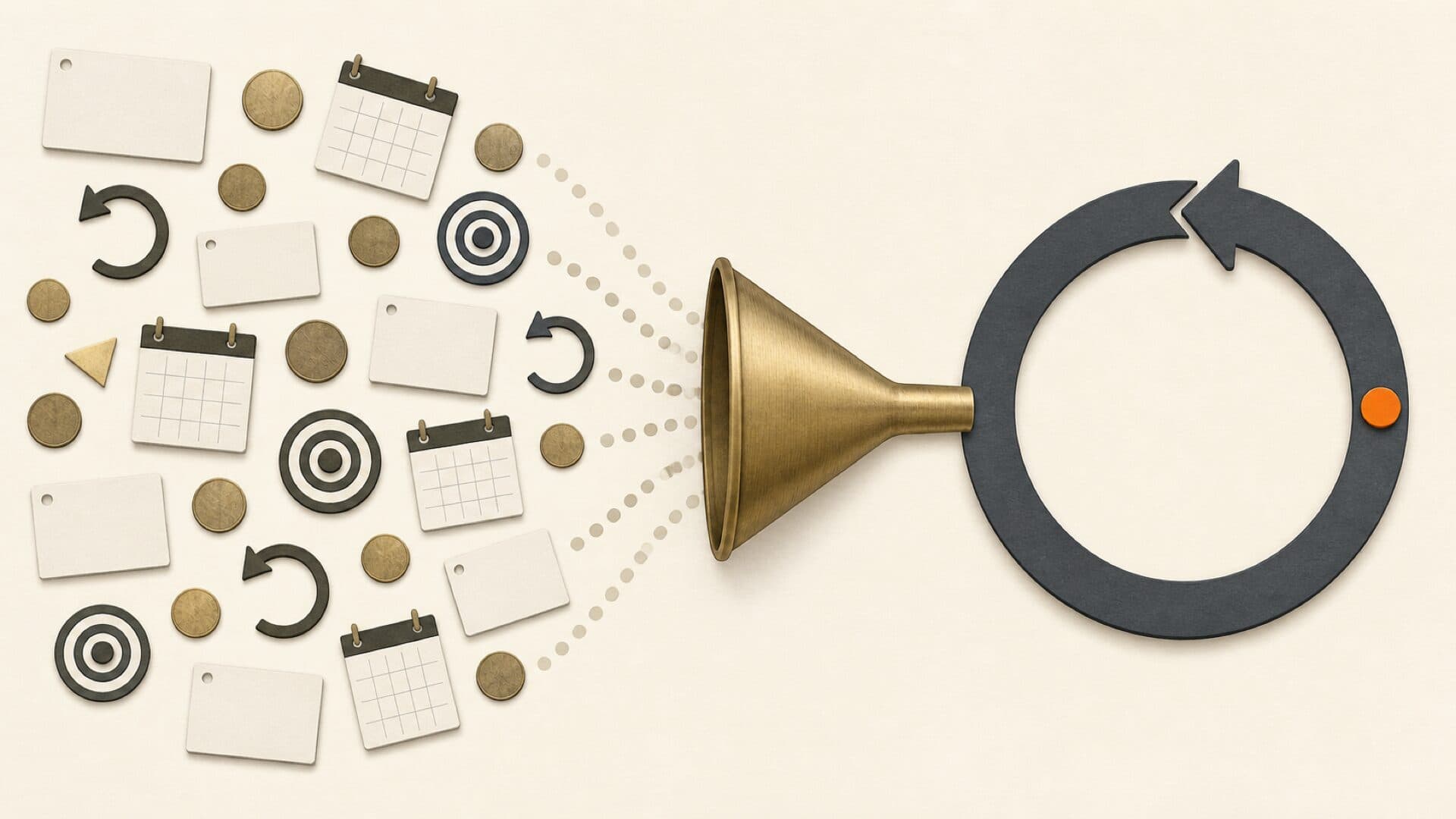
Five streams of audience evidence narrowing into one repeatable product loop
This is why a creator with 50,000 engaged followers can have a better business starting point than one with five million passive viewers. Engagement quality changes the subscription math, but only when a product converts that trust into customer behavior. Test the problem, the promise, and the payment separately before you test software. Start with 15 to 25 people from one recognizable audience segment. Ask about the last time they faced the problem, what they did, what it cost, and what happened. Past behavior is evidence. A prediction about a hypothetical product is courtesy. Then sell the smallest honest version of the result. That could be a paid workshop, a four-week cohort, a personalized plan, or a refundable deposit for a founding membership. Deliver it manually. Watch which step people repeat and which part they ask you to do again. The manual version is not the final business. It is an instrument. It tells you what the product must remember, calculate, sequence, or personalize when software takes over. It also creates real language for the product page because customers have already described the problem in their own words. Spend the first week finding the repeated problem and the second week asking people to act.
DayActionPass signal
1 to 2Pull 100 recent questions from comments, DMs, email replies, and supportOne problem appears in at least three channels
3 to 4Interview 10 people who faced it recentlySeven can describe a concrete failed workaround
5 to 6Write one result, one audience, one priceA stranger can repeat the promise accurately
7Invite 25 qualified followers into the testAt least 10 complete the application
8 to 12Deliver the result manuallyParticipants use it twice without a public reminder
13Ask for payment or a founding depositMoney changes hands
14Review objections and repeat behaviorYou know what the first product must do
These are decision thresholds for the sprint, not universal benchmarks. A high-priced professional product may need fewer customers. A $6.99 consumer subscription needs broader proof. The purpose is to force a decision before excitement becomes a build specification. Choose the smallest audience segment with the most frequent expensive problem. “Fitness followers” is too broad. “New mothers rebuilding strength in 20-minute sessions” gives you a person, a constraint, a schedule, and a result. Look at what already sells. A creator who moves meal plans every January has price evidence and seasonal intent. The opportunity may be a weekly planning product that turns a one-time PDF buyer into a customer all year. That creates recurring revenue, gives the creator a constant stream of customer questions and wins to post about, and lets the product acquire new customers through search and store discovery. The product should do something the feed cannot. It remembers progress. It adapts the next step. It makes the customer's work visible. It opens on the customer's schedule. That distinction is the difference between packaging content and building a business. Activation, retention, and paid conversion count as proof after launch. Downloads do not. User activation tells you whether a new customer reached the first useful result. Retention tells you whether the result was worth repeating. Monthly recurring revenue tells you whether enough people value it at the chosen price. Apple defines retention as the percentage of devices that use an app in the days after download and exposes retention, sessions, conversion, and proceeds in App Store Connect Analytics. Those are business signals because they record behavior after the promotional post has disappeared.
A volatile attention line feeding a steady calendar of returning paid customers
RevenueCat's State of Subscription Apps 2025 shows why plan design cannot rescue a weak habit. Six-month retention for weekly subscriptions was generally below 10% across categories, while annual plans held much more strongly. The lesson is not to force annual billing. It is to build enough recurring value that a longer commitment makes sense. Creator-product fit is visible before the interface exists. It lives in the question that appears every Tuesday, the workaround followers already pay for, and the result they want from this creator specifically. Once the product ships, the evidence gets harder and more useful. Customers activate, return, pay, and invite someone else. The product begins generating stories for the creator to share. New customers find the product without seeing the original launch. Revenue arrives on the customer's schedule instead of the feed's.

Creator app strategy

Curious what your app could be?

Enter your handle and Built by Foundry will research your audience and present custom app concepts. Free.

What Is Creator-Product Fit? 5 Signals Your Audience Will Pay