
Why Niche Creator Apps Are Beating Big Tech in 2026

Why Niche Creator Apps Are Beating Big Tech in 2026

Foundry
May 1, 2026
The most-downloaded fitness app of 2025 was not built by Apple. It was not built by Google, Nike, or Under Armour. It was built by a yoga teacher in Austin, Texas, who films videos in her living room. That sentence describes a real shift. In 2026, creators with deep niche audiences are out-shipping, out-ranking, and out-earning the polished apps that big tech keeps trying to push into wellness, fitness, finance, and faith. The App Store has quietly become a place where a 50,000-follower expert beats a billion-dollar product team. Key Takeaways:
  • Creator-led subscription apps are climbing App Store top charts in categories long owned by big tech, including fitness, mindfulness, and finance.
  • Niche apps win because they ship for a specific person with a specific problem, not a generic user persona.
  • Sweat sold to iFit for around $400M, Headspace and Calm each crossed $2B in valuation, and creator-built challengers are eating share underneath them.
  • App Store search and category browsing send creators users who never saw their content.
  • The 3-week, $0-upfront partnership model lets creators ship before a big-tech roadmap hits review.
A niche creator app is a subscription mobile product built by a single content creator (or a small partner team) that solves one specific problem for one specific audience the creator already serves. Yoga With Adriene's Find What Feels Good is one. Sweat was another before its acquisition. Critical Role's Beacon is a third. The pattern is consistent: a creator who already has trust in a vertical packages their daily method into a subscription app, then funnels existing fans through it while the App Store funnels strangers in from search. Big tech apps optimize for the average user. Niche creator apps optimize for one person, then duplicate them. That difference is now showing up in revenue and ratings. A few public proof points:
  • Kayla Itsines sold Sweat to iFit for a reported $400M after building it from a $70 PDF audience, per Business Insider.
  • Headspace and Calm both raised at multi-billion-dollar valuations, with Headspace Health hitting $3B in 2021 per CNBC and Calm reaching $2B per The Information.
  • Mike Israetel's RP Hypertrophy climbed to the top of the Health and Fitness paid charts on the back of a single YouTube channel.
These products were not the most beautiful, the most feature-rich, or the most marketed. They were the most specific. Three reasons, all structural. 1. Trust transfers, branding does not. When a fan downloads RP Hypertrophy, they are buying a year of Mike Israetel's voice in their pocket. When a stranger downloads a generic fitness app, they are buying a brand promise from a logo. The first one converts. The second one churns. 2. Reviews compound faster. A creator with 200,000 engaged followers can produce hundreds of five-star reviews in a week. App Store ranking algorithms reward review volume and recency. Big tech apps can buy installs, but they cannot buy a fanbase that already feels seen. 3. Niche keywords have less competition. "Hypertrophy training", "Dungeons and Dragons combat tracker", "Christian morning routine" are App Store searches that big tech does not bother to optimize for. Creator apps that map exactly to those phrases sit on top of the results page. We covered this in our App Store Optimization guide for creators.
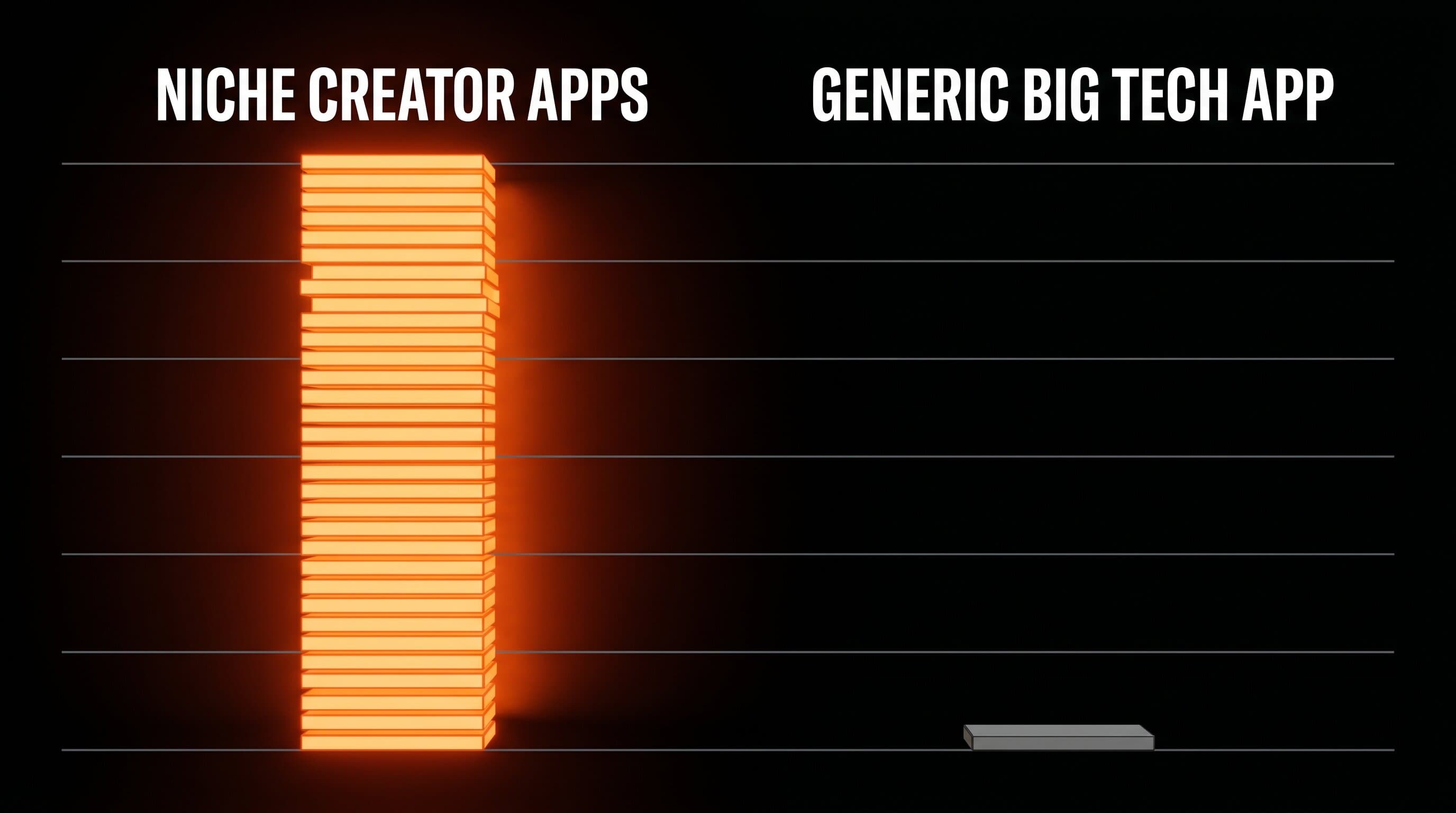
Niche creator apps stacked against generic competitors
The fastest-growing creator app categories in 2026 share one trait: a daily ritual that benefits from a phone. Wellness wins. Faith wins. Finance education wins. Hobby tracking wins. Generic productivity loses, because Notion already owns it. A few categories worth watching:
CategoryExample creator-led appWhy it works
Strength trainingRP HypertrophyDaily logging beats course PDFs
Yoga and mobilityFind What Feels GoodDaily video feed beats one-off videos
TTRPG and gamingCritical Role BeaconCommunity ritual beats merch drops
Nutrition coachingCarbon Diet CoachPersonalization beats generic plans
MindfulnessTen Percent HappierA specific voice beats a generic brand
We broke down many of these patterns in 8 niches where creator apps hit $1M ARR and in why fitness creators dominate the app economy. The numbers that get reported in press are the high end. The middle of the market is what matters for most creators. Public benchmarks worth anchoring on:
  • Kayla Itsines reportedly hit 450,000+ paying subscribers on Sweat before the iFit acquisition.
  • Adriene Mishler's Find What Feels Good charges roughly $13 per month and pulls from a 13M+ YouTube subscriber base.
  • Carbon by Layne Norton, profiled in our Carbon Diet Coach piece, runs on a recurring subscription model and grew on the back of a podcast and Instagram audience.
A reasonable expectation for a creator with 50,000 to 500,000 engaged followers: $20,000 to $250,000 in monthly recurring revenue inside the first 12 months, depending on niche, pricing, and retention. That is not a get-rich plan. It is a small, durable software business that earns whether the creator posts that day or not. Because it is a search engine for problems, not a feed for personalities. A creator's social audience is a megaphone. The App Store is a different funnel. People come there with a clear job in mind: "I need a workout app", "I want to learn guitar", "I want to track macros". They search, they read three reviews, they download. If the top result has a real human attached to it and 4.8 stars, that is the install. This is the engine our model bets on. We build the product. We submit it. We optimize the listing every week. The creator focuses on the part only they can do, which is being themselves. You can read more about how we run apps after launch. Less than they think.
  • A specific niche they have already proven on social.
  • A daily ritual their audience already does or wants to.
  • Willingness to point their existing audience at the App Store once.
  • A partner that handles the build, the launch, the App Store, the payments, the updates, and everything else.
The last one used to be the hard part. A custom app from an agency cost $100,000 to $300,000 and took nine months. A vibe-coded prototype shipped in a weekend, but it could not handle subscriptions, push notifications, or App Store Review. Both options failed creators. That gap is what changed. Three-week launches, zero up-front cost, revenue-share economics, and a real engineering team that owns the product forever is now a category. It is the reason a yoga teacher in Austin can out-ship a five-hundred-person product team in Cupertino. Long-term shift. The acquisitions and valuations started landing in 2018. The 2026 difference is that the cost and time to build dropped enough that mid-tier creators can play, not just the top 0.1%. 50,000 engaged followers in a clear niche is the practical floor. Creators with smaller audiences can win, but they need higher-than-average engagement and a willingness to pay for App Store ads early on. Big tech optimizes for the median user across all categories. A creator optimizes for one person in one category. In a niche, the second strategy wins on conversion, retention, and review velocity. A course is a one-time payment that ends. A subscription app is a daily habit and a monthly bill. The math compounds. We broke this down in 5 reasons creators choose apps over courses. A partner does. Foundry does this for creators on a revenue-share model. Read more about our model and team.
The next ten years of consumer software is being written by people with audiences. Big tech still has the budgets. It does not have the trust. In a category small enough to matter to one specific group of people, that is not a fair fight. Want to turn your expertise into an app? We build custom apps for creators, $0 upfront, three weeks to App Store, and we run the tech forever.
Let's Build →

Get Creator Revenue Insights

How creators are turning audiences into subscription businesses

You might also enjoy...

Why Niche Creator Apps Are Beating Big Tech in 2026