

Case Studies & Success Stories

Ian Sowden: $1.4M Raised, 141K Followers, 1 Thing Missing

August 18, 2026
Share
Ian Sowden: $1.4M Raised, 141K Followers, 1 Thing Missing

Get Creator Revenue Insights

How creators are turning audiences into subscription businesses
Share
Key Takeaways:
  • Ian Sowden's own site credits him with $3M+ shipped in creator launches across five years and an audience reach of 50M+ subscribers.
  • He worked the launch marketing on Veritasium's Elements of Truth board game, a Kickstarter that closed past $1.2 million from more than 11,500 backers against a $37,000 goal.
  • His site also credits him with a $60K per month Patreon rebuild for the World War Two channel and 10x merchandise growth for SolarBalls.
  • He now runs @ian.nyc.guide, a verified Instagram account with 141K followers, built as a licensed New York City sightseeing guide.
  • What that audience can buy is a private full-day walking tour, which is the one product on earth that cannot be sold twice at the same time.
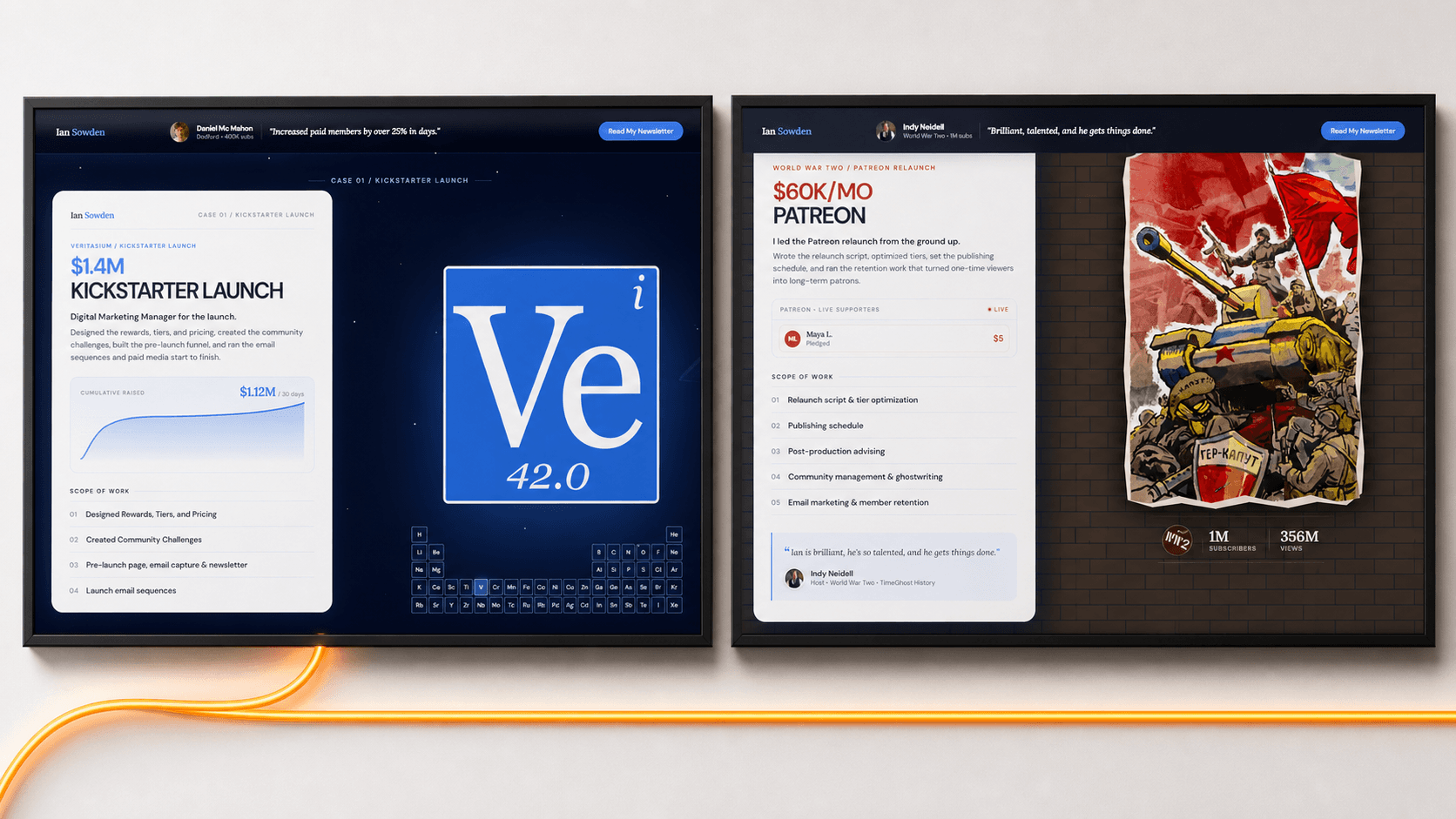
Ian Sowden knows more about turning attention into money than almost anyone reading this. He spent five years doing it professionally, for other people's channels, at a scale most creators never touch. Then he built an audience of his own, and the thing he sells it is a day of his life. Ian Sowden is a launch marketer for creator businesses who now runs a New York City tour guide account with 141K Instagram followers under the handle @ian.nyc.guide. His portfolio site lists the work: rewards and pricing design, pre-launch funnels, email sequences, paid media, merchandise sourcing, Shopify storefronts, fulfillment, and Patreon relaunches. The client roster runs through channels most people have watched without knowing it, including Veritasium, Fireship, Simple History, Mentour Pilot, and Astrum. The headline number on that site is $3M+ shipped in launches across 50M+ subscribers reached. The clearest public artifact of that work is Elements of Truth, the Veritasium tabletop trivia game. The campaign asked for $37,000. It closed past $1.2 million from more than 11,500 backers. Sowden's site calls it a $1.4M launch. That is what a great one-time launch looks like at the top of the market. Now hold it next to the other number on his site. Sowden's site credits him with a Patreon rebuild for the World War Two channel that runs at $60K per month. New tier architecture, publishing cadence, lifecycle flows. Do the arithmetic that nobody does out loud.
What it isWhat it producedWhat it does next year
Kickstarter campaignPast $1.2M in 32 daysNothing, unless you run another one
Patreon rebuild$60K per month$720K, then $720K again
The launch is the story people tell. The subscription is the business. A 32-day campaign that clears seven figures is a spectacular event with an end date, and the day it ends the channel is back where it started, needing another spectacular event. The $60K a month keeps arriving in a month where nobody launched anything. Sowden knows this. He built both. He put both on his own website. And that makes what he did next the most interesting career move in the creator economy right now.
Ian Sowden's portfolio showing a $1.4 million Kickstarter launch beside a $60,000-per-month Patreon business connected by a continuing orange line
He builds it fast, and then he sells the same thing every other expert sells, which is his time. The audience came quickly. His Instagram is verified, sits at 141K followers, and follows 57 accounts back. The bio is nine words long: "NYC Licensed Sightseeing Guide Message to Plan a Private Tour." The same content runs on his TikTok. The videos are Times Square, the Brooklyn Bridge, the Intrepid, how to read the subway, which skyscraper view is worth the money. It is very good content in a category with genuine, verifiable expertise underneath it. He holds an actual New York City sightseeing guide license. That is not a positioning claim, it is a test he passed. And the offer at the end of that funnel, at nyctours.store, is "Private full-day tours of downtown New York." Booking takes about two minutes. You can get a text from Ian. Because a full-day tour consumes a full day, and there are 365 of them, so the revenue ceiling is set by a calendar rather than by demand. Say the tours are excellent, which by every signal they are. Say he books 200 days a year, which would be brutal, and prices at $600 a day, which is strong for a private guide. That is $120,000, earned by walking twelve miles a day in July, and it goes to zero the week he gets the flu. Meanwhile 141,000 people follow him because they are planning a trip to New York, or they live there and still cannot name a good restaurant below Houston Street. Almost none of them will ever book a full-day private tour. They are not in New York yet. They cannot afford a private guide. They are going in eleven months. They just want to know which subway exit at Grand Central puts them on the right corner. That gap between what an audience wants and what a creator can physically deliver is where a subscription product lives. We wrote out the general shape of it in how to turn a coaching business into an app, and the mechanics of the revenue in what MRR actually means for creators. Look at what a licensed guide with 141K followers actually has. Not a content library. An operating system for a city.
What he hasWhat a tour sells it asWhat an app sells it as
Route knowledgeOne person's afternoonA self-guided walk anyone can start
Neighborhood picksA verbal recommendationA saved, filtered, offline map
Timing and crowdsAdvice given onceA notification at the right hour
The license and the credibilityTrust in a strangerTrust in the thing on the home screen
141K followersRoughly 200 bookable daysUnlimited simultaneous users
The last row is the whole argument. A tour serves one party at a time. An app serves everyone who has ever watched a video about the Brooklyn Bridge, including the ones who watched it in Manila at two in the morning and will visit in 2028. It also solves the problem every creator has at 5am, which is what to post today. A self-guided walking app produces its own material: which route people finish, which stop they all skip, what they search for at 11pm on a Friday. That is a month of content nobody had to invent. We laid out that loop in why creators are ditching merch for apps.
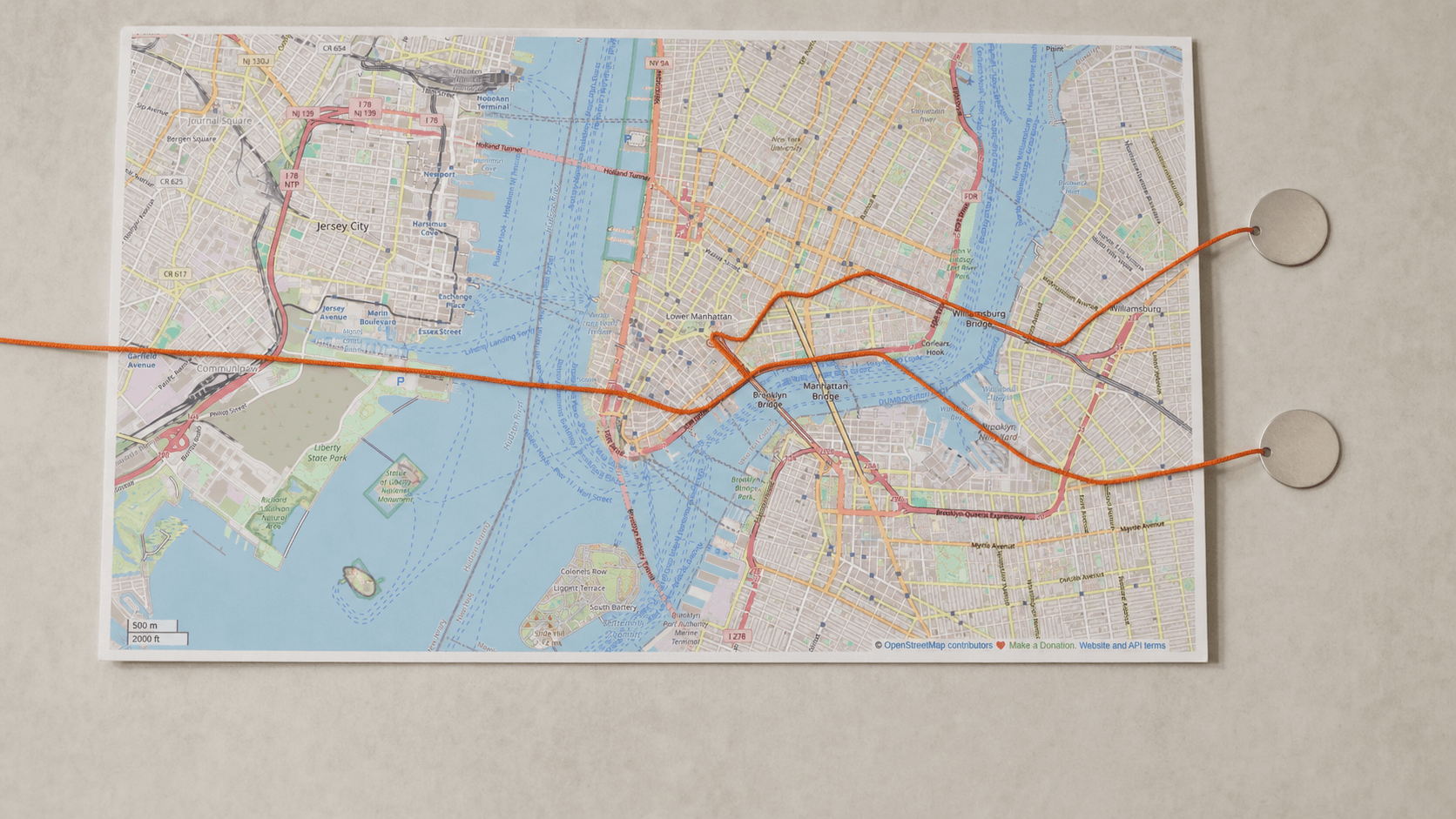
A real New York City street map branching along a burnt-orange route cord into two separate self-guided routes
This is not really a post about New York. If you are a licensed guide, a fishing captain, a sommelier, a trail runner who knows every route in your county, a chef who knows your city's food better than any list does, you are in Sowden's exact position. You have credentials that are hard to fake, an audience that outgrew your delivery capacity, and one product that requires you to be physically present. Your bookings are full and your income is a straight line, because a straight line is what you get when revenue equals hours times rate. The people who broke that pattern did not get more famous. They stopped selling hours. Six creator app niches quietly printing MRR covers where this has already worked, and why creators are leaving Patreon for apps covers what happens when the recurring product lives somewhere you do not control. BUILT BY FOUNDRY builds the whole thing in about three weeks: strategy, design, engineering, App Store launch, and the running of it afterward. Our about page explains the revenue share. App Care covers the part that quietly kills most creator apps, which is year two. 1. Build the audience by being useful in public. He did not tease a product for six months. He posted the actual information, constantly, in a niche where his license made him credible on sight. 141K followers arrived because the free thing was genuinely good. 2. A launch and a subscription are different species. Past $1.2 million in 32 days is a thrilling number that resets to zero. $60K a month is a boring number that compounds into $720K a year. If you can only build one, build the boring one. What ARR means is the vocabulary for it. 3. Nobody builds your software for you, which is why you default to selling time. This is the real lesson, and it is why even a professional monetizer ends up with a calendar-based product. Building an app has historically meant $80,000 and six months and a technical co-founder you do not have. Selling your Saturday requires none of that. The default wins because the alternative was expensive, and that is a solvable problem rather than a law of nature. Ian Sowden is a launch marketer for creator businesses and a licensed New York City sightseeing guide. His portfolio site credits him with $3M+ shipped in creator launches over five years, including work on Veritasium's Elements of Truth Kickstarter and a Patreon rebuild for the World War Two channel. He runs the Instagram account @ian.nyc.guide, which has 141K followers. The Elements of Truth campaign by Veritasium asked for $37,000 and closed past $1.2 million from more than 11,500 backers over a 32-day campaign. Ian Sowden's portfolio site describes it as a $1.4M launch and lists him on the launch marketing. Private full-day walking tours of downtown New York, booked through nyctours.store. The booking flow takes about two minutes and the site also offers a text message from Ian directly. It is a one-to-one service, which means his revenue is capped by the number of days in a year. Because a guided tour serves one party per day and an app serves every follower at once, including the ones who will not visit for another year. A self-guided routing and recommendation app converts the same expertise into recurring revenue that does not require the guide to be physically present, and its usage data becomes content the creator would otherwise have to invent.

Creator app strategy

Curious what your app could be?

Enter your handle and BUILT BY FOUNDRY will research your audience and present custom app concepts. Free.

Ian Sowden: $1.4M Raised, 141K Followers, 1 Thing Missing