

5 Reasons Creators Are Choosing Apps Over Courses in 2026

5 Reasons Creators Are Choosing Apps Over Courses in 2026

Foundry
April 26, 2026
The fastest way to lose creator revenue in 2026 is to build another course. The fastest way to compound it is to build an app. The data is no longer subtle, and the creators paying attention have already moved. Key Takeaways:
  • The creator economy is on track to clear $234 billion in 2026, with the subscription segment growing faster than any other revenue channel.
  • Average online course completion rates sit at 12% to 15%. Most buyers never finish what they paid for.
  • Subscription ecommerce averages 3.4% monthly churn, while one-time products lose 70-75% of customers year over year.
  • App Store search drives buyers who never saw the creator's content. Courses can't do that.
  • An app generates content for the creator daily. A course is a video the creator made once.
For a decade, the playbook was the same. Build a following, sell a course, repeat. That model is hitting a wall in 2026. Course completion rates are stuck. Refund rates are climbing. The "$10K launch" has stopped feeling like a win once you do the math on what it took to get there. Subscription apps are the alternative. Here's why creators with the most to lose are switching first. Online courses sell well. They don't get used. The average online course completion rate is 12% to 15%, and on platforms like Coursera and edX it sits between 5% and 15%. Most buyers never finish what they paid for. They never get the result. They never come back. That's a referral problem and a refund problem at the same time. Refunds spike when the buyer realizes nothing happened. Word of mouth dies when nobody can point to the result they got. The course earns once, then bleeds. Apps invert the math. A subscription app keeps a buyer engaged daily because daily engagement is the product. There's no "did you finish it?" question. The user opens it, uses it, sees a result, opens it again. The creator gets paid for retention, not for the sale. This is why a course buyer is a one-time customer and an app subscriber is an asset. We broke down the full math in App vs Course: The Revenue Math for Creators, and the gap compounds every month after the launch. Because one-time sales reset to zero. Recurring revenue compounds. Traditional ecommerce loses 70% to 75% of customers year over year. Subscription ecommerce averages 3.4% monthly churn. The best mobile subscription apps hold churn under 5% per month. That's the difference between a business that has to be re-launched every quarter and one that grows even when the creator is quiet. Look at the numbers stacked against each other. A creator who sells a $97 course to 1,000 customers in a launch makes $97,000. They have to do it again next quarter to repeat the number. A creator who has 1,000 paying app subscribers at $9.99 per month makes about $9,990 in month one and the same amount in month two and the same amount in month three. By month ten, the app has matched the course. By month twenty, it has doubled it. And the creator did not have to relaunch anything. That's the math creators are running in 2026. The course is a project. The app is a business. Here's the part most creators miss. A course lives on a sales page. The only people who see that sales page are people the creator already brought there. Email list, Instagram link in bio, a TikTok with a discount code. Course revenue is capped at the size of the audience the creator can keep paying attention. An app is searchable. The App Store and Google Play are the two largest paid distribution surfaces in the world for software, and they sort apps by rating, downloads, and category. A fitness app shows up when someone searches "home workouts." A nutrition app shows up when someone searches "macro tracker." A focus app shows up when someone searches "ADHD timer." The creator's name is not in any of those queries, and the user does not need to know the creator to start paying. This is the part of the creator value triangle that creators feel last. The app pulls in fans who never saw the creator's content. New customers find the product first and the creator second. Course funnels do not work this way. They never will.
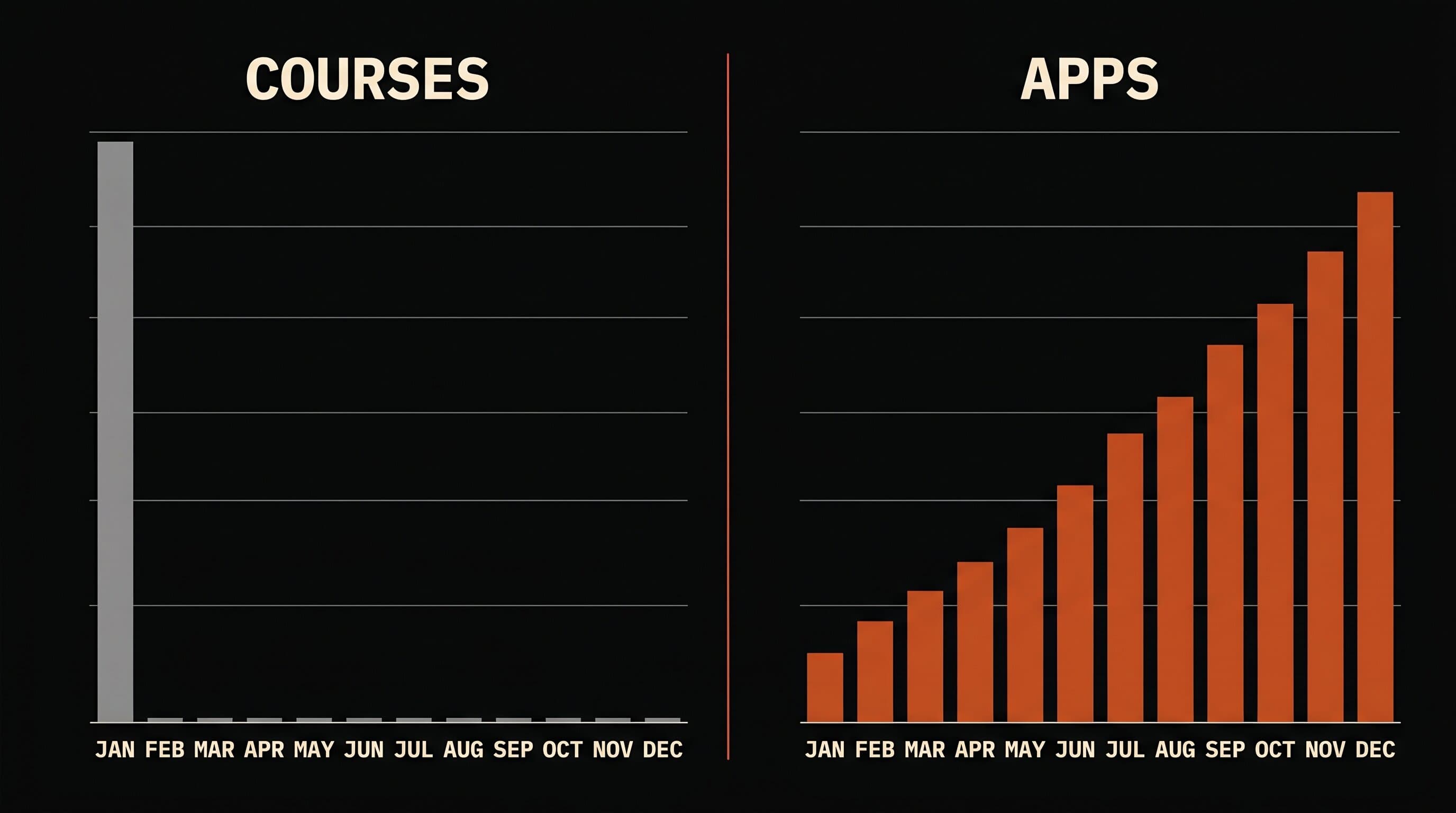
Side-by-side bar chart: courses earn one tall spike in January then drop to zero, while apps climb steadily month over month from January to December
Every action a user takes inside an app is content the creator did not have to brainstorm. A user submits a before-and-after photo. That's a transformation post. A user finishes a 30-day program. That's a milestone video. A user posts a question in the in-app community. That's the topic of next week's YouTube. A leaderboard refreshes. That's a weekly roundup. The app produces material faster than the creator can post it. This is the most underrated reason apps are winning in 2026. Creator burnout is a real, measurable problem, and the content treadmill is the structural cause. A course doesn't help with this. A course is a video the creator filmed once. It does not generate new ideas. It does not produce stories. It just sits there. Kayla Itsines figured this out a decade ago. Every Sweat user transformation became an Instagram post. Every challenge became a launch event. Every program drop became a content cycle. The Sweat app turned into a content engine that fed her social presence, which fed the app, which fed the social presence. She sold the business in a deal valued at around $400M. The course version of that business doesn't exist. The numbers from the analyst reports are blunt. The creator economy is projected to reach roughly $234 billion in 2026 and grow toward $500 billion by 2030. Inside that, the subscription segment is growing fastest. Goldman Sachs has called the broader market a $480 billion opportunity by 2027. Course platforms are still real businesses, but they're not where the new money is going. Why? Because the buyers have changed. The first wave of creator monetization was social-first audiences who'd buy whatever the creator dropped. The 2026 buyer wants daily utility, not a 10-hour curriculum. They want a tool that does something for them, not a video that explains how to do it themselves. Apps fit that demand. Courses don't. The shift is also a defensive one. Brand deal CPMs have softened. Platform algorithm shifts keep wiping out reach overnight. Creators who built audiences on TikTok are watching peers learn this lesson the hard way. We dug into the full math in Brand Deals vs Subscription Apps: Do the Math, and the punchline holds: a creator's worst month of MRR is more durable than their best brand deal.
DimensionOnline CourseSubscription App
Revenue patternOne-time paymentMonthly recurring
Average completion or engagement12% to 15% finishDaily/weekly active use
Customer churn70 to 75% lost year over year3 to 9% per month, top apps under 5%
Discovery channelCreator's audience onlyCreator's audience + App Store search
Content generationCreator must keep postingApp usage produces story material daily
Refund riskHigh, especially in first 14 daysLow, billing pauses on cancel
Build effortWeeks of filming and editingThree weeks with the right partner
No. Courses still work for creators with deep expert authority and a buying audience. They've stopped being the highest-ROI choice for most creators with 50K+ engaged followers. A course is a one-shot revenue event. An app is a business that earns every month. Most agencies charge $50K to $200K and take six to twelve months. Foundry charges $0 upfront and ships in three weeks under a revenue-share model. We earn when the creator earns. Usually the opposite. The app pulls in users who never bought the course because they wanted utility, not a curriculum. Many creators keep both running and let the app do the recurring revenue while the course handles deep-dive buyers. Around 50K engaged followers is the practical floor. Engagement matters more than raw count. An app with 1,000 paying subscribers at $9.99 per month is a $120K-a-year business, and that takes a small percentage of an engaged audience to reach. App Store search ranks apps by category, keywords, ratings, and download velocity. A well-optimized creator app earns installs from people typing in problem queries the app solves. Those users never saw the creator's content. They found the product first. The creator economy is moving from courses to apps because the math is moving. Recurring revenue compounds. One-time launches reset. Apps generate content. Courses sit on a server. The App Store finds new customers. Sales pages do not. The creators with the most to gain in 2026 are the ones who stop selling another launch and start owning a product. The window is open. It will not stay open forever. Want to turn your audience into a subscription business? Foundry builds, launches, and runs custom apps for creators. $0 upfront. Three weeks to App Store. Revenue share, so we win when you win.
Let's Build →

Get Creator Revenue Insights

How creators are turning audiences into subscription businesses

You might also enjoy...

5 Reasons Creators Are Choosing Apps Over Courses in 2026