
Case Studies & Success Stories

Hal Higdon Is 95 and Gives Away the Marathon Plan 1 Million Runners Used. He Charges for the Days They Miss

September 28, 2026
Share
Hal Higdon Is 95 and Gives Away the Marathon Plan 1 Million Runners Used. He Charges for the Days They Miss

Get Creator Revenue Insights

How creators are turning audiences into subscription businesses
Share
Key Takeaways:
  • Hal Higdon turned 95 on June 17, 2026. His family's tribute release says the Higdon running business now reaches more than 2.5 million runners a year, and all three of his children work in it
  • His most popular program, Novice 1, is an 18-week marathon schedule published free on his website. The page says more than a million runners have used his programs
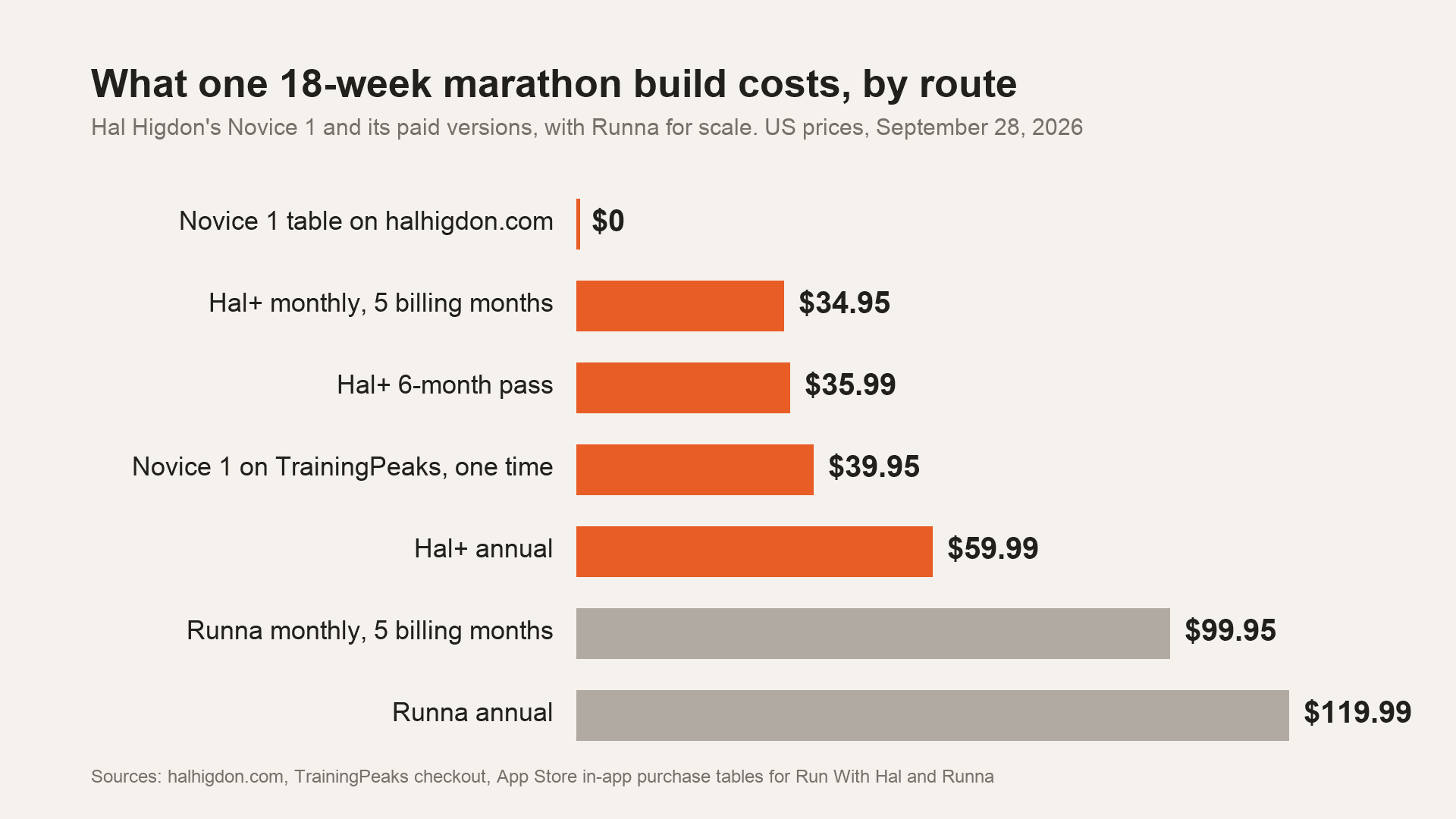
  • The same plan is sold three more ways: $39.95 once as an interactive TrainingPeaks plan, and inside the Run With Hal app as Hal+ at $6.99 a month, $35.99 for six months or $59.99 a year
  • The free table and the paid versions contain the same workouts. What the paid versions add is what happens when a runner misses a day, changes a race, or runs slower than planned
The Chicago Marathon is thirteen days away, on October 11. Hal Higdon's own marathon page says about 40 percent of Chicago's registrants are running their first marathon, and that word of mouth sends many of them to his Novice 1 schedule. He gave that schedule away decades ago and never took it back. He still made a business out of it, and the way he did is useful to any creator whose best work is already free. Hal Higdon is an American runner, writer and coach, born in Chicago on June 17, 1931, known for free marathon training schedules. He calls his Novice 1 plan arguably the most popular program used by first marathoners anywhere. He ran in eight U.S. Olympic Trials, finished fifth at the 1964 Boston Marathon in 2:21:55, helped found the Road Runners Club of America, and wrote Marathon: The Ultimate Training Guide. Wikipedia credits him with 34 books and a freelance career that began in 1959. He wrote for the magazine that became Runner's World from its second issue in 1966, and won four world masters championships. The New York Times profiled his plans in 2021, and his site now quotes it: "King of running plans." He posts as @higdonmarathon on Instagram, X and Facebook. The detail that matters here is in his family's June release: the business "now reaches more than 2.5 million runners annually," and consists of the website and the app. Novice 1 is an 18-week first-marathon schedule with four running days, one cross-training day and two rest days a week. The weekend long run builds from 6 miles in week 1 to 20 miles in week 15, followed by a three-week taper. The whole schedule is a free table on halhigdon.com. On his marathon page, Higdon says one runner told him at an expo she had used Novice 1 for 13 consecutive marathons. The program page shows a 4.8 rating from 52 reviews and says "more than a million runners have used Hal's programs with success." This is a creator's best work, given away in full, with nothing gated behind an email. His instructions on the same page include one sentence that sets up everything he sells: "You can skip an occasional workout, but do not cheat on the long runs." That is good coaching, but a printed table can't do anything about it. When you miss Tuesday, the table still says Wednesday. The free plan is the top of the funnel. The Novice 1 page itself offers two paid versions of the same program. The interactive plan. For more than ten years, according to his homepage, Higdon and TrainingPeaks have sold interactive versions of his plans that load onto a calendar and send daily instructions by email. TrainingPeaks' checkout listed "Hal Higdon: Marathon--Novice 1" at $39.95, one time, on September 28, 2026. The app. Run With Hal launched on the App Store in September 2019. Its listing showed 2,848 ratings at 4.67 stars and version 3.24.0 on September 28, 2026. The in-app purchase table lists Hal+ at $6.99 for one month, $35.99 for six months and $59.99 for a year. The Novice 1 page says the app is free to try for 14 days before an upgrade. The six-month tier stands out. An 18-week block is about four months, so a runner who starts a plan and races can cover the whole build with one purchase that costs less than the one-time TrainingPeaks version. It is priced to fit a training cycle.
Bar chart of what one 18-week marathon build costs by route: $0 for the free Novice 1 table, $34.95 for Hal+ monthly over 5 billing months, $35.99 for the Hal+ 6-month pass, $39.95 for Novice 1 on TrainingPeaks, $59.99 for Hal+ annual, $99.95 for Runna monthly over 5 months and $119.99 for Runna annual
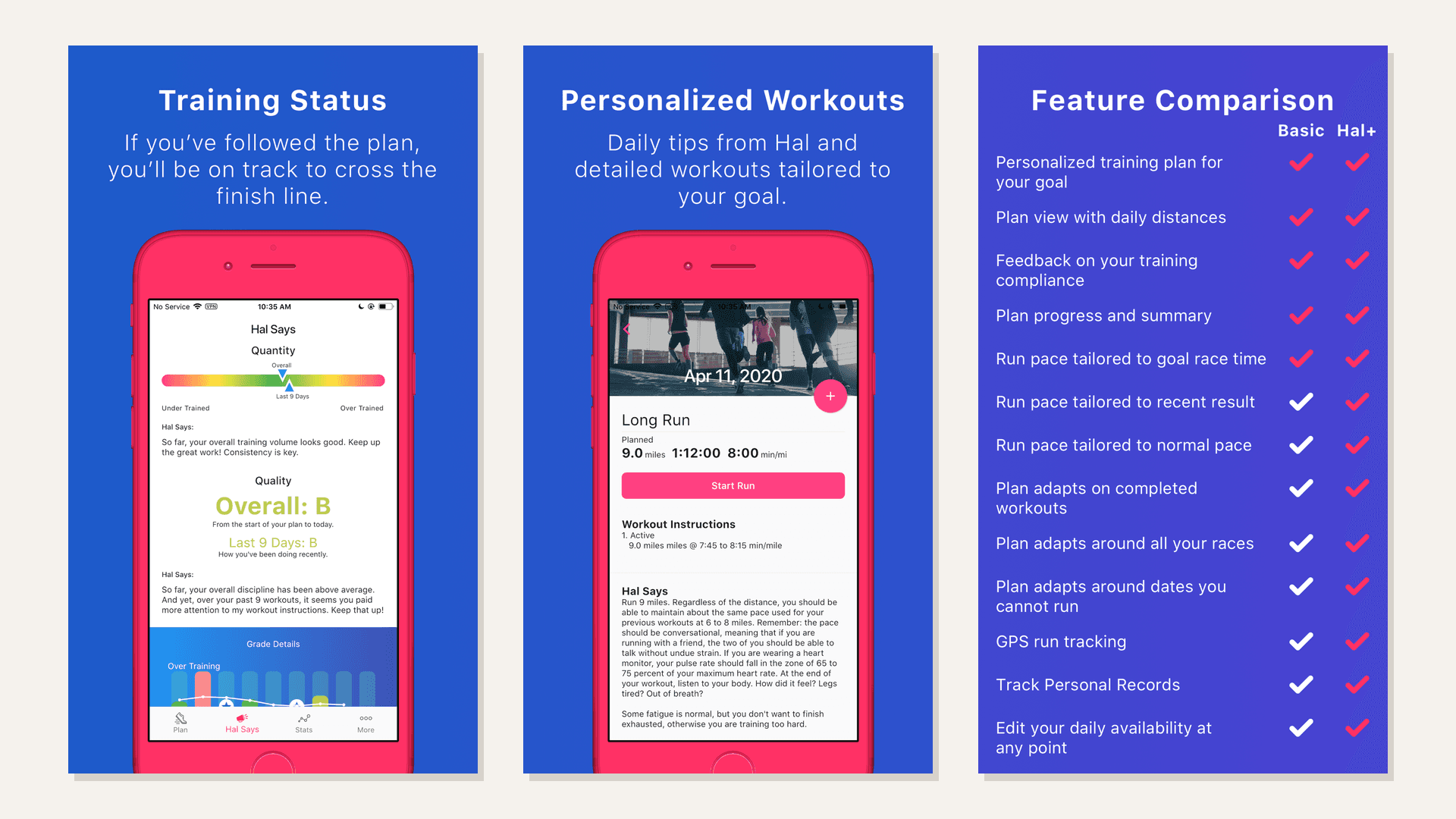
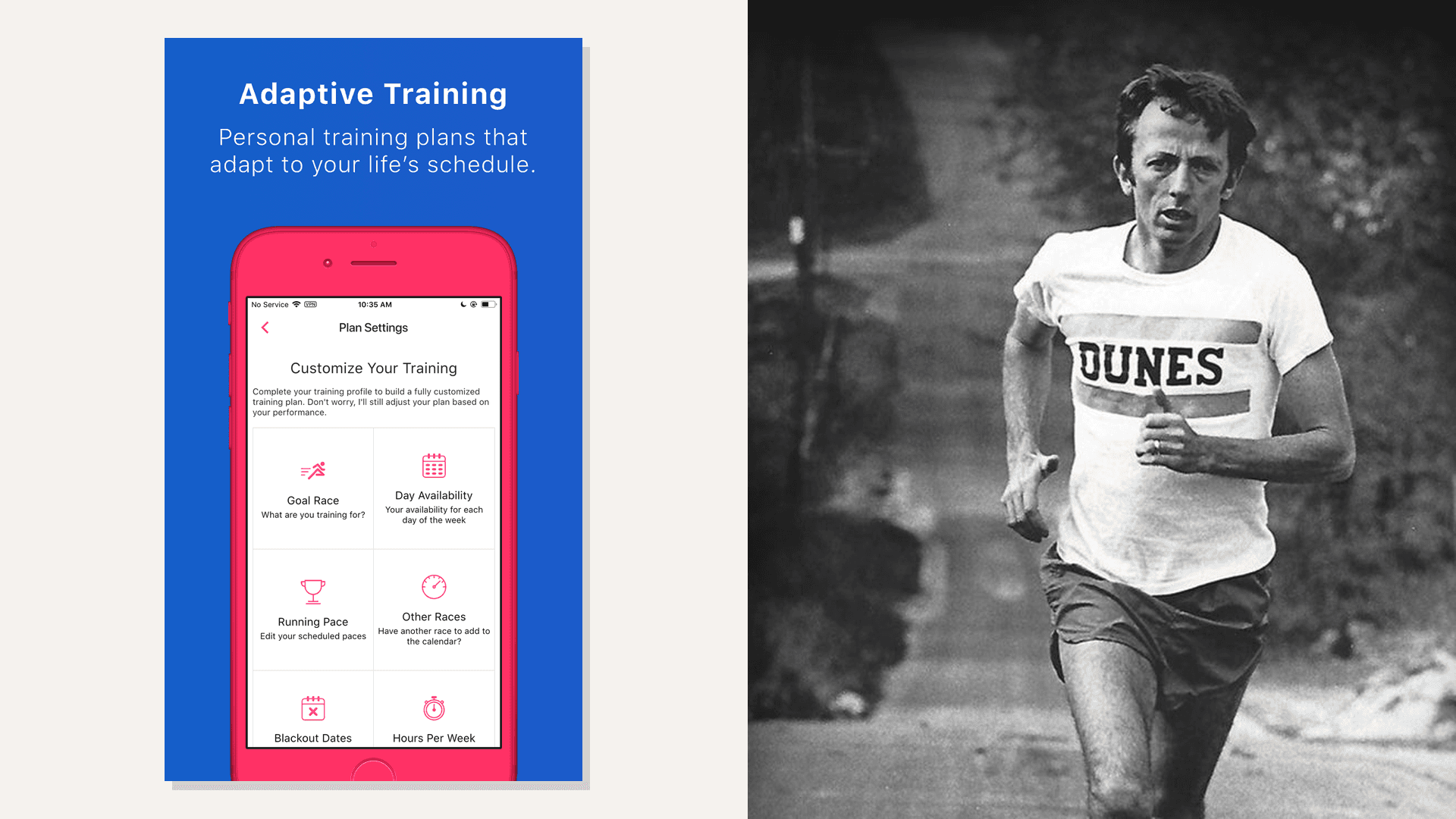
For scale, Runna, the adaptive running coach now listed under Strava Inc., charged $19.99 a month or $119.99 a year for Premium on the same date and showed 34,379 ratings. Hal+ is the paid tier of a product built around adaptation, not new workouts. Per halhigdon.com, Run With Hal updates workouts and pacing as a runner trains and lets them move workouts and set blackout dates. Hal+ adds personalized goals, multi-race training, GPS tracking and custom scheduling, and the Novice 1 page says to upgrade to Hal+ after 14 free days to fully customize the plan. The App Store screenshots make this concrete. A Plan Settings screen, captioned "Adaptive Training," asks for a goal race, availability by day, blackout dates and hours per week. A "Hal Says" panel grades the runner's consistency ("Overall: B"), and a long-run screen adds Hal's own coaching note. A Basic versus Hal+ feature table follows, and its lower rows are about change: "Plan adapts on completed workouts," "Plan adapts around all your races," "Plan adapts around dates you cannot run."
Three real App Store screenshots from Run With Hal: the Training Status screen grading the runner Overall B, a 9-mile long run with a Hal Says coaching note, and the Basic versus Hal+ feature comparison
The best evidence is a review his own team chose to feature on the app's web page: "I tend to be reluctant to pay for workout apps, especially when Hal's website has so many good free training programs." That reviewer paid anyway. We made a related argument in Heather Robertson's profile: free content doesn't cannibalize a paid product if the paid product does a different job. Higdon's catalog is the clearest example we have found, because the paid and free versions contain the same workouts. Here is the reusable part. Take the free thing your audience uses most and imagine the customer misses a day, gets injured, changes their date or falls behind. If your free version can't respond and the customer's outcome depends on responding, you have a paid product that doesn't compete with your free one. Higdon passes easily. A marathon plan has an immovable end date, and every missed run changes what the remaining weeks should hold. The same pressure shows up anywhere a program runs toward a date. Zak George's puppy training has a socialization window, exam prep has a test date, and a strength program has a meet. Creators whose advice holds on any day, like a recipe or a book review, fail the test, and that's fine. Their paid product will be something else. It also explains why the table stays free: it is how 2.5 million runners a year find him. Run With Hal launched in 2019 and showed 2,848 App Store ratings on September 28, 2026. Runna reached the App Store in December 2021 and showed 34,379. Rating counts are not user counts, but a gap that large, for a later entrant charging twice as much, says a famous plan did not automatically become the category's leading app. We can't see Run With Hal's revenue or downloads, and won't guess. The listing does show structure: the app is published under Peaksware, LLC, the company behind TrainingPeaks, and its current version, 3.24.0, dates to March 30, 2026. Licensing a method to a partner's product is a legitimate business, but it is not the same as owning and running the app. One pricing lesson is worth copying regardless. Beyond the general rules in annual versus monthly subscriptions and free trials versus paywalls: when your program has a natural length, sell a pass that matches it. If you're a running, triathlon, strength or exam-prep creator, your free plan is probably your best marketing. Keep it free, then ask what your audience does the morning they wake up behind schedule. If they open a spreadsheet or a competitor's app, that moment is your product. Building the adaptive plan is the easy part. The harder part is running it for years: plan logic, pricing, release cycles and support in the weeks before every big race. That is the business Built by Foundry is in, and running the product after launch is the part most creators underestimate. Dave Ramsey's company needed three builds of the same budget to get it right. Higdon describes the business as a family one, and at 95 he still signs off his birthday message with "Stride on!" The workouts have been free for decades. What runners pay for is a plan that adjusts when they miss a day.
See What We’d Build You →
Our work

Creators who already did this

These are apps we designed, built, shipped, and still run today, with the creator keeping the code and the audience.

Samantha Mae

Samantha Mae

Founder & CEO of NineLives

Cat health tracking from the world's most beloved Scottish Fold.

Top Health App150K+ followers
Read the case study
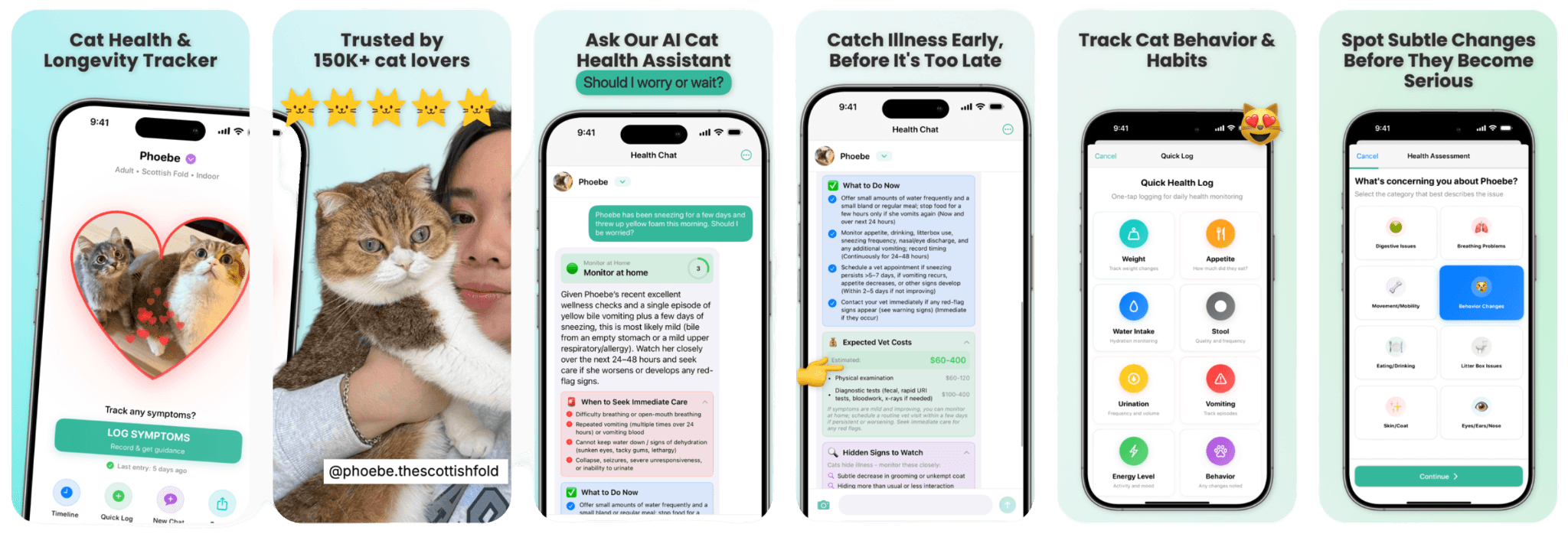
NineLives screenshots
Liv Merima

Liv Merima

Founder & CEO of Claim It

Custom affirmations that help millions choose themselves.

Top Lifestyle App150K+ followers
Read the case study
Claim It screenshots
Brandon Whiteleather

Brandon Whiteleather

Founder & CEO of Freeze Dry Buddy

Freeze drying made foolproof, from a homesteader who's done it 1,000 times.

Top Food App1.4M+ followers
Read the case study

Creator app strategy

Curious what your app could be?

Enter your handle and BUILT BY FOUNDRY will research your audience and present custom app concepts. Free.

Hal Higdon Is 95 and Gives Away the Marathon Plan 1 Million Runners Used. He Charges for the Days They Miss