

- The trigger is a material connection, not a payment. The FTC's Disclosures 101 for Social Media Influencers tells creators to disclose "any financial, employment, personal, or family relationship with a brand," and states that free or discounted product counts "even if you weren't asked to mention that product"
- Placement is a rule, not a preference. A disclosure "likely to be missed if they appear only on an ABOUT ME or profile page, at the end of posts or videos, or anywhere that requires a person to click MORE" does not count as made
- The words are prescribed too. "Advertisement," "ad," and "sponsored" are fine. "Sp," "spon," "collab," "thanks," and a standalone "ambassador" are named as too vague
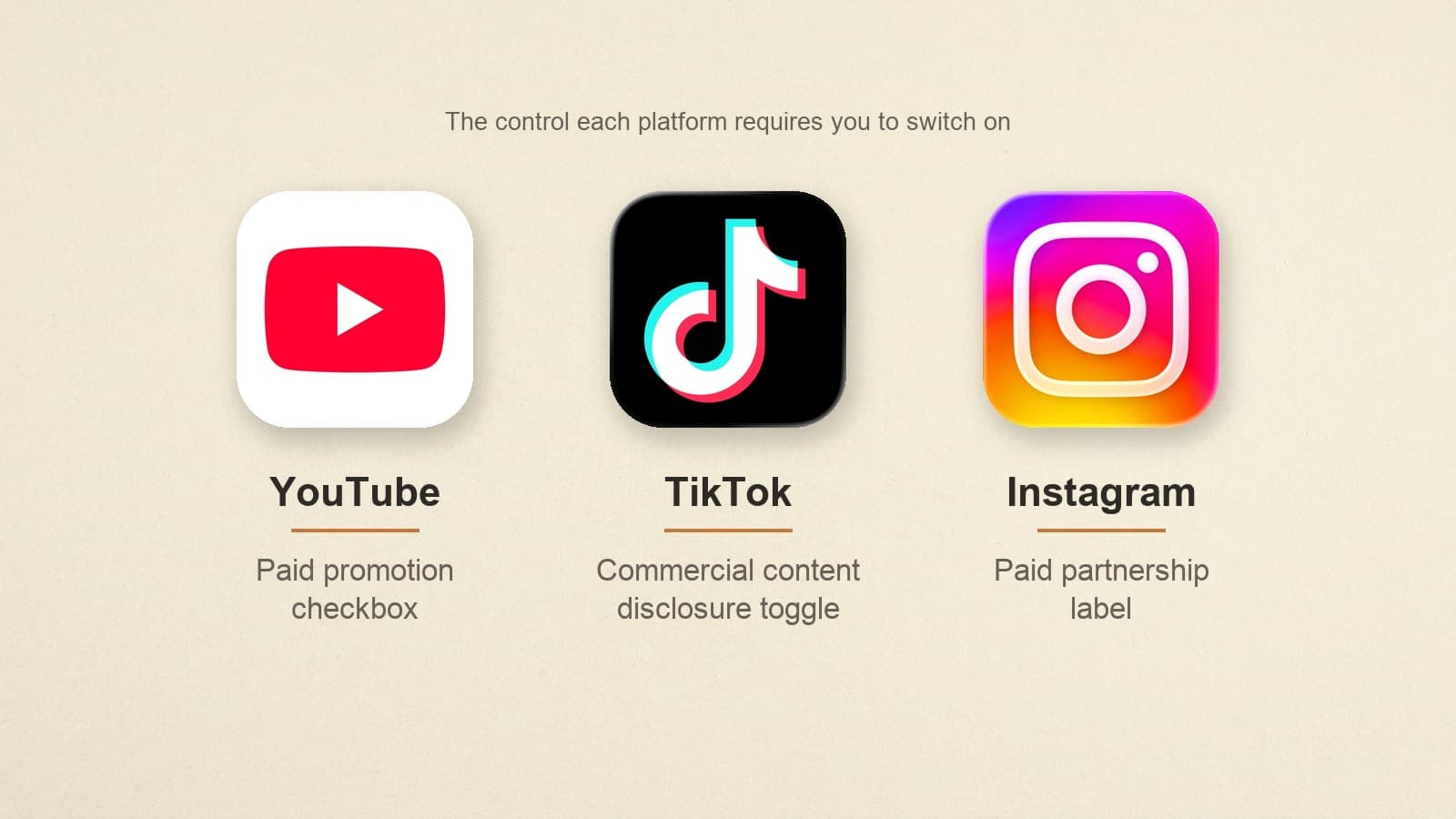
- Flipping the platform switch is a separate obligation from your own disclosure. YouTube has a paid promotion checkbox, TikTok has a commercial content disclosure toggle, Instagram has a paid partnership label, and YouTube's own policy says you and the brand remain responsible for the legal disclosure regardless
- Since October 21, 2024 this is a rule with teeth. 16 CFR Part 465 makes undisclosed insider endorsements a violation carrying civil penalties, currently $53,088 per violation
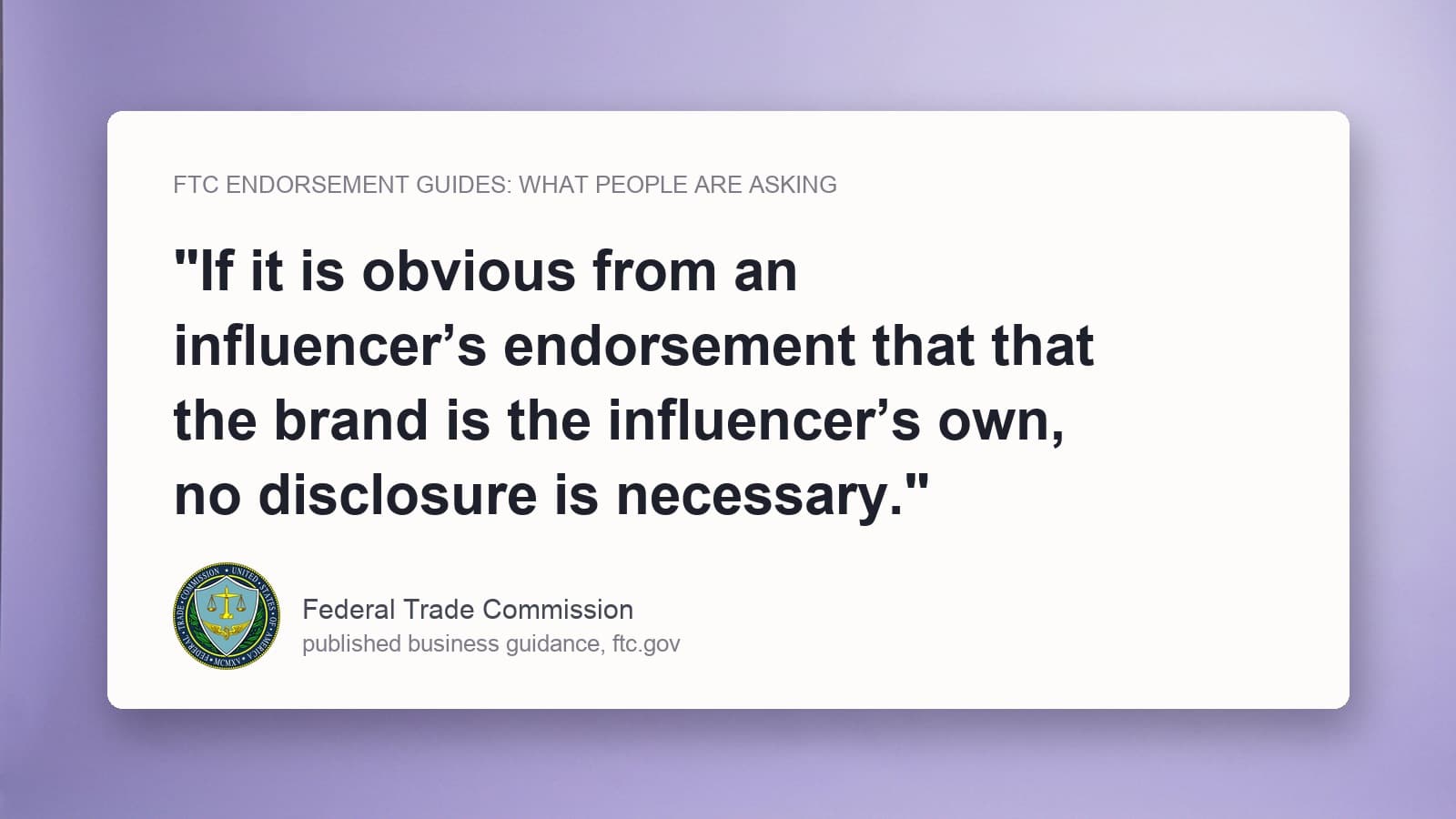
- The exemption is one sentence in the FTC's own FAQ: "If it is obvious from an influencer's endorsement that that the brand is the influencer's own, no disclosure is necessary." Every rule above is a rule about promoting somebody else's product
A creator emails their manager three times a year with a version of the same question. Do I actually have to put "#ad" on this one? It was gifted. It was a discount code. It was a friend's brand. It was a product I genuinely use.
The answer has been public for years, it is shorter than people expect, and it is written in plain English by the agency that enforces it. What has changed is the consequence. Until October 2024 the Federal Trade Commission's endorsement rules were guides, which the agency enforced case by case. They are now backed by a trade regulation rule that carries civil penalties per violation, and every major platform has built its own separate disclosure requirement on top.
This is the working version of the rules, checked against primary sources on September 5, 2026. Six of them govern a sponsored post. One sentence at the end describes the only situation the FTC says needs no disclosure at all, and that sentence is worth more to your business than the other six combined.
Do You Have to Disclose a Sponsorship?
The 6 Rules That Govern a Sponsored Post
| Rule | What it requires | Where it comes from |
|---|---|---|
| 1. Disclose any material connection | Financial, employment, personal, or family relationships, including free or discounted product and perks | FTC Disclosures 101 |
| 2. Put the disclosure with the endorsement | Not on a profile page, not at the end, not behind a MORE link | FTC Disclosures 101 |
| 3. Use words people understand | "Advertisement," "ad," "sponsored," or a plain sentence naming the brand and the freebie | FTC Disclosures 101 |
| 4. Do not bury it in hashtags | "Don't mix your disclosure into a group of hashtags or links" | FTC Disclosures 101 |
| 5. Remember that tags and likes are endorsements | "Tags, likes, pins, and similar ways of showing you like a brand or product can be endorsements" | FTC Disclosures 101 |
| 6. Flip the platform's own switch as well | YouTube paid promotion checkbox, TikTok commercial content disclosure toggle, Instagram paid partnership label | Platform policies |
What Do the Platforms Actually Require?
October 21, 2024: The Day the Guides Became a Rule
| What the rule covers | Status since October 21, 2024 |
|---|---|
| Fake or AI-generated reviews of a product nobody used | Prohibited |
| Reviews by employees, officers or managers with no disclosure | Prohibited |
| Payment conditioned on a positive or negative sentiment | Prohibited |
| Threatening a customer to remove a negative review | Prohibited |
| Buying followers, views or other fake influence indicators | Prohibited |
See What We’d Build You →
If You Are a Creator With 50K Followers and a Brand Deal Calendar
What Is the One Case That Needs No Disclosure?
The One Rule That Survives When the Product Is Yours
The disclosure rules are easy. Being the brand is the hard part, and it is the part that pays.
See What We’d Build You →