
Platform Reviews

Delphi Review 2026: 4 Tiers, $299 a Month, and 0 Ways to Charge Your Audience

September 11, 2026
Share
Delphi Review 2026: 4 Tiers, $299 a Month, and 0 Ways to Charge Your Audience

Get Creator Revenue Insights

How creators are turning audiences into subscription businesses
Share
Key Takeaways:
  • Delphi sells four tiers: Free at $0, Builder at $79 a month, Scaler at $299 a month, and Immortal at custom pricing, verified on the live pricing page on September 11, 2026
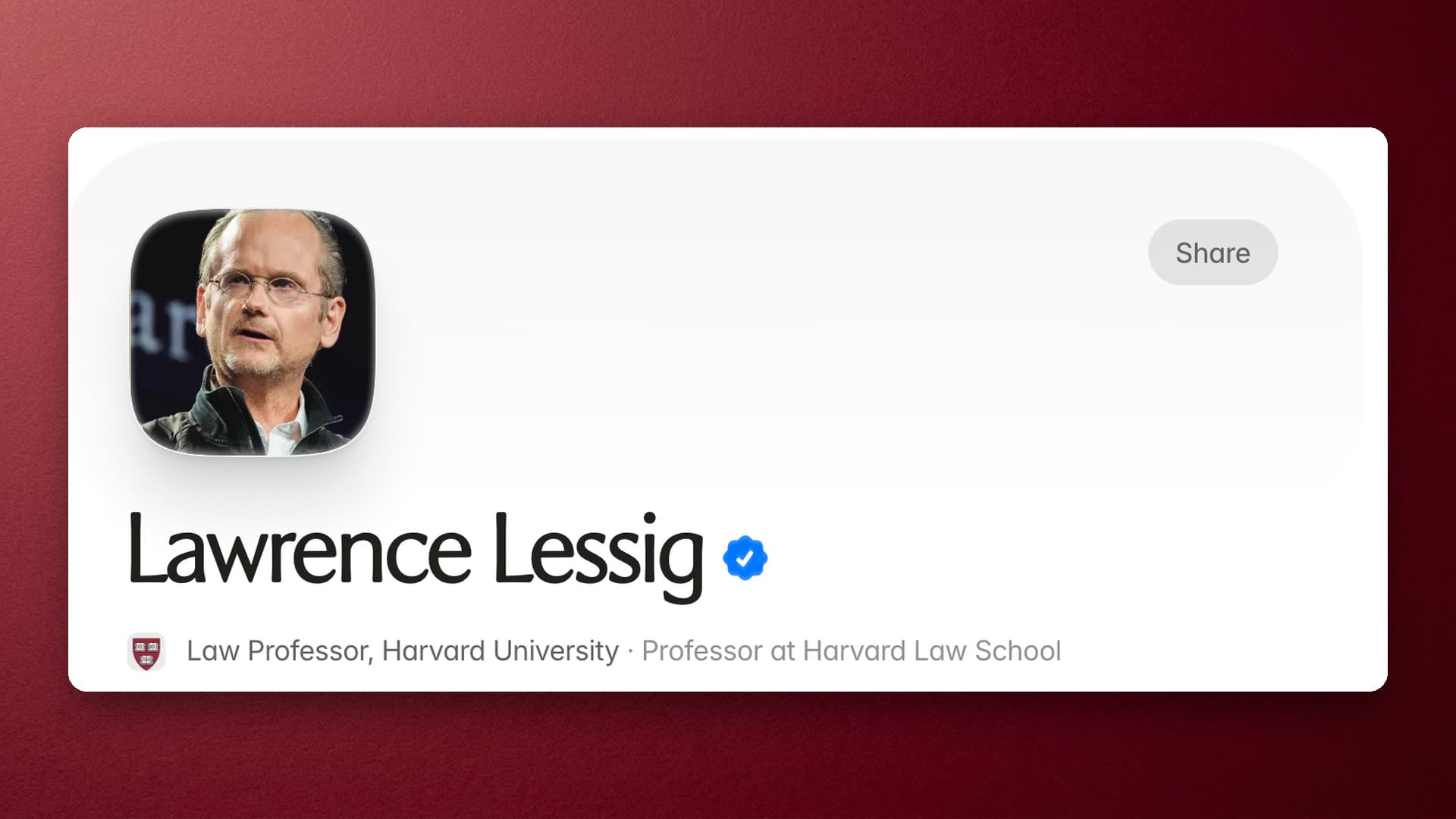
  • The product is real and it is good at its job. Lawrence Lessig, Dr. Mark Hyman, Eckhart Tolle, Karamo Brown, and Matthew Hussey all have public Digital Minds, and Delphi raised a $16M Series A led by Sequoia Capital in June 2025
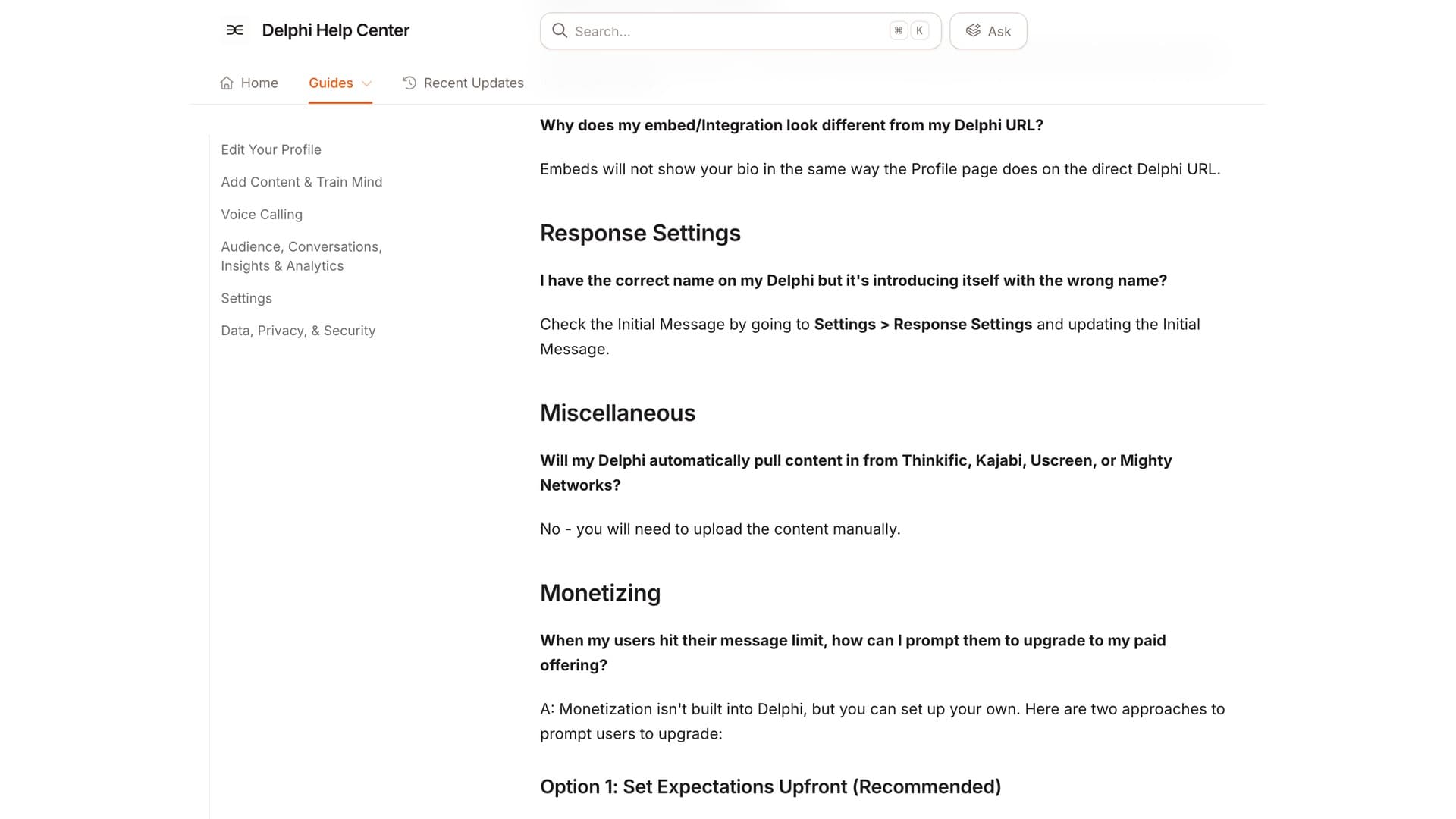
  • Delphi's own help center answers the monetization question in one sentence: "Monetization isn't built into Delphi, but you can set up your own"
  • The only recurring payout Delphi documents for a creator is its referral program, which pays 30% of another creator's subscription for 24 months. You earn recurring revenue by recruiting subscribers for Delphi, not by serving your own audience
  • Rating: 3 out of 5. An excellent answering machine for your expertise, sold to you as a cost, on a surface where no customer of yours can be billed
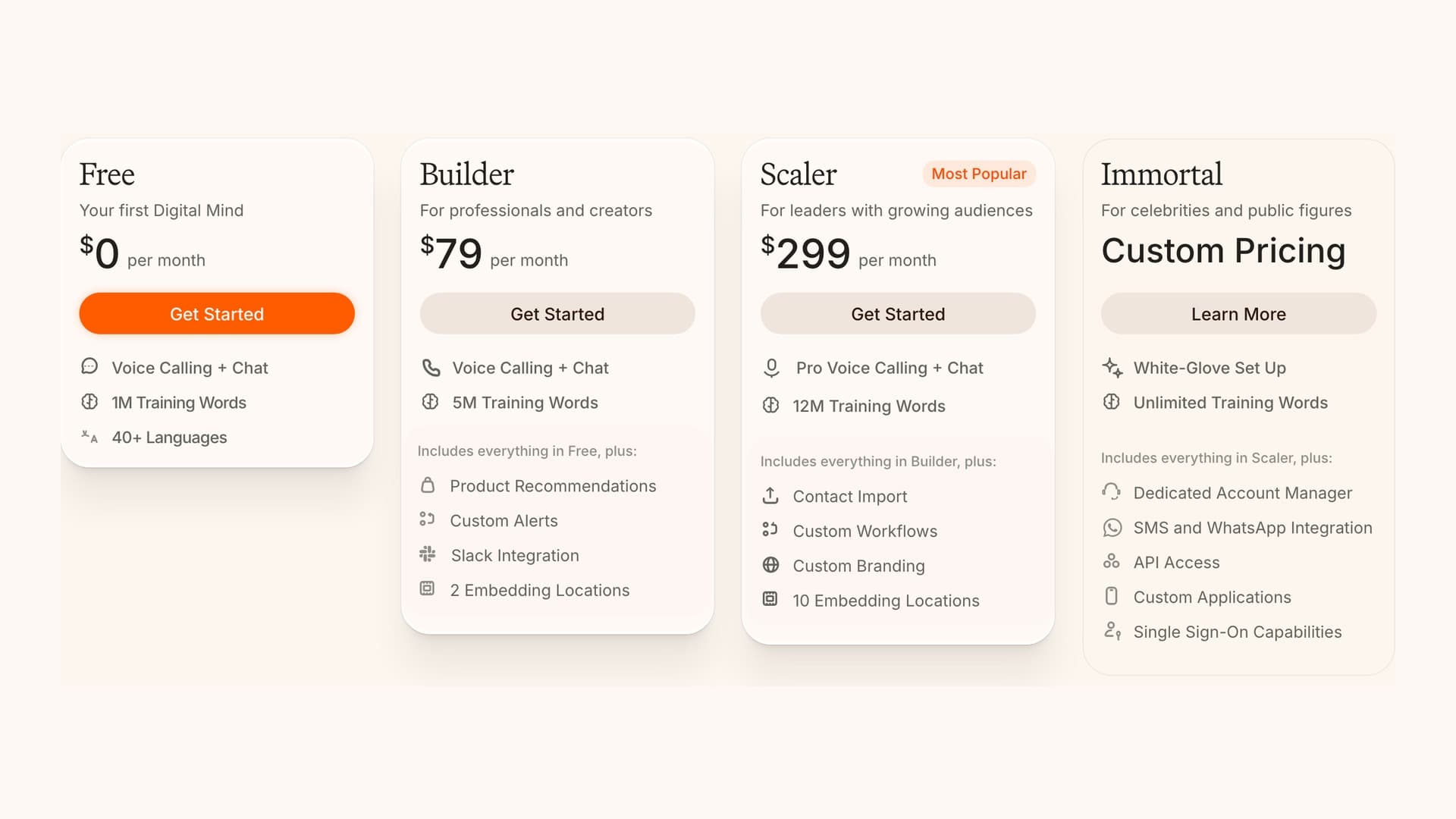
Verdict: Delphi builds the best version of a thing most creators have wanted for two years: a trained, cited, voice-capable version of your own thinking that answers questions at 2am in 40 languages. Buy it if the job you are hiring it for is reach, lead capture, or never answering the same question twice. Do not buy it as a business. Priced at $299 a month, Scaler bills you $3,588 a year for the privilege of being available, and the vendor documents no way for a single person in your audience to pay you inside the product. Every dollar that moves in this system moves out of your account. The 3 out of 5 is a good product with the money pointed the wrong way. Delphi is a hosted service that trains an AI "Digital Mind" on a creator's books, podcasts, posts, and videos, then publishes it as a public profile, an embed, or a voice call that anyone can talk to. It is not an app builder, a course platform, or a membership tool. It is a conversational front door to your body of work. The scale is legible and the company is not hiding it. Co-founders Dara Ladjevardian and Sam Spelsberg started Delphi in November 2022, opened a beta in December 2023, and announced a $16 million Series A led by Sequoia Capital on June 24, 2025, describing the product as already trusted by "2,000+ experts, business owners, and creators." The public minds are genuinely who you would want them to be. Lawrence Lessig's Delphi carries a verified badge, a Harvard Law affiliation, and a chat bar that reads "Ask Lawrence Lessig anything." Eckhart Tolle, Karamo Brown, and Matthew Hussey all have one. If you are a coach, author, professor, or consultant whose inbox is full of the same eleven questions, this product was built for you. The review question is not whether it works. It is what it does to your P&L. Delphi costs $0 on Free, $79 a month on Builder, and $299 a month on Scaler, with a fourth tier called Immortal at custom pricing. Annual billing advertises up to 20% off. Every figure below was read off the live pricing page on September 11, 2026.
TierPriceTraining wordsProductsEmbedding locations
Free$0 per month1MNoneNone listed
Builder$79 per month5M52
Scaler$299 per month12M2010
ImmortalCustom pricingUnlimitedNot publishedNot published
Two footnotes that the plan grid does not carry. Free sign-ups are limited to Canada, the UK, and the US, so most of the world starts at $79. And downgrading is not a pause: the help center states plainly that "we're not able to pause all of Delphi's features without an active subscription at this time," so the advanced work you built is the thing you lose when you stop paying.
Delphi's live pricing page showing four tiers: Free at $0 per month, Builder at $79, Scaler at $299, and Immortal at custom pricing
No. Delphi's own help center answers this directly: "Monetization isn't built into Delphi, but you can set up your own." The two workarounds it then recommends are to paste your own upgrade link into an embed's opening message, or to fire an Action after a certain message count that pastes the same link. In both cases the customer leaves. Read that carefully, because it is the whole review. You are looking at the most sophisticated audience-facing surface a creator can rent in 2026. It knows who is asking, what they asked, how long they stayed, and what they wanted next. And the only way a dollar reaches you through it is a hyperlink to somewhere else. The closest thing to revenue inside the product is the Products page, which lets your Digital Mind recommend affiliate links when a keyword fires, capped at 5 products on Builder and 20 on Scaler. That is a referral surface, not a business. We have priced what a claim on a customer that expires is actually worth, and an affiliate mention is the least durable revenue in the creator economy. Meanwhile Delphi does ship one recurring payout to creators, documented on its Settings page: "When someone signs up using your referral, you earn 30% of their monthly subscription for 24 months." Refer one Scaler subscriber and that is $89.70 a month for two years. So the one mechanism in this product that pays a creator recurring money pays them for recruiting other creators into the subscription. That is an honest, common SaaS referral program. It is also a precise description of who the customer is here, and it is not your audience.
Delphi's help center, Monetizing section, answering how to prompt users to upgrade with the sentence "Monetization isn't built into Delphi, but you can set up your own"
Plenty, and pretending otherwise would make the rest of this review worthless. The training pipeline is the strongest part. You connect documents, sites, social accounts, and video, and the Mind keeps evolving as you add work. Answers carry citations you can click back to the source, and you can right-click any reply and edit it, which saves the revision as a Q&A item in the Mind. That is a real feedback loop, and it is the reason these minds sound like the person rather than like a chatbot wearing their name. The trust posture is better than the category norm. Delphi's data and privacy page states that you keep full ownership of everything you upload and that creator content "is stored in its own private index and is not shared or used to train any external models." It also discloses that voice and video uploads may produce biometric voiceprints, with a separate consent form. Stating that out loud is more than most AI vendors manage. And the analytics answer a question a creator normally cannot answer. The Insights page reports active visitors, total messages, and average session duration, and the Conversations page shows every question your audience actually asked. That is the evergreen content engine side of the value triangle working properly: your audience tells you what to make next, in their own words, for free. Delphi builds you a member directory and then limits what you can do with it: the help center states you "can't export audience lists directly," and CRM sync starts at the Scaler tier. You can import up to 1,000 contacts at a time by CSV, tag people, assign them to access groups named Just Me, Insider, Public, and Anonymous, and revoke access individually. What you cannot do on the $79 plan is take the list with you. API access is Immortal only. So the customer records, the conversation history, and the programmatic hooks all sit one tier above where a working creator starts, on a platform where the audience cannot be charged in the first place. This is the same shape we found in Tony Robbins's AI coaching business, and the difference is instructive. When the conversation happens inside a product the creator owns, the transcript, the subscriber, and the renewal are all the same asset. When it happens on a rented surface, they are three things owned by three parties, and you are renting the one that costs the most. Here is the arithmetic, and it is the only arithmetic that matters. Scaler at $299 a month is $3,588 a year, paid before a single person in your audience has given you anything. Now price the other side. A $9.99 monthly subscription in an app you own nets $8.49 after Apple's Small Business Program rate of 15%, which is $101.88 a year per subscriber. Divide, and the answer is 36.
LineDelphi ScalerOwned subscription app
Fixed annual cost to the creator$3,588$0 platform fee
Platform share of audience revenueNot applicable, no billing15% under the Small Business Program
Audience members who can be billed in product0Unlimited
Subscribers at $9.99 to match $3,588 netNot possible in product36
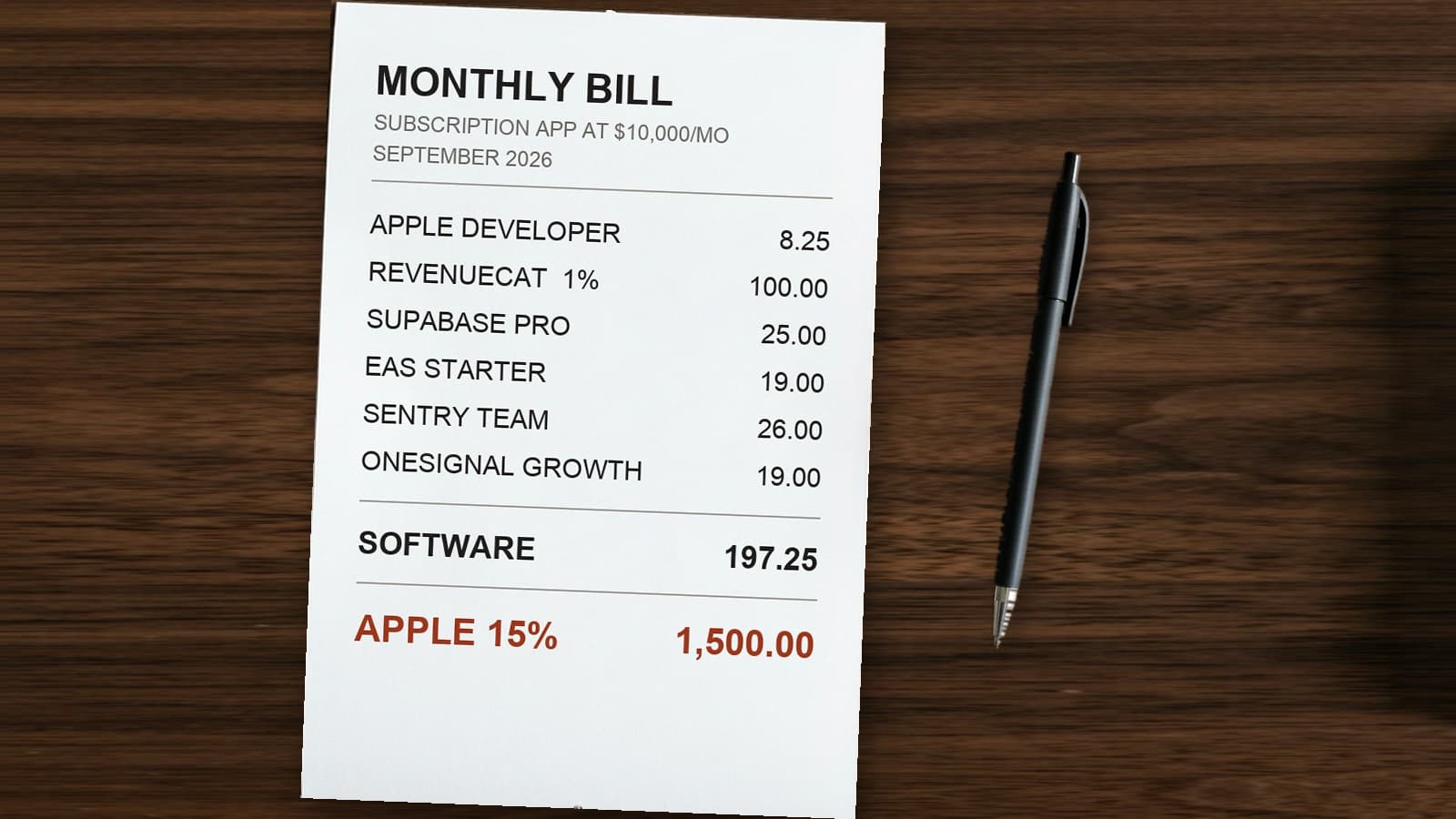
Thirty-six people at ten dollars a month is the entire annual cost of the top self-serve Delphi tier. If your audience is 50,000 people and you cannot find 36 of them who would pay ten dollars a month for a product built around your work, the problem was never the tooling. If you can, then you are currently paying $3,588 a year for a surface that structurally refuses to collect it. We broke down what a subscription app actually costs to operate and the fixed column comes to $97.25 a month, most of which does not grow. You are the exact person Delphi's Builder tier names in its own subtitle, and you are also the person for whom the math is worst. Your audience asks you questions constantly. That demand is the highest-intent signal in the creator economy, because a question is somebody telling you what they will pay to have solved. Run Delphi for a quarter. Read the Conversations page every Friday. Write down the eight questions that repeat, and how the answer changes depending on the person asking. That list is a product specification, and the fact that the correct answer differs per person is exactly what makes it a subscription rather than an ebook. Then go build the thing that charges for it. Built by Foundry does that build at $0 upfront on a revenue share, and we run and optimize it forever so you are not the one shipping releases. Delphi earns its 3 out of 5 and it earns it honestly. The product does something genuinely new, the named people using it are real, the privacy posture is above the category, and the training loop is the best implementation of this idea shipping today. If you hire it to answer questions, capture leads, and tell you what your audience wants, it will do that better than anything else on the market. Be precise about what you are buying. At $79 or $299 a month you are buying presence, and presence is a cost. The company was clear about this in its own documentation before we ever read the pricing page, which is more candour than most vendors offer. The question the documentation leaves on your desk is the one worth answering this quarter: your Digital Mind is having hundreds of conversations with people who want more of you, and not one of those conversations can end in a payment. Who is that arrangement built for?
Our work

Creators who already did this

These are apps we designed, built, shipped, and still run today, with the creator keeping the code and the audience.

Brandon Whiteleather

Brandon Whiteleather

Founder & CEO of Freeze Dry Buddy

Freeze drying made foolproof, from a homesteader who's done it 1,000 times.

Top Food App1.4M+ followers
Read the case study
Kristen Donathan

Kristen Donathan

Founder & CEO of Stain Fix

Snap a stain. Get the fix in seconds.

Top Lifestyle App1.5M+ followers
Read the case study
Stain Fix screenshots
Ellie Fausett

Ellie Fausett

Founder & CEO of Vector Guard

Spot disease-carrying pests before they reach your family.

Top Health App
Read the case study
Vector Guard screenshots

Creator app strategy

Curious what your app could be?

Enter your handle and BUILT BY FOUNDRY will research your audience and present custom app concepts. Free.

Delphi Review 2026: 4 Tiers, $299 a Month, and 0 Ways to Charge Your Audience