
Case Studies & Success Stories

CNC Kitchen Shipped 9 Apps and Priced None of Them. The Top 3D Printing App Sells Printers

September 10, 2026
Share
CNC Kitchen Shipped 9 Apps and Priced None of Them. The Top 3D Printing App Sells Printers

Get Creator Revenue Insights

How creators are turning audiences into subscription businesses
Share
Key Takeaways:
  • CNC Kitchen showed 755,000 YouTube subscribers and 120,145,037 lifetime views on September 10, 2026, on a channel Stefan Hermann started on December 27, 2016
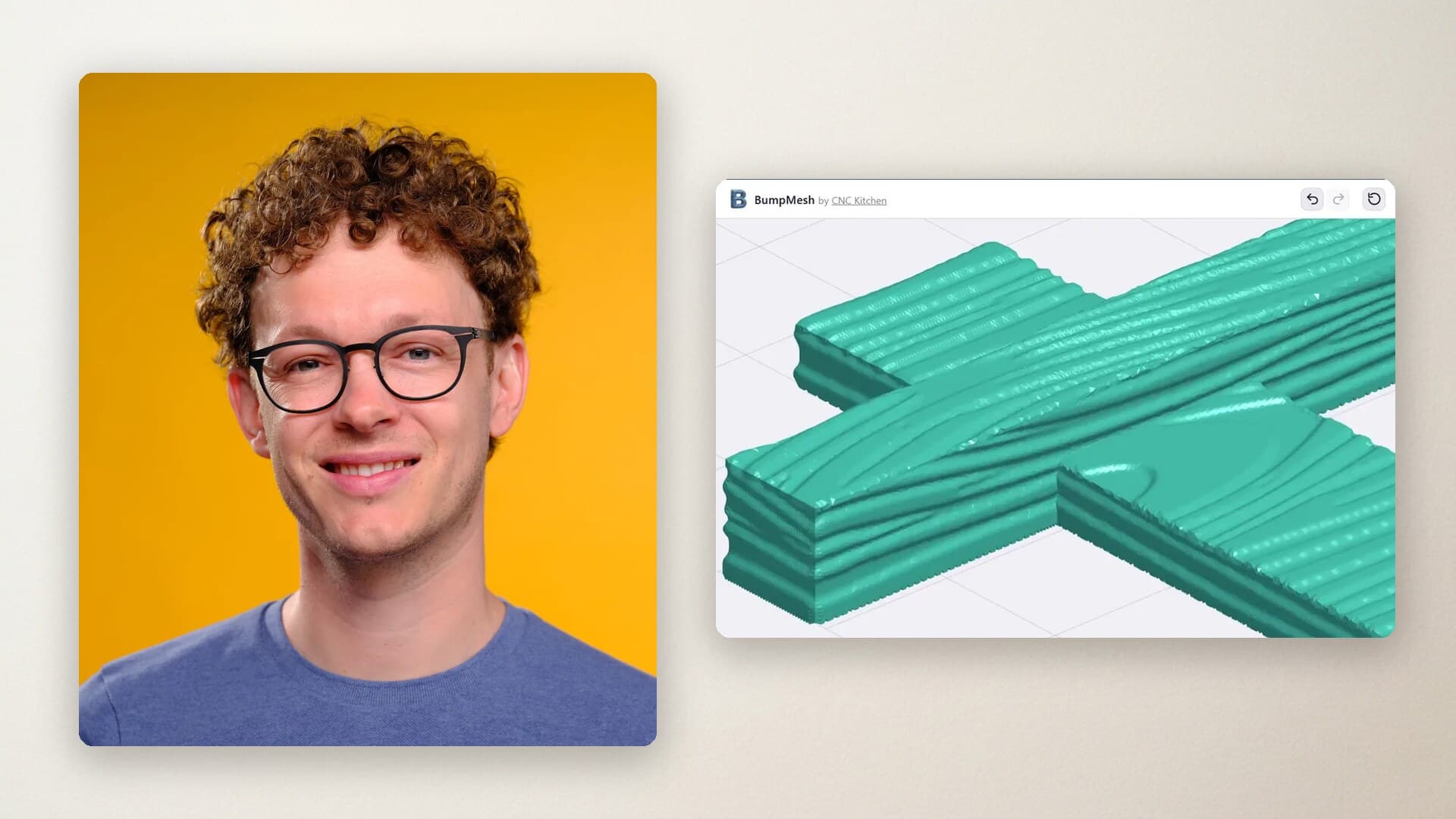
  • His apps page lists nine browser tools under one header: "Free · browser-based · no signup". One of them, filaSim, runs finite element analysis on a printed part in a browser tab
  • The CNCKitchen GitHub account held 29 public repositories and 2,350 stars on September 10, 2026. The source behind BumpMesh alone carried 907
  • His own about page describes the money: "YouTube ad revenue covers the basics", sponsorships, affiliate links, and a store of heat-set inserts that starts at $10.90 for 100 pieces
  • An iTunes Search API query for "3d printing" on the US storefront returned 40 results on September 10, 2026. Not one of them costs money, and the most-rated app that talks to a printer is Bambu Handy at 38,556 ratings, published by the company that makes the printer
A mechanical engineer with seventeen years of aerospace behind him has spent a decade pulling 3D printed parts apart on a testing machine he built in his own workshop, and publishing every number. He has also written nine pieces of real software and given all of them away. Nothing here is a mistake. The interesting part is what already sits on his viewers' phones, because in this category the app was installed before the creator ever showed up. Parts and attention. Stefan Hermann's business is YouTube ad revenue, named sponsorships, Amazon affiliate links, direct viewer support, and a store of high-quality fasteners run out of a converted fire station in the German Allgäu with his business partner Alex. His about page states the mix plainly: "CNC Kitchen deliberately runs on a mix of income rather than a single source." He is precise about all of it, which is what you would expect from someone who describes his background as "seventeen years in aerospace: eight of them as a structural engineer on landing gear systems, six as a research engineer in metal additive manufacturing." The store is the honest part of the story. It began, in his telling, as "a fairly stupid idea": he made videos about heat-set inserts, people wanted them, the ones on the market were bad, so he sourced a batch. Today a pack of 100 M3 x 5.7 inserts is $10.90 and the removal tool is $19.90. That is a genuinely good product line, and it is the same shape as every other line in the mix. A viewer buys inserts once, then again in a year. A sponsor pays once per video. An affiliate link pays once per printer. None of them recurs on the schedule the audience actually operates on, which is every single time somebody presses print. Because the printer company sells printers. Bambu Handy's own App Store description opens with "Remotely control your Bambu Lab 3D printers, explore MakerWorld's vast library of free models, and print your favorite designs with one tap." It is a machine remote and a model catalogue. Its job is to make the machine you already own feel good, and to make the next machine easy to want. Whether the part survives the load it was printed for is not a question it is built to ask. That question is CNC Kitchen's entire body of work. His blog index calls itself "The lab notebook" and carries 115 entries under a promise most publishers would not risk: "No AI articles. Written by humans, from tests we ran ourselves." Read a few titles and the shape appears immediately. Brick layers, where re-ordering print moves into an interlocking pattern made PLA 14% stronger and PETG 10%. Print orientation, tested at 0, 30, 45, 60 and 90 degrees. Z anti-aliasing, where surface roughness dropped from 80 to 25 micrometres on shallow slopes. Carbon fibre PA6 against PA12 for stiffness, impact, creep and heat. Every one of those is a lookup table. Material, orientation, temperature, geometry, load. Ten years of destructive testing is a database, and it is currently published as prose.
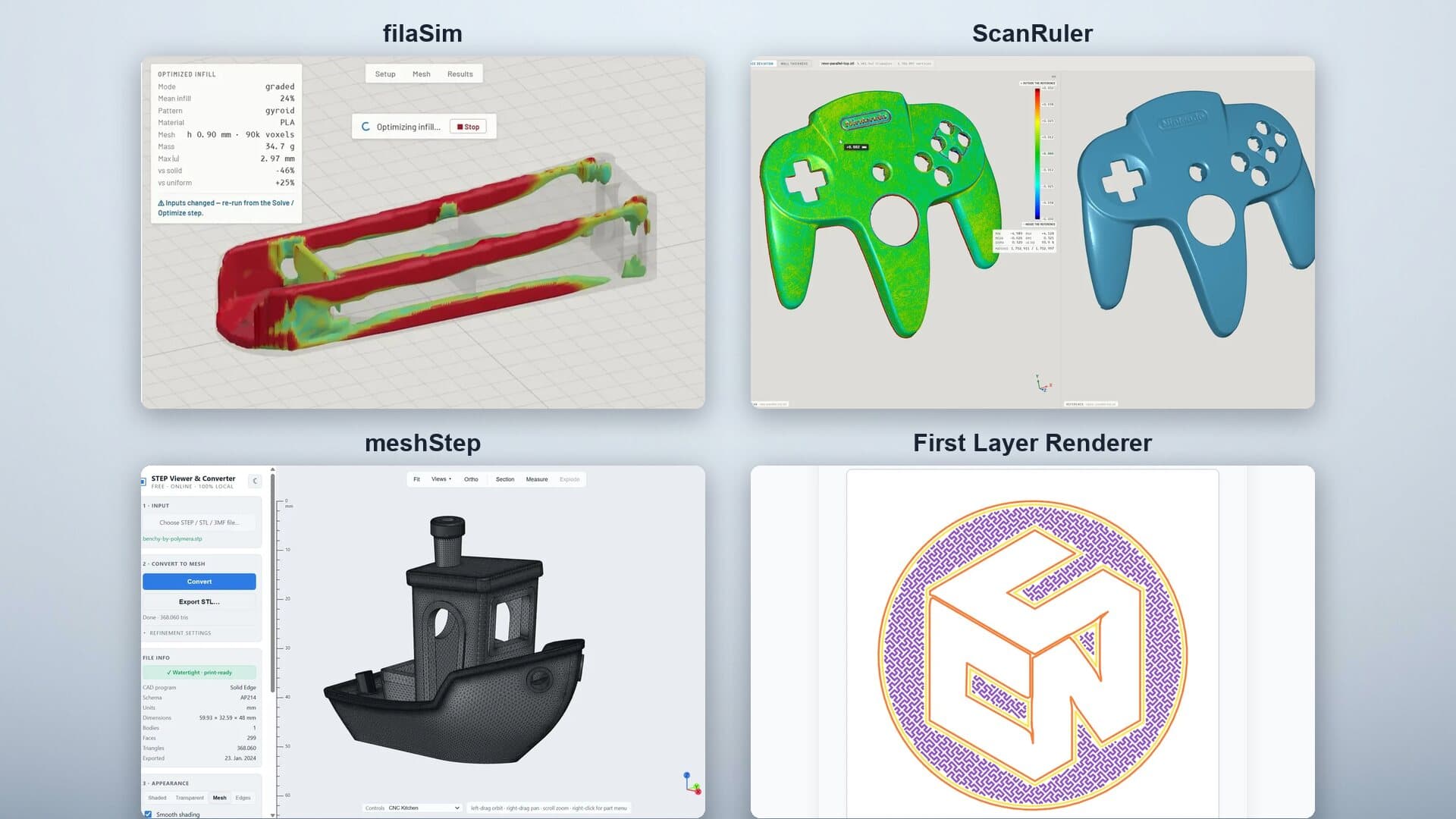
The real filaSim interface showing a graded-infill stress analysis of a printed part, beside real screenshots of ScanRuler, meshStep and First Layer Renderer from Stefan Hermann's apps page
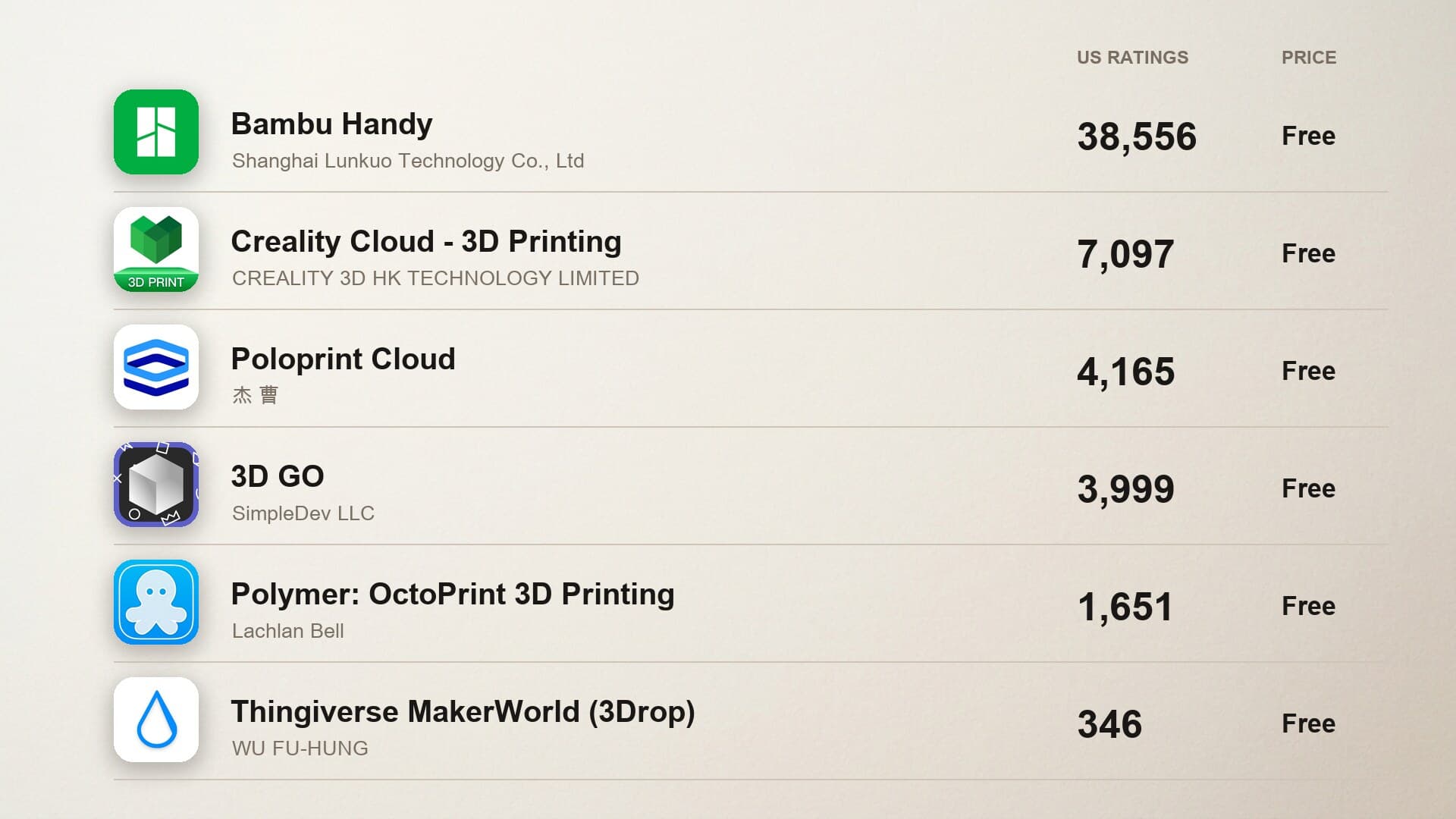
He has already built the front end for it, more than once. filaSim is described on his own site as software that lets you "pick the surfaces that get loaded and held, then see deflection, stress and safety factors at your actual print settings", and grade the infill where the loads really need it. That is a paid engineering feature in a browser tab with no price on it. Hardware companies. An iTunes Search API query for "3d printing" on the US storefront on September 10, 2026 returned 40 results and every single one was free to download. The most-rated app that connects to a printer was Bambu Handy at 38,556 US ratings, published by Shanghai Lunkuo Technology Co., Ltd. Second was Creality Cloud at 7,097, published by CREALITY 3D HK TECHNOLOGY LIMITED. Both companies make the machines.
AppPublisherUS ratingsPrice
Bambu HandyShanghai Lunkuo Technology Co., Ltd38,556Free
Creality Cloud - 3D PrintingCREALITY 3D HK TECHNOLOGY LIMITED7,097Free
Poloprint Cloud杰 曹4,165Free
3D GOSimpleDev LLC3,999Free
Polymer: OctoPrint 3D PrintingLachlan Bell1,651Free
Thingiverse MakerWorld (3Drop)WU FU-HUNG346Free
Real App Store icons and US rating counts for Bambu Handy, Creality Cloud, Poloprint Cloud, 3D GO, Polymer and Thingiverse MakerWorld on September 10, 2026, every one of them free
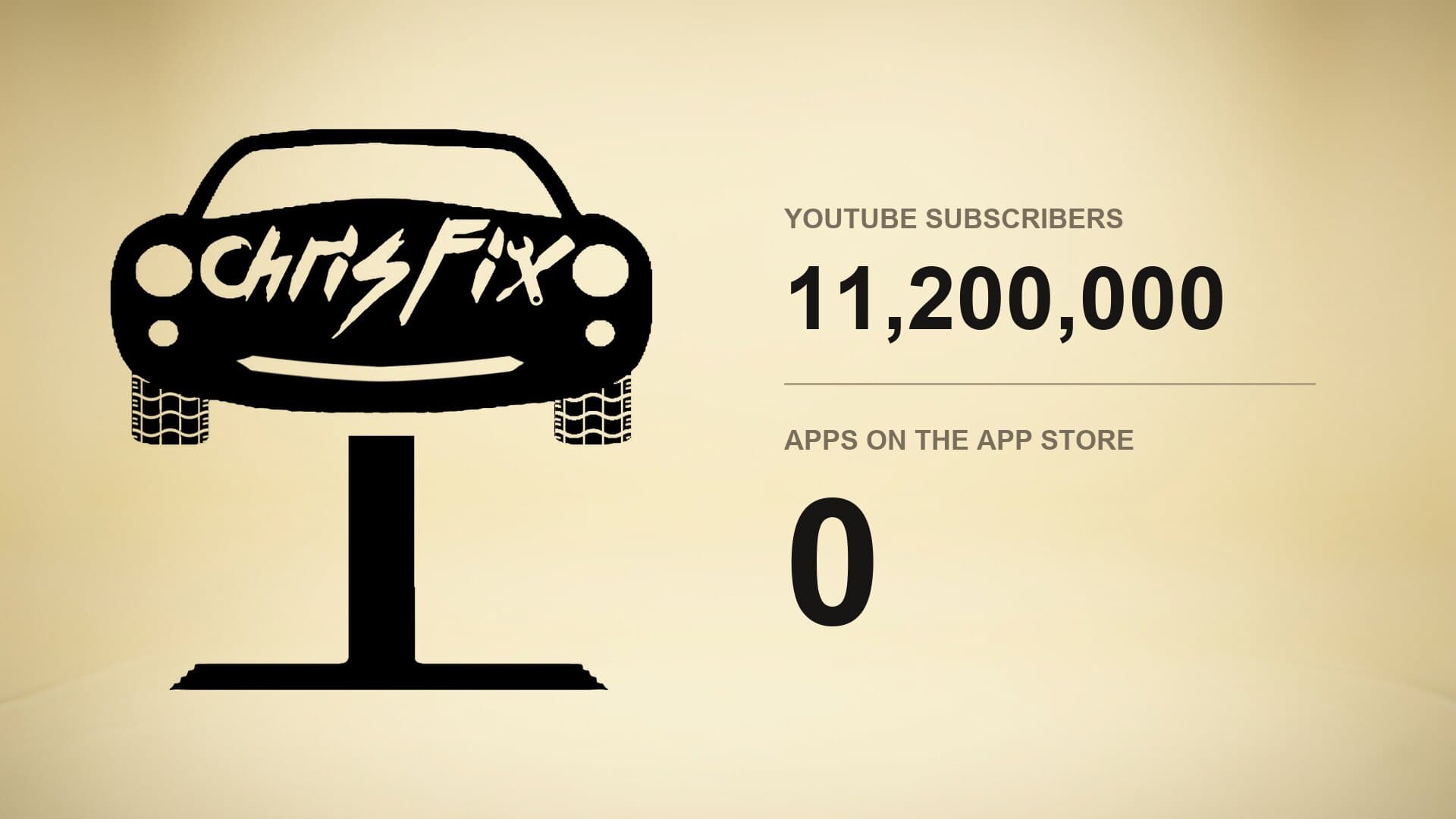
Rating counts approximate installs multiplied by years on the store, so they measure distribution rather than quality. Read that way the table says something specific. The category's software surface is owned by firms whose product is the machine, and for whom the app is a cost of selling it. Nobody on that list is in the business of telling you your part will fail. This is not a crowded niche. It is a niche where the incumbents are structurally disqualified from the interesting question. Here is the part that makes this a case study and not a lecture. He shipped the software already. The apps page carries nine of them: BumpMesh for real displacement textures on a mesh, filaSim for browser-based finite element analysis, ScanRuler for deviation analysis on a 3D scan, meshStep for opening STEP files without CAD, First Layer Renderer, Model Spiralizer, Retraction Optimizer, a Gridfinity label generator, and a dough calculator, because it says Kitchen on the label. Three of them have their own domains. BumpMesh got a follow-up video titled "Half a Million Views Later… BumpMesh Is Way Better", covering three months of community-driven changes: mesh checks, remeshing, undo, project saving, 3MF export and a five times faster exporter. That is a release note. He is running a product. The GitHub account behind it held 29 public repositories and 2,350 stars, including 907 on the BumpMesh source and 160 on Open-Pull, which is a DIY universal test machine published under GPL-3.0. He open-sourced the instrument, not just the results. None of it has a price, and his reason is a real one: "most of my projects are free and open source in return: test geometries, scripts, apps, models. That's exactly how 3D printing got to where it is today." A person who built a career on other makers publishing their findings does not want to be the one who stops. Which is the point rather than the objection. Free tools and a paid product are not in tension when the paid product is the part that keeps a record. ChrisFix ran into the same wall from the car side: the teaching is free forever, and the surface where the customer's own history lives is the thing worth owning. Run this on your own audience in one line. Name the object your audience bought before they found you. Open the App Store page for the company that made it. If a free app from that manufacturer is already on your viewer's home screen, then the question that app refuses to answer is your product. It is falsifiable and it takes two minutes. 3D printing passes: the printer maker's app shows you a live camera and a percentage, and never a safety factor. Home espresso passes: the machine app runs a profile and never tells you the beans are eleven days too old. Reef keeping, sewing, drones, indoor growing, bike training and film cameras all pass the same way. In every one of them the hardware vendor gets the home screen for free and has no commercial reason to go deeper than the device. That is a different vacancy from the ones this blog has been mapping. Recent posts sorted audiences by an answer that only resolves in the customer's house and by whether the audience already keeps score. Hardware categories add another axis. The audience arrives already carrying an app, and it belongs to somebody whose incentive stops at the machine. This section is for creators with 50K or more followers who teach people to operate a thing they own: printers, cameras, machines, tanks, kilns, grinders, looms, rigs. You have a tell, and it shows up in your comments every day. People post their settings at you. The photo of the failed part. The screenshot of the slicer. The "I'm running PETG at 240 and it still snapped, what am I doing wrong?" You did not ask for any of it. They send it because the answer depends on their machine, their material and their part, and you are the only person who has actually measured it. That is an audience asking to be looked up, not entertained. Right now the lookup happens in your replies, one message at a time, for free, forever, and the record disappears the moment you hit send. Your market also refreshes itself without you. Every printer sold this year creates a beginner who needs the same twelve answers, and that beginner opened the manufacturer's app on day one. Free content is not the leak. 755,000 subscribers, 120 million views and 2,350 GitHub stars are distribution that most software companies buy at a painful price. One-time objects cannot fund a repeating question. Inserts sell once, then once more. A sponsorship pays once. The question "will this part hold" arrives on every print, for every owner, forever. Check whether you already shipped the product. Nine browser apps, three custom domains, a released FEA tool and a versioned changelog is not a hobby. The build was never the missing piece, and the cost of running it is tens of dollars a month. A hardware vendor on the home screen is a vacancy, not an incumbent. Their app exists to sell the next machine. Yours would exist to keep the owner's record, which is the thing that makes a product fit a creator rather than merely fit a topic. Stefan Hermann built the test machine, ran the samples, published the numbers, wrote the tools, open-sourced the instrument, and handed the whole thing to the community that taught him. Everything is already in place except a price on the one surface his viewers open at the exact moment they need him, which is also the surface that could fund the free notebook forever. Channel statistics read from YouTube on September 10, 2026. Biography, income mix, store history and the open-source statement read from the CNC Kitchen about page the same day; those are the creator's own claims about his own business and are quoted as such. App descriptions, the "Free · browser-based · no signup" header and the nine-app list read from cnckitchen.com/tools. Article count and the "No AI articles" statement read from the CNC Kitchen blog index, where the tensile, brick-layer and anti-aliasing figures are the summaries of his own published tests. Repository counts, star counts and licences retrieved from the GitHub API on September 10, 2026. Insert prices read from the CNC Kitchen store. App names, publishers, US rating counts and prices retrieved from the Apple iTunes Search API on September 10, 2026, and the Bambu Handy description from its iTunes Lookup record the same day. Stefan Hermann also publishes on Printables and LinkedIn.
Our work

Creators who already did this

These are apps we designed, built, shipped, and still run today, with the creator keeping the code and the audience.

Liv Merima

Liv Merima

Founder & CEO of Claim It

Custom affirmations that help millions choose themselves.

Top Lifestyle App150K+ followers
Read the case study
Claim It screenshots
Brandon Whiteleather

Brandon Whiteleather

Founder & CEO of Freeze Dry Buddy

Freeze drying made foolproof, from a homesteader who's done it 1,000 times.

Top Food App1.4M+ followers
Read the case study
Kristen Donathan

Kristen Donathan

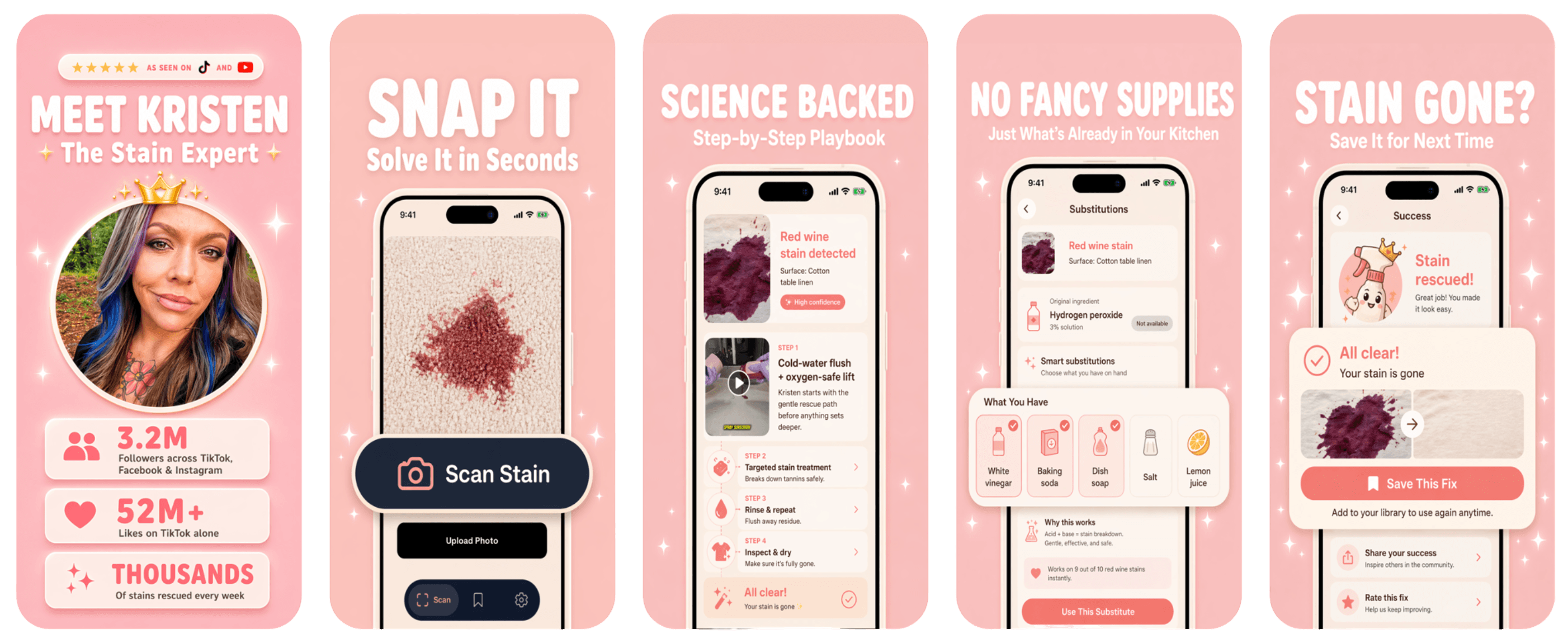
Founder & CEO of Stain Fix

Snap a stain. Get the fix in seconds.

Top Lifestyle App1.5M+ followers
Read the case study
Stain Fix screenshots

Creator app strategy

Curious what your app could be?

Enter your handle and BUILT BY FOUNDRY will research your audience and present custom app concepts. Free.

CNC Kitchen Shipped 9 Apps and Priced None of Them. The Top 3D Printing App Sells Printers