
Turning Knowledge into Products

5 Buy Me a Coffee Alternatives for Recurring Revenue

Foundry
May 23, 2026
Share
5 Buy Me a Coffee Alternatives for Recurring Revenue

Get Creator Revenue Insights

How creators are turning audiences into subscription businesses
Share
Looking for alternatives to Buy Me a Coffee? You are not alone. BMC is built around one-time tips and the occasional supporter membership, which works fine until a creator looks at the numbers and realizes the tip jar is the ceiling. This post compares five Buy Me a Coffee alternatives creators actually use in 2026. Four are platforms. The fifth is the one creators end up at when they decide they want a real business, not a donation button. Key Takeaways:
  • Buy Me a Coffee is the easiest way to accept tips, but tips are one-time payments dressed up as recurring revenue.
  • Ko-fi is the closest BMC clone with slightly better commerce features and a free tier.
  • Patreon and Substack add real recurring billing, but you rent the audience and the platform takes a cut.
  • Stan Store gives you a mobile-first link-in-bio storefront. Still a storefront, not a business.
  • A custom subscription app is the only option on this list that compounds, distributes through the App Store, and pays you while you sleep.

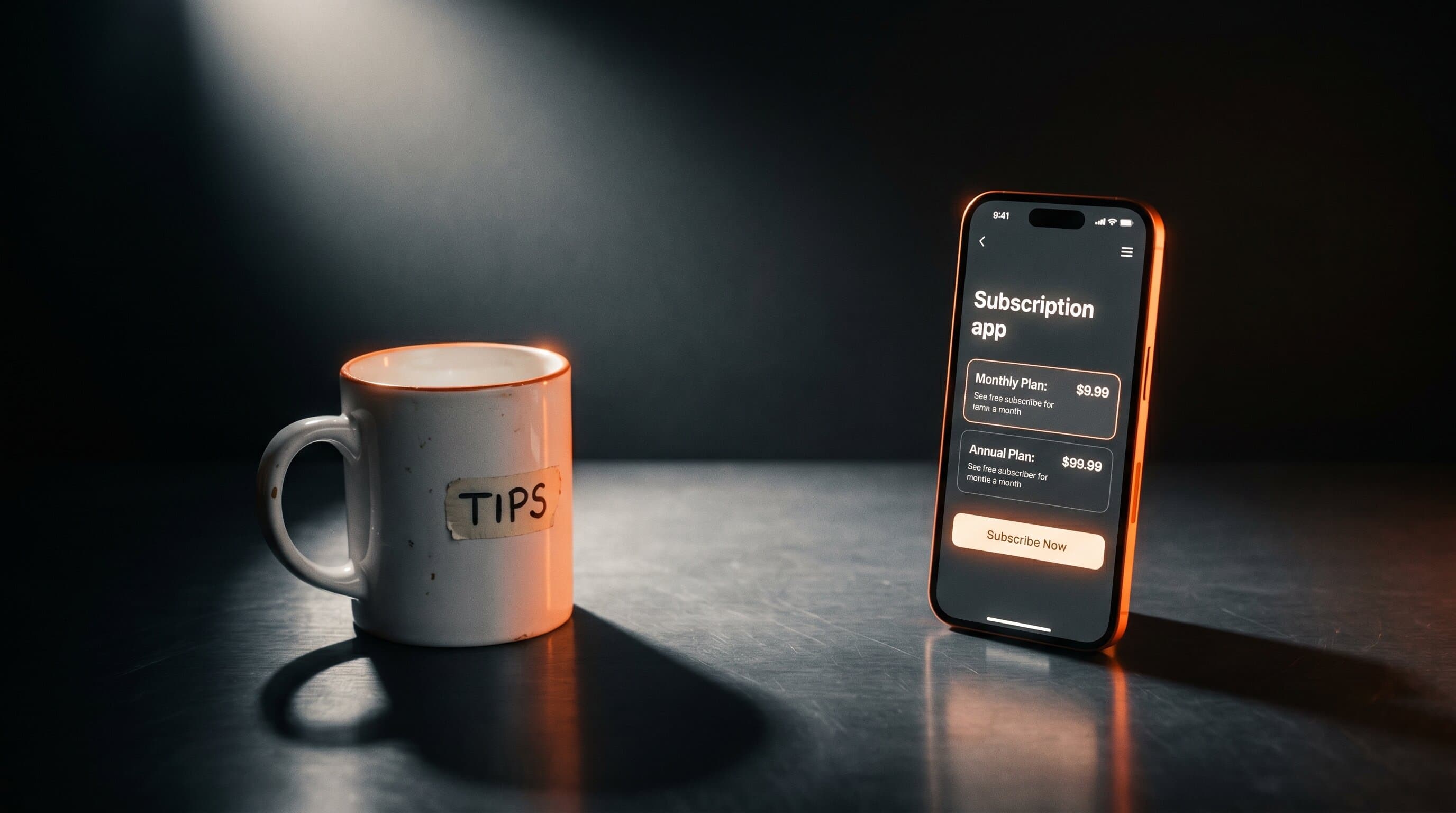
Five generic tip-jar tiles next to one phone glowing with orange rim light on a balance scale
BMC has 1 million+ creators and counting, according to its own homepage, and the product is good at what it does. It is not the product that is the problem. It is the business model. Three patterns come up in every conversation we have with creators leaving Buy Me a Coffee:
  • Tips do not compound. A $5 tip is a $5 tip. There is no second month of the same $5. Revenue is whatever you can drive this week.
  • Memberships are bolted on. BMC added monthly memberships, but the product still feels like a tip jar. Subscribers churn fast because the offer is "support me," not "use a thing."
  • No discovery. Nobody opens buymeacoffee.com to find a new creator. If you did not bring the traffic, no traffic shows up. The same complaint we hear about Linktree and your own app.
If you are searching for a Buy Me a Coffee alternative, you are usually searching for one of two things: a slightly cheaper tip jar, or an actual recurring business. The first four picks below are tip jars with different paint jobs. The fifth one is a business. Here is the side by side. We go deeper on each below.
PlatformStarting PriceBest ForRecurring Revenue?Discovery Channel
Ko-fiFree + 0% on tipsHobbyist creators, tipsLimited membershipsNone (you bring traffic)
Patreon8 to 12% of revenueMemberships, behind-the-scenesYes (rented)None (you bring traffic)
Stan Store$29/monthLink-in-bio storefrontsLimitedYour social bio
Substack10% + Stripe feesPaid newslettersYes (rented)Substack network
Custom app$0 upfront, rev shareCreators who want to own a businessYes (owned)App Store + your audience
Now the details. Ko-fi is the most direct alternative. Same tip-first model, similar UI, same audience of creators who want a button on their profile that says "support me." Ko-fi charges 0% on tips on its free tier, which beats BMC's 5% on transactions. Memberships and a Ko-fi Gold subscription unlock more features for $8/month. What Ko-fi does well:
  • Genuinely free tier. Tips come through at 0% fees plus payment processing.
  • Shop feature lets you sell digital downloads and commissions without an upgrade.
  • Built-in monthly memberships, similar to BMC.
Where Ko-fi falls short:
  • Same ceiling as BMC. The product is a tip jar with extras, not a business.
  • Discovery is non-existent. Nobody browses Ko-fi to find new creators.
  • Memberships churn fast because the offer is gratitude, not utility.
We did a full breakdown in our Ko-fi review. The short version: if you want a slightly better Buy Me a Coffee, Ko-fi is a fine pick. If you want recurring revenue that compounds, this is not the move. Patreon is the real recurring revenue play among hosted platforms. Creators set monthly tiers, fans pay every month, and Patreon handles billing. The platform reportedly paid out more than $3.5 billion to creators since launch, according to TechCrunch. That is real money. The tradeoff is the take rate and the relationship. What Patreon does well:
  • Genuine monthly recurring billing, not tips dressed up as subscriptions.
  • Strong product around posts, community, and member tiers.
  • Established muscle memory: fans know what Patreon is and how it works.
Where Patreon falls short:
  • Take rate is 8 to 12% before payment processing, plus a per-payout fee.
  • Discovery is weak. Patreon does not send new fans your way.
  • Your subscriber list is locked inside Patreon. You can export emails, not relationships.
  • The product is designed for paywalled content, not real software experiences.
Creators leaving Patreon usually want one of two things: lower fees or a real product. We wrote about both in our piece on Patreon alternatives for serious creators. A subscription app does both. The take rate is yours and the product is a real thing your fans use, not a folder of locked posts. Stan Store is the platform Instagram and TikTok creators land on first because it slots in where Linktree used to be. One link in the bio, every product behind it, mobile-first checkout. At $29/month it is the cheapest paid tier on this list. What Stan Store does well:
  • Mobile checkout is real. Phone conversion is meaningfully better than desktop-first platforms.
  • Templates for digital products, coaching calls, courses, and small communities.
  • Sets up in an afternoon.
Where Stan Store falls short:
  • It is a link in a bio. Your business is downstream of the algorithm.
  • No App Store presence. Every customer comes from your social feed.
  • Memberships exist but churn fast for the same reason BMC and Ko-fi memberships do. The offer is access, not utility.
If your goal is just "replace BMC with something more capable," Stan Store is the obvious upgrade. If your goal is recurring revenue you actually own, read our Stan Store alternative for creators who want recurring revenue. Substack turns "I write things" into monthly recurring billing. Subscribers pay $5 to $20/month for newsletters, and Substack takes 10% plus Stripe's processing fee. For writers, podcasters, and analysts, it is a legitimate path to real MRR. What Substack does well:
  • Recurring subscriptions baked in, plus a respectable internal network for discovery via the Notes feed and recommendations.
  • Email and web are bundled. Subscribers can read in the app or inbox.
  • Free to start, simple to use.
Where Substack falls short:
  • Take rate is 10%. On $20K MRR that is $2K/month going to the platform, every month, forever.
  • Format is locked to "long-form text and audio." If your product idea is software, this is not the tool.
  • Subscriber list belongs to you, but the surface area is Substack's, including app downloads and ranking.
We covered the full picture in our Substack review. Substack works if your product genuinely is words on a page. It does not work if what your audience actually wants is a daily workout, a habit tracker, a recipe generator, or any other thing that wants to be an app. Here is the alternative the other four do not talk about: a custom-built subscription app, in the App Store and Google Play, with monthly billing, push notifications, your brand, your data, and your name on the business. Why a custom app beats every other option on this list:
  • It charges monthly, forever. A $9.99/month subscriber pays $119.88 a year. A $5 tip pays $5.
  • It distributes itself. The App Store has 1.5+ billion active users browsing for new apps every week. Your bio does not.
  • You own everything. The codebase, the brand, the customer relationships, the revenue, the data.
  • It generates content for you. Every user submission, leaderboard, and result is a video you did not have to brainstorm.
The objection is always the same: "But I cannot build an app." That has been true for a decade. It is not true anymore. Heather Robertson built a free-workouts YouTube channel into a subscription fitness app. Read our writeup on Heather Robertson's free-workouts-to-paid-fitness-app pivot for the playbook. The old answer: $80K to $200K, six to twelve months, and you still do not have a team to run it after launch. The new answer: $0 upfront. We build the app, ship it to the App Store in roughly three weeks, and run everything forever in exchange for a share of revenue. We earn when you earn. Read more about how the model works and how we keep apps running after they launch. That changes the math on every platform above. If a $5 BMC tip is a one-time event and a $9.99/month app subscriber is a $119.88-a-year asset, the only question is how many tips it would take to equal one subscriber. The answer is twenty-four. The harder question is which one is easier to find: twenty-four people willing to tip you $5 once, or one person willing to subscribe for a year. Match the platform to the goal.
  • You want a free, cleaner BMC: Ko-fi.
  • You want hosted monthly memberships: Patreon.
  • You want a mobile-first storefront: Stan Store.
  • Your product genuinely is a newsletter: Substack.
  • You want a real business with recurring revenue, App Store discovery, and ownership: Stop picking platforms. Build an app.
The first four are tools. The fifth is a company. That is the gap this post is really about. The mistake most creators make is treating BMC alternatives like a product decision when it is actually a business model decision. Switching from Buy Me a Coffee to Ko-fi or Patreon changes the take rate. It does not change the earnings ceiling. You are still asking for tips. You are still depending on the same audience to keep paying. You are still doing the work of finding every customer yourself. The revenue model is the constraint, not the platform. A subscription app changes the model. Subscribers pay every month until they cancel. The App Store sends you customers who never followed you. Your $10K month becomes a $10K month next month too. If you want to see how that math plays out in detail, read our piece on the $10K brand deal vs $10K MRR math. Same dollar amount. Very different businesses. Buy Me a Coffee is worth it if you want a clean, simple tip jar for a hobby project or a niche audience that already wants to support you. It is the wrong tool if you want recurring revenue that compounds, App Store discovery, or true ownership of your customer relationships. Ko-fi's free tier with 0% tip fees is the cheapest direct alternative. Substack is free to start but takes 10% on paid subscriptions. Both have the same business model limitations as BMC: you rent the audience and the platform sets the rules. Yes. Built by Foundry handles design, development, App Store submission, and ongoing updates. You approve the product direction. We build and run it for a share of revenue, with $0 upfront from you. About three weeks from kickoff to App Store submission with Built by Foundry. Traditional agencies quote six to twelve months. The difference is having a team that has already shipped dozens of apps and a model that does not require six months of scope documents before code gets written. Buy Me a Coffee is a hosted tip jar with optional memberships. A custom app is a standalone subscription business in the App Store with monthly billing, push notifications, your brand, and full ownership of customer data. BMC is a button. An app is a company. Your audience is a business. Build it.
Let's Build →
5 Buy Me a Coffee Alternatives for Recurring Revenue