

5 Patreon Alternatives for Serious Creators

5 Patreon Alternatives for Serious Creators

Foundry
March 21, 2026
Key Takeaways:
  • Patreon takes 10% of all creator earnings plus payment processing fees, totaling 13-15% of revenue
  • Buy Me a Coffee (5% fee) and Ko-fi (0% fee) are cheaper but still limit you to someone else's platform
  • Memberful ($49/mo + 4.9%) integrates with your own website but is owned by Patreon
  • Substack charges the same 10% as Patreon and works best for writers, not creators with broader audiences
  • Building your own app costs $0 upfront with a revenue share partner, gives you full brand ownership, and adds App Store discovery as a growth channel
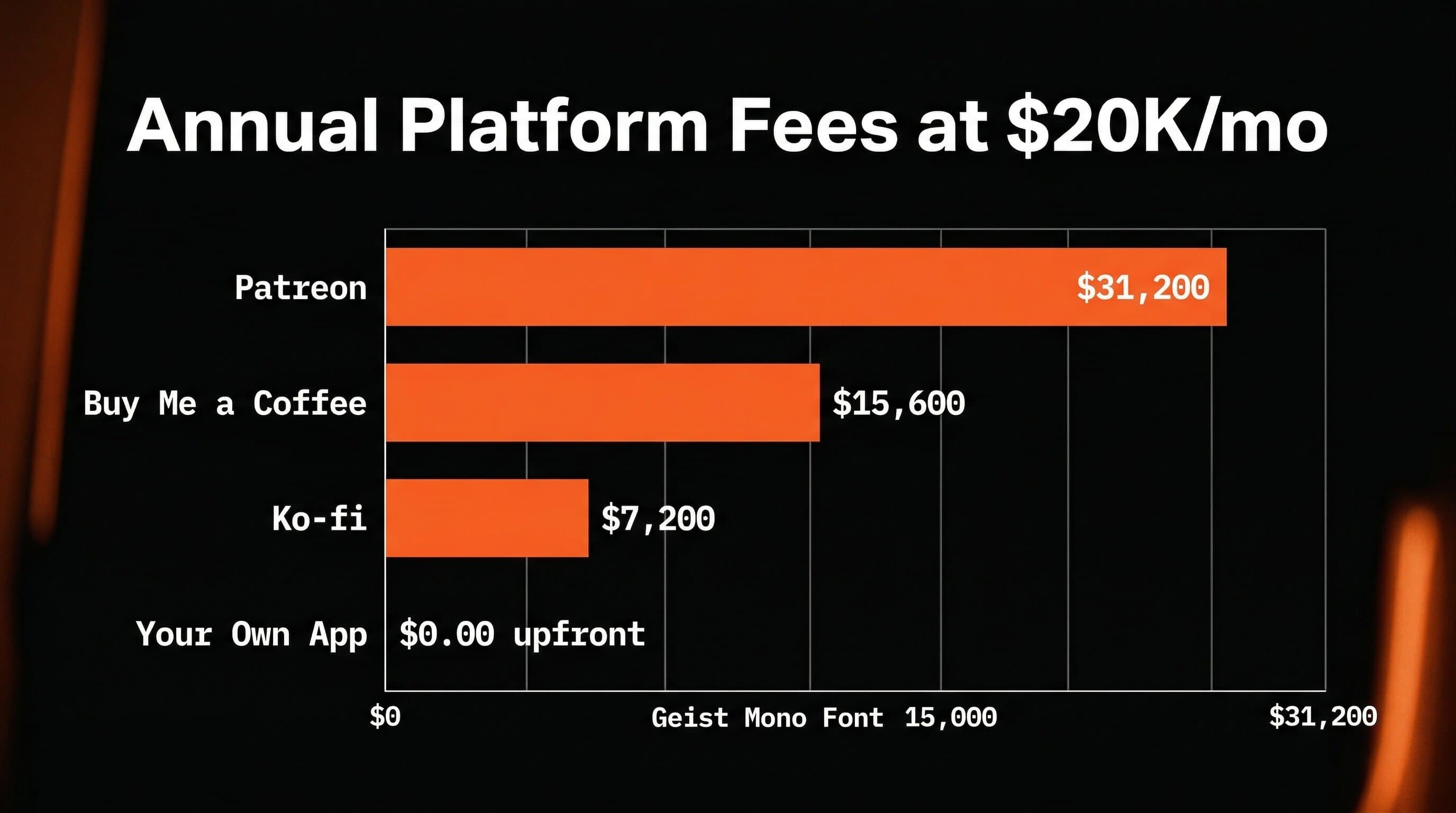
Looking for a Patreon alternative? You're not alone. Patreon has over 300,000 creators and 10 million paying members. But a growing number of those creators are doing the math on that 10% platform fee and not liking what they find. A creator earning $20,000/month on Patreon hands over $2,000 in platform fees plus another $600-800 in payment processing. That's $31,200-$33,600 per year going to a platform that puts its own brand on your page, recommends your competitors to your fans, and controls whether your audience ever sees your content. This is not a hit piece on Patreon. The platform helped launch creator memberships as a category. But there's a difference between a platform that helped you start and a platform that helps you scale. Here are five alternatives worth considering, ranked from the simplest switch to the biggest upgrade.
PlatformPlatform FeeMonthly CostContent OwnershipCustom BrandingApp Store Presence
Patreon10% + processing$0Patreon's serversLimitedNo (Patreon's app)
Buy Me a Coffee5%$0BMC's platformLimitedNo
Ko-fi0%$0-6/moKo-fi's platformLimitedNo
Memberful4.9%$49/moYour websiteFullNo
Substack10% + processing$0SubstackLimitedNo (Substack app)
Your Own App0% to partnerRevenue shareYou own it allFullYes, your brand
Buy Me a Coffee takes 5% of your earnings instead of Patreon's 10%. That's the main selling point. For a creator earning $10,000/month, that's $500/month saved, or $6,000/year. The platform is backed by Y Combinator and Stripe. It supports one-time donations, monthly memberships, and digital product sales. Setup takes minutes. The checkout accepts credit cards, Apple Pay, Google Pay, and Cash App. Who should use it: Creators earning under $5,000/month who want a simple, low-fee membership platform. If you're just starting to monetize, the 5% savings over Patreon adds up fast. Where it falls short: You're still building on someone else's platform. Your page lives at buymeacoffee.com/yourname. Your audience data sits in their system. And your fans discover you through your social links, not through any independent channel. Ko-fi charges 0% platform fees on its free tier. You only pay payment processor fees (Stripe or PayPal). Their paid tier, Ko-fi Gold, costs about $6/month and unlocks memberships, commissions, and a built-in shop. Even on Gold, Ko-fi takes zero platform cut. For creators who watch every dollar, Ko-fi is the most cost-effective option on this list. A creator earning $10,000/month on Ko-fi keeps roughly $9,700 after processing fees. The same creator on Patreon keeps about $8,500. Who should use it: Creators who prioritize keeping every dollar and don't need a polished membership experience. Ko-fi works well for artists, illustrators, and smaller creators building their first paying audience. Where it falls short: The platform is less polished than Patreon or Buy Me a Coffee. Fewer integrations, less brand recognition among fans, and the same fundamental problem: your business runs on someone else's domain. Memberful takes a different approach. Instead of hosting your content on their platform, Memberful plugs into your existing website. You keep your domain, your design, your brand. Memberful handles the payment processing, member management, and content gating behind the scenes. The Standard plan costs $49/month plus 4.9% of transactions. That's more expensive than Ko-fi or Buy Me a Coffee for small creators, but the tradeoff is real: your members interact with your website, not a third-party platform. Memberful supports Apple Pay, Google Pay, coupons, group plans, referral programs, Discord integration, and custom domains. It works across 15 languages. Who should use it: Creators with an existing website who want membership revenue without rebuilding their entire online presence. Podcasters and newsletter creators who need gated content on their own domain. Where it falls short: Memberful is owned by Patreon. That matters if your reason for leaving Patreon is wanting independence from that company's decisions. The $49/month base fee also stings if you're earning under $2,000/month. And like every other option on this list except the last one, there's no App Store presence. Most creators don't do this math. They should. Here's what the fee difference looks like over 12 months at different revenue levels:
Annual platform fees comparison at $20K per month across Patreon, Buy Me a Coffee, Ko-fi, and your own app
Monthly RevenuePatreon (10% + ~3% processing)Ko-fi (0% + ~3% processing)Your Own App (revenue share)
$5,000/mo$7,800/year in fees$1,800/year in fees$0 upfront, shared revenue
$10,000/mo$15,600/year in fees$3,600/year in fees$0 upfront, shared revenue
$25,000/mo$39,000/year in fees$9,000/year in fees$0 upfront, shared revenue
$50,000/mo$78,000/year in fees$18,000/year in fees$0 upfront, shared revenue
At $25,000/month, the gap between Patreon and Ko-fi is $30,000 per year. That's a full-time salary going to a platform that doesn't build anything for you. But fees are only part of the equation. The bigger cost is what these platforms don't give you: a compounding revenue stream that grows through channels you control. Substack charges 10% of subscription revenue, the same rate as Patreon, plus Stripe processing fees. Creators keep roughly 86% of what subscribers pay. Substack built a strong product for writers. The reading experience is clean. The newsletter distribution works. Tens of millions of readers use the platform weekly, and subscribers have paid out hundreds of millions of dollars to creators. Who should use it: Writers and newsletter creators. If your primary output is written content and you want to monetize a subscriber list, Substack is purpose-built for that. Where it falls short: If you're a fitness creator, a cooking creator, a musician, or anyone whose value isn't primarily text-based, Substack doesn't fit. The platform is also highly competitive for reader attention. When someone opens the Substack app, they see Substack's recommendations, not just yours. Same discovery problem as Patreon, different wrapper. Every option above solves the fee problem to different degrees. None of them solve the ownership problem. Your content still lives on someone else's platform. Your brand still sits behind someone else's URL. And your only way to grow is still pushing your social media followers to someone else's checkout page. Building your own app changes the economics entirely. What you get that no platform offers:
  • App Store discovery. People find your app by searching the App Store, not just through your social links. Patreon itself reports that 60%+ of new paid memberships come from fans already on Patreon. Your own app in the App Store reaches people who have never seen your content.
  • Full brand ownership. Your name. Your icon. Your design. When a fan opens their phone, they see your app, not Patreon's app with your page inside it.
  • Push notifications. Direct communication with your audience that doesn't depend on an algorithm. No social platform gives you this level of access.
  • A content engine. Every user action inside your app is a potential piece of content. Leaderboards, results, submissions, streaks. Your app writes your content calendar for you.
  • Recurring revenue that compounds. This is the math that matters. Subscription MRR doesn't reset to zero every month. It stacks. 200 subscribers this month becomes 250 next month becomes 400 the month after.
The "but it costs too much" objection: Traditional app development costs $50,000-$200,000 and takes 6-12 months. That's real. But revenue share models exist now. Built by Foundry builds your app for $0 upfront, ships in three weeks, and takes a percentage of revenue. You earn when they earn. No risk, no upfront capital.
A glowing smartphone representing app ownership next to discarded platform membership cards
The fee conversation is the obvious one. The less obvious loss is audience ownership. Patreon controls the relationship between you and your fans. They decide what the app looks like. They decide what notifications your fans receive. They recommend other creators on your page. And if Patreon changes its policies, raises its fees (they already eliminated the 5% Lite plan and moved everyone to 10%), or alters its algorithm, you have no recourse. Patreon's Trustpilot rating sits at 1.2 out of 5 across 850+ reviews. The top complaints: account suspensions without explanation, billing errors that charge fans multiple times, and customer support that doesn't respond. These aren't isolated incidents. They're structural risks of building your business on a platform you don't control. The creator middle class, creators earning $10K-$50K per month, is growing fastest among those who own their revenue infrastructure. Not because they're anti-platform, but because they've done the math.
If you are...Best alternative
Just starting to monetize (under $2K/mo)Ko-fi or Buy Me a Coffee
A writer or newsletter creatorSubstack
Already have a website with trafficMemberful
Earning $5K+/mo and want to own your businessYour own app
A fitness, cooking, education, or lifestyle creatorYour own app
The first four options on this list are platform swaps. They change the fee structure but not the fundamental relationship. You're still renting space on someone else's platform, sending your audience to someone else's URL, and hoping the rules don't change. The fifth option is a different category entirely. It's the difference between switching landlords and buying the building. Patreon charges a flat 10% platform fee on all creator earnings, plus payment processing fees (typically 2.9% + $0.30 per transaction). Total fees usually land between 13-15% of revenue. A creator earning $10,000/month keeps roughly $8,500-$8,700 after all Patreon fees. You can export your patron list from Patreon, but migrating active subscriptions requires each subscriber to re-enter payment information on the new platform. Most creators see 40-70% of subscribers follow them, depending on how engaged the audience is and how smooth the transition communication is. For creators earning $5,000+ per month with an engaged audience, the math strongly favors owning your own app. You eliminate platform fees, gain App Store discovery, own your audience data, and build an asset that compounds in value. With revenue share partners like Built by Foundry, you can launch an app for $0 upfront in three weeks. Ko-fi is the cheapest option with 0% platform fees on its free tier. You only pay payment processor fees (roughly 2.9% + $0.30 per transaction through Stripe or PayPal). Ko-fi Gold at $6/month unlocks memberships and shop features while still charging 0% platform fee.
The real question isn't which platform charges less. It's whether you want to build a business or rent a page. Patreon, Buy Me a Coffee, Ko-fi, Memberful, Substack: they're all pages. Your own app is a business.
Let's Build →

Get Creator Revenue Insights

How creators are turning audiences into subscription businesses

You might also enjoy...