
Key Takeaways:
- Stan Store is genuinely great at what it does: fast setup, zero commission, mobile-first digital product sales
- The ceiling isn't Stan Store's fault. It's structural: one-time digital product sales require constant new buyers
- A creator selling 200 copies of a $27 ebook on Stan earns $5,400 once. The same audience subscribing to an app at $9.99/mo generates $23,976/year and grows every month
- One of Foundry's creators pulled their Stan Store link from their bio entirely and replaced it with their app link. That's the moment a storefront becomes a stepping stone
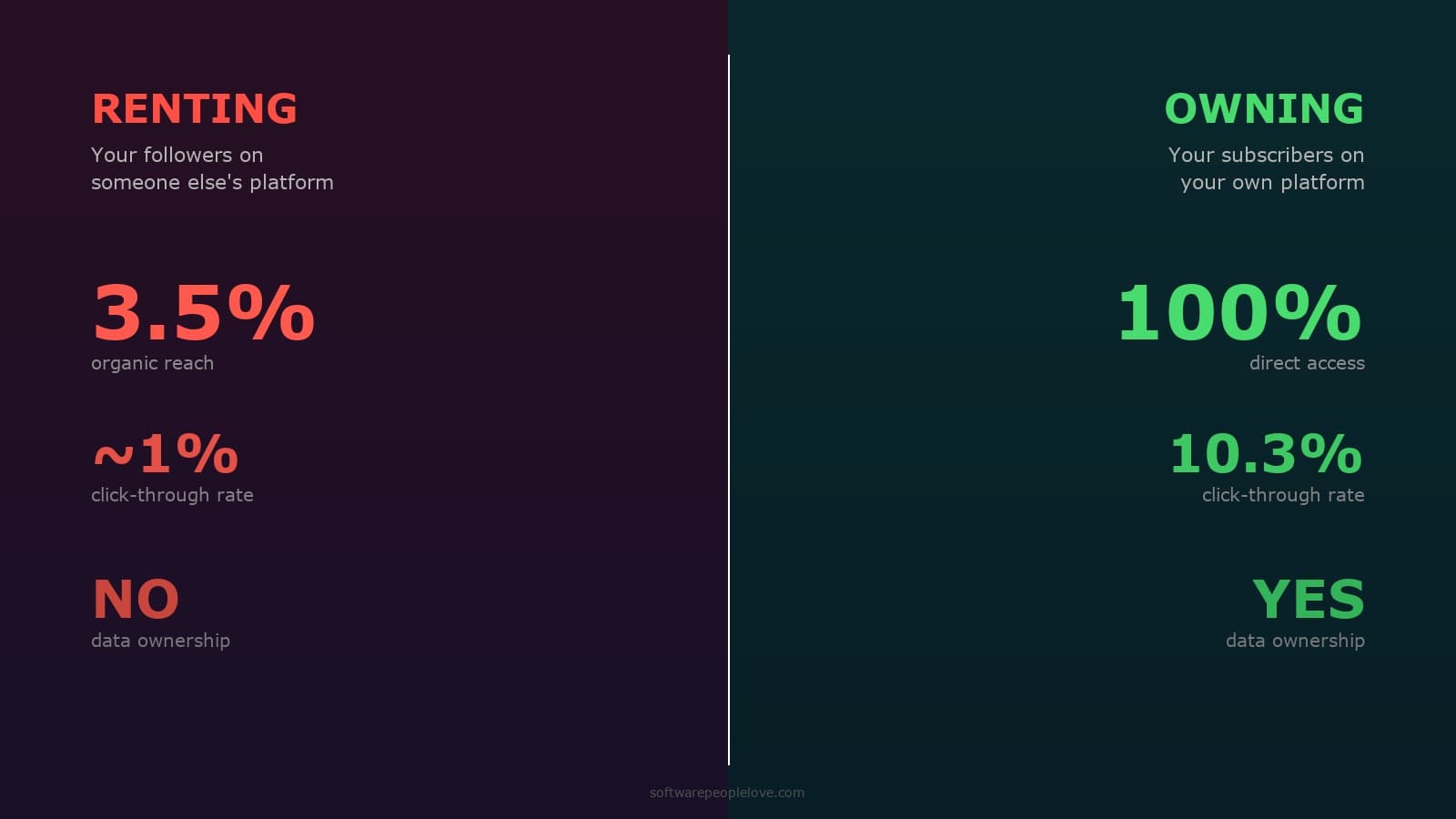
- The real Stan Store alternative isn't another storefront. It's a subscription business you own
Stan Store is the best link-in-bio storefront for creators who want to sell digital products. That's not a hedge. It's the truth. At $29-99/mo with zero revenue share, mobile-first design, and a setup process that takes hours instead of weeks, Stan Store earned its position.
John Hu built something real. Stan crossed $30M+ ARR, growing 20% month-over-month through early 2024. Forerunner Ventures backed it. Hundreds of thousands of creators use it daily.
This post is not about why Stan Store is bad. It's about what happens after Stan Store works.
| Stan Store Creator ($29/mo) | Stan Store Business ($99/mo) | Your Own App |
|---|
| Digital product sales | Yes | Yes | Yes |
| Courses | Yes | Yes | Yes |
| Email marketing | Basic | Advanced | Yes (owned list) |
| Booking calendar | Yes | Yes | Yes |
| Recurring subscriptions | Basic | Yes | Yes (App Store native) |
| Mobile app in App Store | No | No | Yes, your brand |
| Push notifications | No | No | Yes |
| Audience data ownership | Stan's system | Stan's system | Fully yours |
| Discovery channel | Your bio link only | Your bio link only | App Store + bio link |
| URL | stan.store/you | stan.store/you | App Store listing + your domain |
The bottom three rows are where storefronts and software businesses diverge.
Outgrowing your Stan Store?
We build fully branded subscription apps for creators. $0 upfront, we handle everything from design to App Store submission.Book a free strategy call →
What Stan Store Does Right
Give Stan Store credit for solving a genuine problem. Before Stan, creators who wanted to sell digital products had three options: Gumroad (10% cut), Kajabi ($149+/mo and overkill for most), or cobbling together Stripe, a landing page builder, and an email tool.
Stan Store compressed all of that into one product:
- Zero revenue share. You keep every dollar minus Stripe processing fees. That's rare and genuinely creator-friendly.
- Mobile-first checkout. Stan was built for Instagram and TikTok traffic. The buying experience works the way your audience actually shops: on their phone, fast, no friction.
- All-in-one for early monetization. Digital downloads, courses, coaching bookings, email capture, and a clean storefront. One subscription covers everything.
- Fast setup. A new creator can go from zero to selling in a single afternoon.
For creators in their first $0-5K/month of digital product revenue, Stan Store is hard to beat. If you're reading this and you haven't monetized yet, go use Stan Store. Seriously. Validate your offer, sell your first 100 digital products, build your email list. It's excellent for that phase.
The question is what comes after.
The Revenue Ceiling: One-Time Sales vs. Recurring
Digital product sales are transactional. You sell an ebook, a template pack, a course. Someone pays once. You deliver the product. Done.
To earn $10,000 next month, you need new buyers next month. Every month resets to zero. That's not a flaw in Stan Store. That's the nature of one-time digital product sales on any platform.
Here's what the math actually looks like:
Stan Store digital products (one-time sales):
| Month | New buyers needed | Revenue (at $27 avg) | Cumulative |
|---|
| 1 | 200 | $5,400 | $5,400 |
| 3 | 200 | $5,400 | $16,200 |
| 6 | 200 | $5,400 | $32,400 |
| 12 | 200 | $5,400 | $64,800 |
You need 200 new buyers every single month to maintain $5,400. If your content slows down, if the algorithm shifts, if you take a vacation, revenue drops immediately.
Subscription app (recurring revenue):
| Month | Total subscribers | Monthly revenue (at $9.99) | Cumulative |
|---|
| 1 | 200 | $1,998 | $1,998 |
| 3 | 350 | $3,497 | $8,491 |
| 6 | 550 | $5,495 | $23,976 |
| 12 | 900 | $8,991 | $71,910 |
Assumes 50 new subscribers/month, 5% monthly churn
By month 6, the subscription app surpasses the digital product revenue. By month 12, it's generated more cumulative revenue and is earning $9K/mo on autopilot. The digital product seller is still grinding for the same 200 new buyers.
This is what compounding does. Brand deals vs MRR is the same math problem. One-time revenue requires constant effort. Recurring revenue accumulates.
Here's something that happened with one of Foundry's creators.
They had a Stan Store link in their bio. It was working. They were selling digital products, collecting emails, booking coaching calls. Stan Store was doing its job.
Then we built their app. It launched in the App Store. Subscribers started coming in.
Within weeks, they pulled their Stan Store link from their bio and replaced it with their app link.
That's not a decision you make lightly. Your bio link is the single most valuable piece of real estate in your entire creator business. Every piece of content, every video, every story points there. When a creator replaces their Stan Store link with an app link, they're saying: this is worth more.
And the math backed it up. The app was generating more revenue per visitor than the storefront because each visitor who converted became a recurring subscriber, not a one-time buyer. One download could mean 12+ months of revenue instead of one transaction.
Stan Store gave them a cash register. The app gave them a business.
How Subscription Revenue Compounds Over 12 Months
Let's make this concrete. Take a creator with 150,000 Instagram followers who currently sells a $35 workout guide on Stan Store.
Scenario A: Stay on Stan Store
They sell 300 copies/month (a strong month). That's $10,500/month. But they need 300 new buyers next month. And next month. A bad month drops to 150 copies and $5,250. Revenue bounces between $5K and $11K depending on content performance, algorithm mood, and how many new followers they're pulling in.
Annual total: roughly $80,000-$100,000, but unpredictable.
Scenario B: Launch a subscription app at $9.99/month
They convert 2% of followers in month one (3,000 subscribers). Even with 6% monthly churn, here's what happens:
| Month | Active subscribers | Monthly revenue |
|---|
| 1 | 3,000 | $29,970 |
| 3 | 2,900 | $28,971 |
| 6 | 2,750 | $27,473 |
| 12 | 2,500 | $24,975 |
Even with conservative churn and zero new subscriber growth, the app generates $300K+ in year one. With even modest monthly additions of 200 new subscribers, year one crosses $400K.
That's not a storefront anymore. That's a business with predictable revenue, a subscriber base you can contact directly, and an asset you could sell.
The creator middle class earning $10K-$50K/month figured this out: the platform that validated your offer isn't always the one that scales it.
App Store Distribution and Push Notifications
Stan Store lives on stan.store. Your page is stan.store/yourname. It works when someone clicks your bio link. It doesn't work when someone searches "workout app" or "meal planning" in the App Store.
The App Store and Google Play have over 2 billion active users combined. When your app is listed there, you have a second discovery channel that works independently of your social media content. People find you through App Store search, editorial features, and category rankings without you posting anything.
Push notifications are the other piece Stan Store can't replicate. Email open rates for creators average 20-25%. Push notification engagement rates run 5-10x higher because they appear on someone's lock screen. When a subscriber is about to miss a workout, skip a lesson, or lapse on a habit, you can reach them directly.
Stan Store has email. Email is fine. But your app sits on someone's home screen next to Instagram, next to their banking app, next to their calendar. That real estate is worth more than an email address.
Who Should Stay on Stan Store
Not everyone needs to leave. Stan Store is the right tool if:
- You're under $5K/month in digital product revenue and still figuring out what your audience will pay for
- Your products are genuinely one-time purchases (templates, presets, design assets) that don't lend themselves to subscriptions
- You're testing multiple offers and need speed over infrastructure
- You don't yet have daily or habitual content (workouts, lessons, routines) that justifies a subscription model
Stan Store is a great starting line. Treat it like one.
Not sure if you've outgrown Stan Store?
We'll look at your audience, your current revenue, and your content type to figure out if a subscription app makes sense for your stage.Schedule a strategy call →
You've outgrown a storefront if:
- You're consistently selling digital products and your bottleneck is finding new buyers every month
- Your content is daily, habitual, or routine-based: workouts, meal plans, study sessions, meditations, practice routines
- You're already making $5K+/month and want that revenue to compound instead of reset
- You're tired of sending your audience to a URL you don't own (stan.store/you) instead of an app with your name on it
- You want push notifications, App Store discovery, and a direct subscriber relationship
The creators who've built the biggest businesses in the creator economy all made this jump. Kayla Itsines didn't sell workout PDFs forever. She built Sweat and sold it for $400 million. Krissy Cela moved from selling guides to building EvolveYou, now valued at over $70M.
They didn't abandon digital products because they failed. They moved beyond them because digital products have a ceiling that subscription software doesn't.
Frequently Asked Questions
Is Stan Store worth it for new creators?
Yes. At $29/month with zero revenue share, Stan Store is one of the best ways to start selling digital products. If you're pre-revenue or under $3K/month, Stan Store gives you everything you need without overcomplicating things. The question of alternatives becomes relevant when your revenue is consistent and you want it to compound.
What's the best Stan Store alternative for recurring revenue?
The best alternative depends on what you're building. Kajabi works for course creators who want an all-in-one web platform. Patreon works for community-first creators willing to pay 5-12% fees. A custom branded app works for creators who want App Store distribution, push notifications, and full ownership of their subscriber relationships. Each serves a different stage.
Can I use Stan Store and have my own app at the same time?
You can. Many creators keep their Stan Store for one-time digital product sales while their app handles subscriptions. Over time, most shift their primary bio link to the app once subscription revenue outpaces digital product sales. The transition doesn't have to be abrupt.
Is Stan Store good for fitness creators?
Stan Store is excellent for fitness creators selling workout guides, meal plans, and one-time digital products. Where it falls short is daily engagement: no push notification reminders, no workout tracking, no Apple Health integration, no offline access. Fitness is a daily-use category. The creators who've built the biggest fitness businesses (Whitney Simmons, Pamela Reif, Joe Wicks) all did it through apps, not storefronts.
How much does it cost to build an app as a Stan Store alternative?
Traditional development runs $50K-$200K upfront. Built by Foundry uses a different model: $0 upfront, revenue share after launch. We design, build, ship, and maintain your app in exchange for a percentage of subscription revenue. No risk to you until the app earns money. Learn more about how we work.
How is a custom app different from Stan Store's subscription feature?
Stan Store offers basic recurring payments through their web storefront. A custom app gives you a native App Store listing, push notifications, offline access, device-specific features (Apple Health, widgets, haptics), and a branded experience your subscribers download and keep on their home screen. The difference is between a checkout page and a product people use every day.
Stan Store built a great cash register. But at some point, you stop needing a better cash register and start needing a business.
The creators who figure this out early spend less time chasing new buyers and more time building something that compounds. Your audience is an asset. The question is whether you're converting that asset into one-time transactions or recurring relationships.
Content creators are the most powerful distribution force on the planet, and almost none of them own anything. We build every creator a real business of their own.
Talk to us about building your creator app →