
Turning Knowledge into Products

What Is RPM? YouTube Creator Pay in 5 Numbers

August 16, 2026
Share
What Is RPM? YouTube Creator Pay in 5 Numbers

Get Creator Revenue Insights

How creators are turning audiences into subscription businesses
Share
RPM (revenue per mille) is how much money a creator earns per 1,000 views, after the platform takes its share. It is the honest version of creator pay, and it is the number that decides whether an audience of a million people is a business or a job. Key Takeaways:
  • RPM = Total Revenue / Total Views x 1,000, counting every view, monetized or not
  • YouTube defines RPM as earnings per 1,000 views from ads, channel memberships, YouTube Premium, and Super Chat and Super Stickers combined (YouTube Help)
  • CPM is what advertisers pay before YouTube's cut. RPM is what lands in your account after it
  • YouTube pays 55% of net watch page ad revenue and 45% of the Shorts Creator Pool allocation (YouTube Help)
  • 67% of creators earn under $10,000 a year, and income tracks follower count more tightly than engagement (CreatorIQ and Influencers.club, State of Creators 2026)
  • One subscriber paying $12.99/month replaces roughly 1,818 monetized views every month, forever
RPM stands for revenue per mille, or revenue per 1,000 views. It is your total earnings divided by your total views, multiplied by 1,000. YouTube publishes the definition plainly: RPM is "how much money you've earned per 1,000 video views," and it rolls up ads, channel memberships, YouTube Premium revenue, and Super Chat and Super Stickers into one figure.
RPM = (Total Revenue / Total Views) x 1,000
Two details make RPM more useful than any other pay number a platform shows you. First, the denominator is every view, not just the monetized ones. A video that ran ads on 60% of its views still divides by 100% of them. That is deliberate, and it is why RPM is lower than creators expect and closer to reality than CPM. Second, it is post-split. YouTube has already taken its cut before the number appears in your analytics. Nothing else gets deducted at the platform level. For Shorts, YouTube calculates RPM per 1,000 engaged views rather than per 1,000 views, which is a different denominator on a different product. Comparing your Shorts RPM to your long-form RPM is comparing two things that were never measured the same way. CPM is what advertisers spend to reach 1,000 people. RPM is what you keep per 1,000 views after YouTube's revenue share. They are different sides of the same transaction, and creators lose money by quoting the wrong one.
MetricWhose moneyBefore or after the splitCounts which views
CPMAdvertiser spendBefore YouTube's cutMonetized impressions only
RPMYour earningsAfter YouTube's cutAll views on the video
A $20 CPM does not mean $20 per 1,000 views in your pocket. YouTube takes its share first, and then the figure gets spread across every view including the ones that never served an ad. This is why the CPM screenshots that circulate in creator Discords are always higher than anyone's actual deposit. RPM is the number to use when you are pricing anything: a sponsorship, a product, your time. It is also the number that tells you what a view is genuinely worth, which is usually less than a fraction of a cent. Every RPM figure is built from a handful of inputs, and only one of them is yours.
NumberWhat it controlsWho sets it
1,000The denominator RPM is always quoted againstThe industry
55%Your share of net watch page ad revenueYouTube
45%Your share of the Shorts Creator Pool allocationYouTube
67%Share of creators earning under $10,000 a yearThe market
1,818Monetized views one $12.99 subscriber replaces each monthYou
The first four are handed to you. YouTube's Partner Program terms state the splits directly: creators receive 55% of net revenues from ads on their watch page, and 45% of the revenue allocated from the Creator Pool based on their share of Shorts views. Those percentages are not negotiable at any subscriber count. The 67% comes from the State of Creators 2026 study, which Influencers.club ran with CreatorIQ across 5,095 creators in 100 regions between May 29 and June 29, 2026, with a margin of error of 1.4 percentage points. Two thirds of working creators earn under $10,000 a year from content. Just under 5% clear $100,000. The last number is the one you build. The State of Creators 2026 study found that creator income tracks follower and subscriber counts more closely than engagement across Instagram, TikTok, and YouTube, with Instagram follower count showing the strongest relationship to annual income of any metric measured. CreatorIQ's own framing calls this the authenticity gap: brands say they value trust, and the money still pays for reach. Read that through RPM and it stops being a philosophical complaint. RPM has one variable input you can move, and it is views. Not loyalty, not trust, not how many people would pay you if you asked. Views.
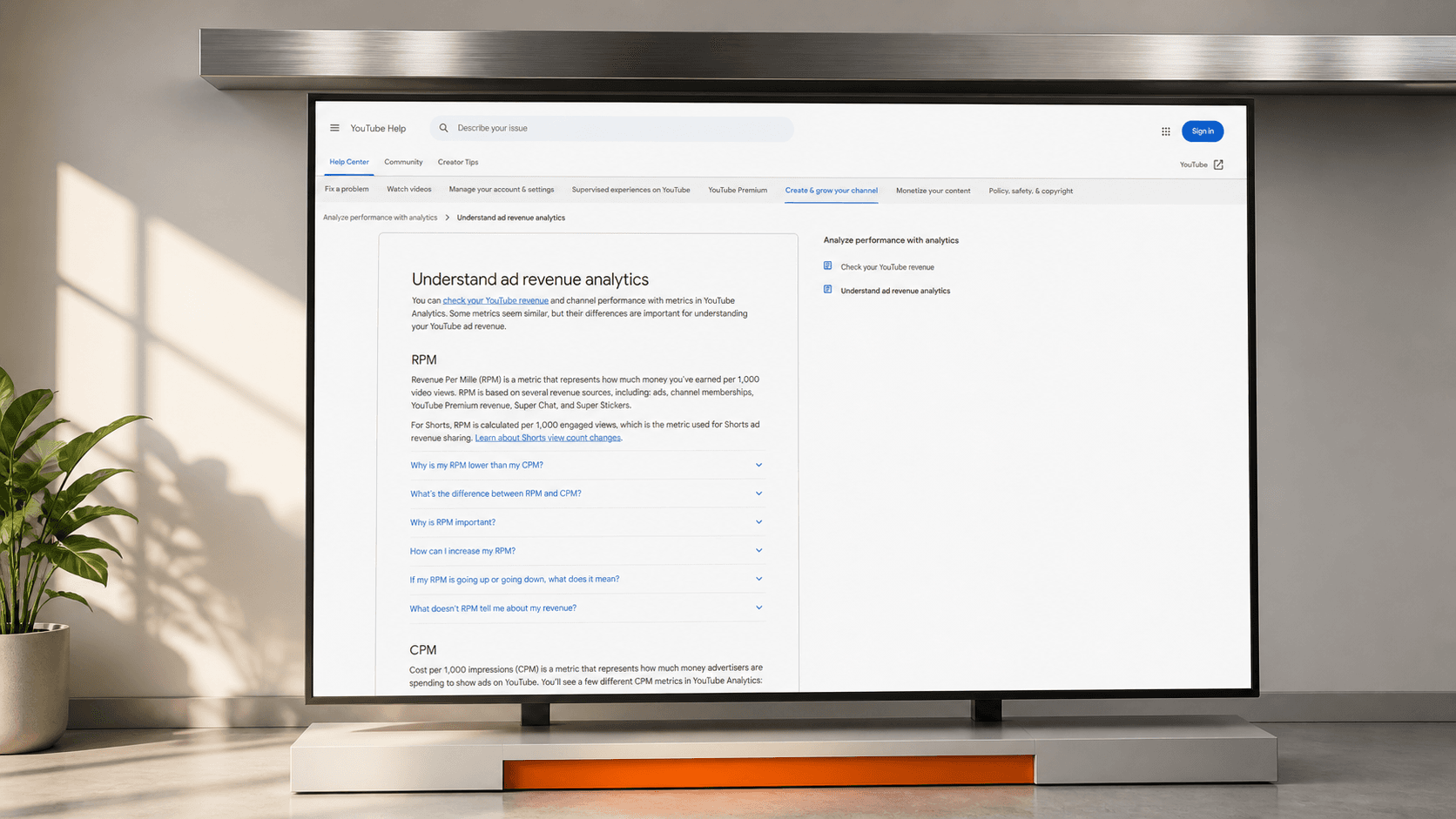
The official YouTube RPM help page displayed beneath a low steel ceiling bar, showing that the platform defines and caps the rate
So the growth plan RPM implies is: make more views. Then make more views again next month, because last month's views paid last month and paid nothing since. Your income resets to zero every month is not a metaphor about ad rates. It is what dividing by views does to a business. Meanwhile the split above your head is fixed. A creator with 50,000 subscribers and a creator with 15 million receive the same 55%. Scale buys you a bigger numerator and never a better deal. ARPU, average revenue per user, replaces RPM the moment your audience pays you directly instead of paying an advertiser's proxy. RPM is revenue per 1,000 views. ARPU is revenue per person per month. The unit changes from an impression you rent to a relationship you own. Run the conversion. Take a $5 long-form RPM, which sits in the normal band for a US audience. Now take one subscriber at $12.99/month in a creator app. Apple pays out 70% of the subscription price during a subscriber's first year and 85% after a year of paid service, and 85% from day one inside the App Store Small Business Program. At the 70% tier that subscriber nets $9.09 a month.
What you haveMonthly value at a $5 RPMWhat it takes to hold
1,000 views$5.00A video that performs this month
1 subscriber at $12.99/month$9.09 netAn app they open
500 subscribers$4,545 netThe same app
909,000 views$4,545909,000 more views next month
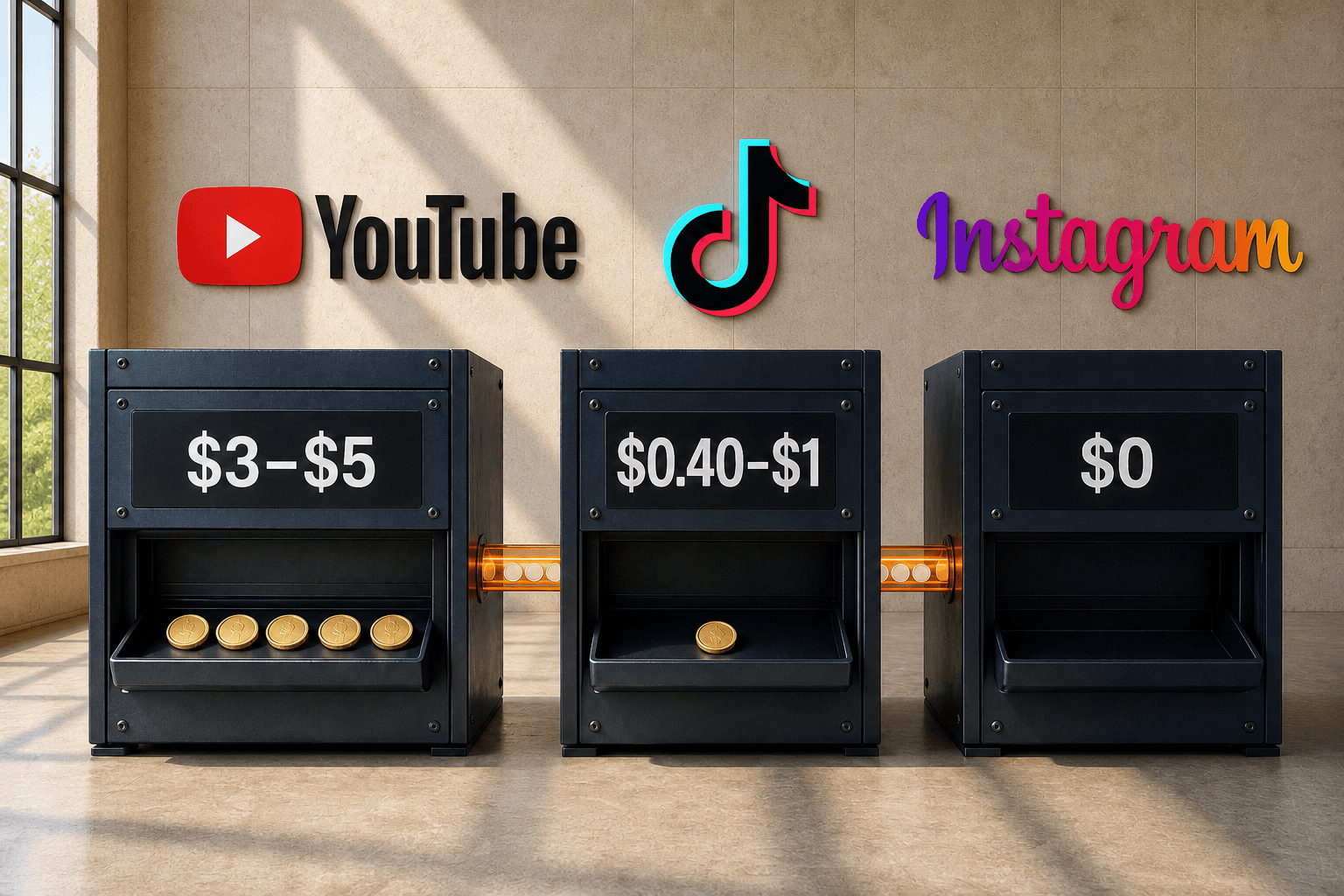
One subscriber is worth 1,818 monetized views every single month. Five hundred of them are worth 909,000 views a month, in perpetuity, without a single upload. That is the same arithmetic we ran across every major platform in how much platforms pay creators in 2026, and it lands in the same place every time. The subscription number also compounds in a direction RPM cannot. Views expire. Subscribers renew. RevenueCat's State of Subscription Apps puts median payer ARPU in health and fitness at $16.44 a month, which is three months of a $5 RPM on 1,000 views arriving from one person who already trusts you.
Disposable video-view tickets falling from a conveyor while one orange membership card keeps circling a recurring track
Here is the calculation, and it takes four minutes. Open YouTube Studio, find your RPM for the last 90 days, and write it down. Then multiply your monthly views by that RPM divided by 1,000. That is what the algorithm paid you. Now take 2% of your engaged followers. At 50,000 that is 1,000 people. Price them at $12.99 a month, net $9.09 after Apple's first-year cut, and you have $9,090 a month that does not depend on this month's uploads. Compare the two figures. For most creators at 50K the second number is larger, and the gap is not close. That is the whole reason BUILT BY FOUNDRY exists: the audience is already there, the willingness to pay is already there, and the only missing piece is a product to point it at. We build it in three weeks at $0 upfront, take a revenue share, and keep running and updating it so the recurring revenue stays recurring. RPM is a real metric and you should know yours. Just be honest about what it measures. It is the price a platform pays for your attention, set by the platform, quoted per thousand, and reset to zero every month. A good long-form RPM depends almost entirely on audience geography and topic, and creators commonly see single-digit dollars per 1,000 views. The more useful test is whether your RPM times your monthly views clears your monthly costs. YouTube's own analytics show RPM per channel, and no published benchmark beats the number in your own dashboard. No. YouTube's RPM covers ads, channel memberships, YouTube Premium revenue, and Super Chat and Super Stickers. Brand deals, affiliate income, merchandise, and your own product sales are outside it entirely, which is why RPM understates total creator income and overstates how much of it the platform controls. Because CPM is advertiser spend before YouTube's revenue share, and RPM is your earnings after it, spread across every view rather than only the monetized ones. YouTube pays 55% of net watch page ad revenue, so the split alone accounts for most of the gap, and the unmonetized views account for the rest. The levers are audience geography, video length and ad placement, topic category, and the share of views that are monetizable. All of them move RPM within a band the platform sets. None of them change the 55% split, which is why creators who want a materially different rate change what they sell rather than how they sell views.
RPM is the rate you were assigned. ARPU is the rate you set. BUILT BY FOUNDRY builds subscription apps for creators, then runs and optimizes them. $0 upfront, revenue share, three weeks to the App Store.
See What We’d Build You →
Our work

Creators who already did this

These are apps we designed, built, shipped, and still run today, with the creator keeping the code and the audience.

Creator app strategy

Curious what your app could be?

Enter your handle and BUILT BY FOUNDRY will research your audience and present custom app concepts. Free.

What Is RPM? YouTube Creator Pay in 5 Numbers