

Thinkific Review 2026: Is It Worth It for Creators?

Thinkific Review 2026: Is It Worth It for Creators?

Foundry
May 11, 2026
Our verdict: Thinkific is one of the cleanest, most stable course platforms in the market in 2026. The builder is fast, the editor is intuitive, and the company actually pays its bills, which matters more than creators give it credit for. But Thinkific is a course hosting tool, not a business. The 10,000 student ceiling on every published tier, the $199/month surcharge for a branded mobile app on the Plus plan, and the lack of any real App Store presence put a hard cap on what a creator can build on it. Rating: 3.5/5. Key Takeaways:
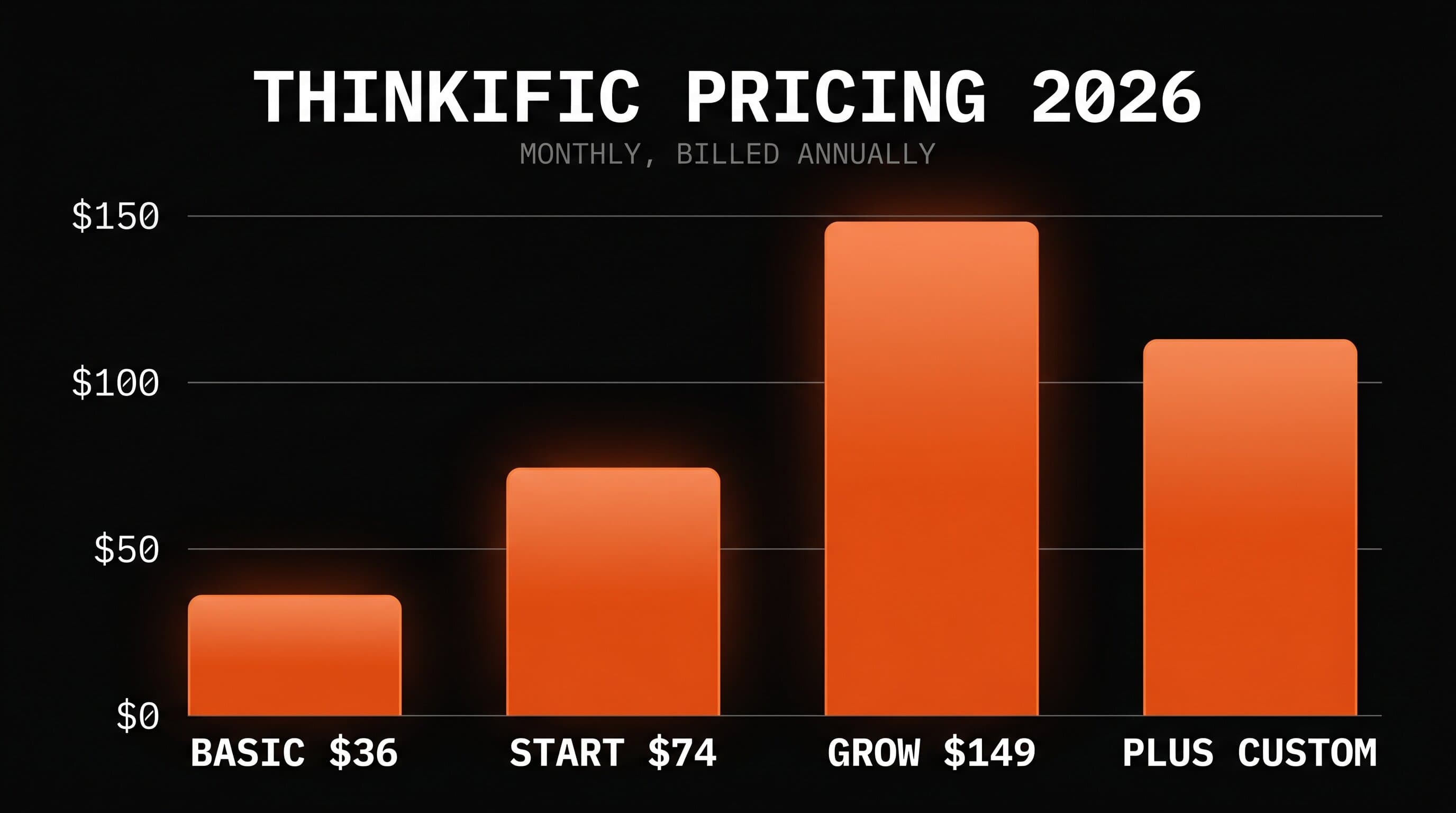
  • Thinkific pricing in 2026 runs $36/month on Basic to $149/month on Grow, billed annually, with Plus enterprise sitting on top behind a sales call (Thinkific pricing)
  • Thinkific Payments takes 2.9% of every transaction, on top of standard gateway fees through Stripe or PayPal
  • A fully branded mobile app is a $199/month add-on, only available on Thinkific Plus
  • The platform reported $18.7 million in Q1 2026 revenue and $75.7 million in gross payments volume, up 16% year over year (Q1 2026 results)
  • Capterra reviewers give it 4.4/5 across 205 reviews, with 86% positive sentiment (Capterra)
  • For a course creator who wants a clean checkout and a video library, Thinkific is fine. For a creator who wants a subscription business their audience pays for monthly, it is a starting point, not the finish line.

Thinkific is a Canadian course platform that lets creators build, sell, and deliver online courses, memberships, communities, and live cohorts under their own brand, in exchange for a monthly fee plus a 2.9% payment processing cut. Founded in 2012 by Greg Smith, Matt Smith, Miranda Lievers, and Matt Payne in Vancouver, the company went public on the Toronto Stock Exchange in April 2021 under the ticker THNC. The product started as a pure course tool and grew into something closer to a creator suite: communities, memberships, certificates, live events, coaching, an AI assistant called Thinker, and an optional branded mobile app for Plus customers. As of the Q1 2026 earnings release, Thinkific reports $61.3 million in annualized recurring revenue and $175 ARPU per paying customer, with the launch of Thinker generally available since February 24, 2026. Plenty of large creators run on Thinkific. The platform has been used by individual experts, certification bodies, and consultancies to ship courses without writing any code. That is still its strongest pitch in 2026.
CategoryScore
Course builder and editor4.5/5
Pricing transparency4/5
Transaction fees3/5
Branded mobile app access2/5
Customization and brand control3.5/5
Community and engagement3/5
Audience ownership3.5/5
Ceiling as a business model2.5/5
Overall3.5/5
Thinkific scores high on the parts a course creator touches every day: the editor, the upload flow, the checkout. It scores lower on the parts a founder touches every day: distribution, App Store presence, product expansion beyond a video library. Thinkific charges a monthly platform fee, with annual billing knocking 25% off the price. Here is the live pricing pulled from thinkific.com/pricing in May 2026:
PlanMonthlyAnnualBest for
Basic$49/month$36/monthSolo creators with one or two courses
Start$99/month$74/monthMost full-time creators selling courses and memberships
Grow$199/month$149/monthLarger creators wanting API access and three communities
PlusCustomCustomEstablished education businesses needing SSO and a branded app
Every paid plan supports unlimited courses, unlimited products, and unlimited students, up to a current-student ceiling of 10,000 below Plus. Video bandwidth scales by tier: 100 GB/month on Basic, 200 GB on Start, 400 GB on Grow, and 7,500+ GB on Plus. On top of the subscription, Thinkific Payments takes 2.9% of every transaction. Stripe and PayPal gateway fees apply on top if you bring your own processor. The free plan exists but is locked to one course and is essentially a trial. The branded mobile app is a $199/month add-on, only available on the Plus tier. Stack the math for a creator pulling $20,000/month in course revenue. The Grow plan costs $1,788/year billed annually. Thinkific Payments takes another $580/month, or $6,960/year. That is roughly $8,748/year in platform cost before the branded mobile app add-on, which adds another $2,388. If you want the branded app, you are paying close to $11,000/year for the right to run a video library under your own logo on a phone.
Thinkific pricing tiers compared side by side
Several parts of the product are genuinely good and worth paying for if you are running a course business. The course builder. The drag and drop editor is fast and forgiving. You can structure a course into chapters and lessons in minutes, drop in video, PDFs, audio, quizzes, surveys, and assignments without leaving the page. The preview is honest. The publish flow does what you expect. Zero transaction fees on the platform side. Thinkific's own platform fee on course sales is 0%. The 2.9% is Thinkific Payments, which is the processing layer, comparable to what Stripe charges directly. By contrast, Teachable historically charged a transaction fee on top of processing on its lower tiers. Thinkific does not. That matters once you start shipping volume. A real company under the hood. Thinkific is a public company on the TSX with $61.3 million in ARR and a positive cash flow trajectory in 2026, according to its latest investor release. For creators who got burned by the wave of creator platforms that ran out of funding and closed in 2024 and 2025, that stability has real value. Thinker, the AI teaching assistant. Launched on February 24, 2026, Thinker sits inside a course and answers student questions in the voice of the course content. Greg Smith, the CEO and founder, told investors customer response "validates both the investment and the direction of our AI strategy." For creators selling expertise-heavy courses, this is a genuine differentiator against bare-bones competitors. Communities and memberships. The Grow plan includes three communities with up to 20 spaces each. You can layer a community on top of your courses for a monthly subscription, which is the closest Thinkific gets to recurring revenue. It works. It is not best in class against Circle or Skool, but it is competent. Customer reviews are strong. Thinkific holds a 4.4/5 rating on Capterra across 205 reviews, with 86% positive sentiment, 8% neutral, and only 6% negative. That is a healthier distribution than most platforms in the category. The gaps show up the moment you try to treat your course empire like a real software business instead of a video library with a checkout. The branded mobile app sits behind a wall. The default Thinkific student app is a generic, multi-tenant app. Your students download "Thinkific" and log into your school inside it. Your logo is on the school. The app icon, the splash screen, the App Store listing, none of those are yours. To get a fully branded iOS and Android app, you need Thinkific Plus, which requires a sales call, plus the $199/month branded app add-on. In a world where the App Store is the single best discovery channel a creator can have, hiding that capability behind enterprise pricing is a deliberate choice. The 10,000 student ceiling is real. Every plan below Plus caps current students at 10,000. For most creators that is fine. For creators with serious distribution behind a free tier or a high-traffic funnel, it becomes a forced upgrade conversation. The cap is not on lifetime students; it is on currently enrolled students. The line is fuzzier than the pricing page makes it look. Customization gets thin past the theme editor. Thinkific's site builder is decent for a course platform and weak as a website builder. You can pick a theme, change colors, drop in your logo, and tweak a few sections. Deeper customization means writing Liquid or hiring a developer who knows Thinkific's specific code blocks. The further you go from the templates, the more it feels like fighting the tool. Email marketing is barely a feature. Thinkific includes basic broadcast email. It is not a serious email tool. Most creators end up paying for ConvertKit, MailerLite, Beehiiv, or ActiveCampaign on top, which adds another $30 to $200 a month to the stack. No real App Store presence of your own. This is the structural issue with every course platform. Your course sits inside a web URL and inside a generic platform-branded app. You do not have a listing in the App Store under your own name. You do not show up when someone searches the App Store for the topic you cover. New customers who never saw your social content cannot find you on the App Store, because there is nothing of yours to find. We covered the math on this in the App Store as a creator growth channel. No product surface beyond a course. A course is a finite asset. You build it, you ship it, you sell it, and you spend the next two years on Instagram telling people it exists. Software is a different shape. A subscription app keeps generating value every day a user opens it, which keeps generating content for the creator to post, which keeps the cycle alive. Thinkific does not give you that surface. The product is always going to be a video library with a quiz at the end. Migrating off is awkward. Exporting course content is possible. Migrating paid students with their card on file is not clean, because the Stripe customer relationship sits inside Thinkific's account, not yours. The longer you stay, the higher the switching cost. That is platform lock in dressed up as a feature. Thinkific is the right call for a narrow set of creators. Pick it if all of the following are true:
  • You are selling courses, not building a subscription product
  • Your audience is comfortable buying through a web checkout and consuming on a desktop or a generic student app
  • Your business is one to ten courses, not a daily-use product
  • You want the cleanest course editor on the market and you are willing to pay for that comfort
  • You do not need a branded mobile app, or you are large enough to pay for Plus plus the add-on
If you are an academic, a corporate trainer, a certification body, or an expert with a high-ticket course, Thinkific does its job and does not get in your way. For a comparison against Kajabi's all-in-one positioning, we wrote up Kajabi vs Stan Store vs building your own app. For a course-platform sibling, see our Teachable Review 2026. This is the real comparison most creators with 50K+ engaged followers should be making. A course platform is a tool. A custom app is a business.
DimensionThinkific GrowCustom App (Foundry)
Setup cost$0$0 upfront, revenue share
Monthly platform fee$149/month + $199/month for branded app$0
Transaction fees2.9% Thinkific PaymentsApple/Google standard (15% to 30%)
App Store listingNone of your own below PlusYour app, your listing, your reviews
Student cap10,000 current studentsUnlimited
Product typeVideo library + quizzesDaily-use software product
Content generationNone, you brainstorm postsApp usage becomes content automatically
Ownership of audience dataInside ThinkificYours
Discovery channelYour social posts onlyApp Store + your social posts
Long-term equityCourse catalogA standalone software business
We ran the full revenue math on this in Thinkific vs Your Own App: The Revenue Math. The short version: a 50K-follower creator who would gross $80K to $120K a year selling courses on Thinkific can clear $300K+ a year running a $9.99/month subscription app to the same audience, with App Store discovery layering on new users who never saw the social content. The decision is not really Thinkific versus a competitor course platform. The decision is course business versus software business. Our position is unambiguous. Software wins, every time, for any creator with daily-engaged followers and a real area of expertise. See why creators are leaving Kajabi for apps for the same logic applied to the most expensive course platform on the market. Thinkific is worth it for a course creator who wants a clean, stable platform with strong reviews and a competent editor. At $36 to $149/month annually plus 2.9%, it is fairly priced for what it does. It is not worth it for a creator who wants a daily-use subscription product, a branded App Store presence, or recurring revenue from software rather than from courses. Thinkific charges 0% in platform fees on course sales. Thinkific Payments takes 2.9% per transaction. If you use Stripe or PayPal directly, their gateway fees apply on top, varying by country. Yes, but only on Thinkific Plus, the enterprise tier, with a $199/month branded mobile app add-on. Below Plus, students download a generic Thinkific app and log into your school inside it. Your logo and content live inside someone else's app. Thinkific has the cleaner editor, no platform transaction fees on course sales, and a stronger Capterra rating. Teachable, owned by Hotmart since 2020, has stronger international payment support and a more flexible affiliate program. Both have the same structural ceiling: they are course tools, not businesses. Course content exports. Paid student card relationships do not migrate cleanly because the Stripe customer is owned by Thinkific's account, not yours. Plan migration costs into the decision before you stay too long. For a single course, yes. For a creator with 50K+ engaged followers and a defensible area of expertise, no. A custom app gives you App Store discovery, recurring revenue, audience ownership, and a product surface that generates content for you. Read about our model and team to see how the revenue share economics actually work. Thinkific is a 3.5/5 platform. It does the course thing well and prices itself reasonably for what it delivers. If your business is a video library with a checkout, this is one of the best ways to run it in 2026. If your business is a software product your audience opens every day, Thinkific is the wrong shape. You are paying for a tool when you should be building an asset. Stop renting a course platform. Build your own app. $0 upfront, 3 week delivery, App Store discovery, recurring revenue, we handle the tech forever.
Let's Build →

Get Creator Revenue Insights

How creators are turning audiences into subscription businesses

You might also enjoy...

Thinkific Review 2026: Is It Worth It for Creators?