
Platform Reviews

Streams vs Subscribers in 2026: 72 People Match Spotify's 100,000th Artist

September 5, 2026
Share
Streams vs Subscribers in 2026: 72 People Match Spotify's 100,000th Artist

Get Creator Revenue Insights

How creators are turning audiences into subscription businesses
Share
Key Takeaways:
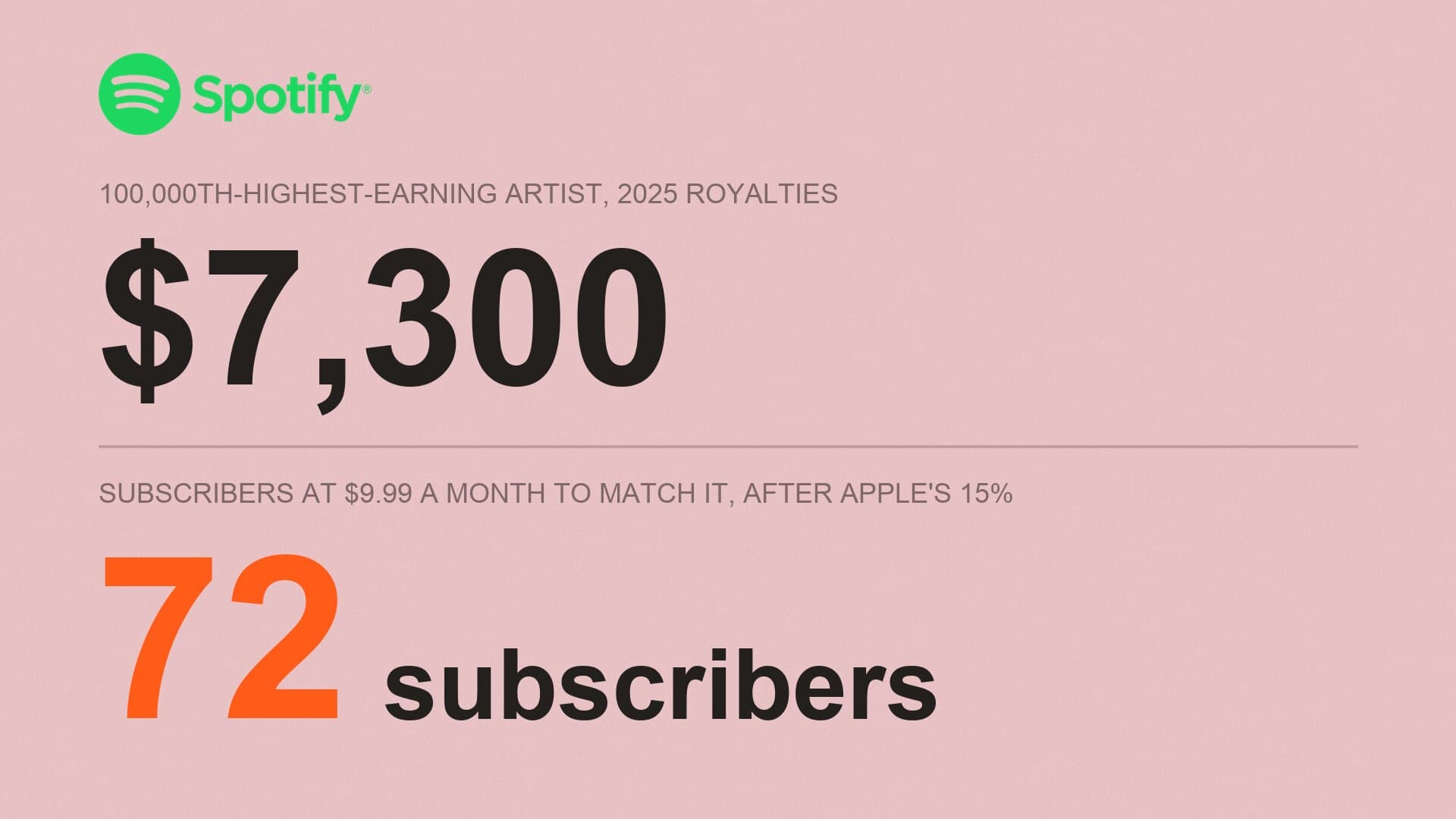
  • Spotify's Loud & Clear release of March 11, 2026 reports that the 100,000th-highest-earning artist generated more than $7,300 in 2025 royalties, up from roughly $350 in 2015
  • Spotify states plainly that "a 'per stream' rate isn't actually how anyone gets paid" and publishes the real benchmark instead: capturing one in a million of all Spotify streams in 2025 generated about $11,000
  • At $9.99 a month under the App Store Small Business Program rate of 15%, one subscriber nets $101.90 a year. So 72 subscribers match the 100,000th-ranked artist and 982 match the $100,000 tier that 13,800 artists reached worldwide
  • The payout is not paid to you. Spotify's own words: "We don't pay artists or songwriters directly, we pay rights holders, who then pay you based on your agreement with them"
  • Streaming is a distribution machine, not a business model. It is very good at putting your work in front of strangers and structurally incapable of telling you who they are
Every year Spotify publishes the most useful document in the creator economy and almost nobody reads it as a business case. Loud & Clear is the company disclosing, in its own numbers, exactly what its payout curve looks like from top to bottom. The 2026 release covers 2025, and it is a genuinely good year: more than $11 billion paid out, nearly $70 billion since launch, and roughly half of it generated by independent artists and labels. Read the same document as an operator and a different sentence jumps out. The 100,000th-highest-earning artist on the entire platform generated more than $7,300 in 2025. That is not a scandal. It is twenty times what the same rank produced in 2015, and Spotify is right to publish it. It is a measurement, and the moment you have a measurement you can price the alternative against it. So we did, using one identical scenario and only published rates. A creator with an audience has two ways to convert attention into money that arrives every month. Route one is streamshare: your work sits on a platform, strangers play it, and you receive a fraction of a royalty pool. Route two is a subscription your audience buys from you directly. Priced under Apple's Small Business Program rate of 15%, a $9.99 monthly subscription nets $8.49 a month, which is $101.90 a year per subscriber. Every figure in the right-hand column below is that number divided into Spotify's own published tier.
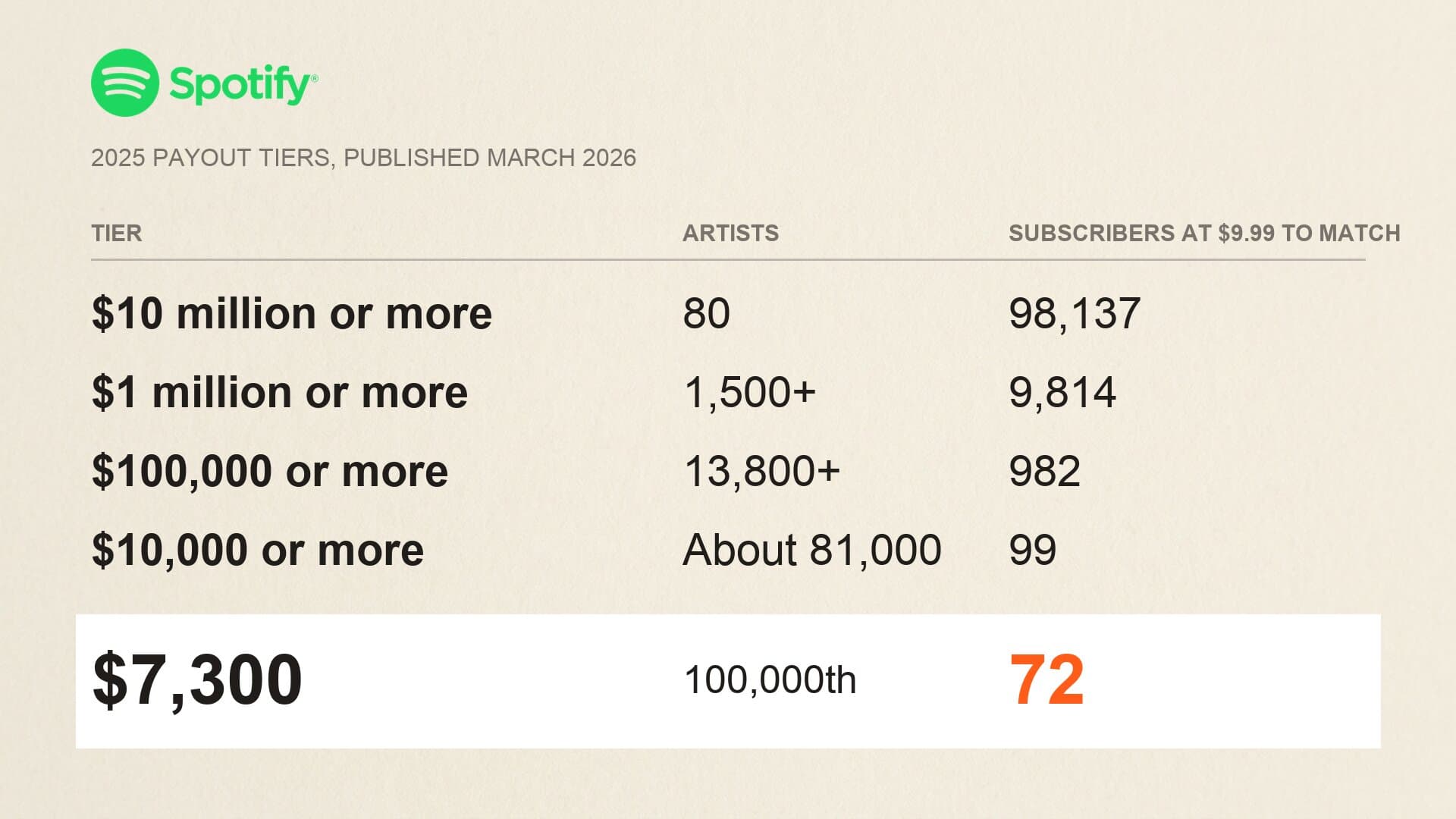
Spotify payout tier, 2025Artists who reached itSubscribers at $9.99 to match it
$10 million or more8098,137
$1 million or more1,500+9,814
$100,000 or more13,800+982
$10,000 or moreAbout 81,00099
$7,300, the 100,000th-ranked artist172
The artist counts come from Spotify. The subscriber counts are arithmetic a reader can redo in a calculator. Nothing in that table depends on an opinion about streaming. Spotify does not pay a per-stream rate, and says so directly: "a 'per stream' rate isn't actually how anyone gets paid." Royalties are calculated as streamshare, which Spotify defines as your streams in a market divided by total streams in that market, applied to that market's royalty pool. The company's published benchmark is that capturing one in a million of all Spotify streams in 2025 generated about $11,000. That last figure is the most useful number Spotify has ever published, because it converts the whole platform into a single unit you can do division with. Want $100,000 a year from Spotify? You need roughly nine millionths of every stream on the service, worldwide, for twelve months. Every language, every genre, every catalog track, every playlist, every car ride. Nine parts in a million of all of it. Spotify frames the same math optimistically in its FAQ, noting that capturing 1% of streams from 1% of listeners earns $1 million a year. Both framings are true. The difference is that one describes a share of somebody else's pool and the other describes a customer, and only one of those two things can be sold, willed, or grown on purpose. Spotify's Loud & Clear release of March 11, 2026 reports that the 100,000th-highest-earning artist generated more than $7,300 in royalties in 2025, compared with roughly $350 for the same rank in 2015. That is before rights holders and distributors take their share. Sit with what rank 100,000 means. Spotify says about 13 million people have uploaded at least one song, and estimates roughly 250,000 of them are pursuing music professionally. Being the 100,000th-biggest earner puts an artist inside the top 1% of everyone who has ever uploaded, and roughly at the 40th percentile of working professionals. Seventy-two people paying $9.99 a month produce the same money.
Spotify's published 2025 payout tiers set against the number of $9.99 subscribers required to match each one
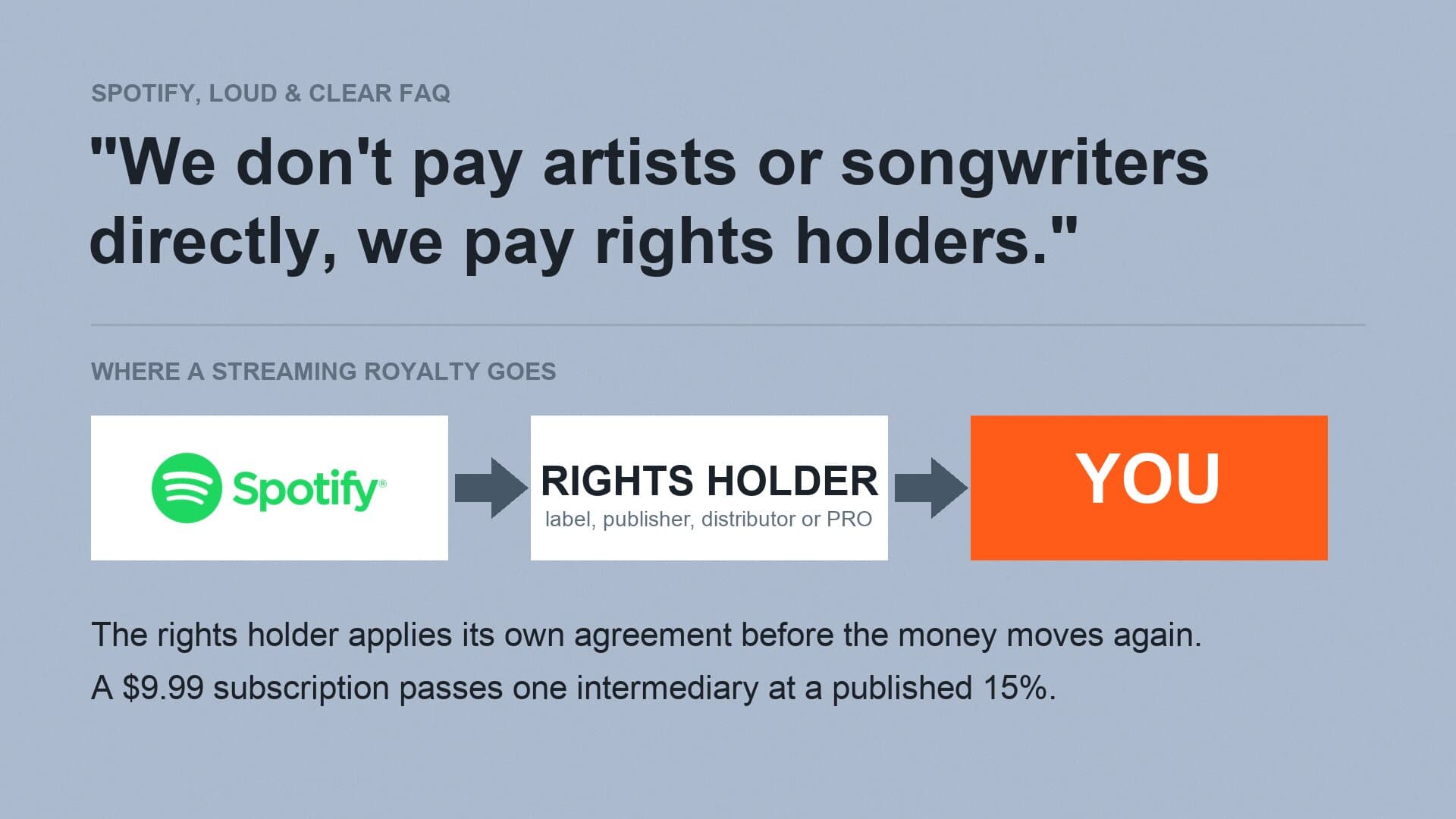
Seventy-two is not a marketing number. It is a birthday party, a small lecture hall, a decent Tuesday in a Discord server. Any creator reading this with 50,000 followers has 72 people who would pay for the right thing, and the reason they are not paying is that nobody has built the thing. Meanwhile the $10,000 tier, reached by about 81,000 artists according to the same release as reported by Music Ally, takes 99 subscribers to match. Two-thirds of professional artists on the platform earn less than that. Because Spotify is not your customer's payer and never was. In its own words: "We don't pay artists or songwriters directly, we pay rights holders, who then pay you based on your agreement with them." A rights holder is a label, a publisher, a distributor, a performance rights organization, or a collecting society, and each one applies its own agreement before the money moves again. This is the structural difference and it survives every argument about rates. The $7,300 is gross into a chain, not net into a bank account. Even a fully independent artist on the cheapest possible setup is routing through a distributor: DistroKid's Musician plan is $24.99 a year and advertises that you keep 100% of earnings, which is the best version of this deal that exists, and it still means a company you pay stands between you and your listener.
Spotify's published statement that it pays rights holders rather than artists, shown as the chain a royalty travels
Now run the same trace on the subscription. A listener opens an app with your name on it, pays $9.99, and Apple takes 15% under the Small Business Program and remits the rest. There is one intermediary and its rate is published on one page. More importantly, the transaction leaves a record: a person, a start date, a renewal, a cancellation you can ask about. Spotify's royalty statement contains none of those things, because a stream is not a relationship. This is the same problem we found in what a creator storefront actually earns, and it has the same shape everywhere: revenue that cannot accumulate context cannot compound.
Streaming royaltiesDirect subscription
What you ownA share of a poolA customer record
Who pays youA rights holder, on their scheduleApple, monthly, as merchant of record
Published rateNone; streamshare varies by market and month15% under the Small Business Program
Growth leverMore streams, competing against all streamsMore subscribers, competing against nobody
What happens if you stop postingCatalog decays as new music floods the poolRenewals continue until someone cancels
Who your audience belongs toThe platformYou
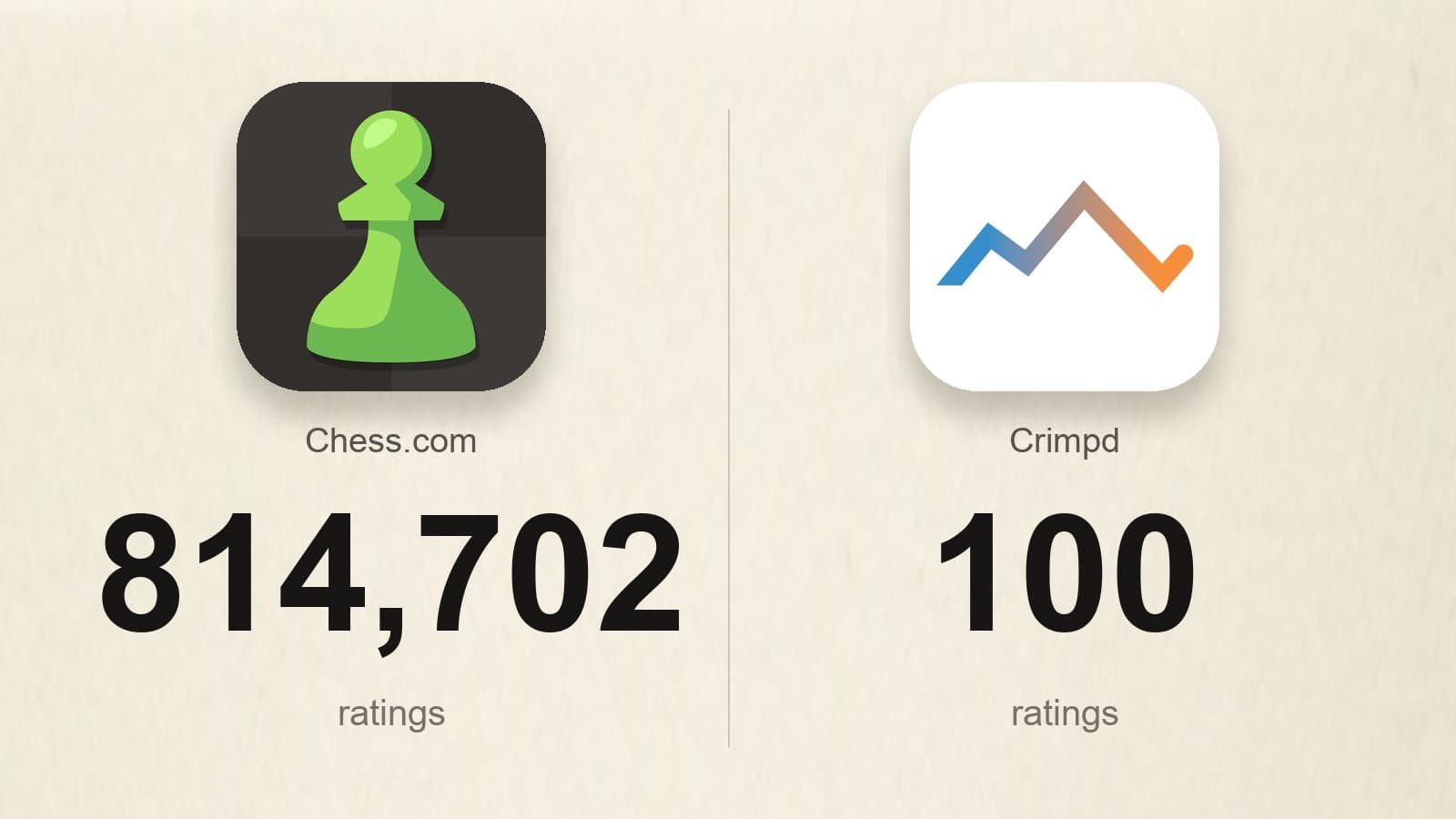
The row worth arguing about is the fourth one. Streamshare is a zero-sum denominator: every artist who releases anything this month makes your fraction smaller, whether or not a single one of your listeners left. Nobody's subscription gets cheaper because a stranger launched a product. That single structural fact is why a smaller number of subscribers beats a larger number of streams, and it does not depend on Spotify raising or lowering anything. Both, and in that order, because they are not competitors. If you are a musician, a producer, a music teacher, or anybody whose audience found you through sound, keep releasing. Spotify accounts for roughly 30% of global recorded music revenue, up from under 15% in 2017, and it is the most efficient discovery surface ever built for music. Treat it as the top of the funnel it actually is. Nine millionths of all streams is a bad target; being findable by strangers is an excellent one. Then build the thing your audience already does badly without you. Not a paywalled feed, which nobody wants. The tool. Ear training for the people who watch your theory breakdowns, the way we wrote about the software gap under a music education channel. A sample and practice environment for the producers who copy your technique, which is the argument in our piece on flip-and-sampler workflows. The daily thing, on a schedule, that somebody currently pays a stranger for. Ninety-nine subscribers is the entire $10,000 tier. You do not need a hit. You need a hundred people and a product that opens on a Tuesday. It deserves the honest column. Spotify grew the 100,000th-ranked artist's income twenty-fold in a decade, paid $11 billion in a single year, and put 16 languages into its Global Top 50. Loud & Clear also reports that more than 80% of artists earning over $1 million have never had a top-50 hit, which is a real statement about a long tail that used to earn nothing at all. None of that is in dispute. What is in dispute is whether it constitutes a business. A business has customers you can name, revenue you can forecast, and an asset that survives a quarter you spent on something else. Streaming supplies none of the three by design, and it never claimed to. The mistake is not using it. The mistake is finishing there. The same trap catches every creator whose income depends on continuing to appear, which is why a million-subscriber streamer can take nine months off and watch the number collapse. Reach that stops paying when you stop performing is a job with extra steps. Find your rank. Open your distributor's dashboard and total your last twelve months of streaming income. Compare it to $7,300. That number now has a public meaning. Convert it. Divide by $101.90. That is how many people paying $9.99 a month would replace your entire streaming income. Almost every reader will get a number smaller than the group chat. Name what they do daily. Not what they listen to. What they practice, track, log, or fail at repeatedly. That is the product, and it is a different question from what you release. Check who owns the shelf. Search the App Store for the thing your audience does. If the leader has a few hundred ratings, that is a vacancy, and we wrote the twelve-search version of that check so you can run it in five minutes. Spotify told the truth this year, in public, with numbers. Rank 100,000 pays $7,300. Seventy-two people pay the same, and unlike a millionth of a royalty pool, they answer when you write to them. Payout tiers, the 100,000th-artist figure, the streamshare definition, the one-in-a-million benchmark, the rights-holder statement, and the 30% market-share figure retrieved from Spotify's Loud & Clear takeaways, payouts, and FAQ pages and the Spotify Newsroom release of March 11, 2026 on September 5, 2026. The $10,000 tier count as reported by Music Ally on March 11, 2026. Commission rate and eligibility from Apple's App Store Small Business Program. Distribution pricing from DistroKid. Subscriber-equivalent figures are our arithmetic on a $9.99 monthly price at the 15% rate.
Our work

Creators who already did this

These are apps we designed, built, shipped, and still run today, with the creator keeping the code and the audience.

Creator app strategy

Curious what your app could be?

Enter your handle and BUILT BY FOUNDRY will research your audience and present custom app concepts. Free.

Streams vs Subscribers in 2026: 72 People Match Spotify's 100,000th Artist