
Turning Knowledge into Products

Does Your Store Have Recurring Revenue? 1 URL and 4 Numbers

September 1, 2026
Share
Does Your Store Have Recurring Revenue? 1 URL and 4 Numbers

Get Creator Revenue Insights

How creators are turning audiences into subscription businesses
Share
Add /products.json to the end of any Shopify store's address and the store hands you its entire catalog, then read four numbers in the response: how many products exist, what they cost, how many were published in the last twelve months, and how many can be bought on a repeating schedule. The fourth number is the one that decides whether the business compounds. On five of the six creator stores tested for this post, it was zero. Key takeaways:
  • The catalog is public. No account, no tool, no permission, no scraping software.
  • Product count measures effort. New products in the last twelve months measures the treadmill.
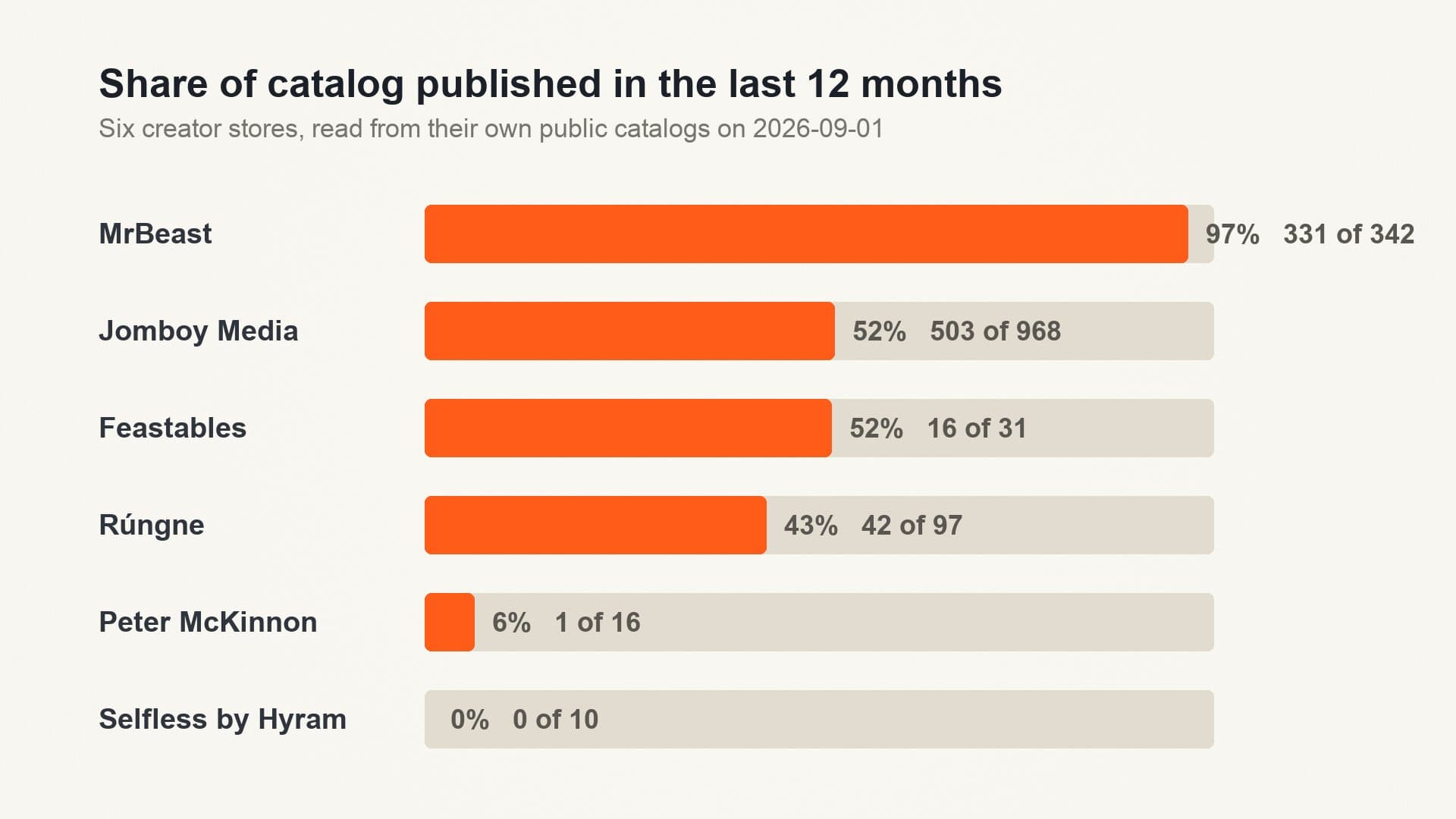
  • Jomboy Media has published 503 new products in twelve months. MrBeast's store has published 331. Neither sells anything on a schedule.
  • The field most people read to check for subscriptions is the wrong field, and it will tell you a store has none when every product has one.
  • A catalog with no repeating purchase in it is not a small problem to fix later. It is the reason the revenue resets in January.
Every creator with a store has a number they quote in interviews, and it is almost always the number of products or the revenue in a launch week. Neither of those tells you whether the business would still be earning in six months without a single new post. The catalog itself does, and it is sitting behind a URL anybody can open. A catalog tells you what the customer's second purchase has to be, and a catalog of one-time goods requires that second purchase to be a different item you have not made yet. That is the whole mechanism. When nothing in a store repeats on its own, revenue is a function of how many new things were released this quarter, which means the creator is the engine and stopping is the same as churning. This is a different question from whether a store is successful. Several of the stores below are excellent businesses by any normal measure. The question is narrower and harsher: if the creator posted nothing for ninety days, what would still bill? The reason this is checkable at all is that Shopify storefronts publish their own catalog in machine-readable form by default. It is the same data the store's own theme uses to draw the product grid. You are not getting behind anything; you are reading the front window in a different font. Open a browser. Take the store's domain and add /products.json?limit=250. That returns the first 250 products. Add &page=2 for the next 250, and keep going until a page comes back empty.
  • Count the products. How much catalog work exists. This is the number creators quote.
  • Read the price band. Take the lowest and highest price field across all variants. This is the one-time ticket the customer is being asked for.
  • Count what is new. Every product carries a published_at date. Count how many fall inside the last twelve months. That is the release rate the current revenue depends on.
  • Count what repeats. This one needs a second URL, and it is the reason most people get it wrong. It is covered in the next section.
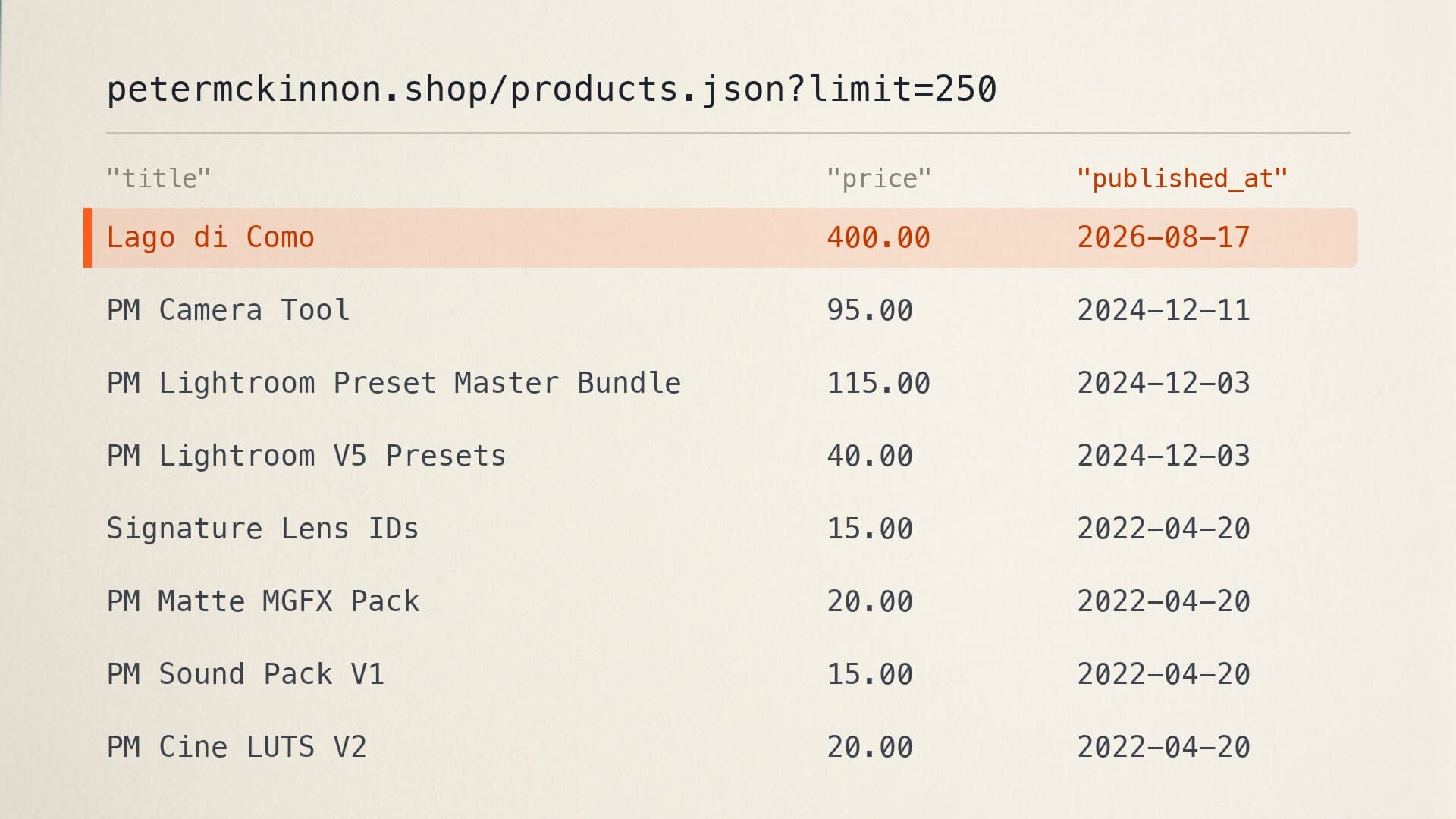
The public catalog for petermckinnon.shop, listing product titles, prices and published_at dates with the single 2026 release highlighted
Here is that test run against six creator stores on 2026-09-01. Every number came from the stores' own public catalogs on the day this was published, and rerunning it will move them. Price bands exclude gift cards and the $0 trade-display listings some stores keep in the catalog.
Creator storeProductsPrice bandPublished in last 12 monthsProducts sold on a repeating schedule
Jomboy Media968$14 to $1755030 of 10 checked
MrBeast342$1.99 to $139.993310 of 10 checked
Rúngne (Magnus Midtbø)97$3 to $399420 of 10 checked
Feastables31$6.99 to $64.99160 of 10 checked
Peter McKinnon16$15 to $40010 of 10 checked
Selfless by Hyram10$20 to $50010 of 10 checked
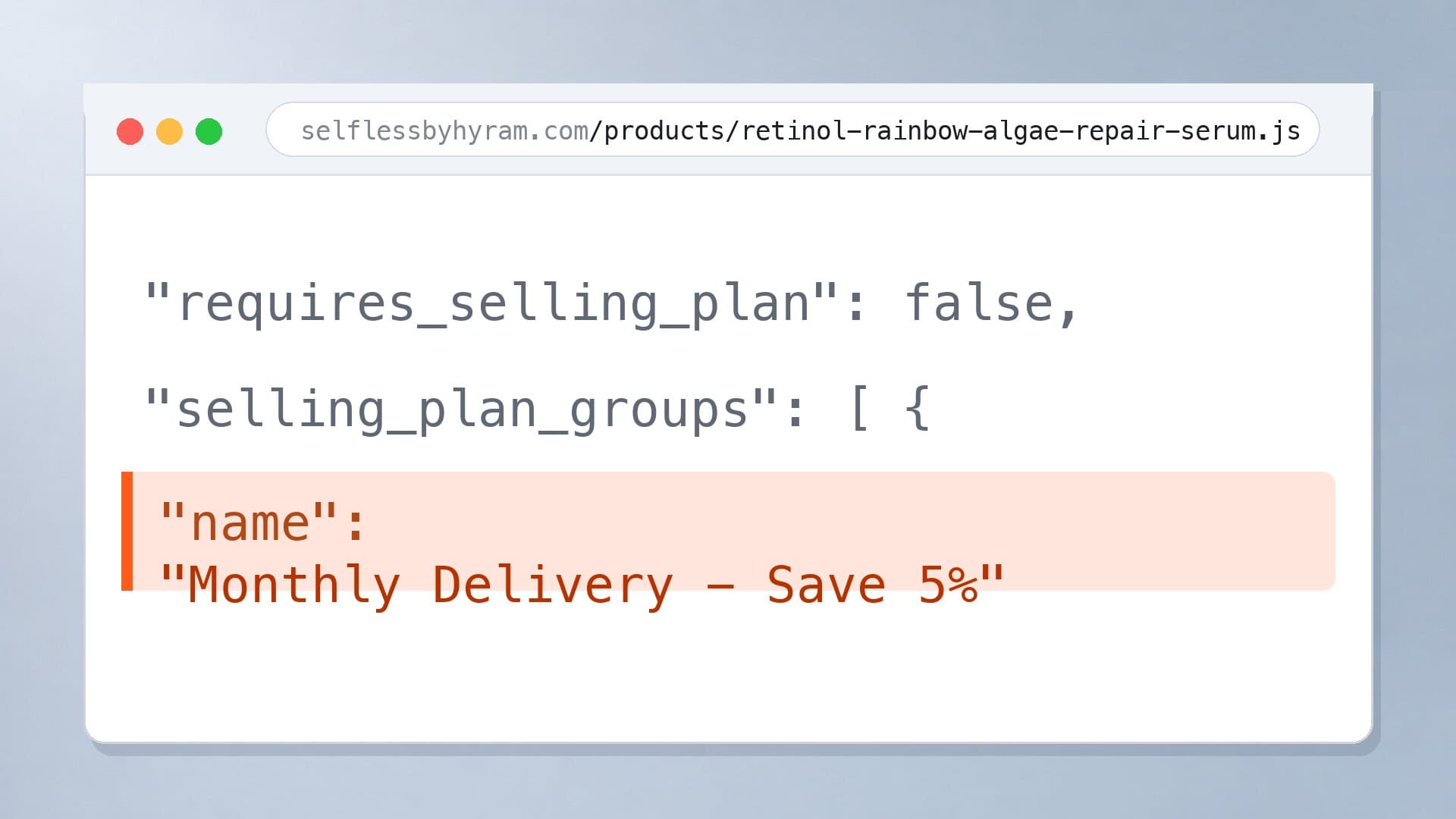
Read the last two columns together and the shape of each business appears without anyone describing it. Jomboy Media and MrBeast are release machines: almost the entire catalog is younger than a year, which is how the revenue stays up. Peter McKinnon is the opposite, a settled catalog of sixteen items with one new thing in a year. Selfless by Hyram is the only store in the set where a customer can start something that continues. Because requires_selling_plan is only true for products that cannot be bought any other way, so a store where every single item offers a subscription still returns false on all of them. Almost no merchant sells subscription-only. Nearly all of them offer one-time purchase alongside a repeating option, and that field reports the absence of the restriction rather than the presence of the plan. Read that field alone and you will conclude Selfless by Hyram has no subscriptions at all. Every product in the catalog returns "requires_selling_plan": false. It is a clean, confident, wrong answer, and it is the exact failure mode of trusting one field because it has a plausible name. The right endpoint is one level down. Take any product's handle from the catalog and open https://STORE/products/HANDLE.js, the storefront's own product endpoint. That response carries selling_plan_groups, and each group has a real name written by the merchant. On all ten Selfless by Hyram products the group reads "Monthly Delivery - Save 5%". On Death Wish Coffee, a non-creator control, the coffee products carry "Subscribe and Save" with 30, 60, and 90 day options while the apparel carries nothing, which is exactly what you would expect and is a good way to confirm you are reading the endpoint correctly. Do the second check on ten products, not one. Merchants apply plans unevenly, and a store can have subscriptions on its consumables and nothing on its merch, which is a finding rather than an error. Jomboy Media published 503 products in the twelve months to 2026-09-01, out of a catalog of 968. MrBeast's store published 331 out of 342, which means the store is effectively rebuilt every year. Those are not lazy businesses. They are two of the hardest-working commerce operations in the creator economy, and the numbers say so. They also say something less comfortable. Each of those products needed a design, a sample, a photograph, a copy pass, an inventory decision, and a launch post. Then it sold, and the relationship ended at the doorstep. The customer who bought a mug in March has no reason to open anything in April, and the only lever available is another mug. That is the treadmill described in why creator product buyers never come back, quantified for a specific store by a number the store published itself. Compare it with the McKinnon row. Sixteen products, one new item in a year, a settled and profitable catalog, and nothing at all that bills again on its own. Two opposite operating styles, the same structural gap, which is the point made at length in the profile of his sixteen products and zero recurring revenue.
Share of each creator catalog published in the last twelve months, from Peter McKinnon at one product to MrBeast at 331 of 342
The useful way to hold this number is as an annual cost of staying level. If half your catalog has to be new every year for revenue to stay flat, that half is what recurring revenue would replace, not add to. If you have 50,000 or more engaged followers and your catalog returned a zero, you are not behind, you are holding the harder half of the problem already solved. You have proven that your audience buys, at a real price, without a discount, from you. The missing piece is the container, and the container is the cheap part. The move is not to bolt a subscribe-and-save option onto a t-shirt. It is to find the thing your audience does on a schedule and put a product inside that schedule. A climbing audience trains on a plan written weeks ahead. A baseball audience sits down in front of 13 games a night. A skincare audience runs a routine twice a day. That repeating action is where a subscription attaches, which is what creator-product fit means in practice, and it is usually already visible in what people ask you in the comments. Then check whether anyone has built it. Running the same five-minute discipline against the App Store answers that, and the search test for a crowded niche is the companion to this one: this post tells you what your business is missing, that one tells you whether the space to put it in is open. A product that lives inside a weekly practice earns whether you posted this week or not. It generates its own material, because every question a user asks inside it is a video you did not have to invent. And it turns a follower who watches into a participant who logs in, while store search introduces it to people who have never heard of you. That is the difference between a catalog and a company, and what happens after launch is the part most creators are never offered at all. Every number in this post is one URL away, on a store you do not own, and it will be different next year. That is the useful part. It is not a claim you have to accept, it is an instrument you can point at your own domain in the next five minutes. Open your store, add /products.json?limit=250, and count. Then take one handle, open the .js endpoint, and look for selling_plan_groups. If that array is empty on everything you sell, you now know the exact reason the revenue chart looks like a series of launches instead of a line going up. And you know which single product would change the shape of it.

Creator app strategy

Curious what your app could be?

Enter your handle and BUILT BY FOUNDRY will research your audience and present custom app concepts. Free.

Does Your Store Have Recurring Revenue? 1 URL and 4 Numbers