

Beehiiv Review 2026: Is It Worth It for Creators?

Beehiiv Review 2026: Is It Worth It for Creators?

Foundry
May 3, 2026
Our verdict: Beehiiv is the best newsletter platform a creator can use in 2026, full stop. Tyler Denk and the Morning Brew alumni who built it understand newsletter growth at a level no competitor matches. But "best newsletter platform" is not the same thing as "best business for a creator." Rating: 4/5. Key Takeaways:
  • Beehiiv pricing in 2026 ranges from free (up to 2,500 subscribers) to $109/month for the Max plan, with custom Enterprise pricing above 100,000 subscribers
  • Beehiiv takes 0% of paid subscription revenue, compared to Substack's 10% cut, which is the single biggest financial advantage on the platform
  • The platform hosts 7,500+ newsletters and reaches 35 million monthly unique readers, according to beehiiv's own disclosures
  • Newsletters are still a borrowed-audience business: subscribers live in inboxes you don't control, and email deliverability now sits between you and your customers
  • For creators who want a real subscription business with App Store distribution and a product their audience pays to use daily, a newsletter is a starting point, not the destination
Beehiiv is a newsletter platform that lets creators publish, grow, and monetize email newsletters with paid subscriptions, an ad network, and growth tools, with no take rate on subscription revenue. Founded in 2021 by Tyler Denk, Benjamin Hargett, and Jake Hurd, three engineers who built Morning Brew from a free college newsletter into a multi-million-dollar media business before starting their own company. That origin story matters. Most newsletter platforms are built by founders who have never run a newsletter. Beehiiv was built by the people who scaled Morning Brew past 4 million subscribers. Every feature reflects a problem they hit firsthand. The referral program looks the way it does because they invented the modern newsletter referral playbook at Morning Brew. The ad network exists because they spent years selling newsletter sponsorships and knew the matching problem from both sides. The company has raised over $48 million across seed, Series A (Lightspeed Venture Partners), and a $33 million Series B led by NEA, according to Inc.. It is one of the fastest-growing creator-economy companies of the last five years.
CategoryScore
Newsletter publishing tools4.5/5
Audience growth features5/5
Monetization options4.5/5
Paid subscriptions take rate5/5
Analytics and reporting4/5
Pricing value4/5
Ownership and portability3.5/5
Ceiling as a business model2.5/5
Overall4/5
Beehiiv earns near-perfect marks for everything inside the newsletter category. It loses points only on the structural ceiling every email business hits. You can build a great newsletter on Beehiiv. You cannot build a product on Beehiiv. Beehiiv has four plans. The free Launch tier is generous, and the paid plans scale with subscriber count.
PlanMonthly PriceSubscriber CapKey Features
Launch$02,500Newsletter, website, podcast tools, basic analytics
ScaleFrom $49/mo100,000Ad Network, Boosts, paid subscriptions, automations, 3 publications
MaxFrom $109/mo100,000Remove beehiiv branding, dynamic content, priority support, 10 publications
EnterpriseCustom100,000+Custom infrastructure, dedicated support, advanced controls
Annual billing drops Scale to roughly $43/month and Max to $96/month, per beehiiv's pricing page. Pricing scales with subscriber count: the headline numbers above are starter prices for smaller lists. A newsletter with 50,000 active subscribers on Scale will pay materially more. The 0% take rate on paid subscriptions is the headline financial advantage. Run a $10/month paid newsletter with 500 subscribers and you keep $5,000/month minus Stripe fees. On Substack, the same newsletter would lose $500/month to platform fees. Over a year, that is a $6,000 difference. Over five years, $30,000. The math compounds in your favor every month. Several features genuinely earn the price tag. Growth tools that actually grow lists. The Recommendations Network is the most effective list-building tool any newsletter platform has shipped. Other newsletters recommend yours after a subscriber confirms, and you do the same. Boosts is a paid acquisition marketplace where you pay other newsletters per qualified subscriber they send you. Together, these turn the Beehiiv ecosystem into a flywheel: every newsletter on the platform grows faster because every other newsletter is also on the platform. The Ad Network. Beehiiv runs a programmatic ad marketplace that places sponsorships into your newsletter automatically. You set rates, accept or reject brands, and beehiiv handles the placement and reporting. For a newsletter with 10,000 engaged subscribers, this can generate $500 to $2,000 per month with no manual sales work, based on creator reports on TechRadar. It is a real revenue stream, not a vanity feature. Paid subscriptions with no take rate. Beehiiv's 0% cut on paid subscriptions is the cleanest deal in the creator economy. You pay your monthly platform fee, Stripe takes its standard 2.9% plus $0.30 per transaction, and the rest is yours. No tiered fees. No "but only on the Pro plan." Just zero. That is rare and worth saying twice. Genuinely good editor and template system. The post editor is fast, the email templates render correctly across Gmail, Apple Mail, and Outlook (which is harder than non-newsletter people realize), and the website builder produces real-looking sites with custom domains. This sounds boring. It is also where most platforms fall apart. Audience portability. You can export your subscriber list at any time. This is non-negotiable for a creator-owned business and many platforms make it harder than it should be. Beehiiv does not. The limits of Beehiiv are the limits of email itself. Newsletters are a borrowed audience. Your subscribers live in Gmail, Apple Mail, Outlook, and Yahoo. You do not control inbox placement. You do not control whether your sender reputation drops because one campaign got marked as spam. You do not control when Apple, Google, or Yahoo decide to reshuffle the rules. You build the list. The inbox owners decide if it gets seen. This is not a Beehiiv flaw. It is the structural reality of email as a distribution channel. But it shapes what kind of business you can build on top of it. No App Store presence. Beehiiv newsletters live on the web and in inboxes. They do not appear in the App Store. Nobody wakes up tomorrow, searches "fitness newsletter" in their phone's App Store, and finds your publication. App Store search drives roughly 65% of all iOS downloads, which means newsletter creators are sitting out a discovery channel that delivers customers who never saw your social posts. A creator app captures that traffic. A newsletter does not. Engagement decays the moment you stop publishing. A newsletter is a content treadmill. Stop sending and open rates fall, churn climbs, and the content treadmill you escaped from social media reappears in your email schedule. An app earns whether you post or not, because users open it for the product, not the publishing cadence. Pricing scales aggressively with list size. The Scale plan starts at $49/month at small list sizes but climbs significantly as you grow. A 50,000-subscriber newsletter on Beehiiv Max will pay several hundred dollars per month before any add-ons. This is fair for what you get, but it is not the "$49/month forever" that the homepage implies. Analytics stop at the email. Beehiiv tells you who opened, who clicked, and who unsubscribed. It does not tell you what your subscribers do once they leave the email, because the moment they click a link they are off the platform. Real subscription businesses need cohort retention, daily active users, time-in-product, and feature engagement. Email cannot give you those metrics because email is not a product.
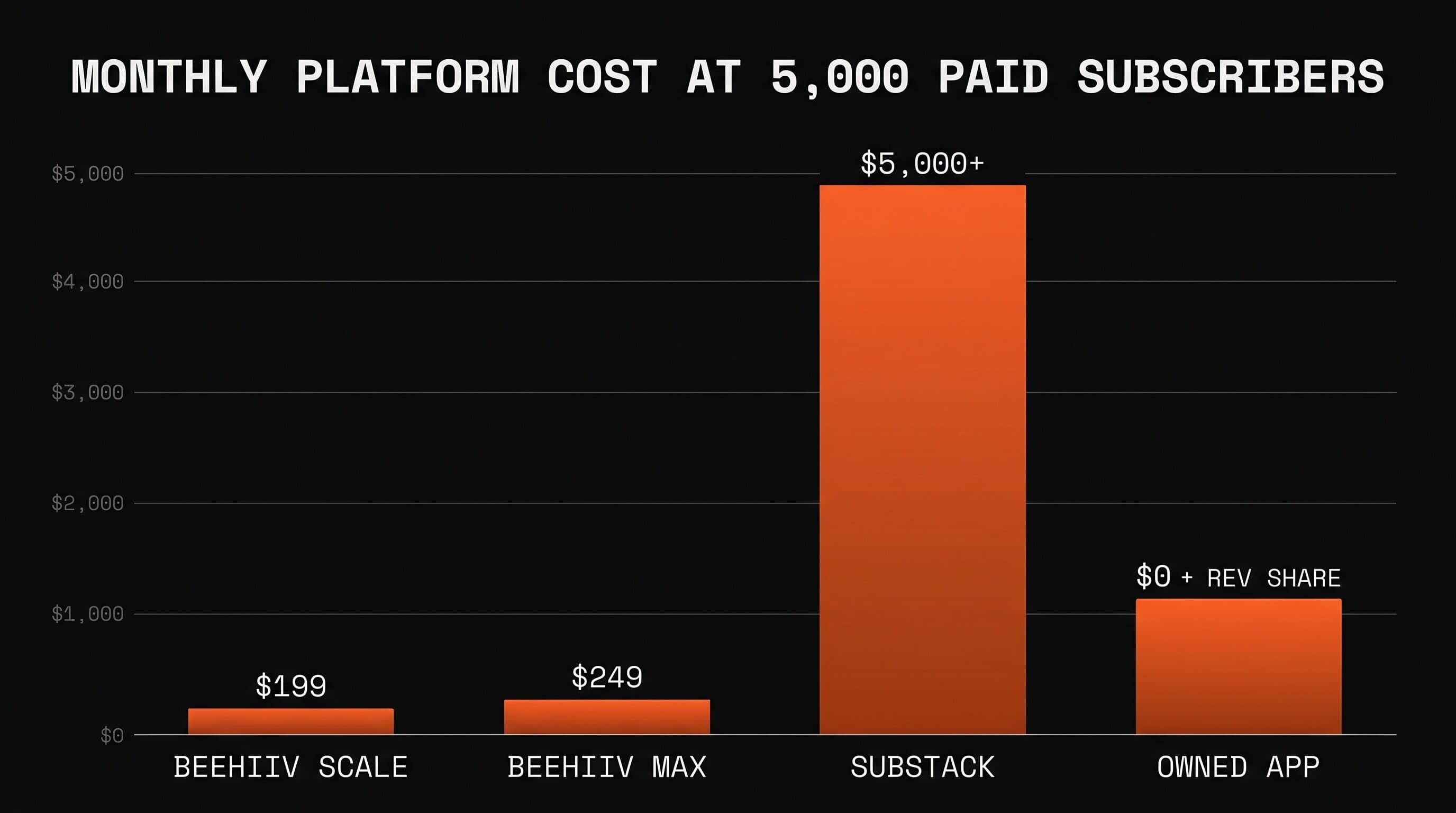
A bar chart compares average monthly platform cost on Beehiiv Scale, Beehiiv Max, Substack, and a custom subscription app at 5,000 paid subscribers
The most common comparison creators run is Beehiiv versus Substack. Here is the honest breakdown.
FeatureBeehiivSubstack
Paid subscription take rate0%10%
Free tier subscriber cap2,500Unlimited
Ad networkYes (built-in)No
Recommendations / boostsYes (paid acquisition)Yes (free recommendations)
Custom domainYes (included)Yes (one-time fee)
Audience exportYesYes
Discovery surfaceLimitedStrong (Substack's network)
Best forCreators monetizing existing audiencesCreators starting from zero who want network discovery
Substack wins on cold-start discovery: their app and network surface new newsletters to readers who do not know you yet. Beehiiv wins on monetization economics and growth tooling. Most creators above 5,000 subscribers will make more money on Beehiiv. Most creators below 1,000 subscribers may grow faster on Substack. If you have already built an audience and want to monetize it, choose Beehiiv. If you have no audience and want a free-and-easy place to write while a network drives traffic, choose Substack. We have written more on this in our Substack alternatives roundup. Beehiiv is the right choice for:
  • Creators with 1,000 to 50,000 subscribers who want to monetize aggressively
  • Operators running multiple newsletters from one workspace (Scale gives you 3, Max gives you 10)
  • Newsletter businesses that want ad revenue alongside paid subscriptions
  • Writers escaping Substack's 10% take rate
Beehiiv is the wrong choice for:
  • Creators whose audience is on TikTok, Instagram, or YouTube and who do not have a strong email list yet
  • Creators who want a product their audience opens daily, not a content drip they read on Tuesdays
  • Anyone who wants to be discovered organically through the App Store rather than through email referrals
This is where Beehiiv hits its ceiling. Newsletters are a great content distribution medium. They are a mediocre product. A newsletter sells a creator's words once a week. An app sells a creator's product every day. The economics tell the story: a $10/month newsletter with 1,000 paid subscribers generates $10,000 in MRR. A $10/month app with 1,000 paid subscribers generates the same $10,000 in MRR plus App Store discovery, push notifications, daily engagement loops, and a content engine that writes social posts for you. Compare this to creators who built apps instead of newsletters. Codie Sanchez built Contrarian Thinking into a multi-million-dollar newsletter empire and is now expanding into products her audience uses daily. The Critical Role team built Beacon instead of relying on Patreon. In both cases, the content engine sits inside an owned product, not in a third-party inbox. When we build apps for creators, the goal is the same: turn the audience into a daily-use product, not a weekly send. The newsletter can stay. The newsletter is great. But the newsletter is not the business. The product is the business. For creators monetizing an existing audience, yes. Beehiiv's 0% take rate on paid subscriptions saves serious money: a $10/month newsletter with 500 paying subscribers keeps $6,000/year more on Beehiiv than on Substack. Substack still wins on cold-start discovery because its network promotes new newsletters to readers, while Beehiiv expects you to bring your own audience. Beehiiv pricing starts free for up to 2,500 subscribers. Paid plans start at $49/month for Scale and $109/month for Max, with subscriber-tier pricing that scales as your list grows. Enterprise plans are custom and required above 100,000 subscribers per workspace. No. Beehiiv takes 0% of paid subscription revenue. You only pay Stripe's standard processing fee of 2.9% plus $0.30 per transaction. Substack, by comparison, takes 10% on top of Stripe fees. Yes. Beehiiv allows full subscriber list export, including emails, signup dates, and segmentation data. Audience portability is a core platform principle. A newsletter is real revenue. Whether it is a real business depends on what you build around it. Newsletters generate income but rarely generate compounding equity value, because the audience lives in inboxes you do not own. Creators who want a sellable, durable business pair the newsletter with an owned product, usually an app, that turns email subscribers into daily product users. Not switch. Stack. Keep the newsletter as a top-of-funnel content engine and build an app as the product. The newsletter brings readers in, the app converts them into daily users with recurring revenue, App Store distribution acquires customers who never read your newsletter at all. The newsletter feeds the app. The app feeds the business. Want to turn your newsletter audience into a recurring-revenue app? We build custom apps for creators, $0 upfront, three weeks to App Store, and we run all the tech forever.
Let's Build →

Get Creator Revenue Insights

How creators are turning audiences into subscription businesses

You might also enjoy...

Beehiiv Review 2026: Is It Worth It for Creators?