

Thought Leadership

The Algorithm Owes You Nothing. Build What Does.

Foundry
May 31, 2026
Share
The Algorithm Owes You Nothing. Build What Does.

Get Creator Revenue Insights

How creators are turning audiences into subscription businesses
Share
Key Takeaways:
  • Instagram organic reach has collapsed to roughly 3 to 4 percent of followers in 2025, down from 10 to 15 percent in 2020 (Socialinsider)
  • The legacy TikTok Creator Fund paid creators around $0.02 to $0.04 per 1,000 views, and the newer Creator Rewards Program still tops out around $0.40 to $1.00 per 1,000 qualified views
  • YouTube CPMs swing 20 to 40 percent lower in January and February every year, before any policy change touches your channel
  • Subscription apps in productivity, health, and education earn $5 to $10 per active user per month, every month
  • The algorithm owes you nothing. A subscription app owes you the renewal it processed at 3 a.m.
You woke up on a Tuesday in 2024 and Instagram had decided your Reel was now a "boosted creative post." Your reach dropped 60 percent overnight. You did nothing wrong. You also got no email. That's the deal. The algorithm doesn't owe you reach. The Creator Fund doesn't owe you a payout rate. The CPM doesn't owe you Q1. AdSense doesn't owe you a category. The platform you spent six years building on can change the rules tomorrow, and your only recourse is to post harder. That's not a business. That's a hostage situation with a ring light. Three things happen, in order. Your reach drops. Your revenue drops. Your inbox fills with "what happened to your stuff?" DMs from the same fans who'll forget you by next week if you don't post. Instagram engagement bottomed out at 0.45 percent in June 2025, the lowest rate recorded in 18 months, according to Socialinsider's 2026 benchmarks. Average organic reach has fallen from 10 to 15 percent of followers in 2020 to around 3 percent in 2025. Half a million followers, fifteen thousand people seeing the post on a good day. YouTube creators get the same treatment in a different costume. Average CPM sits around $3.50 in 2026, but the variance is the whole story. Finance channels see $25 to $50 CPM. Gaming channels see $1 to $4. YouTube Shorts RPM is $0.01 to $0.06 per 1,000 views, which is roughly the price of one M&M for a million eyeballs. And every January, every YouTuber watches their CPM fall 20 to 40 percent because advertisers stopped buying after Q4. You did the same work. You earned half the money. The algorithm shrugged. For most creators, the answer is "less than a barista shift." The original TikTok Creator Fund paid roughly $0.02 to $0.04 per 1,000 views. A million views earned you $20 to $40. The Creator Rewards Program that replaced it pays better, $0.20 to $2.50 per 1,000 qualified views, but only on videos longer than a minute, and only when TikTok's quality score says yes. Translation: you need to make different content, hit a longer runtime, and pass an opaque originality test for the chance to earn $400 to $2,500 per million views. After taxes, after the time you spent producing, after the views that didn't qualify, the math gets ugly fast. Now compare that to a subscription app. 500 paying subscribers at $20 per month is $10,000 a month. Not per million views. Per month. Whether or not you posted. Whether or not Reels worked. Whether or not the Creator Rewards Program decided your last video was "original enough." Read this carefully. On every platform you post to:
  • You do not own your followers. The platform has the relationship. You're a tenant.
  • You do not own your reach. The algorithm decides what fraction of your followers sees you.
  • You do not own your CPM. The ad market sets it. Brand-safety bots adjust it. Q1 cuts it.
  • You do not own your DMs export. Most platforms make it deliberately hard.
  • You do not own the next API change.
You own what you can carry off the platform. A subscription app moves with you. Your subscribers are charged by your Stripe or RevenueCat account, not by Instagram. The relationship is direct. The renewal is automatic. The list is yours. That's the difference between renting your business and owning it. We wrote a whole post about the platform trap creators fall into when they build on rented land, and it gets sharper every quarter.
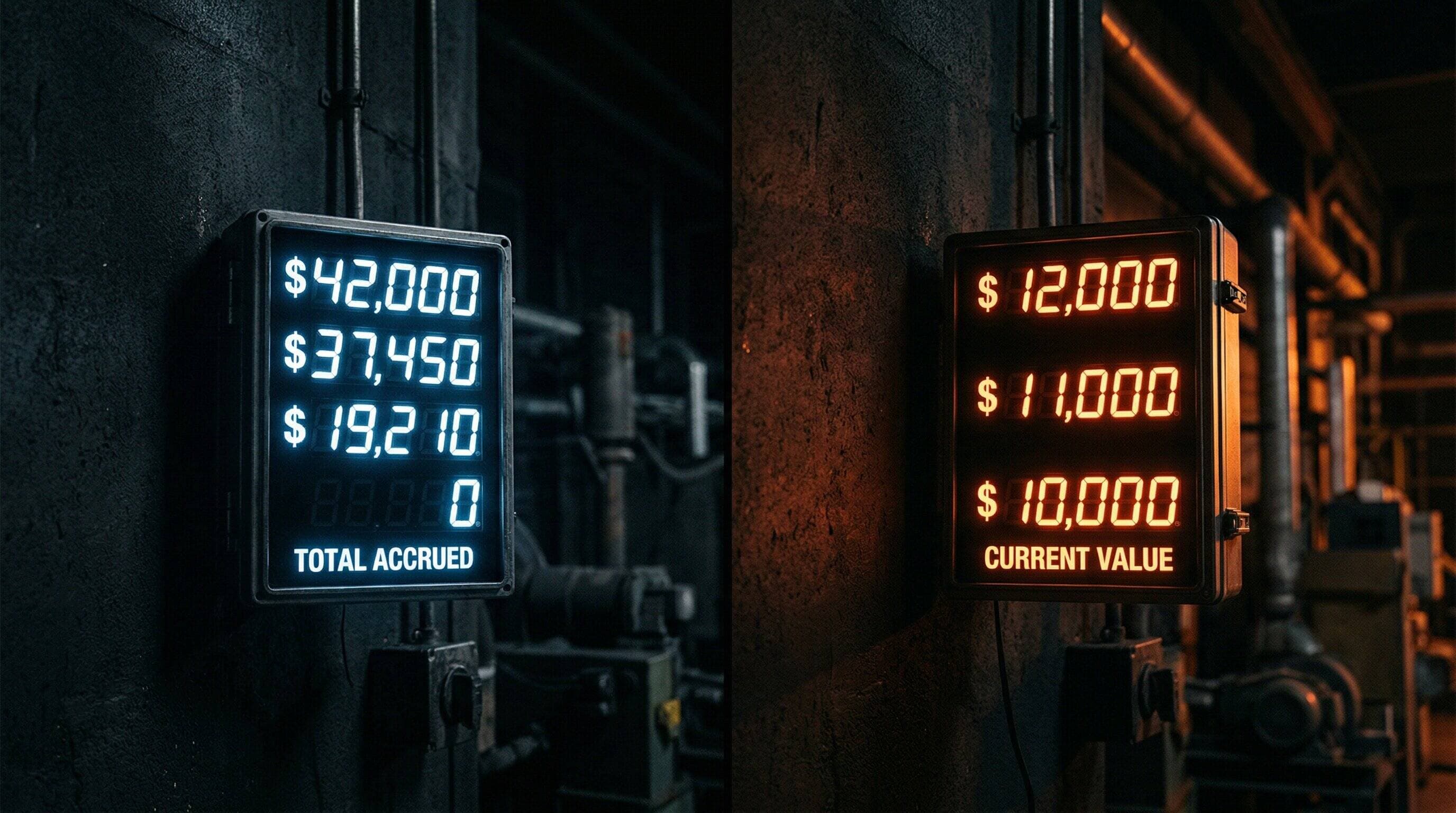
Dim industrial control panel with red lights showing platform reach and revenue dropping while a single warm orange dial labeled MRR climbs steadily upward
Reach is a number that flatters you. Revenue is a number that pays you. Most creators conflate them and end up with a great-looking dashboard and a stressful 1st of the month. Here's the math on a single 100,000-follower creator running three monetization plays in parallel. Real benchmarks, no inflation.
ChannelTypical 2026 OutputVolatilityStops Earning When
Instagram Reels (organic)3,000 to 5,000 reach per postAlgorithm flips, format changesYou stop posting
TikTok Creator Rewards$0.40 to $1.00 per 1,000 qualified viewsQuality score, RPM swingsYou drop below 10K followers or stop hitting runtime
YouTube AdSense (10K views/video)$35 to $60 per video at $3.50 CPM20 to 40% Q1 drop, demonetization wavesPolicy update or ad market dip
Brand deals$2,000 to $10,000 per dealDeal-by-deal, fades in Q1You don't pitch this month
Subscription app (500 subs at $20)$10,000 per month, recurringSingle-digit monthly churnYou shut the app down
Four of those five rows reset every month and none of them are yours. One of them compounds and is. That is the entire argument. It's the same argument we made when we explained why your income resets to zero every month. Brand deals and ad revenue are not businesses. They're shifts at a casino that runs the table. By not playing. A subscription app earns when someone uses it, not when an algorithm distributes it. Sensor Tower's 2025 State of Mobile report put global in-app purchase revenue at $150 billion across iOS and Google Play, with non-gaming subscriptions driving most of the 13 percent year-over-year growth. Subscription apps in health, productivity, dating, and education routinely pull $5 to $10 per active user per month. Three things change when your revenue comes from a paid app instead of platform exposure:
  • App Store search becomes a growth channel. People who never saw your TikTok find your app by typing what they want into the App Store. Kayla Itsines' Sweat app reached 450,000+ paying subscribers, and a chunk of that growth came from App Store discovery, not Instagram. We broke down the Sweat exit and what it means for solo creators.
  • The renewal happens whether or not you post. Your subscribers don't need a Reel to remember they pay you $19.99 a month. The card on file does the remembering.
  • The price is yours to set. No CPM, no Creator Fund rate, no brand-deal negotiation. You set the monthly price. The market either pays it or doesn't.
If you've been doing the brand deal versus MRR math, you know what compounding does. Year one is a slog. Year two is the floor that pays your rent. Pick a number. 200 subscribers at $15 per month. That's $3,000 per month. $36,000 in year one. With single-digit monthly churn and steady App Store growth, year two could be $7,000 per month and year three could be $12,000 per month, without a single new launch. Now stack that against your best brand deal year. $80,000 across 12 deals, all front-loaded, all dependent on pitching. If you stop pitching, you stop earning. Year two starts at zero. The MRR starts at $36,000. It's a slower line. It's the line that doesn't reset.
A single warm orange ember glowing steadily in a dark void next to a row of flickering blue platform logos fading in and out, representing recurring revenue versus algorithm dependence
The creators making real money in 2026 stopped trying to outsmart the feed and started building products their audience pays for directly.
  • Fitness creators shipped subscription workout apps that bill independently of YouTube ad rates. Sweat, RP Hypertrophy, Caroline Girvan's apps, BBB by Bret Contreras. All of them ride App Store search as much as their socials.
  • Education creators turned classroom-style content into apps with paywalled lessons and progress tracking. Chess apps from former streamers, music apps from former Instagram instructors, language apps from solo polyglots.
  • Wellness and parenting creators built apps around community plus tools. Dr. Becky Kennedy's Good Inside built a parenting subscription that scaled past $34M without depending on a single TikTok view.
None of them quit social media. They just stopped treating it as the business. The social became the funnel. The app became the floor. Three reasons, all wrong. 1. "I'm not technical." You're not supposed to be. You're the product, the audience, and the brand. Your job is to keep creating. Building an app is a job for a product partner. We wrote about what to look for in a creator app dev partner so you don't get burned. 2. "I can't afford a six-figure dev quote." You're right, you can't, and you shouldn't. The old agency model wanted $80K to $200K upfront for a 6-month build that didn't always ship. A revenue-share model with $0 upfront flips the incentive. The builder only wins if your app does. 3. "My audience won't pay for an app." Your audience already pays Spotify, Duolingo, Strava, Calm, Headspace, and ten other apps. The question isn't whether your audience pays for apps. The question is whether they pay for yours. The answer depends on what you build, not how big your following is. Most successful creator subscription apps charge $5 to $20 per month and net somewhere in that range per active subscriber. Sensor Tower's 2025 data shows subscription apps in health, productivity, and education routinely earn $5 to $10 per active user per month. Top performers like Sweat have charged closer to $20. If you earn $60,000 a year in brand deals, you need 500 subscribers at $10 per month or 250 subscribers at $20 per month to match it in MRR. The difference is that your app keeps earning the next year and the next year. Your 2025 brand deals don't. Yes, and you shouldn't quit. Your social platforms become the top of the funnel. Your app becomes the recurring revenue floor. You still post, you still grow, but you stop depending on the algorithm to pay you. The platform is a billboard, not a paycheck. Old agency model: 6 to 12 months and a six-figure invoice. Built by Foundry's model: 3 weeks to App Store, $0 upfront, revenue share. We build, ship, and run it forever so you can keep creating. Existing subscribers keep paying. New subscribers from App Store search keep joining. Your floor stays. Compare that to what happens when you take a month off social: reach craters, brand inbound dries up, the algorithm punishes you when you come back. The app doesn't notice. Every platform is going to keep changing the rules. The algorithm will keep adjusting. The Creator Fund will keep being recalibrated. The CPMs will keep swinging. None of that is a problem you can fix. None of that is in your control. What's in your control is whether you spend the next five years renting an audience from a company that owes you nothing, or building a product that your audience pays you for directly. The algorithm owes you nothing. A subscription app owes you the renewal it processed at 3 a.m. last night. Ready to build what does? We build subscription apps for creators. $0 upfront, 3 weeks to the App Store, revenue share, and we run everything forever.
Let's Build →

Creator app strategy

Want us to review your creator business?

Apply for a Foundry Creator App Review. We'll tell you whether there is a real app opportunity hiding in your audience.

The Algorithm Owes You Nothing. Build What Does.